Wonder…

About a decade ago, when I was first navigating single parenting (so many unfun challenges!), I held to the notion that every time a door slammed in my face, I’d scramble through a window. In my novel that will be published next year, a character says Really? We’re taking life advice from The Sound of Music? But it’s a darn useful approach. Small and scrappy, I’ve been tumbling through windows for years, although admittedly wounding myself on broken glass sometimes.

These balmy autumn days, raking leaves over garden beds, I’ve had a whole sun-rich summer of remission, of cancer survivor, of figuring out how to walk and eat, work and sleep again, these simple things that often eluded me all winter. A summer of learning to live within the bounds of this alive-but-more-broken body. By chance, I meet an old friend who comments about my short hair, and I spill a snippet of my lymphoma which she had not heard. Our lives, connected through kids now grown up, have taken different paths. I’m on the edge of saying that I don’t know how I survived last winter, but I hold back.

Last night, I stepped out of our warm house where the cats are again sprawled in their favorite place before a toasty wood stove and walked out to the nighttime garden to look at the half moon, hung in the sky among the constellations like a profound mystery, cream tinged with autumn’s gold, loveliness incarnate. The cold held me. One of my earliest small-child memories is looking through my father’s telescope at the pocked moon, wondering, wondering…

Mid-October, and the crickets are still singing. The elements for my survival include so many of you here, who sent me letters and cookies, books and cards; access to medical care (a great privilege); friends and colleagues and my dear family… and my own scrappiness, my fierce desire not to slip away from this world and this patch of acreage, the half-moon sailing silently over my frost-gnawed garden.

“You own everything that happened to you. Tell your stories.” ~ Anne Lamott

Pie.

I write an email to friends: Come eat pie and keep me company

In northern Vermont, in the grips of drought, wells and springs dry up. Towns send pleas to be mindful about water usage. Dry, dry, in need of rain, nonetheless the sunny days unfold, day after day after day, and we revel in these, the longest span of perfectly perfect wonderful weather unmatched in anyone’s memory. Soon enough, the weather will shift.

Less and less I write on the back deck, that glass table I bought in the pandemic with stimulus money. Never much of desk user, I write at the kitchen table my brother made for me, or the couch beside the wood stove and my heat-glutted cats. In one evening, I sprawl on the couch and read Meredith Winn’s Uncertain Behavior, her story of bone cancer, passing parents, creativity.

In four-week bursts, I zoom into a writing circle through Dartmouth Hitchcock, all of us linked in some way through cancer, survivors or caregivers. At 5 p.m., I’m spent for the day, hardly a creative whisper stirring in my mind, and yet I manage to rise, so often astounded at the profound and beautiful and fearful words of my compatriots. These folks pull out the better side of me.

Some take stock of their lives (and how can you not, with the leer of death toothy around us), an apt exercise, as this autumn-gorgeous tapestry threads through with lifeless brown, the shadow of winter rising. But joy, too, and all the parts of our lives: raising kids and aging parents and chimney sweeping and sowing garlic for next summer’s table. I search for my leaf rake and check my email…. it’s apple pie season.

The thief left it behind:
the moon
at my window. ~Ryokan

Crossroads.

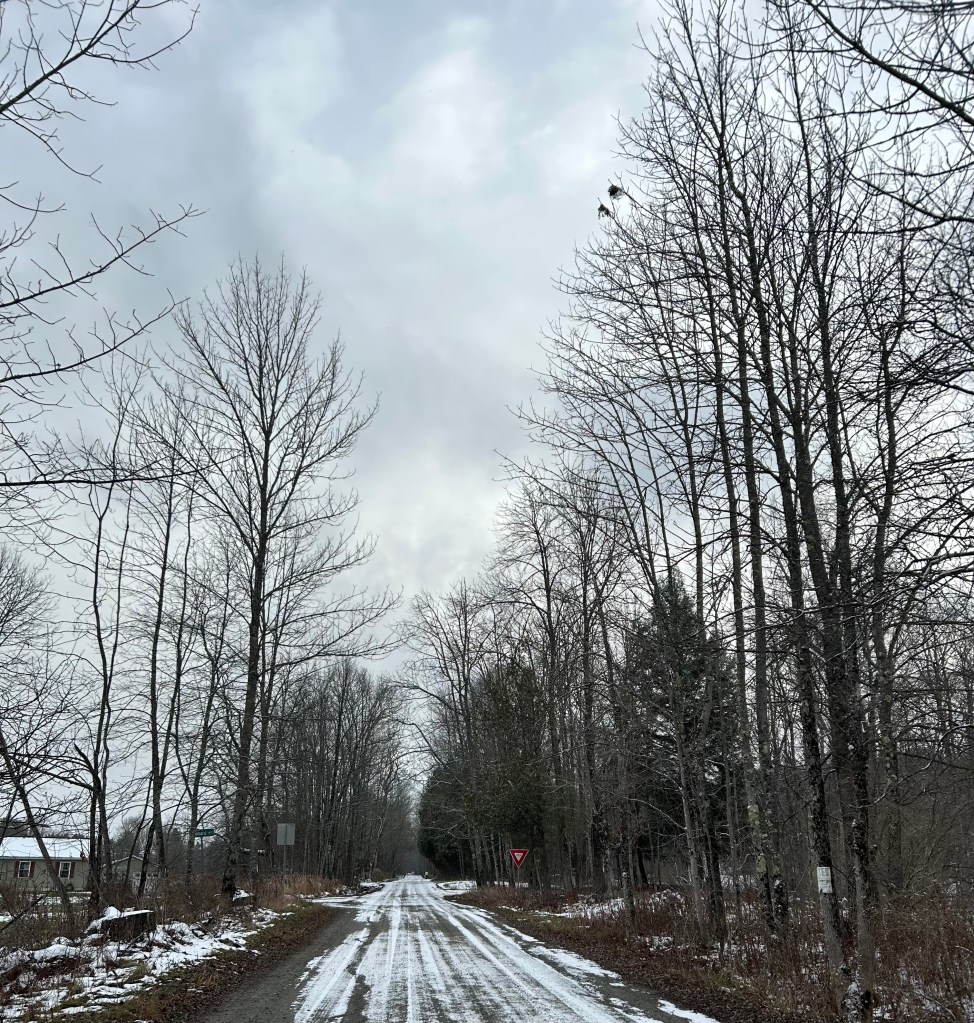
I park at a dirt crossroads this weekend beside a former tavern and walk up the hill to the Old West Church. The sunny afternoon speckles through the roadside maples, and I meet others doing what I am, in pairs or singly, and we greet each other, cheerily. At the Old West Church, I hear two terrific poets, but on my walk back to the tavern the line that runs through my head is from a Franz Wright poem, There is but one heart in my body, have mercy/on me, an incantation.

I keep thinking of my dead mother on this radiant Sunday, my mother who pulled her last breath a year and a half ago, hardly a hopscotch jump ago. In my mind, I’m building the architecture of what I’ve tagged as this Cancer Atlas I’m writing, scaffolding this book’s bones. The book is about the here-and-now, about living (at least for now) through a terrible disease, about walking along Vermont’s autumn-gold back roads, about pulling up this summer’s frost-killed pepper plants that produced so bountifully this summer. And my mother? As I work, I think so often of her, this woman both generous and mercurial, the double blade I harbor in my own heart. Gracious, how much she’d enjoy this picturesque walk. She was a woman who loved old churches, was fascinated by adjacent cemeteries, who would have relished the art in the tavern.

At the tavern, I linger in an open doorway, talking with a curator, drinking iced tea from a half-pint jar. My mother would have drunk the wine, feasted on the cured meat and seeded crackers. Dust kicks up in the road. Old friends appear, and we joke about winter’s ferocity. It’s always a crossroads, isn’t it?

“We are created by being destroyed.”
― Franz Wright

Touching the Earth.

Right at the solstice, frost.

My garden planting this spring was a combination of friends who appeared and weeded and planted, of the sunflower seeds I sowed and the woodchucks ate and I replanted and the woodchucks devoured again, of volunteer calendula and love-lies-bleeding and towering gold sneezeweed, and the pepper plants from a friend that produced in enthusiastic abundance.

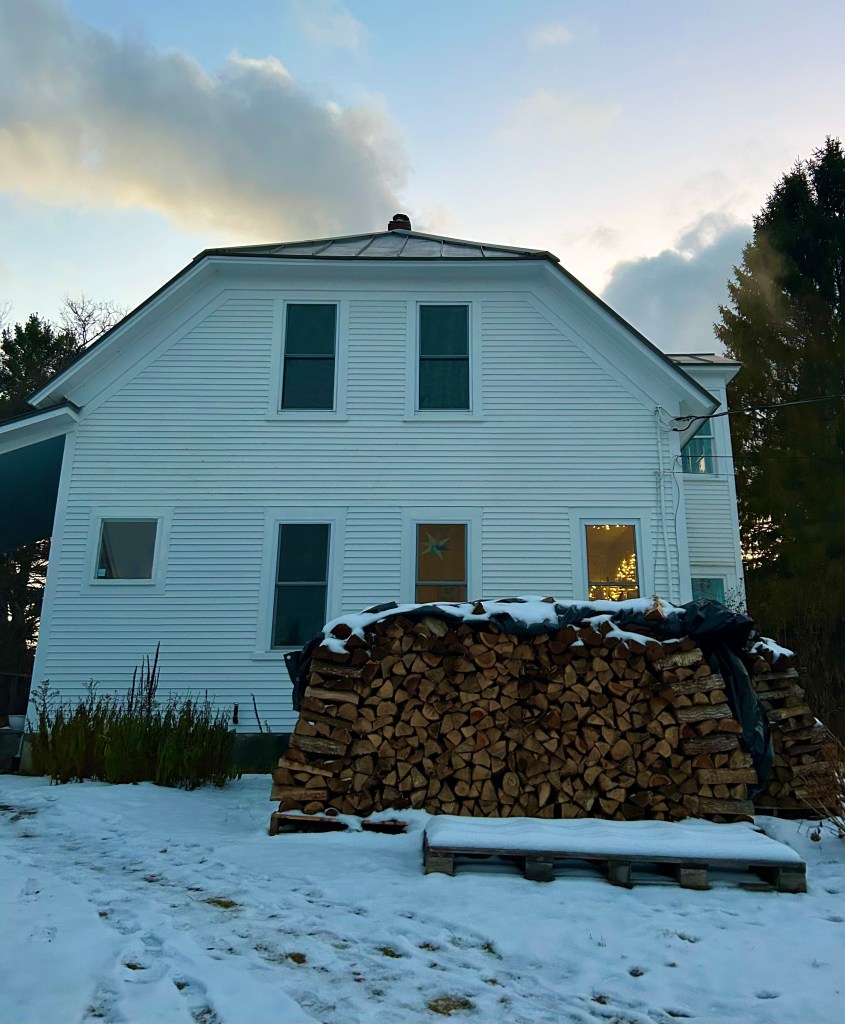
Hurray for the garden. These evenings when I light the first wood stove fires of the autumn, my cats chew shreds of birchbark, sprawl before the warm stove. Hurray, they purr in their cat way.

Season’s change again, so familiar and yet different, each day fresh and welcome. Season’s change for me, too, some days filled with friends and colleagues, other days I hole up and get my work done. Writing now about cancer, I imagine holding this keen awareness of my mortality, of the perishable world, in my hands: a tender-eared rabbit, a vicious rat, or maybe simply a handful of sunlight.

In the deep fall
don’t you imagine the leaves think how
comfortable it will be to touch
the earth instead of the
nothingness of air and the endless
freshets of wind? And don’t you think
the trees themselves, especially those with mossy,
warm caves, begin to think
of the birds that will come – six, a dozen – to sleep
inside their bodies? ~ Mary Oliver

This Glorious Autumn Light.

My sister, a caner survivor, once told me that a cancer diagnosis was a great leveler. This was years before my own cancer experience, and, sure, I had an intellectual understanding of this. Lymphoma schooled me in many ways, among these that I live in my body. Such a simple, profound thing. I had never lived in a body that couldn’t walk up the stairs in my own house, not just because of a sprained ankle or a new baby in arms, but because of weakness in my bones and flesh. I had never considered that I might never be able to enter the bedroom whose walls I painted, where I have slept for so many years.

These days, after a summer devoted to learning how to eat and sleep again and to walk those stairs, outside as much as possible in this gloriously sunny, perishingly dry Vermont summer, I no longer embody the near-translucence of cancer-and-chemo patient. Such pleasure I have when people ask why I’ve cut my hair, and I can reply that I didn’t snip, I lost. The hair I’ve lost is now returning in a metaphor that I can’t ignore: softer but with my childhood cowlick.

Disease hasn’t magically transformed me; if anything, my thorns have proliferated. But here’s a thing: the world where I live is descending into spectacular autumn. Sure, some years the fall foliage bursts brighter than other years, but always, always, heartstopping in beauty. Autumn’s a reminder of my mortality, your mortality, the dearness of this fleeting world. A reminder to pause in our gardens, on our house steps, the sidewalk, whatever trail we may be following. Take a moment. Breathe in, out, in….

From Stephen Jay Gould’s essay “The Median Isn’t the Message”:

Of course I agree with the preacher of Ecclesiastes that there is a time to love and a time to die—and when my skein runs out I hope to face the end calmly and in my own way. For most situations, however, I prefer the more martial view that death is the ultimate enemy—and I find nothing reproachable in those who rage mightily against the dying of the light.

Habits of the Heart.

A radiantly sunny September afternoon, I’m at the northern edge of Caspian Lake, an afternoon with the slightest of breezes so the water shimmers and ripples. The summer people have all returned to other places, the local families at work or school, so it’s just me. For the longest time, I stand at the edge of the long dock and watch a bald eagle fly low over the water, then circle back and disappear into the woods.

Where do you find succor?

For years, with little girls, I spent hours with my friends at the public beach on the other side of the lake. Our worlds dispersed now, I haven’t walked there this summer. In no rush on a day that’s already been crammed with people and my to-do list, I take the longer trail back to the road. The usually wet forest is so parched the boardwalk bridges span over dry soil.

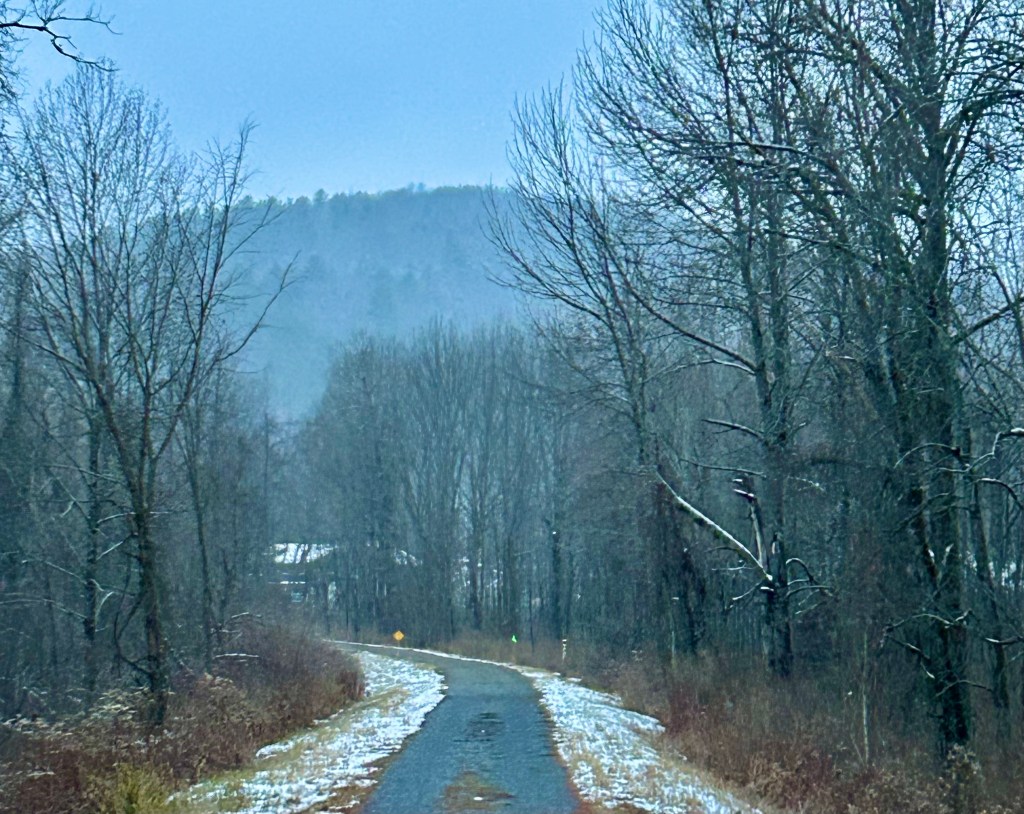
As the afternoon folds down, I take a walk along the river, the path I’ve been following all summer, watching the trout lilies give way to soapwort to the persistent asters. A pickup truck idles across the trail. A woman I knew years ago from a library kids’ group waits for me to pass, then ropes off the trail so she can move her cows from one pasture to another.

On my way home, I stop at the co-op for vinegar and coffee beans and cashews. A stranger says hello in the bulk aisle and reminds me he’d passed me on the trail, he on a bike and me walking in sandals. We talk about the moon and a star named Arcturus. When we part, he says, “See you on the trail — a metaphor for life.” Slow I am these days, as if I’m floating on my back in a warm pond, my eyes open to this flawless blue sky, the undulating water gulping in my ears. Autumn, this heartbeat of beauty, its own true metaphor.

… From this week’s New Yorker:

… what made America great—were “habits of the heart”: the everyday engagement of citizens that sustains institutions by holding leaders to account. Habits fade, but they can also be revived.