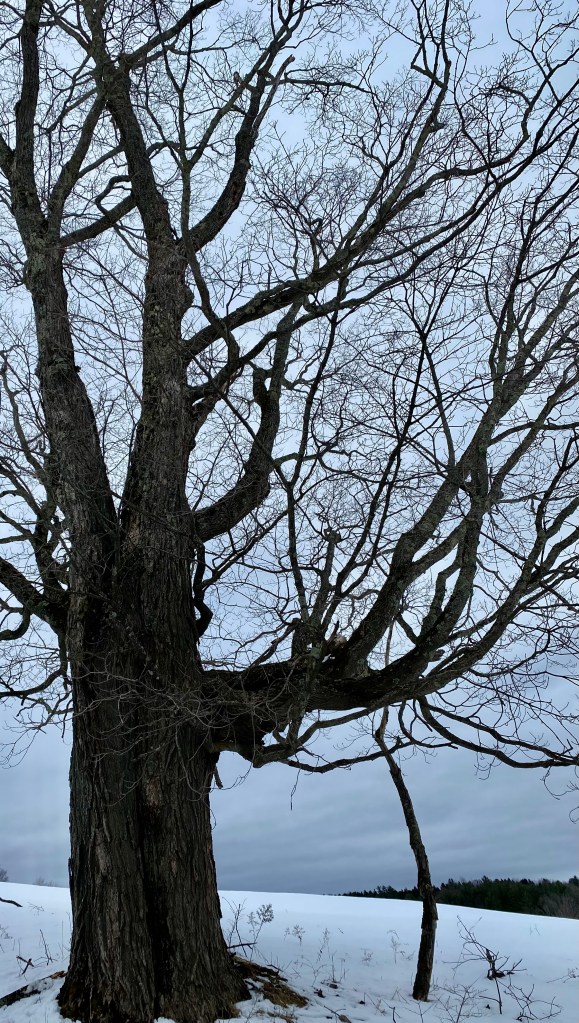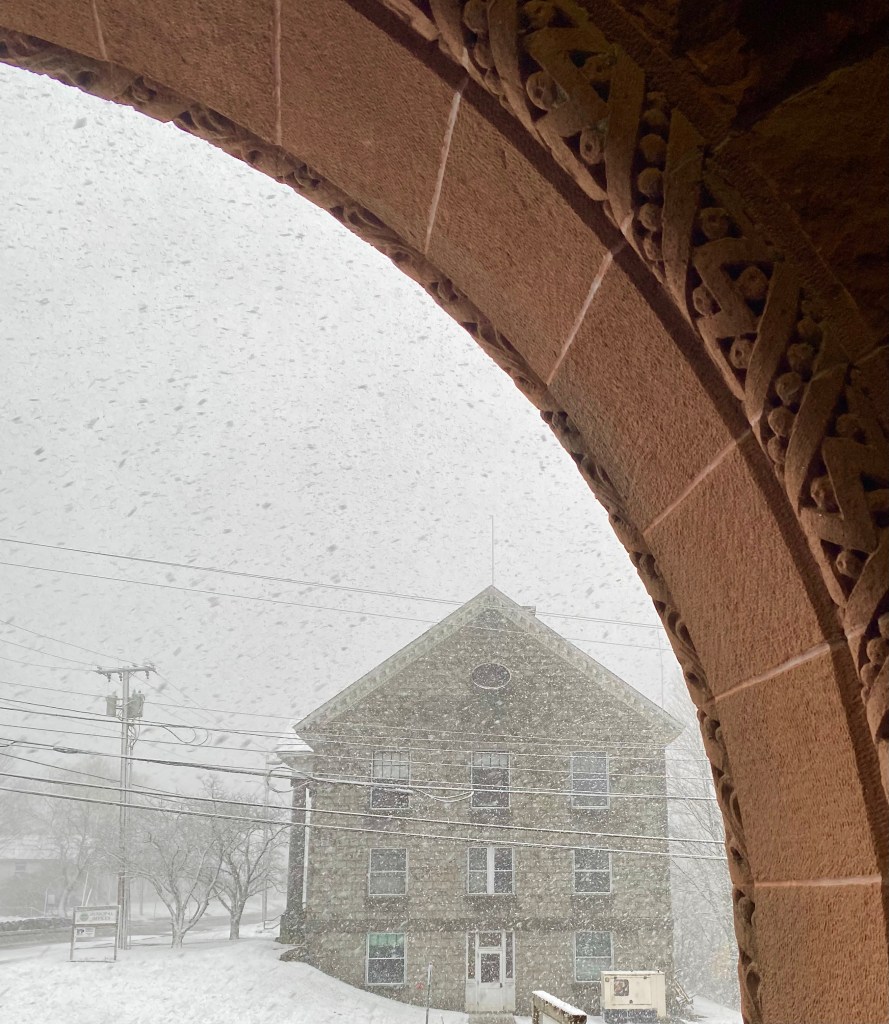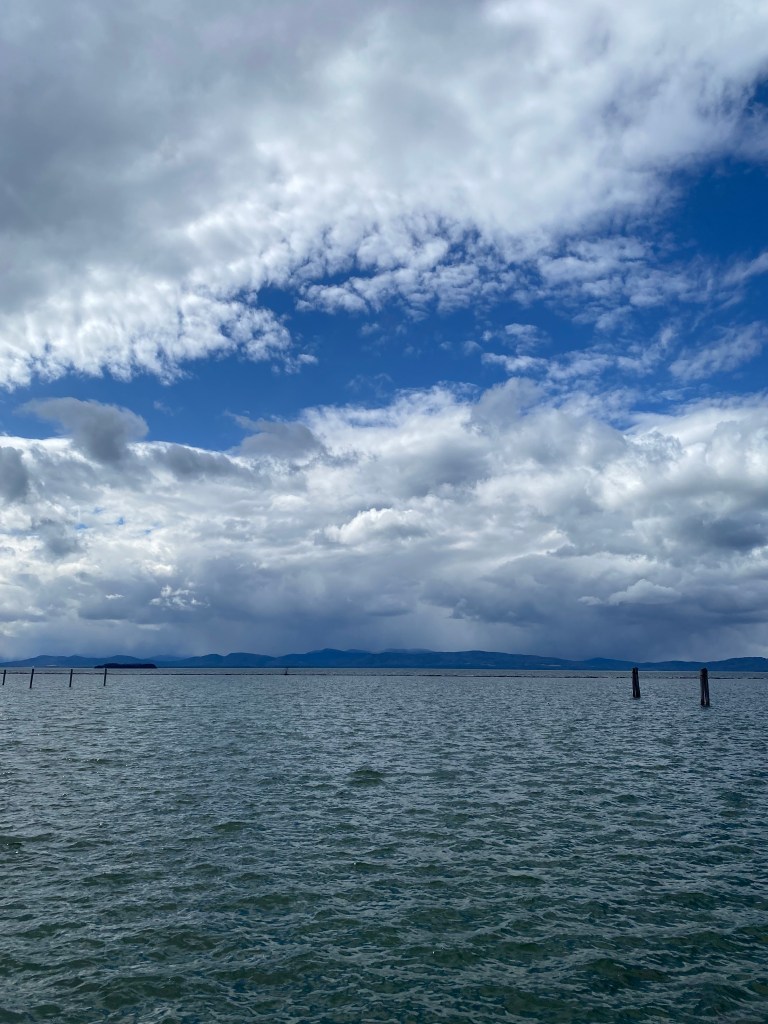
Roadside View.

In these tail-end days of January, I’m alone midafternoon when I stop by the edge of the road. We’ve endured a cold for days that’s not so much bitter but a raw damp that my brother says reminds him of the ocean. The kind of weather for wearing wool sweaters all day, that make you wrap your hands around cups of coffee. So many years ago, I lived for a winter in an apartment on a brick Main Street building in Brattleboro. The building was heated by radiators, clanging and spewing steam all over that large building, in a heating design where I was mere witness, the grateful recipient.

This dreary afternoon, I follow three-toed turkey tracks down a driveway. In the snowy field, the large birds set up a clanging holler when they spy me, ruffling feathers and jostling. It’s just me, I’d like to tell them, a small woman who’s forgotten her mittens and hat. I stand for a bit. Down the hillside, the frozen lake spreads immensely around the spits and coves of the shoreline: breathtakingly awesome.

After a bit, the turkeys seem to care little about my dull presence, gleaning through the thin granular snow.

January: wonder & diligence.

Twenty-five years ago, on a frigid January night, I went to a birthday party and ate chocolate cake. I would have my first baby in a week, and I had gone at that pregnancy with wonder and diligence, heavy on kale and broccoli, scant on refined sugar. The cake was marvelous.

In this warm January, a friend lingers with me over coffee. Melting snow drips from the porch roof as we talk about travel, making art and making a living, parenting. I’m reminded of a line from Raymond Carver that the mightiest force in his life was his two children, Carver who wrote brilliantly about laundromat hours. Wonder and diligence. Our conversation winds around to The List, the eternal draft of chores and visions, the crossing off and adding on, the drafting and revising, the diligence that strings our days together, a crude framework of parenting.

End of January: the weather is slushy and icy, sunbeams a rarity, hardly the season of wonder. My firewood holds the month’s damp, as if resistant, too, to the lousy weather. I lay chunks of wood beneath my stove, drying them a little before I chuck them in, burn the wood to ash.

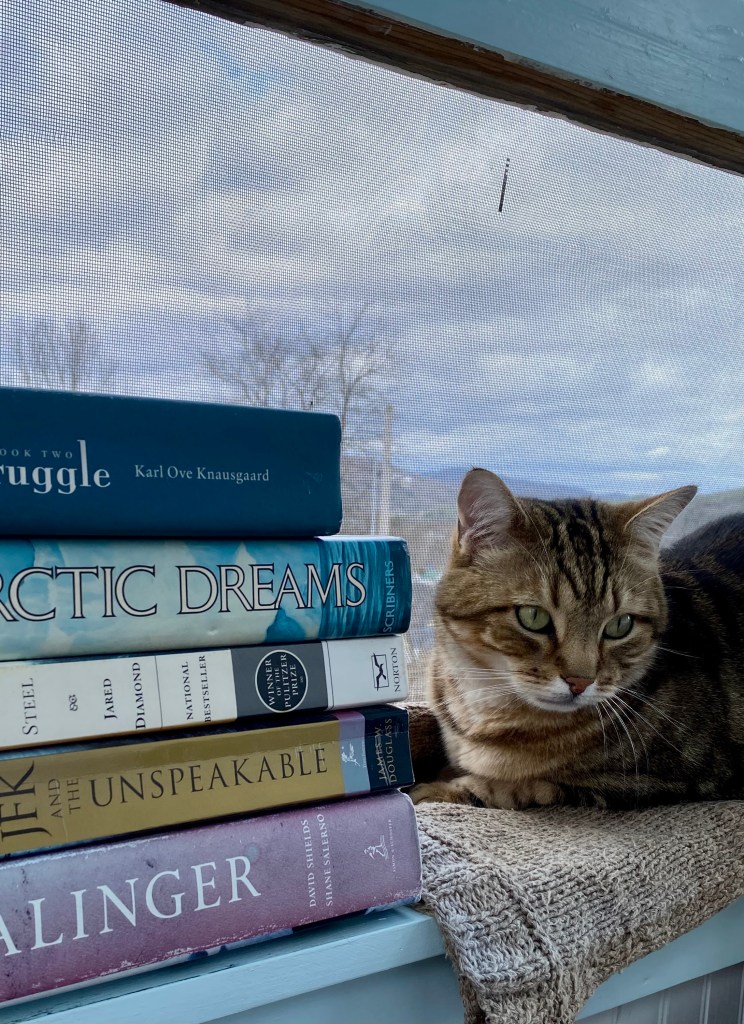
My little cat flicks his tail. A cardinal nestles in the mock orange’s bare branches, crimson feathers in the muted world. I lay my hand on my cat’s silky back, murmuring, “Well, what do you know….”

And a Raymond Carver poem:

“Happiness”

So early it’s still almost dark out.

I’m near the window with coffee,

and the usual early morning stuff

that passes for thought.

When I see the boy and his friend

walking up the road

to deliver the newspaper.

They wear caps and sweaters,

and one boy has a bag over his shoulder.

They are so happy

they aren’t saying anything, these boys.

I think if they could, they would take

each other’s arm.

It’s early in the morning,

and they are doing this thing together.

They come on, slowly.

The sky is taking on light,

though the moon still hangs pale over the water.

Such beauty that for a minute

death and ambition, even love,

doesn’t enter into this.

Happiness. It comes on

unexpectedly. And goes beyond, really,

any early morning talk about it.

Are you for real?!

The other night, I’m leaving a meeting in the high school library devoted, more or less, to hashing out what community means (nothing to be solved in a few hours). In the parking lot, a woman says Goodbye, Brett — and quicksilver, I shout, Are you for real?!

As the other folks empty out of the school into the spitting snow, she and I talk beneath the ghostly streetlamp. Very quickly, it’s clear to me how utterly wrong I am about this woman. What I believed was true was not. I once ate chocolate covered strawberries in her house with my youngest daughter. The woman packed up a bowl of these delicacies for one sister to give to another.

In ten minutes, we are speaking animatedly of matters of our hearts. We’re both shivering by then in the damp snow. We hug and head to our homes.

I don’t know what’s happening in the rest of the country, and I surely can’t speak for anyone else, but how glad I am that I called out in anger. And how much more grateful I am that she took the time to listen to me, to lend me her shoulder, and I could do the same for her. Indeed: real.

A community… is the knowledge that people have of each other, their concern for each other, their trust in each other, the freedom with which they come and go among themselves.

— Wendell Berry

The true religion, the religion of snow…

I stand at my kitchen’s glass door devouring blood oranges and watching the sifting snow. Blood oranges — could I choose a less local delight? I open the door and cast out the peels for the birds.

The cat Acer sits on my feet, listening to the morning radio news, too. Just over the river, my home state New Hampshire revels in the Presidential primary. Meanwhile, Vermont prepares for its March Town Meeting Day, with the calculations and passion of budgets and petitions. Close an elementary school? Pledge to become a pollinator-friendly town? So much of January in my state is devoted to public meetings and discussion/debate, to a reckoning of the way forward, a jostling for who’s running for what seat — and what seats might remain empty.

Meanwhile, snowy winter has finally arrived, spare and elegant. Fearsome and enchanting. As the days deepen in cold, the light hours increase: no stasis in this world.

A fan of local chicken, bacon, milk, my cat stares at my orange-sticky fingers with disdain. I crunch the orange seeds, too, devouring this sunlight sweet.

Here’s Billy Collins’ poem about shoveling snow with the Buddha:

[Shoveling snow] is so much better than a sermon in church,
I say out loud, but Buddha keeps on shoveling.
This is the true religion, the religion of snow,
and sunlight and winter geese barking in the sky,
I say, but he is too busy to hear me.

Onset of Pre-Cabin Fever.

I shake stunningly beautiful snow from my mittens onto my cats. Mid-January. Winter’s loveliness has just arrived. My house is again the three of us, two fluent in Cat and one marginally fluent in Human. The one who speaks Human gets the deciding vote, so we get up very early. The Cat speakers are wholly in favor of this, as the wood fire is fed and the cat kibble rationed into bowls. Eventually, the dawn finds us, and the rest of the world creeps in.

If this keeps us, the prognosis is mad-as-a-hatter by Honest Abe’s birthday. No fear of that. Any hermiting is constrained around here. Two small excerpts from my novel are accepted by journals. The cats and I nestle into our narrative. I let them lick butter from my fingers. Snow silently fluffs around us, concealing the stars, the sunflower stalks, the ash bucket I left by the step.

Music = flowers = courage.

Nearly a decade ago, my then-husband and I attended an improv poetry reading and concert in a church in Cabot, Vermont — an afternoon I later remembered as the last good thing we did together as a couple. Later that afternoon, news arrived of illness in our family. Although there was no way I could have predicted it at the time, the stress of disease further fractured our fragile marriage.

This weekend, I returned to that church with its high-ceilinged rough beams and unadorned crucifix for a performance with native flutes and storytelling as part of the town’s Twelfth Night celebration. Before the performance, the storyteller remarked about a flute, tens of thousands of years old, made from the rib of a cave bear. Flute music, like the drum which mirrors our mothers’ heartbeats, is bound into our DNA. With a rattle of shells, he began with the Chippewa’s creation story of the flute and expanded into a meditation about music as auditory flowers. Not Hallmark’s pastels: flowers are the rugged beauty that propagate our world. The music poured my heart full with courage.

Outside, a light snow sprinkled. Somewhere in the pandemic, my youngest played spring soccer in this town. In that time, no one was carpooling, and so I always drove. While she played, I walked along the river, early enough in spring that the peepers were singing but the black flies hadn’t hatched.

I had left my hat on the pew. When I walked back in, I met the poet’s wife. The poet, who was once so kind to me, has passed on now. His wife and I spoke for a few minutes, and then I went out, hat in my hand, snowflakes falling into my hair.

“… the need is now for a gentler, a more tolerant people than those who won for us against the ice, the tiger and the bear. The hand that hefted the ax, out of some old blind allegiance to the past fondles the machine gun as lovingly. It is a habit man will have to break to survive, but the roots go very deep.”

— Loren Eiseley