The truth is erasure.

Saturday morning, I chip at my day’s list, persistent: my thousand creative words, email that shouldn’t linger, the house chores of wood and compost. On the nearby trails, I ski and later drink coffee with my beloveds, and we ponder construction that will tie up this town, Hardwick, until the sundress-wearing season. At home again, I finish the 2025 taxes, stow things in boxes, preparing for a carpenter who will remove a kitchen wall and put a window in my kitchen. This plan I hatched while I was marooned in my house for months, struggling through chemo. Now, this winter, I wondered, Am I mad? Will I still proceed? But opening the heart of my house to the view of the village seems a hopeful act, a kind of creative resistance against dismal five-year survival statistics, an act of beauty in contrast to the darkening world.

I abruptly need the sky and the muddy earth beneath my boots. I consider phoning this friend or that friend to walk with me, but I doubt anyone will jump at the sudden request. On this ridgeline road, I see a friend who quickens my blood. We walk and talk for bit about the things that nourish my winter-worn soul: about the unexpected in our lives, about writing and doubt, an April event of poetry and art and food. About what Bashō called “the journey itself is home.”

She heads home, and I keep on along the maples. All winter I’ve walked here. One frigid January, I’d gone too far and considered flagging a stranger in a car for a ride, but I didn’t. I kept on, as we all do. An eagle spreads its wings over a hayfield then disappears over a treeline. Blackbirds sing. A skunk waddles along the road. The snowbanks are above my head. The creature and I consider each other. Then, on our respective sides of the road, we each ease along. When I look back, the skunk is hurrying along, too.

Another spring. So many years I’ve lived through a New England winter, so many springs, and yet each March arrives as a surprise, a fresh reckoning. The wind smells of the opening earth. Twilight will soon be nestling in, and I’ll be home again, feeding my cats and the woodstove, eating a blood orange. A friend plans to visit, and we’ll keep each other company. Better to think of the days without names or numbers. Wiser to place these with a friend’s name, with skunk, puddle, blood moon.

You ask the sea, what can you promise me
and it speaks the truth; it says erasure.

… Nothing can be forced to live.
The earth is like a drug now, like a voice from far away,
a lover or master. In the end, you do what the voice tells you.
It says forget, you forget.
It says begin again, you begin again. ~ Louise Glück

Stars as a trail of crumbs.

When I was a little child, age six or so, I lay awake before sleeping and wondered at the borders of the darkness. My sister, brother, and I shared a room that seemed vast, although now I remember the footprint of that townhouse and realize my memory of that room is child-sized. Above the kitchen and entryway, the room could not have been large. Across the upstairs landing was our parents’ room with a view of the interstate and, some nights, a flickering drive-in movie screen. While my younger brother slept, my sister and I discussed the limits of infinity.

We lived there for two years. Now, I realize my parents turned 40 in that townhouse with the orange-painted metal door. In those two years, I have no memory of the stars in that place, an odd thing given that the night constellations are my earliest memory, my father parking our Volkswagen bug on a roadside, and my mother admiring how the Santa Fe city lights mirrored the stars.

The night before I realized I had cancer I stood on a back road in rural Vermont. It was late autumn, and, my God, how the country dark gleams its power, how radiant the ineffably distant stars. I carried that memory with me as I descended into the depths of profound illness. A few nights ago, over a year after that autumn night, I parked in Montpelier and walked along the sidewalk that was mostly empty in the sharp cold. Small lights gleamed in the closed-up shops—the candy store, the bookshop, the AT&T outlet. The stars pierced the night: sacred and profane illumination. The cold drove me back to my car, and my headlights showed me the way over the low mountains, back home again. I’d left my porch light on. I stood on my step for a moment, shivering. I was more perceptive as a child, before language encouraged me to divide the world into categories. Wonder. For this moment, nothing but wonder.

“Sometimes I think we can learn everything we need to know about the world when we read fairy tales. Be careful, be fearless, be honest, leave a trail of crumbs to lead you home again.
― Alice Hoffman

Making more tracks than necessary…

I’m standing on a dirt road, looking up at the blue sky unblemished by any smear of cloud as my friend wraps a scarf around her face, when a Subaru speeds over the crest. Jolted, I lurch to the roadside.

$750k in cancer treatments and I’m felled by wrong-place, wrong-time on an otherwise untraveled back road? Not this afternoon.

Bitter cold warnings jam the local news. In snow-drenched Vermont, February marks winter’s swing, where the daylight begins to rush back, the light tinged with warmth, suffused with this second-half-of-winter’s promise that seeds will stir again. In the meantime, I take off my mittens as we walk and talk about writing and people and the value of a precise query letter.

We step aside for intermittent vehicles, a silver pickup, a friend’s Prius, a Corolla with split exhaust. A year ago, I’d been sprung from a stay at Dartmouth-Hitchcock and returned to my cancer-and-chemo habits that shifted from bed to couch to what felt like a Herculean effort to open my notebook at the kitchen table and scrawl a few lines, my shaky pencil a balloonist’s line that tethered me to the world. What I didn’t know then was that the hard things I’d endured in my life, some of my making, some not so (sobriety, a divorce, selling a house and lighting out for new territory with my daughters, writing and selling books, the pandemic, the constant wear of subpar home economics), was training for the next 10 weeks. In what is now a blur of that back-and-forth from home to Dartmouth, at one point my oncologist’s eyes widened just the slightest; I wondered if my life was tapering to its end. Was my body about to be driven under?

But not last winter. Not this sunny afternoon, either. What rich luck to walk on a Vermont ridgeline road, the snowy mountains in the distance, finches in a roadside maple. To work, to share a plate of roasted salty Brussels sprouts with a friend, bake a chocolate cake for my daughter’s birthday.

I will never escape this cancer, whether I live a year more or thirty. Its fearsome and awesome power churns through my heart. How it revealed unequivocally to me the brutality and dearness of this world.

Meanwhile, as I cherish these days, these hours and minutes, the country where I live hemorrhages, the last moment of a man’s life pounding through the chaos, his words to a stranger, “Are you okay?” illuminating suppurating wounds. All the things, sadness and delight and such sorrow, the radiant sunlight. Each of us, moving along our paths: separate, together.

Be like the fox
who makes more tracks than necessary,
some in the wrong direction.
Practice resurrection.
― Wendell Berry

Cold.

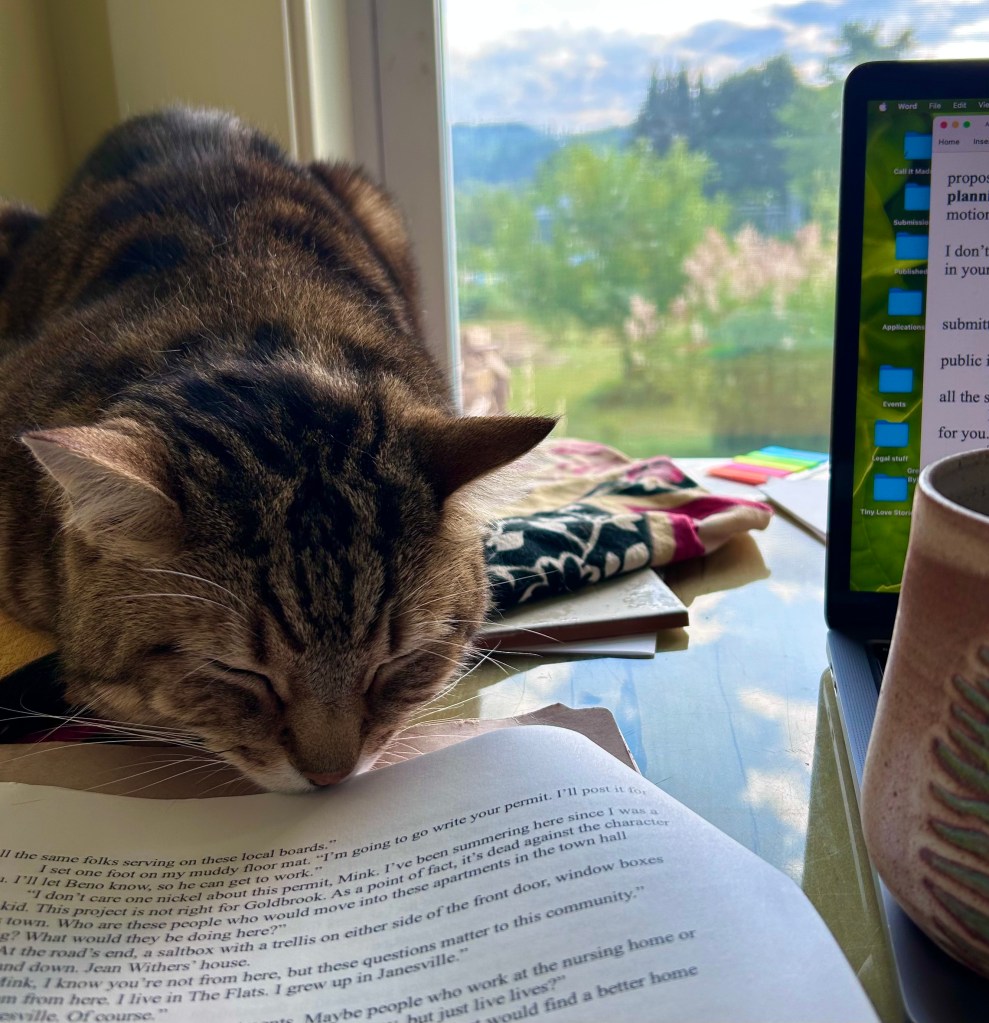
The cold lingers. A friend texts about walking, proposed temperature 5 degrees. It’s a balmy 3, the sun dazzling on fresh snow. A year ago, I sat miserably in her car, hardly able to walk around the high school — did I manage that loop twice? This end-of-January, we walk and talk. Later, sprawled before my woodstove, revising a manuscript that my cat uses as a nest, twilight and then darkness press against the windows. I have not forgotten how easily a body breaks, how rapidly the world shifts from wellness to suffering.

The world propels through flux, and while I’m (at least momentarily) emerging towards fuller health, so much human darkness deepens. My college student daughter phones from Burlington — Vermont’s big city on our own Great Lake — the streets jammed with protestors. The mayor issues a statement as officials prepare for an ICE invasion. “Stay steady,” she urges.

Under the moon hanging in the sky, we head downtown to the coffee shop to admire photographs of the northern lights. The photographer plays a short film of footage shot in locations the audience knows well, roads and lakes and a ridgeline above the village. Turns out, he wrote the music, too, weaving in calling coyotes and chirping crickets, loon songs. It’s no antidote, no balm, but a radiant reminder of the vast universe, of how the horizon shifts from black to pink to green, that we are driven by love of beauty, too. A steadiness.

On Frozen Fields

1 
We walk across the snow,
The stars can be faint,
The moon can be eating itself out,
There can be meteors flaring to death on earth,
The Northern Lights can be blooming and seething
And tearing themselves apart all night,
We walk arm in arm, and we are happy.

2
You in whose ultimate madness we live,
You flinging yourself out into the emptiness,
You - like us - great an instant,

O only universe we know, forgive us. ~ Galway Kinnell

Nurses.

If you don’t know nurses, you will, or someone you love will. In my past year of cancer-and-chemo appointments, of those dozen hospital stays, in variations of days to weeks, the nurses were my very best friends. Nurses cajoled me to eat chicken soup and drink water (even a sip, just try); they were kind to me and looked out for my daughters. They taught us the ropes of the hospital ship: the habits of doctors and surgeons, how to adjust a bed and order food, find the light switches, turn up the room’s heat, find warm blankets. They offered orange juice and sandwiches to my daughters and hotel vouchers. The nurses told me I would live.

Nurses taught me about IVs, how not to bend my arm, what downstream occlusion meant, and when I must absolutely ring immediately for a nurse. They helped me to shower when I couldn’t stand, and never laughed when I said I forgot I had no hair. But they did tell funny stories and made me laugh. When I had a terrifying reaction to a chemo drug that was absolutely necessary for me to endure, a nurse sat with me for hours.

There was that terrible ED visit when I couldn’t stop throwing up from pain, and I was too weak to talk, and the nurse stayed long after his shift ended, holding my hand while I cried. There was yet another awful stay in the ED, those three nights in the room with the beige metal walls and the heat that wouldn’t turn off, and the nurse and the MD together figured out a pain med plan that brought me back to my body, that made the cancer bearable again.

Another nurse helped me get discharged on a spring day when I pleaded to go outside and see the apple blossoms, to have sunlight and wind on my face; she arranged for my daughter to sit with me on a bench and sip hibiscus tea, and she arranged for the hotel room where I slept all afternoon and then traveled in the morning across the road again, back to the cancer center for more chemo. She did this to help me heal. The chemo nurses tend the frail and the hopeful, the recovering and the dying. I had no port, so my arms were bruised and scabbed from months of sticking, and these fine nurses turned my forearms over and over and never failed me. Who in your life never fails you? They took such care.

I could write on and on. The nurse that first visit to the ED, who knew from a scan that I had metastatic cancer before I did. He walked in my room and looked at my daughters with such compassion. We did not know, but he did. He knew the hardship that lay ahead of my dear daughters.

The nurses, unfailingly, cared me as one of their own. I have notes in my journals, names and stories of strangers who cared so tenderly for me and my daughters, but really what I have is gratitude, admiration, and such sorrow for the unnecessary murder of one of our tribe.

The Goddamn Gray, the Brilliance of Language.

A year ago, my daughter was driving me to the local ER, yet again, under the frigid winter sky. Wordless, I leaned my head against the side window of her Subaru, staring at the faraway pricks of stars vanishing and reappearing among the clouds. In the darkness, I fixated on one thought—the white hospital bed, the clear liquid drugs that would make the pain cease—and held to that, my lifeline. Cancer-and-chemo, in its infinite complexity, is a monotone landscape. In all those months, my existence was the blackness of pain, the temporary light of relief-from-pain, the crimson drug injected into my veins. Occasionally, a cardinal at a feeder, blood oranges, and then I couldn’t eat those, either, and I remained alive on Saltines and water.

I keep thinking of those below zero nights as I drive this night to the opposite end of town. There, with a friend in a place where I’ve never been, we eat drunken noodles and green curry, and then drive again through the darkness and the drifting snow that’s no threat, simply prettiness. At the Vermont Studio Center for the Arts, we settle into the dining hall with the residents. We’re greeted warmly, and the room is scented with the lingering remains of a savory dinner, of coffee and wine and the fragrance of flowers likely from the tables freshly scrubbed. This is a dear place, where I’ve been lucky to stay and work hard, meet friends and share stories about creativity, its hardness and joy.

Rigoberto González reads magnificently, his words, reminding me of when I was a teenager reading James Joyce for the first time, thinking yes, yes, this is what writing can do, push us into a place where we glimpse the world for a moment in all its shimmering and confounding complexity, its immense sorrow, utter fun, or the way a hand plucks a pebble from a river and holds it dripping and glistening to the sunlight.

At home, I stand in the darkness that is sodden with cold, a forerunner of the mighty freeze rushing this way. The crescent moon pushes against the clouds. In those underworld months, the goddamn gray occasionally scattershot with goldfinches exploding from bare branches, my fate might easily have veered another path. A storm and brutal cold loom over this nation submerged beneath political nefariousness.

This terrible disease, this exacting instructor, taught me brutal lessons. Among these, savor these draughts of warmth, recognize heart. Know this value. Do not disparage.

“Every person with a body should be given a guide to dying as soon as they are born.”
― Anne Boyer