Changing Worlds

The cold, my old familiar friend, sweeps back.

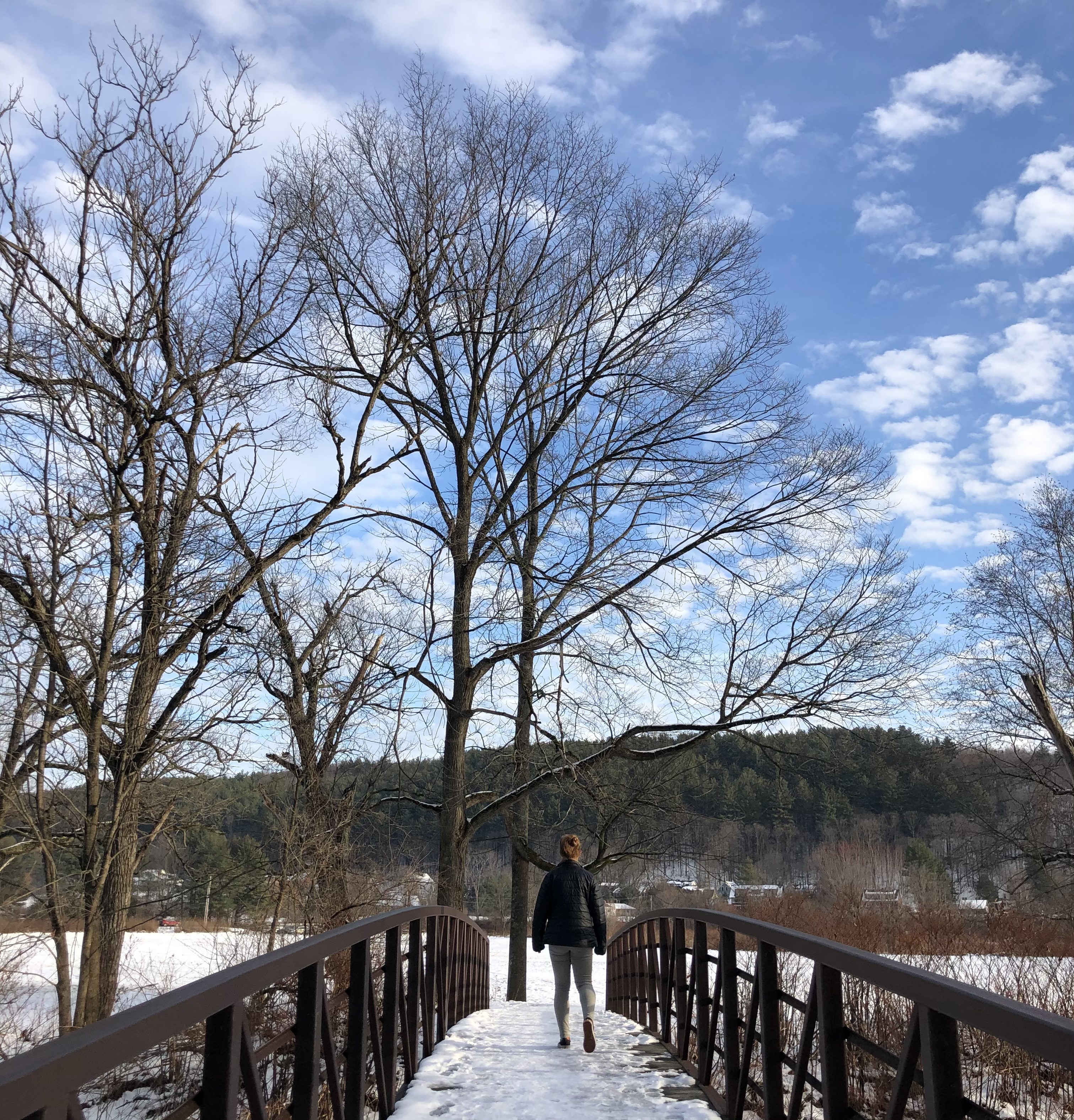
Carrying out a bucket of hot ashes from the woodstove in the early morning, I stand for a moment in the gusting wind. Is snow falling or merely blowing?

Inside, the cats pace, hungry, then hunker before the stove, waiting for warmth.

Midwinter, our days unfold in an unusual patience, a kind of dreamy standstill, fluctuating between work and home for my older daughter and myself, and the new version of school for my youngest.

In Vermont, the Agency of Ed aims to fully reopen schools by the end of April. My high schooler asks me, while we make spicy egg rolls, what that means. Among all the things she doesn’t like about this mixed-up world, she’s come to relish the kind of collegesque schedule she’s managed at the high school, coming and going at her own will.

At fifteen, she’s composed and level-headed, determined to get done what’s necessary.

I tell her what I believe — that the world will not revert to the way it was, that our future is already unfolding around us, in ways we don’t yet understand.

I can’t tell her what I’m thinking — seize the reins you’re already holding and steer your own fate — because I know she doesn’t want my advice. Maybe she doesn’t even need my advice.

Instead, I scrape out the last of the cabbage from the pan and say, “Do what you need to do. This is your life.”

Outside, this morning, the wind chimes bang in the wind.

In the bleak Winter
When the World is one color
Is the Sound of Wind

— Bashō

Hardwick, Vermont, January

A Year Ago

…. A year ago, the date was looming near where I had that wretched dental procedure. On the 21st, as the oral surgeon brought a scalpel near my face, he said nicely, You might want to close your eyes for this.

This December, after weeks of virtual schooling — whatever that may be — I knock off work Friday afternoon, so the 15-year-old can drive. My oldest asked us to bring coffee. She steps out behind the doctors’ office where she works, dressed in scrubs, with a stethoscope around her neck.

Then she heads back in, jazzed for the afternoon challenge of of families and fears, from earaches to coronavirus.

In the village, my youngest parks behind the famous Stowe church, and we walk along the bike path. The path winds along the river, not at all iced over yet. We pass a few dog walkers. Behind a restaurant, the scent of dinner cooking follows us as we walk in the thin December sunlight. The savory smell reminds me of when I lived in Brattleboro, so many years ago, above a Korean restaurant.

The smell is delicious, and it follows us for a long way across a field. Stowe reminds us of those summers and falls when we sold maple syrup and ice cream at the farmers market. As we walk, my youngest tells me what she remembers of the market. These are good memories, and we share snippets of the vendors we knew in those years.

Back at the Subaru, it’s nearly four, and the sun is sinking towards the mountains’ horizon. We’ve been gone from Hardwick just a few hours and filled these hours with coffee, a scattering of snow beneath our boots, the sky overhead, the smell of dinner, and the narrow December sunlight between our words.

Carefully, she backs out of the parking space and heads for Route 100. She reminds me my brother told her to enjoy the small victories.

She pauses at the stop sign and looks at me. This is a big victory, she says.

December, 2020.

Leisure”

By William Henry Davies

What is this life if, full of care,

We have no time to stand and stare.

No time to stand beneath the boughs

And stare as long as sheep or cows...

Phone Talk

I’m on the phone at work, answering some standard questions, nothing serious, just information passing from me to a woman. She offers that she’s working at home — she’s employed by the Barre, Vermont, school system. Barre closed up their schools awhile ago, when Covid spread through the town.

I offer a few words of thanks, and then her words keep unraveling. She works with kids at risk, and she knows kids who live in cars. Immediately, I glance through the window at the gray November day, on the verge of snow. Maybe, she says, the families have vouchers for a motel rooms.

I lay down my pen. For those moments, I keep listening.

The woman has moved here from Elsewhere, and she keeps talking about those hidden, or not-so-hidden pockets of deep poverty in Vermont. I think of my own daughter, home alone, in our warm house, with her two sleek house cats. Eventually, I say the only thing I can think to offer: thank you, just thank you.

She asks for my name again, and I spell out my strange name carefully, first and last names. When we hang up, I step outside in a rain that’s just beginning to fall. There’s no birds out today. The road is empty.

Inside, I dial my daughter who asks, suspiciously, why I’m calling.

I’m calling, I say, to say hello. What’s up? How are your cats?

Photo by Gabriela S.

Rubber on the Road

By chance, I start reading a new novel — The Father Clause by Jonas Hassen Khemiri — and I’m back in those young motherhood days I thought would go on and on eternally — changing diapers, mashing peas, carrying little kids. Those days didn’t, of course. The youngest is now learning to drive.

My youngest logs in hours for her driver’s ed class. Sunday morning, we head to Montpelier. She parks in front of the statehouse, and we walk up the enormous granite steps. There’s no one around, save for five joggers decked out in full Santa suits. They wave merrily at us.

We head south along Route 2, through stoplights, towards Barre, talking about green arrows, lane changes, and the rules about turning, or not, on red. I’m giving my daughter a road map. At the same time, she asks questions about her father and where he’s gone. Talking with my daughter, on this sunny Sunday morning, at the end of a November that hasn’t even gotten cold yet, I know there’s so much unknown in all our lives, that the mystery of pandemic and chance and human relationships is a piece of participating in the human world.

Be wary, I caution my daughter. Look before heading into intersections. Read signs. Get out and admire the view from the steps, and wave to the silly Santas, too.

Dead my old fine hopes
And dry my dreaming but still…
Iris, blue each spring

― Shushiki

Photo by Molly S.

Lighting the Way

On our evening walk in the dark, we pass by a house where a couch, a love seat, and an ottoman have been sitting in the front yard for nearly two months now. Last night, in the rain, passing by the FREE sign that had fallen on the wet ground, I wondered, What’s the plan here?

These evenings, I often stop by the neighboring house. That small house on Winter Street was built for granite workers around 1900, like the house I bought instead. The Winter Street house was dirty and unkempt, the kitchen not really a kitchen; no one seemed to have cooked in that room for a very long time. The woman who bought that house fixed it up, room by room, but now that house appears to be empty again; I’m hoping she’s found true love and moved elsewhere.

From her free pile, I’ve taken little things — a patterned bowl, a small plate with a fish.

Post-Thanksgiving, I walk with my youngest, who imagines a post-Covid world when she’s ready for college and then wonders about her few high school years remaining. What will that look like?

She knows the future is utterly unknown. Post-holiday, we’re in watch-and-wait, partly to see how the virus surges or not, and partly to see how, collectively, how our behavior will unfold. As always, the kids are at the mercy of adult behavior, for good or for ill.

So, when I hear the governor on the radio yesterday urge Vermonters to light up these long early winter nights, I abandon my usual bah-humbug attitude of not running up the electric bill or burning more fuel.

There’s plenty of winter ahead. The plan might be as simple as day-by-day take a walk in the dark, through the mist and beneath a gauzy moon. Walking across our front yard last night, I remembered where I had planted crocuses and daffodils, that the blue squill will return next spring, that night always passes, too.

“I know how hard this pandemic has been, especially as we make our way through the holidays without the ‘normal’ get-togethers and sense of closeness we all want,” said Governor Scott. “So, in celebration of the coming holiday season, I think it’s time to lift our spirits. Let’s get creative and show the world that Vermonters are here for each other and that even through these dark and difficult times, Vermont Lights the Way…. I hope this effort will spread joy and hope, especially for our kids… there are brighter days ahead.”

Rain, Cats, Kids, Home

It was raining this morning when I carried out a pail of hot ashes. For a moment, I stood in the cold rain, looking at the village below, its few lights blurry through the mist that creeps in on these early winter mornings.

Like just about everyone I know, we’re home — the three of us — for this holiday, with not much more planned than cooking and walking and hanging out in our warm house, with the walls I painted the color of daffodils.

It’s the strangest time, for sure. Decades into my life, I know this, too, will pass. My daughters — ages 21 and 15 — will someday decades hence look back at this time. I imagine they’ll remember this holiday as a time when so many relinquished their own desires for the health of the whole.

So much in 2020 was not as usual, so it’s fitting, I think, that the holiday season starts this way, too. In past years, we’ve had a huge Thanksgiving table, or we’ve traveled, or sometimes it’s simply been our family. But this year, perhaps, draws out the quieter, deeper meaning of this holiday.

So, of all the many things I’m grateful for, I’m grateful that we can endure the pandemic together, the three of us. Around us, I know, as my daughters know, there’s so many eating alone today, separate, but lending their energy toward better community health, even in a cold rain.

I thank thee God, that I have lived
In this great world and known its many joys:
The songs of birds, the strongest sweet scent of hay,
And cooling breezes in the secret dusk

— Elizabeth Craven