Vectoring….

Autumn has stretched out in Vermont into days of balminess, the warm air shot-through with the gold that lingers on the trees. It’s so warm, I keep at my makeshift back porch deck, a table I moved out this summer that’s become a place of succor, resting my bare feet on a wooden crate of those onions I pulled from the garden.

I’m taking a class with the unmatchable Lauren Markham about structure in writing, one of the hardest challenges. Online, there’s attendees from California (what? you get sun and ocean?) and Phoenix and Boston. Signing in, I leave my laptop camera on. I throw a chunk of wood in my stove from sheer laziness so I won’t need to rekindle the fire as the colder night creeps in, but I open the back window so my cats can sit on the sill and enjoy this sweet October breeze. When I join, the group is admiring the view of my clapboard house and frost-killed morning glories vines. I tell them my chore which doubtlessly immediately marks me as…. quaint rural.

Late afternoon, I pull out the dead basil plants and then lie down under an apple tree. Her leaves, blacked with frost spots, spiral down, one by one, to the unmown grass. It wasn’t until I had babies and was forced to slow down (all those nursing hours beneath apple trees, milk-sweet baby in my arms) that I realized every leaf takes its own precise trajectory, from spring bud to the autumn dive earthward. Around me, rotting apples, persistent slow-flying wasps.

I might have slept; when I open my eyes, the sky is already draining of blue. Thinking of Markham’s words, I suddenly see the taunt arc of this fourth, yet unfinished book, the map that holds this story, the treasure at the reader’s end far from a Hallmark card. Vector is the word she used. Indeed, all story, all life, is motion. The chill rising up from the earth, I vector myself indoors….

A great many, who have spent their lives in cities, and have never chanced to come into the country at this season, have never seen this, the flower, or rather the ripe fruit, of the year. I remember riding with one such citizen, who, though a fortnight too late for the most brilliant tints, was taken by surprise, and would not believe that there had been any brighter. He had never heard of this phenomenon before. 

— Thoreau
Messy democracy.

So this whole democracy thing? Since we’re in an election year and all?

I work in a small town for a Selectboard. Monday morning, I pull into work (late, again), and a Selectboard member is eating a blueberry muffin as fast as he can in the parking lot, a muffin I’m certain the town clerk made. I get out and make some comment roughly along the lines of it’s a good thing I don’t do drugs anymore because Your Town….

He counters with, Let’s get serious. What’s your cucumber and zucchini situation? I’m coming back at noon with four full boxes.

Monday morning, it’s revealed that people have stolen signs. People have written letters to the Selectboard and newspapers and the Sheriff about the theft. People arrive in the office with dogs and laptops and questions, eat muffins and disappear. I walk outside with the phone. It’s possible that the thief arrives. It’s also possible there’s some laughter. Or maybe I’m making all this up.

Democracy is messy, chaotic, often brutal. People arrive who look as though they’ve slept in ditches for their entire adult lives and complain about the flood. People complain about their neighbors. People run for election. In all of this, I take off my shoes and walk around barefoot. I do all the things I’m supposed to do and I keep wondering if I’m doing any of these right. I give an old woman a bottle of water. I am always trying to leave, disappearing into the asters around the lake, into the rooms upstairs where it’s just me and the wasps and the open windows. I am always trying to sew the pieces of my life together. Sometimes I crumple paper and throw it at my coworkers, which is not really at all charming or funny.

As a writer, I learned from reading. I learned so much from sugaring — the majesty of the world, the inarguableness of cause and consequence. I learned joy and love as a parent. I learned grief as a broken wife. Working for a small town, I’ve learned the peculiar American craziness of little towns and politics, of gossip. How to spy cowardice and when to lean against the courageous.

There’s not one damn thing perfect about any of this. Here I am as usual, half in, my head and heart filled with my garden gone rampart with rudbeckia and coneflowers. But we’re all that way…. July is the season of joy, January the season of despondence and loneliness. In the heart of midwinter, I leap from the snowy shore to the frozen lake. Far out, I sometimes lie down in the middle of the day, the ice a bed between my bones and the sludgy lightless waters. Overhead, the infinity of the heavens.

But today it’s Good Old July. In the afternoon, I walk with a woman along the forest trails she’s cut. She’s eased white quartz from the soil. The rocks gleam, as if freshly scrubbed with rain.

Human chaos, the desert.

Galisteo, New Mexico

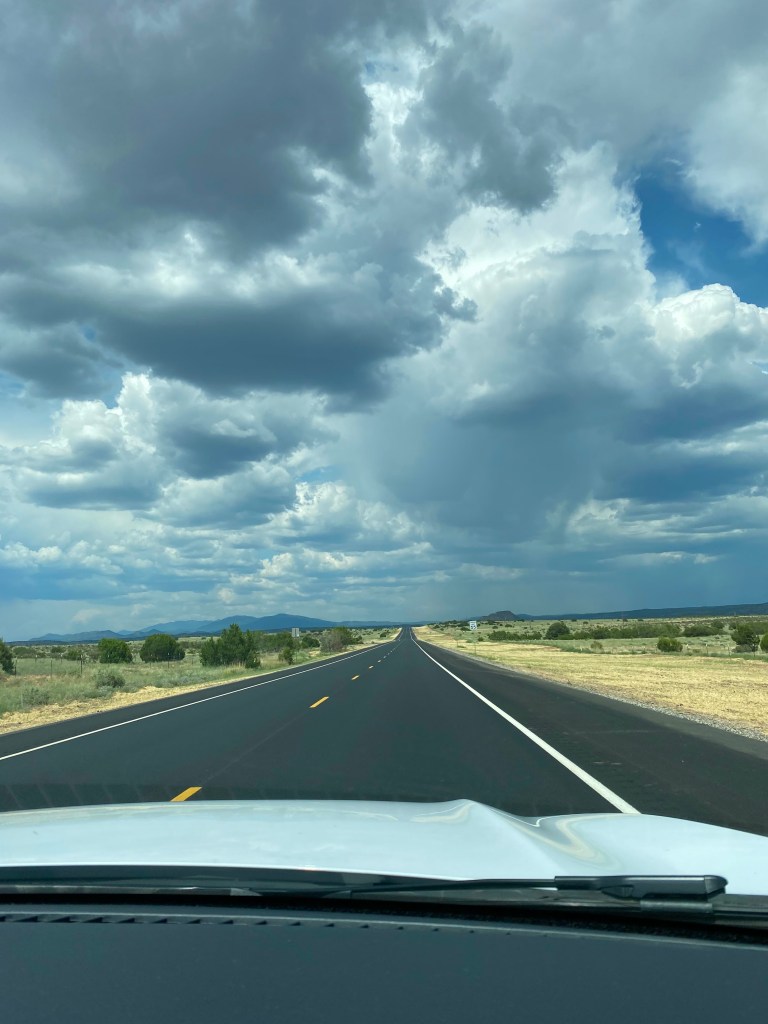
My daughter sends word of rain and more rain in our Vermont world. Meanwhile, on the other side of the continent, visiting my father in New Mexico, we’re amazed by the hues of green. The desert’s rainy this year, too. In the afternoon, I work outside while a storm blows in. In New Mexico’s wide skies, sooty clouds may lower and threaten and yield not a drop of water, blowing elsewhere, breaking or not.

In this quiet, edge-of-the-greenbelt place, news comes to us, the President now ill, an election teetering any which way. We do the everyday familiar things — drink coffee and eat dinner, play cards, talk about my mother’s recent death, about each one of us. After dark, the two girls and I stand outside in the dark in the cool rain, breathing in that ineffably sweet fragrance of the rain-damp desert. Wind shakes the junipers. Here, at fifty, I seem to be carrying a goblet of my life, the wind in the junipers one of the very first sounds I remember as a little girl, so many trips crisscross between Vermont and the desert, the enthusiasm of these young women with me who have seen so much of this world already, so eager they are for more, more of life. Later, when the girls are whispering and laughing in bed, the rain falling, the breeze blowing through the window, I feel that endless ancient desert around me, the calling coyotes, dwarfing for this moment even our human chaos.

Complex People.

I was on a Claire Dederer reading jag, stepping into her island home, soaking up her kids and her questions and her fierce writing. Witty, smart, edgy. Which led to me to the father of those children and his books. 

Bruce Barcott writes in The Last Flight of the Scarlet Macaw:

 “… a good portion of my life I believed that a law of benevolent action held sway in the world. This law maintained that if you did the right thing and worked hard, eventually things would work out; that the world generally tended towards fairness, decency, and wisdom. But of course the world doesn’t work that way. The people who learn that lesson through crushing experience and still refuse to bow to it astound me. They go on fighting, again and again and again. These people aren’t perfect. They aren’t simple heroes. They are complex human beings. And we need them. Because without them the world would be lost.”