Dividing line: rivers running north and south.

Lost, I spend a crazy amount of time on back roads, driving from here to there, searching for a house where I’ve never been. A porcupine ambles along a dirt road. I slow, the car windows rolled down, the sunroof open and dust drifting in. The quilled creature disappears into the roadside weeds. I follow the paved state highway north, a two-line twisting road that cuts through farm fields jeweled with blooming dandelions.

I find them, finally, this kind couple, and apologize for my lateness. Turns out, they’ve worried about me. We stand outside in the sunlight, with their little dog and their grown daughter who stops by, this witty and laughing family who has endured tragedy. We’re on a rise of land that overlooks a pond. We are at the dividing place, I learn, where water flows both south and north. As we talk on this old homestead, I sense the world’s expanse, how brooks and streams and thin rivers join immense lakes, powerful rivers, the mighty beast of the Atlantic Ocean. Around us rises the history of this homestead, how the house and family has grown and contracted and changed over the decades. Spread overhead, the gleaming night sky, the pinprick constellations.

Black flies chew my hairline. Post-chemo, my lost straight hair returned as ringlets. On my way again, I retrace my way through swamps dense with marsh marigold. On this sunny day, the trees push out new leaves, further, further, in these few hours. I return to a former school house, where the town is voting again that day on a failed school budget. People come and go, cheery with the spring weather. I stay late for a hearing and drive home under a blood-red sunset, the breeze through my car windows sweet with plowed earth and manure.

How furiously I labor to remain in this world. To savor the inevitability of lostness, the chance crossing of a porcupine on its solitary animal journey, the stunning May blossoms. Many months ago, I asked my brilliant oncologist what I did to invite lymphoma into my body. Vehemently, he replied that I’d done nothing, absolutely nothing, to cause this brutal disease.

This physician saved my ragged life, but do our philosophical planes align? Two years ago, as the cancer sunk its silent teeth into my flesh, those intertwined demons of fatigue and despair shook me, too. Always now, skimming beneath my days and nights, flickers that fear: relapse. I’d spent so much time, that winter of illness, in the Dartmouth ED that the nurses and MDs became familiar. They knew my daughters and I by name. The general surgery team appeared repeatedly in that huddle around my bed, and I began to understand the hues of that word restraint as they considered their surgeon thoughts. There was that dreadful evening when I informed the oncologist that I could endure no more, and he gently replied that I could. He would get me through. So I endured. Many years ago, when I was so young, 21 and naive and freshly falling in love, I whined to a professor that I could not finish my thesis; I’d done enough. He kindly informed me that someday I would write a book and I would fear I would never reach the end. All this, in fact, transpired.

Restraint and effusive joy. Sooty despair, the pleasure of a purring cat. As the night settled down through twilight, I drank tea on my back step, leaning against my house. A fox trotted across the violet-strewn grass, quickly, on its way. So much for monotone winter. Wild spring.

Dandelion 

The first of a year’s abundance of dandelions 

is this single kernel of bright yellow 

dropped on our path by the sun, sensing 

that we might need some marker to help us 

find our way through life, to find a path 

over the snow-flattened grass that was 

blade by blade unbending into green, 

on a morning early in April, this happening 

just at the moment I thought we were lost 

and I’d stopped to look around, hoping 

to see something I recognized. And there 

it was, a commonplace dandelion, right 

at my feet, the first to bloom, especially 

yellow, as if pleased to have been the one, 

chosen from all the others, to show us the way.

~ Ted Kooser
Risking Delight with the Lion

Precisely a year ago, to the day, Isele Magazine published my essay “Red Devil, Survivor Herself.” I had written all through the godawful cancer treatments, AKA chemotherapy, and publishing this essay marked my tenacious determination to remain among the living—and to remain a fierce writer, too.

Over the summer and autumn, “Red Devil” morphed into a manuscript-in-process. Recently, three more chapters were picked up. The kind folks at Isele Magazine published “Risking Delight with the Lion.” The following two will be published in different journals later this spring.

Here’s the opening of “Risking Delight.”

In my winter of chemotherapy, I woke at night, quivering. Where was I? What was happening? Gasping, I reminded myself that I was in bed, I was okay, that whatever demons had sought me in sleep had been banished by my waking. I didn’t blink my eyes open into peace. My breathing never eased into contentment.

Cancer-and-chemotherapy is a path of suffering, an involuntary hairshirt. The first morning I met my oncologist Dr. Valera in that Dartmouth-Hitchcock hospital room, I was surfacing, bleary and exhausted after an emergency admission and an exploratory surgery that verged on plunging me into a sedated coma. My daughters had been summoned through a snowstorm. What remained of my vitality was vanishing. Me or the lymphoma would triumph. There was no middle ground. Yet, that first morning, Valera assured me, “I can cure you.” Not cocky, not boastful, merely stripped down to facts: the lay of my body and disease, his skill and treatment course.

I clutched his words desperately, but I never repeated aloud, “This physician makes a claim that I will live.”

What was the levy I would pay for remission?…

Last… with the 2050: Vermonters Take a Swipe at the Future project, I’ll be reading at the Tenney Memorial Library in Newbury, Vermont, this Saturday, 4 p.m. Come!

Strange gift.

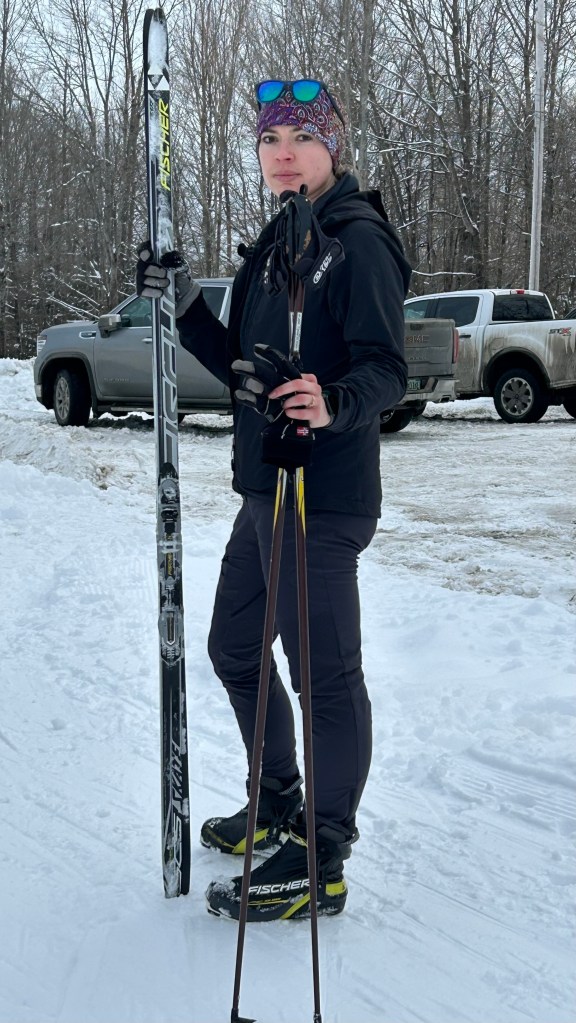
A year ago, I couldn’t manage the three steps onto my back porch without holding a daughter’s hand. A reversal of those early parenting years when I held my toddlers’ teeny fingers as my children learned to walk and then, quickly, to run. A year later, my oldest and her partner load up our skis, and we head out for a seven-mile trek. I once thought idly of skiing, a mere pastime, nothing more. Now, it feels nothing less than miraculous.

A year ago, my daughters and the partner propped me together through the darkest months of my life. In those months while I endured chemo, little bits of lights and happiness trickled towards me, as if falling down an ancient stone-walled well. Sunlight in my living room, in the hospital halls, (never in the subterranean ER), flash of cardinals, the boxes of books and gifts of miso and cards and checks that kept me alive.

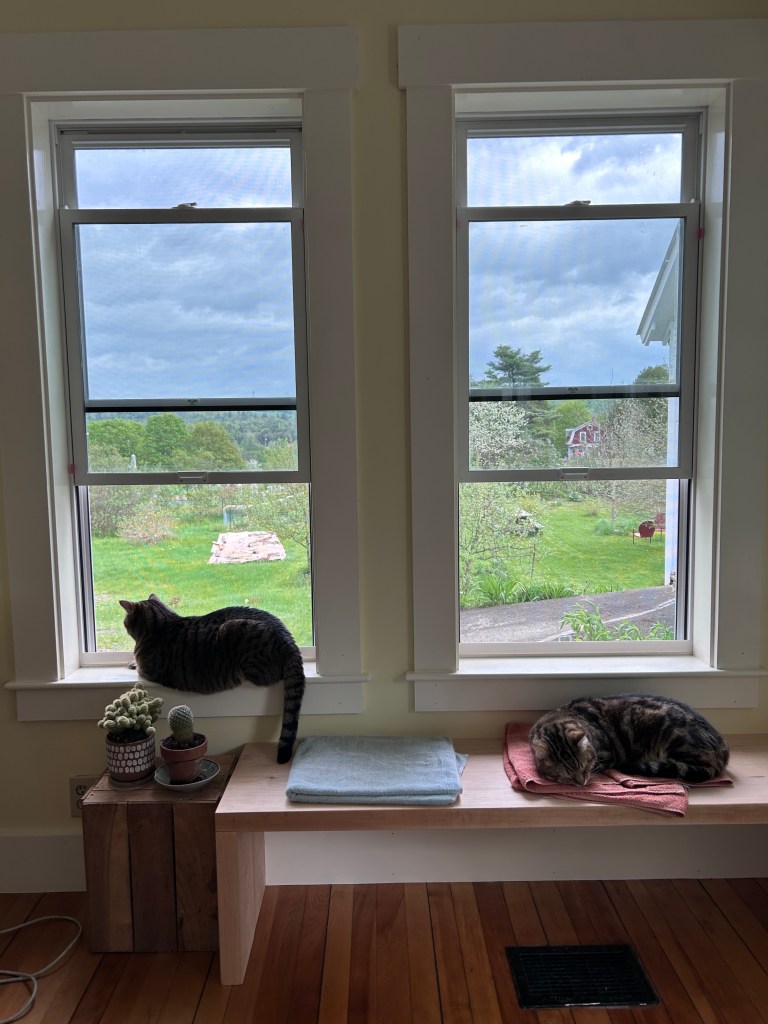
Post-ski, I feed my mewling cats and eat blood oranges, then lie on the couch and read Jonathan Buckley’s One Boat. I’m relaxed as if I’ve swum with a friend in a Vermont pond, and then we linger on the shore, talking about nothing and everything. But it’s February yet and snowfall is circling again. We’d skied from hayfields down into the forest and circled around and around. At one moment, I’d hit fatigue, where I wondered if I would emerge from these deeply snowy woods. It’s a place I’m now beginning to know intimately, where I know the life I clutch so fiercely can so easily slip away. I was reminded recently of Robert Frost’s lines that “the best way out is through,” a minute guide for human life. On this day, all the human things.

Lucky.

August is exceptionally hot this year, the rivers so low they can be crossed by foot. In the woods, streams have dried to rock beds. In Montpelier, the state’s tiny capital, I walk by a store with bright bowls in the window and think, My mother would love this store. She passed over a year ago, and yet I still catch myself thinking that she might appear around a corner, her purse tucked under her arm, amused at me. Of course I’m not gone…

My father, the physicist, schooled his three kids early on about entropy. In a week where things repeatedly broke — the hot water heater leaking, the Jetta refusing to start in the rain — he made jokes that we were in a High Entropy Zone. So, this lovely August, with the chorusing crickets and the waning red moon — I’m determined to suck each day to its marrow. Sandwiched around work and the steadiness of washing dishes and so on, I’ve pushed aside space for swimming and ice cream, for lying under the apple tree and studying a spider spin her web. The entropy of living keeps on, as it does.

In the years when I was raising my own young daughters, our days zigzagged from bowls of blueberries to bath time. The days were endless, and the years rushed by. Now, my girls newly grown, I relish the silence and crave their company. Lucky I am, so lucky, to be alive this summer, this month, these days. All day long, I walk around with my tender heart cradled in my hands, wounded and raw from cancer, from weeks of hospitalization, from the knife of mortality pressed against my windpipe. August: the season of great loveliness, the intimation of winter. The reminder to love where and what we are.

Hitch Hiker at a Truck Stop

The hitch hiker asks to look at

the palms of my cold hands

and thanks me for unfolding them

on the frost-edged

picnic table between us.

While I look at his downcast eyes

trying to see if he sees,

nearby truckers stare

at his narrow face,

long blond hair.

He asks me if I garden,

rips a scrap of newspaper

and folds it up

into a tiny origami

package for anise seed.

Here, he says,

seed I gathered in Oregon,

plant it in Colorado.

I always have a garden, he adds,

I plant and leave to others.

He tells me he has no sex;

when you ride in the righthand seat,

you have to nod your head

without listening.

Face pressed to the window,

he can see the lacquered edges

of the earth.

So I imagine him 

practicing calligraphy

on truck windows,

recommending honey and vinegar

in a glass of water

every morning.

Mad, mad, mad.

A yellow warbler,

the moon at the bottom of the stream.

Out on the highway

he is raising his thumb again. ~ Mary Crow

“Like a definition of love…”

Eight summers ago when my daughters and I first moved into this house, we swam in a nearby pond, usually with friends who lived nearby. In those eight summers, the kids grew up and are now swimming in other lakes, other ponds. I kept on. The swimming and conversation was a peaceful way to end jammed and often chaotic working days.

Late last fall, as part of extensive testing after I was diagnosed with lymphoma, I realized I had Giardia, too, proverberial small potatoes compared to cancer and easily treated. This year, I never started swimming. In May, I’d endured a painful surgery with a lengthy incision that needed to heal. That nearby pond was the most likely source of the Giardia.

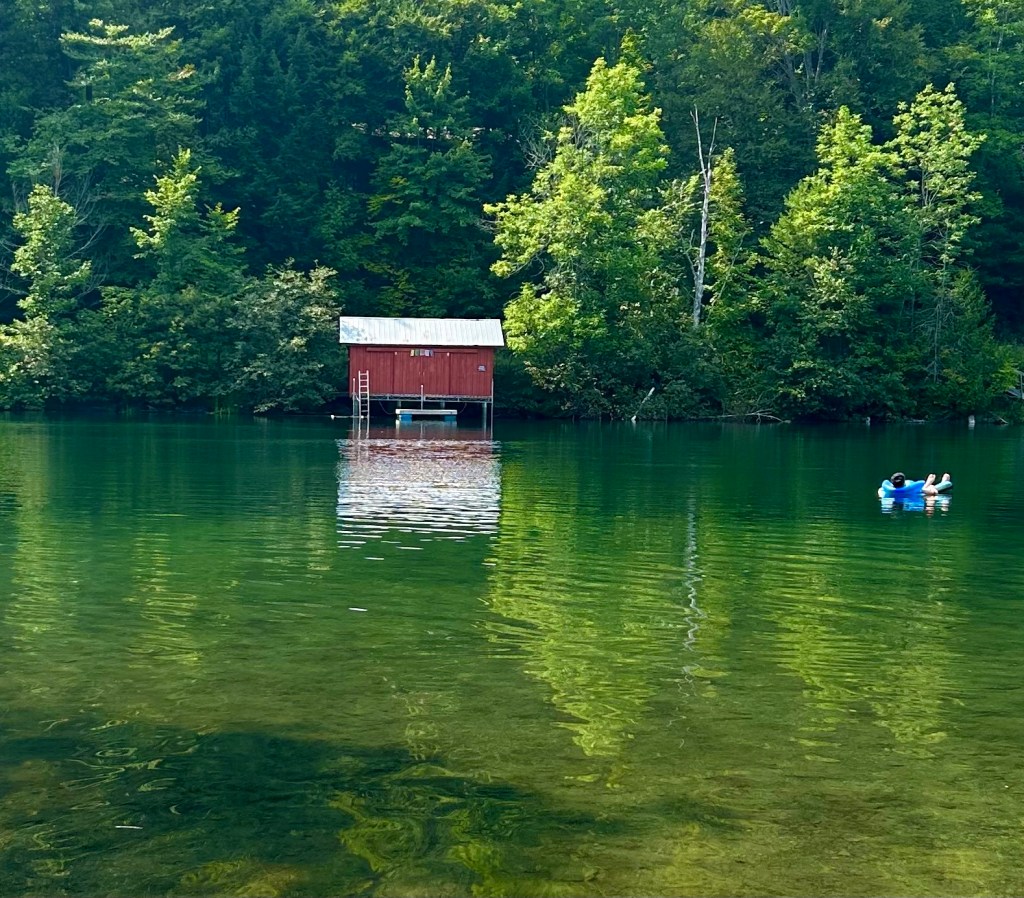
This August, a friend convinced me to swim at #10 Pond, familiar territory between our two houses, another place where my daughters and I swam and kayaked and picnicked. I arrived a few minutes early, opened my book, and the loons cued. This pond has always been one of my favorites: clear water, friendly fellow swimmers, scant motorized boats, little development. The water was cool. Kicking my legs, I felt my incision tug, but it was a sensation, nothing more. Afterwards, we lingered, drying and warming in the sun.

Yesterday, I was in sultry Barre and drove by the pharmacy where I had the go-around with the pharmacist and sharply insisted he fill my dilaudid prescription. I was on my way home from yet another lengthy stay at Dartmouth. We had to wait for the prescription, so my brother and I walked around Barre. It was early spring, hot, and the trees hadn’t yet leafed out. He’d parked on a hill and worried I couldn’t walk back up. I’d been on blood thinners, and the bandage around my IV site was soaked with blood. Don’t open it up! he warned me. It was so dusty and hot, and I was exuberant to be in the world where daffodils were blooming.

So yesterday, on my way home, I stopped at #10 Pond again, swam and read and listened to a nearby conversation between two men who were fishing — and the loons, of course, the loons.

We’ve now crested beyond the high summer. Each August day offers its own potential, for swimming or heartbreak or simply eating ripe peaches. Reader, wherever you are, love at least slices of your lives and places.

I’m about to send off a third novel manuscript to an interested party. In the dark this morning, I woke and began the book I’ll write about cancer and motherhood. Sure, cancer changed my life in small and great ways, but a year later it’s still the same me, rowing my life against the common current, compelled to write something that seems impossible.

And, for historical and record-keeping notes, I’ll add that the full moon, the Sturgeon Moon, rose smoky and red, ineffably beautiful over the cricket chorus.

“Green Apples” by Ruth Stone

In August we carried the old horsehair mattress
To the back porch
And slept with our children in a row.
The wind came up the mountain into the orchard
Telling me something:
Saying something urgent.
I was happy.
The green apples fell on the sloping roof
And rattled down.
The wind was shaking me all night long;
Shaking me in my sleep
Like a definition of love,
Saying, this is the moment,
Here, now.

Don’t these greens taste good…

My oldest daughter attended preschool for a year on the second floor of a Unitarian Church in a little village on a pristine glacial lake. The village is heavy on the white clapboard quaintness. To get to the town, we drove through acres of farm fields. In May, the fields gleamed with dandelion gold. The merry month of May: bumblebees and blossoms. Revel on…

My daughters visited me yesterday at Dartmouth, a repeat that’s become bizarrely routine — a repeated I’m determined to break. They came bearing gifts of peonies and good cheer. Sunday, we wandered through the wide and mostly empty halls. The hospital is designed to pour natural light into the building, and the sunny afternoon showed its success. We admired the blooming crabapples and wandered through garden courtyards. I gathered more reading material.

I rarely post photos of myself, but here’s me, in my daughter’s sweatshirt, in a photo snapped in an elevator. Dandelion from the youngest tucked into my zipper.

The First Green of Spring

Out walking in the swamp picking cowslip, marsh marigold,
this sweet first green of spring. Now sautéed in a pan melting
to a deeper green than ever they were alive, this green, this life,

harbinger of things to come. Now we sit at the table munching
on this message from the dawn which says we and the world
are alive again today, and this is the world’s birthday. And

even though we know we are growing old, we are dying, we
will never be young again, we also know we’re still right here
now, today, and, my oh my! don’t these greens taste good.

~ David Budbill