I found a paper butterfly on my car windshield yesterday afternoon — a gift, I’m guessing, from a local child.
My youngest and her friend, dreaming of summer and drivers’ licenses, create a plan of mountains to hike. While a pizza bakes in the oven, she lists summits on their list: Pisgah, Hunger, Belvidere….
I love this. While I worry about these girls driving, about the two of them heading off without a parent or big sister, I love that their dreams involve tying on hiking boots and pushing for summits. I love that they love mountains.
My younger daughter drives the two of us on a cold January afternoon to Montpelier. I can’t remember the last time I’ve been to the state capital, although (pre-pandemic) I was in Montpelier at least once a week.
We’re in search of a birthday present for my oldest daughter — a single present, that’s all I’m looking for — and we go into only one store. At the register, the owner tells me how happy she is to see people; the city has been a ghost town for the last week.
In the downtown’s heart, we pass empty storefronts. I’ve never seen so many vacancies in Montpelier before. On one main corner, my daughter notices the bakery where I once bought her chocolate chip cookies is locked, too.
Where I can’t bear to pass by is the library, the beautiful stone building where a year ago I often spread out my laptop and papers and worked for hours. In the large reading room, the well-heeled snapped on lamps and read and wrote. There was a couple who always appeared who seemed to be gambling online. The homeless and college students filled chairs. After school, children ran through.
At my daughter’s request, we walk through Hubbard Park in the cold and up the stone tower to see the city surrounded by mountains.
When we walk down the snowy steps, a mother and her daughter are sitting on the tower’s stone floor. There’s only openings for windows and doors, and the girl is crying with cold. The mother struggles to tie an icy lace on the girl’s ski boot.
Been there, I think, done that.
I no longer have the keys to my own car. My daughter drives past the state house where no one is out. Not a single person on the granite steps. Driving home, she suddenly says, The good thing about living in Vermont is spring. Even if winter seems forever, there’s always spring.
[Kintsugi], the Japanese method of repairing broken pottery [uses] gold to bind the pieces together. In this way, the break becomes what is beautiful, what is valued. It is a way to embrace the flaw, the imperfect. In place of the break, there is now a vein of gold.
— Nick Flynn, This is the Night Our House Will Catch Fire
I step out of our house just after sunset, and a crescent moon hangs over the road — a silent slice of gleaming beauty in a dark blue sky. By then, I’ve been on a school board call for hours, and I’ve had to remind myself repeatedly that what appears to be illusion at times — this strange, Hollywood-squares conversation — will shake out in ways that affect people’s lives directly: adults’ livelihoods, kids’ educations.
Although it’s five on a Friday, there’s not much traffic in town. In the little neighborhoods where I walk, no one is out. Against one maple tree, I see two plastic red sleds propped against the trunk.
As I round a corner, I hear laughter. I pause for a moment in the twilight, listening. A row of adults is bundled in coats and hats, sitting on a porch, talking and laughing. The cold air is wet with tomorrow’s approaching snow.
I’m no stranger to Vermont’s long winters, but mid-January 2021, and such a deep loneliness has set in — not just in my house, not just in my town, but spread ubiquitously. I stand under that gleaming sliver of moon, listening to the laughter of strangers. For the moment, I’m utterly stunned by the unexpected bliss of the moment, the sheer luck I have to be standing here, part of this shifting world.
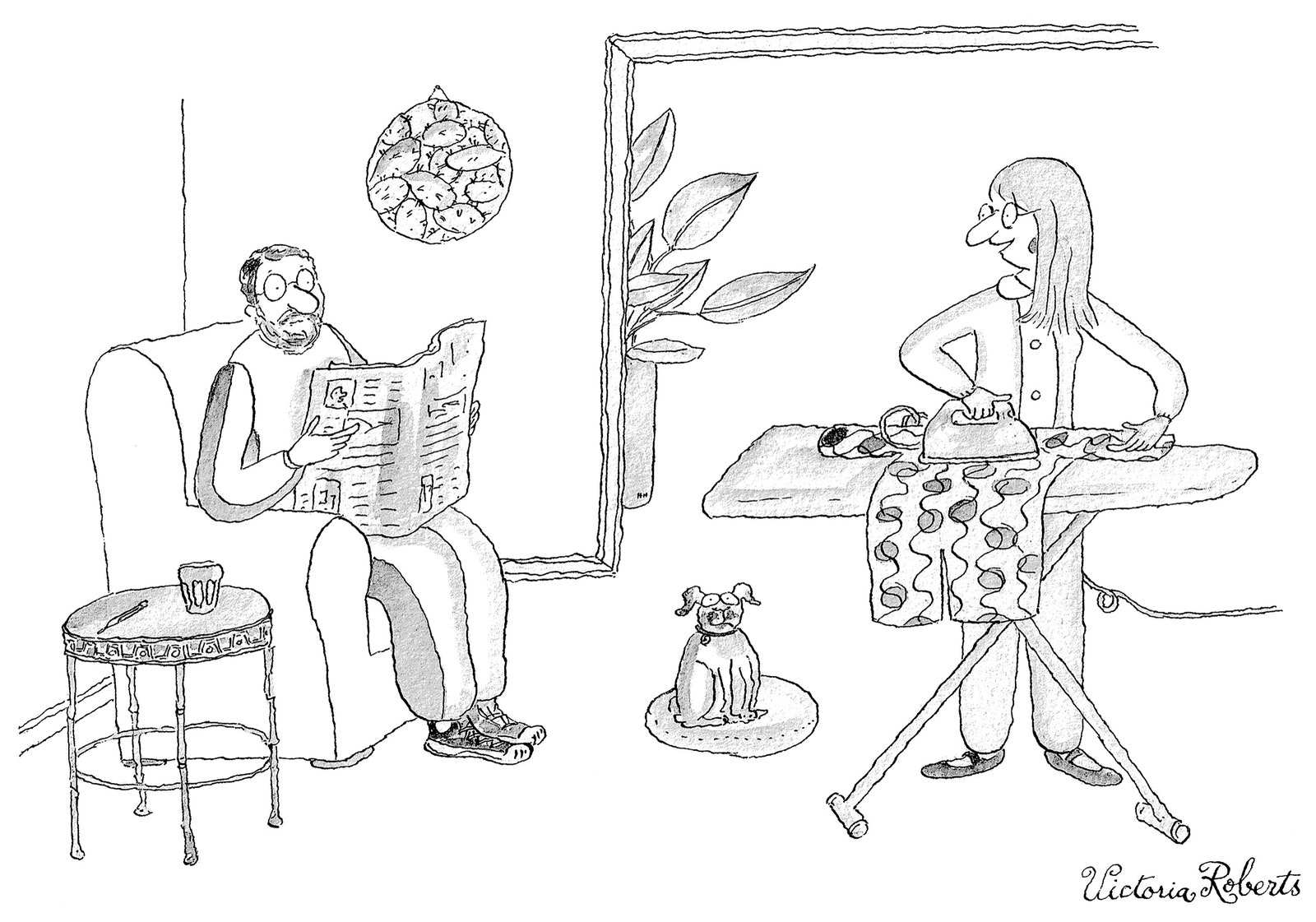
“I don’t like ironing, but it reminds me that once, long, long ago, there was a semblance of order in the world.”
After a terrible week, my daughter heads to ski with a friend. Because of the pandemic, she doesn’t catch a ride with the friend. Because my daughter is 15, I’m the designated adult — for what that’s worth — in the passenger seat while she drives.
Sunday morning in rural Vermont, the roads are nearly empty. North of St. Johnsbury, we pick up the interstate for a small stretch, then turn off and head along the Passumpsic River.
I lean toward the windshield and point out a bald eagle flying over the fields and then a second eagle.
Excited about those eagles? she asks me. From the corners of her eyes, she glances at me. She rounds bend and the eagles disappear from sight.
While she skis, I take a long walk into the snowy woods, and then work in our car. There’s nothing new here: I’ve been wandering through the woods and working in my car, waiting for my kids for years now.
And yet — while everything is the same, nothing is the same.
On our way home, she drives again, and stops at a church so I can get out and take a picture of the steeple and the blue sky.
Day whatever it is of the Stay Home order. On a virtual school board meeting that evening, we began asking each other who’s looking out their windows. I’d been staring out mine for a while, at snow falling briskly. Like December.
My friend emails about the year 1816 “and froze to death. Wouldn’t that be something? We could relive that dreadful summer at the same time as reliving the flu pandemic of 1918…”
The next morning, after I shovel snow off the back porch, I have another work call — something in pre-pandemic days that might have been handled by a few emails opens into a conversation about this stranger’s high school senior daughter, and college tuition, and poverty in Vermont’s Northeast Kingdom.
The cat lies sleeping in my feet in sunlight on my kitchen floor. There’s this elongated sense of time. Why not keep talking?
Much later that evening, my daughters and I take a walk through the woods where the light falls through the bare forest, still without its canopy. On the floor, we discover trilliums, Dutchman’s breeches, trout lilies, and — everywhere — spring beauties.
Day whatever. Tuesday or Wednesday — somewhere in there. The peas are up in the garden.
Like I hope everyone else — I hope — we’re holing up for the long haul in our house, figuring out our world day by day, in utter suspension of any “normalizing” of life. What’s normalcy again? Something we’ll never return to — or so I imagine at this point.
In the evenings — some balmy like last night, or others spring-raw and wet — we go for walks. The open-ended time reminds me of being a young mother again. Days and nights with young children had frustrations and challenges, sure, but also the deep pleasures of those endless walks and wanders I took with my daughters, learning the names of wildflowers, splashing through streams.
When I pick up beef for our freezer from a friend’s farm, he stands on his deck while I’m at a distance. In a wind so cold I begin shivering, we talk and talk. He asks about my daughters — he always does — and I tell him how my older daughter had considered moving out this summer, but she’s offered to stay home now, for whatever the long haul might be, pooling our resources.
She’s smart, he says. Now’s the time for unity.
When I leave, driving carefully around his flock of snow-white geese and slowly along the mud-rutted back road, I turn off VPR in my little Toyota. There’s never any returning full circle in this life, never getting back to where you once were. But we’re still here, our little family, sometimes irritable at each other, sometimes joyous and laughing. It’s different world, an American dream utterly broken that my daughters will redefine for themselves.
And for these days, I hope wherever each of you are, you’re settled into your own version of social isolation, with the sky’s beauty around you.




 Stony Soil Vermont