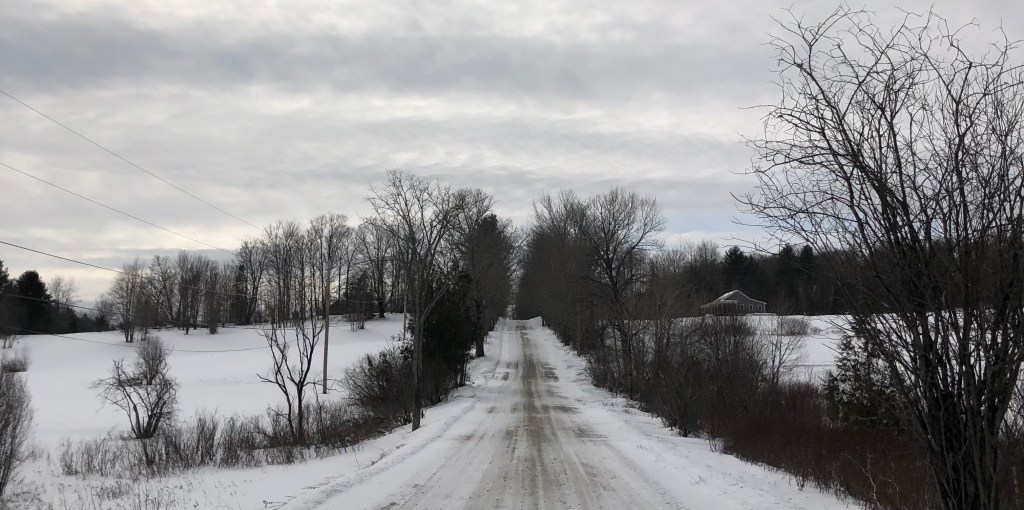
Somewhere in February. Dirt Road Land.

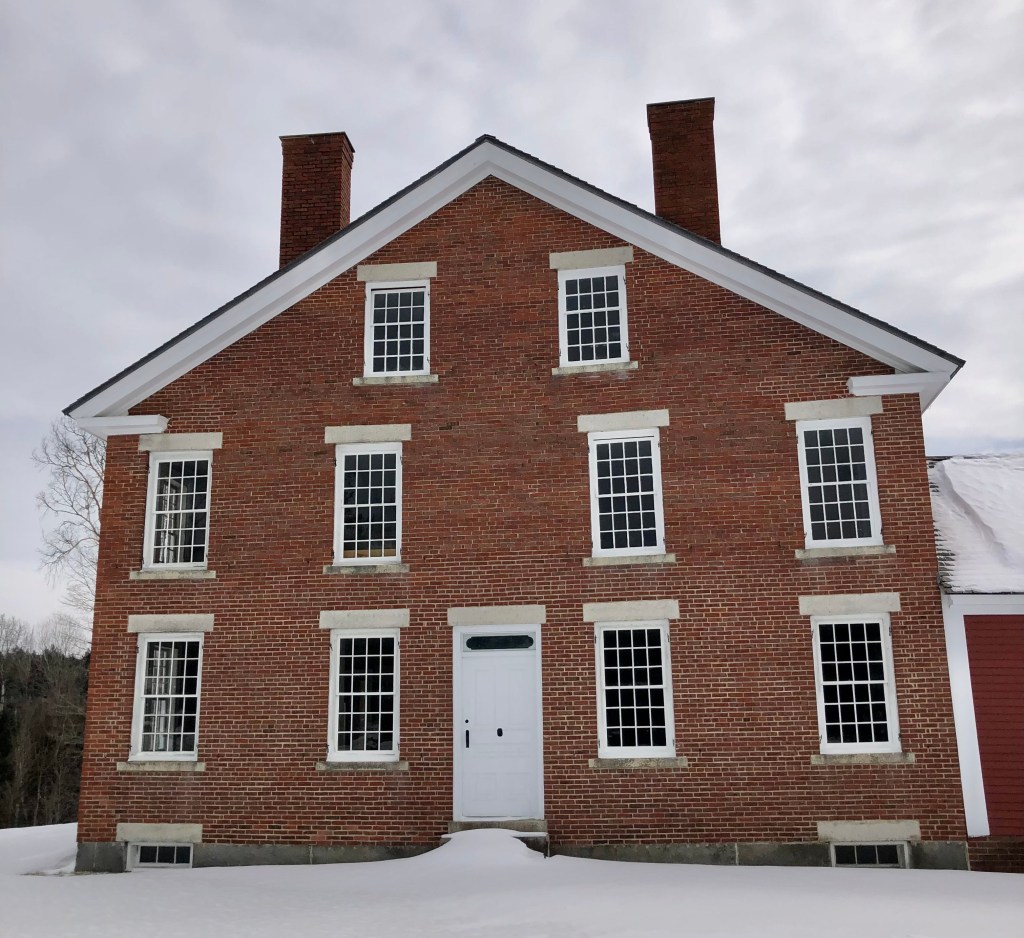
Kents Corners, Calais, Vermont

Every so often, a friend and I make plans to meet at a rural crossroads, at a brick inn that was once a stagecoach stop. I imagine in those days the crossroads was populated with chickens and horses, with people coming and going, not Priuses, but in wagons and on foot. My friend and I began this habit in the summer of 2020, and so the inn has been shuttered to the public all this time.

Walking, we pass a few other Sunday walkers bundled in coats and hats. But few people are out, and there’s scant traffic. In contrast, our conversation is packed — about raising kids and planning spring gardens, about relationships, about navigating the working world as a female in a patriarchy (why are these conversations still necessary, anyway??)

The thing about Vermont in midwinter is the stillness and what breaks that quiet. Icicles drip, freeze, and then thaw and drip again. Birds appear at our feeder in increasing numbers, then whisk away again. A rouge wind blows in a squall, soon chased away by the emerging sun.

Pandemic notwithstanding, robins return to our crabapple trees.

“Things are as they are. Looking out into the universe at night, we make no comparisons between right and wrong stars, nor between well and badly arranged constellations.” 

— Alan Watts

(And many thanks for Erika Nichols-Frazer for a review of Unstitched in the Valley Reporter.)

Walking with Skis.

Greensboro, Vermont

Someday, maybe I’ll look back at this photo of my daughter on the Christmas she was sixteen…. goodness, what will I be thinking then?

In the late afternoon, I ski up through the woods to where the farm fields meet the forest in two strands of electric fence. The fence is off now, and the fields are empty of grazers, save for the odd crow that picks in a bare spot. The day, although not sunny, has warmed, and snow clumps on my skis. The skis need waxing, which I haven’t done. Instead, I take the skis off and shoulder them, and walk down the trail through the few inches of snow.

These days, I’m working hard, the outside world coming at me in a fury. In the evening, we play cards. I’ve picked up a copy of a Mark Sundeen book that reminds me of my idealistic youth and a happy summer we spent in a tipi. The circumstances have changed; the world has changed, indeed, since my wild twenties; but the questions are the same.

I take the long trail back home through the woods, despite carrying my skis. At a stream, I stop. The ice hasn’t yet completely skimmed over the rocks. I pull off my mitten and dip my fingers in, the water so clear and cold.

How can a man hope to promote peace in the world if he has not made it possible in his own life and his own household?” 

― Mark Sundeen, The Unsettlers: In Search of the Good Life in Today’s America

Thaw, Finally

Right at the equinox this year, spring cracks winter’s back in Vermont. The pavement buckles into frost heaves. The dirt roads mush and muddy. Sunday, I find the season’s first coltsfoot, the tiny gems of gold.

A Vermont spring is either a heartbeat — bang, done — or weeks of freeze and thaw, thaw and freeze. Although the days have hit 60 degrees, the nights are still cold, and our wood stove keeps our house warm.

Last evening, we walked by a sugarhouse, its cupola open and steam billowing. The air was tinged with the sweetness of maple, the slight rotting of thawing mud. Instinctively, my upper arms ached. Walking behind my daughters, listening to their chatter, my arms remembered those years when we sugared, and how my arms and gloved hands bent into the woodpile.

Spring is all those things: the radiance of the strengthening sun, the beauty of wildflowers, and how, when the earth thaws, our winter debris of ash pile and last year’s kale stalks emerge.

The bush warbler.
The rain wouldn’t let up.
The travel clothes.

— Mizuhara Shuoshi

Cardinals — crimson and soft brown

Two cardinals perch in our mock orange bush, a brilliant flash of feather and beak, meeting and mating, much to the joy of our cats, who want to eat these these little creatures.

Around our Vermont house is yet an oasis of snow and ice, not a single sign of grass yet apparent. In the front yard, the rhododendron emerges stubbornly. I’m here! I’m here!

On this early morning that promises warmth, lines from poet Marie Howe.


Johnny, the kitchen sink has been clogged for days…

We want the spring to come and the winter to pass. We want
whoever to call or not call, a letter, a kiss–we want more and more and then more of it.

But there are moments, walking, when I catch a glimpse of myself in the window glass,
say, the window of the corner video store, and I’m gripped by a cherishing so deep

for my own blowing hair, chapped face, and unbuttoned coat that I’m speechless:
I am living. I remember you. 

— Marie Howe, from “What The Living Do”

Phone Chat

To save some cash, I switch cell phone companies, and I realize,  while I’m on the phone with the representative, that she’s working at home when she talks to her dog.

Knowing this opens up our conversation, and I learn her husband likes to turn down the heat, they’ve been living in Phoenix for two years, and she sought out this job because she likes the company so much. I’m amazed, because I never considered working for a phone company an interesting career option. She insists the people are all just so darn nice. It’s a great job.

While she types in my info, she hums faintly. I hear a screen door squeak open, and her husband’s voice. We chat about the coronavirus, and what it’s like to work only from home, for week after week.

When she’s finished setting up my phones, she wishes me good luck and welcomes me to the company family. I feel weirdly delighted. I don’t even know this woman’s name.

Somewhere along the way, I’ve more or less resigned myself to a kind of lone wolf existence — raising kids and gleaning work hours — and much of the work I do requires solitude. But this coronavirus existence has made me realize how valuable are our slenderest connections.

When I hang up, I step over my daughters who are sprawled on the rug doing a workout in preparation for bikini season. The cat wanders between them, clearly confused, likely wondering, What now? I step out on the back porch. Snowflakes are twirling down. Summer? Hello? I wonder.

Many people nowadays live in a series of interiors… disconnected from each other. On foot everything stays connected… One lives in the whole world rather than in interiors built up against it.

― Rebecca Solnit

IMG_7642

Succor

When I was twenty-eight and living in a hunting camp with my husband, I read Ernie Hebert’s The Dogs of March. The building was heated — well, we attempted heating — with a barrel stove designed for coal. The little insulation in the walls had been gnawed to just about nothing by mice. But this isn’t a story about how young I was then, how naively starry-eyed for so very long, but my first introduction to that word. I was so innocent then I thought the word was out-of-place in that novel.

Much later, my daughter’s kindergarten teacher suggested families acquire the habit of repeating the same family walk, no matter the weather. We had already established this, and likely because my husband and I had walked all through our childhoods. Even now, in a different house, one of the first things the girls and I did — and unconsciously — was try different walks. Where’s a better view? A running creek?

Today, I realized one of our walks has been downtown Montpelier and around the state house — again, in every kind of weather — and in the enormous crowds at the 2017 women’s march.

Walking is succor, a lifting up and an assistance. A widening from the narrowness of ourselves, a reminder of sky above, the eternal steadiness of the earth beneath our feet. The robins nesting in the maples on the state house lawn. Nearly 13 summers ago, on hot July and August days, I nursed my baby beneath those maples while the 6-year-old ate cookies and ran barefoot on the grass.

One repeated the same old mistakes. Each of us has a blind spot in his thinking that defeats him time and again against all teaching and experience and pain.

— Ernest Hebert, The Dogs of March

IMG_1602.jpg

Montpelier, VT, April 15