Put on a dress of flowers…

I spy a young fox on my front yard sniffing the trunk of the pear tree. Someone planted these two fruit trees long before I lived here. The smaller bends into the lilac hedge as if it’d prefer to be a lilac. This one, the taller, shoots high, its branches like an enormous hand raised in greeting.

The fox checks out the cohosh I planted this fall. Dawn is coloring up towards whatever day might emerge. I’m walking around my downstairs rooms, a dress in my hand, headed into work today, to sort out questions I both can and cannot answer, to talk with my office partner about town roads and FEMA, the drying up streams and lakes, about the merits of apple cider vinegar, and grownup kids. We’ll open the screen-less windows wide open in this 100-year-old former school, letting in the sunlight over the dusty sills. Hungry wasps fly in and out. An ordinary day of the things of this world, some humdrum, some irritating, some lovely as this balmy October weather. As for me, broken by cancer, limping back to whatever rude red health I can summon, I think, Put on a dress with flowers.

The fox crosses my neighbor’s pine-cone-strewn grass and disappears down our thin road. A fortuitous sign, I think, for this day.

Ode” by Zoe Higgins

Here’s to everything undone today:
laundry left damp in the machine,
the relatives unrung, the kitchen
drawer not sorted; here’s to jeans
unpatched and buttons missing,
the dirty dishes, the novel
not yet started. To Christmas
cards unsent in March, to emails
marked unread. To friends unmet
and deadlines unaddressed;
to every item not crossed off the list;
to everything still left, ignored, put off:
it is enough.

Habits of the Heart.

A radiantly sunny September afternoon, I’m at the northern edge of Caspian Lake, an afternoon with the slightest of breezes so the water shimmers and ripples. The summer people have all returned to other places, the local families at work or school, so it’s just me. For the longest time, I stand at the edge of the long dock and watch a bald eagle fly low over the water, then circle back and disappear into the woods.

Where do you find succor?

For years, with little girls, I spent hours with my friends at the public beach on the other side of the lake. Our worlds dispersed now, I haven’t walked there this summer. In no rush on a day that’s already been crammed with people and my to-do list, I take the longer trail back to the road. The usually wet forest is so parched the boardwalk bridges span over dry soil.

As the afternoon folds down, I take a walk along the river, the path I’ve been following all summer, watching the trout lilies give way to soapwort to the persistent asters. A pickup truck idles across the trail. A woman I knew years ago from a library kids’ group waits for me to pass, then ropes off the trail so she can move her cows from one pasture to another.

On my way home, I stop at the co-op for vinegar and coffee beans and cashews. A stranger says hello in the bulk aisle and reminds me he’d passed me on the trail, he on a bike and me walking in sandals. We talk about the moon and a star named Arcturus. When we part, he says, “See you on the trail — a metaphor for life.” Slow I am these days, as if I’m floating on my back in a warm pond, my eyes open to this flawless blue sky, the undulating water gulping in my ears. Autumn, this heartbeat of beauty, its own true metaphor.

… From this week’s New Yorker:

… what made America great—were “habits of the heart”: the everyday engagement of citizens that sustains institutions by holding leaders to account. Habits fade, but they can also be revived.

Survive, Thrive.

In search of a story about wool and weaving, about Colonial America and these sultry August days, I discover a trailhead for a nearby town forest. I return with my daughter. We drive on back dirt roads, the terrain unfamiliar to me. But the way the maples are nearly in the road, their leafy branches stretching over the road and touching, is the Vermont I first loved, so many years ago when I was 18.

We pass houses flanked by sunflowers and hydrangeas, gardens with six-foot high fences to keep deer from marauding the kale. Not so many decades ago, these were farm fields. In the forest, we follow a former road beside a stone wall. In New England, a forest moves in quickly, erasing the labor that once cleared this land.

August, the woods are quieting. In a break in the forest, we walk through a field of goldenrod, a strip of pink Joe Pye Weed at its edge. All summer, I’ve written sparsely in this space, intently picking up the stitches of my life: walking to mend lost muscle, relearning habits of sleeping and cooking and eating — such simple things I once did so easily. When an acquaintance’s dog leaped on me on a walking trail, I rushed deeper into the woods and wept. I’ve cried so little during this year of cancer, but there I was, ridiculously weeping beneath pines, so fearful of my own fragility, of breaking.

August, and I’d take a whole summer again, an impossibility. Instead, again, we’re in the edge between seasons, the days shortening, chilly at sunset and sunrise. My cats eye the unused wood stove and then eye me, wondering what my plans might be.

Survive, I think. I’m cooking fish and offer these plump tabbies a second course. Thrive, I add.

We must risk delight. We can do without pleasure,
but not delight. Not enjoyment. We must have
the stubbornness to accept our gladness in the ruthless
furnace of this world. ~ Jack Gilbert

Mad World, Abundant Wildflowers.

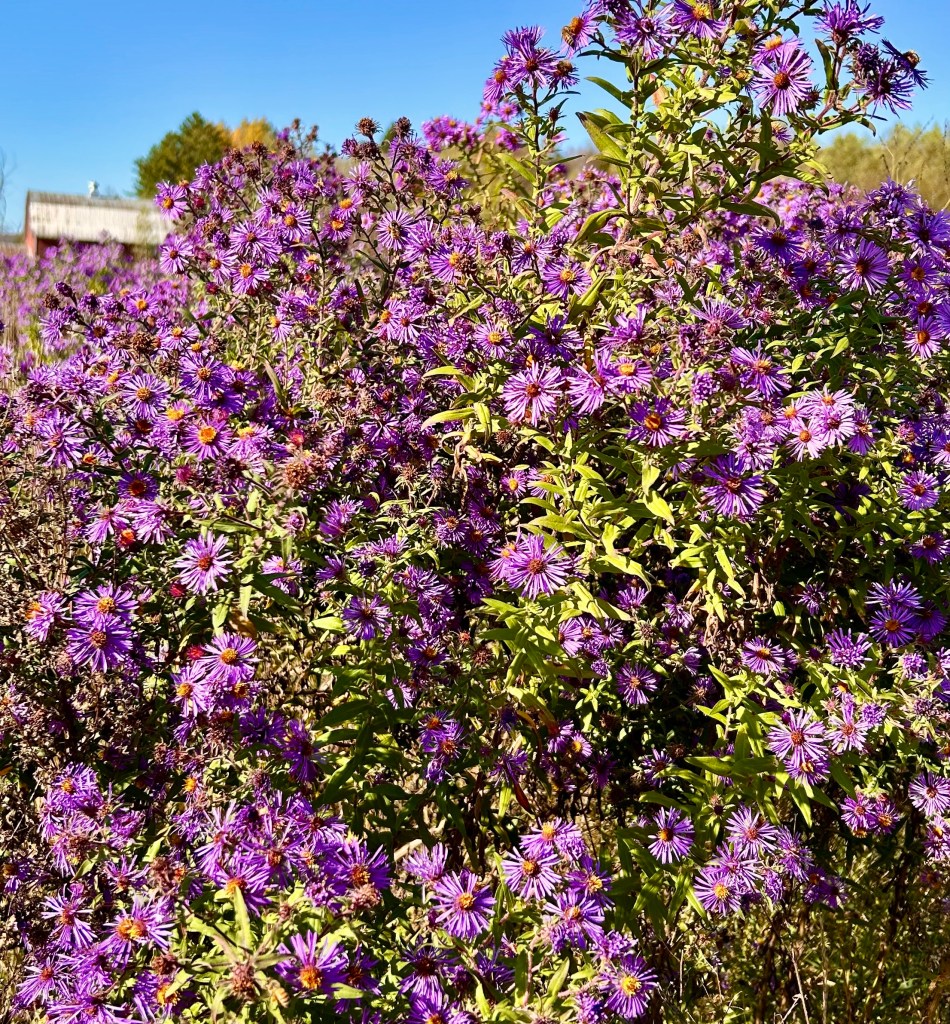
For no particular reason, I walk on the path along the river which leads to the road where I once lived. In the meadows and beside the trail, the wildflowers blossom abundantly: yellow toadflax and pink asters, bluets and Black-eyed Susans, cinquefoil.

I dawdle at the dirt road. At a turnout, long ago I had a carpool meeting spot. Over the years, my daughters and I passed hours there. In the afternoons, I lingered with my friend, the girls lingered with their friends. The girls played in a brook. The fields have been used for hay, vegetables, seeds, THC. In the past few years, the flooding river dumped sand in these acres. Burdock and thistle claim this terrain now. These fields are for sale again.

A few pickups zoom by. When my ex and I were splitting up, we’d meet here, too. I’d run down the mountain road and leave the girls at home, baking cookies or riding bikes. In my then-husband’s truck, we’d argue about our lives. That autumn as an early dusk washed in, I leaned my head against the truck window and watched two coyotes running across the field. He kept talking and talking and I kept thinking about our daughters who would be hungry for dinner. Someone else lives in that house now. Our lives have long ago moved on.

A friend pulls up, and I get in her car. We talk about kids and aging parents, about money and oranges. The world around us is falling apart. What we see now might be just the cracks of a shifting society. Yet, our lives spin on. My friend and I keep talking and talking. Children grow up. The fields’ bounty changes. I no longer live a few stones’ throws down an empty road from this friend, but how I love her.

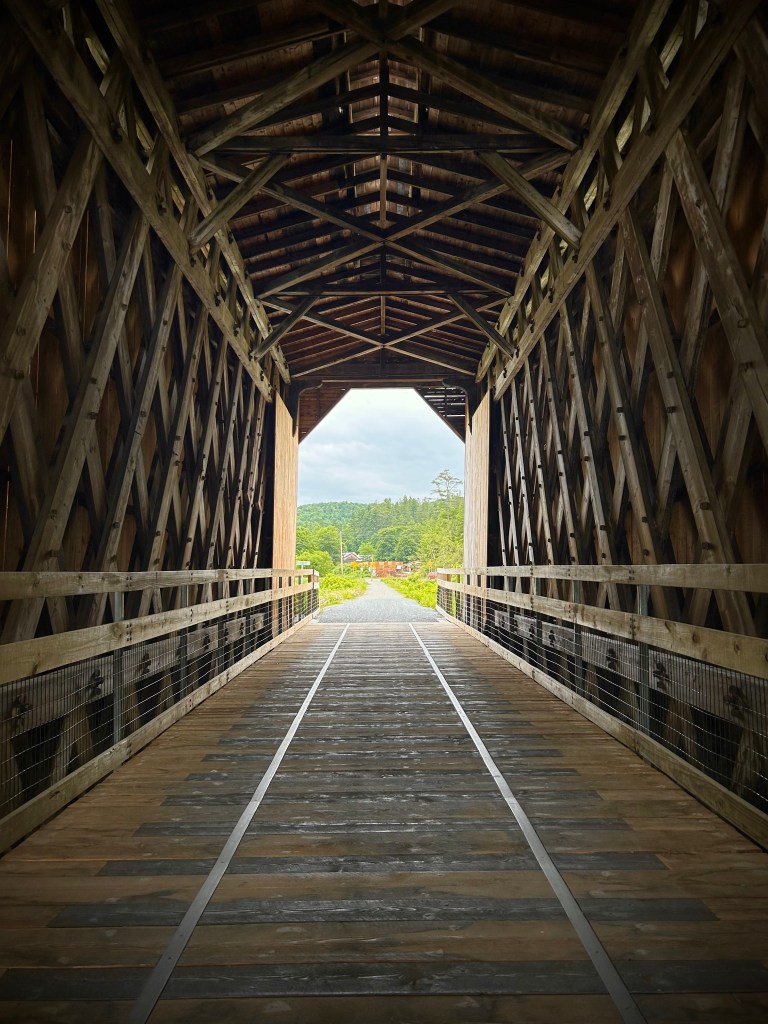
I walk back slowly on that trail, under the cool shading trees. Chicory, knapweed, Canada lily. In the covered railroad bridge, I pause in its interior dimness, light at either end. There’s no one around at all. I soak it in.

The heart’s actions
are neither the sentence nor its reprieve. 

Salt hay and thistles, above the cold granite. 
One bird singing back to another because it can’t not.

~ Jane Hirshfield

Rowing in autumn…

In a cold rain, my friend and I set off walking. It’s a joke between us. When we were neighbors, I would call and ask her to meet me for a walk.

It’s sleeting, she’d say.

Only a little.

Invariably, she’d join me, gung-ho.

The rain lets up, though, as we walk up a muddy path, cross streams, pause to admire where a view might be through dense mist. The woods are gold and black, redolent with the humus-y scent of fallen leaves, this summer’s bounty already turning back into the damp soil. I remember her oldest son, now a teacher himself, standing on a chair in my kitchen, rolling out dough for sugar cookies, happy. Rain or snow probably fell then, too.

This is familiar forest to me, as I lived here for so many years. But I grew up surrounded by New Hampshire forest, and the exquisite beauty of New England fall, its sharp bite reminding us of winter, is as familiar to me as the backs of my hands. While the greater political world is utterly unfamiliar — which way will this go? — this path, our conversation, is balm for my soul. Both our lives have gone rocky ways, and yet here we are in rain, pressing on, pocketing especially pretty leaves.

On my way home from our soggy walk, I stop at the coffee shop and spread out my papers and laptop on a table. I’m standing there, thinking (or maybe dreaming), when a long-ago acquaintance appears. We sit and talk for a bit. There was a quarrel in the past between us. As she speaks, I feel the blood quickening in my rain-damp flesh, from my cheeks to my sodden toes. Here it is again, how experience shapes and changes us. Our culture pushes us, pushes us as women, to smooth the edges, say all’s well, be polite, diminish ourselves and pretend we’re still in the land of childhood, when the grownup woman world is a vast sea of star and moonlight, treacherous waves, radiant beauty, and the great unknown. At the end of our conversation, there’s no conclusion, no tidy wrap-up, just the two of us rowing together for a bit, handing the oar back and forth.

“The real, long history of this place…”

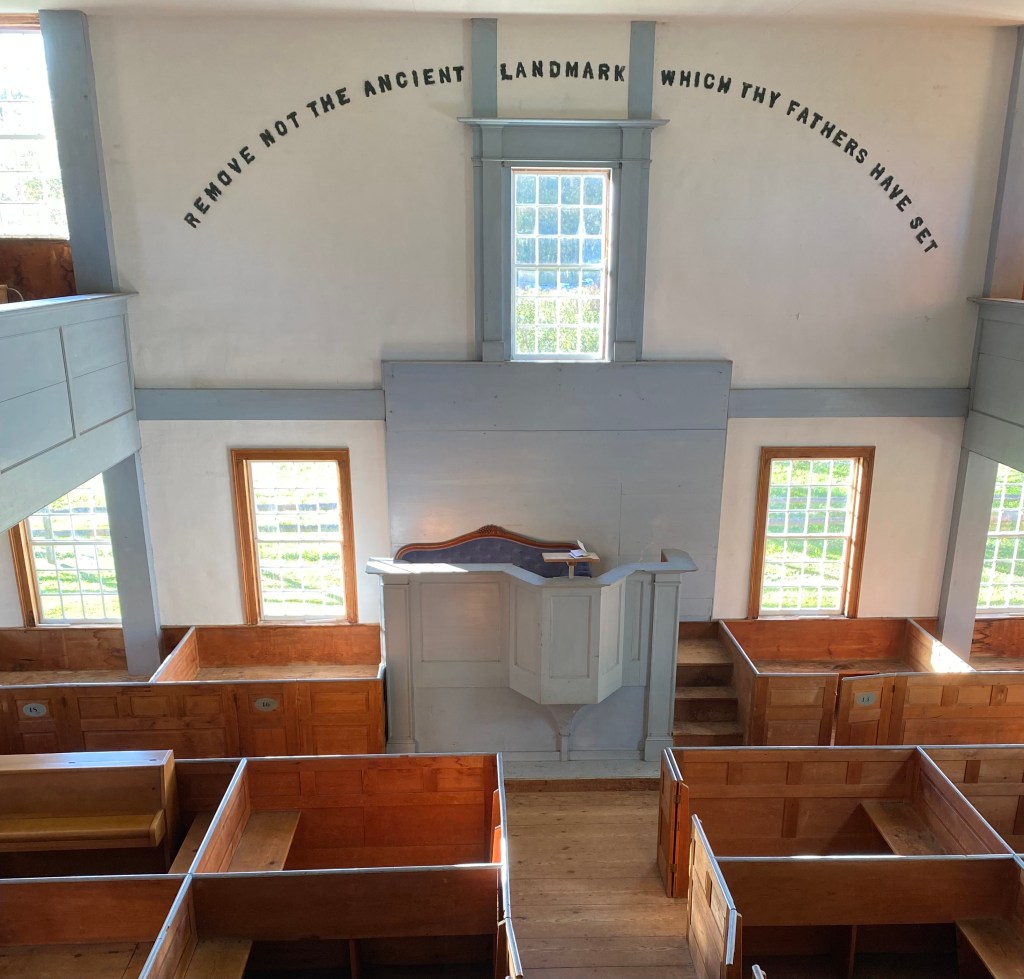
Old West Church, Calais, Vermont, 1823…. The fieldstone foundation was laid 200 years ago. I’ve been tossed a lucky bone, and I’m reading here this afternoon. Recently, I swung by with a friend to check out the acoustics and ended up sitting and watching the sunlight shift through the space. The structure remains in the 19th century with no electricity.

In an interesting way, it seems fitting to do these things in the autumn when the light in our northern realm is shifting so rapidly. On each side, the days shorten. What began in April as a sprinkling on the forest floor of hepatica and trillium and spring beauties has flourished all summer in such a lush and lovely summer. Strangers remark, “What a summer of growth!” as if to make up for these past few years of soddenness, of rain and wildfire smoke from faraway (but apparently not that faraway) places.

At the transfer station, I pull up with my hatchback crammed with that metal lidded can of cat food cans, my bins of used paper and things I no longer want in my house. I’ve been coming here for decades now. On this peach of a September afternoon, the owner and I stand outside his office, our faces up to the sunlight and a circling hawk. I mention that I’d take a month more of these days, but I don’t want to be greedy. He looks at me and says, Let’s just be greedy and want that, anyway.

Autumn is the long weeks of the growing season’s finale, the landscape gold and crimson. But within the landscape are the tiny places where we walk and live: my garden’s pink glads, the neighbor’s blooming roses, the gold flush of the butternut tree I planted as a bare root stick, seven years ago, and the girls laughed at me. The tree stretches far above our heads now, and my girls marvel. Have faith, I remind them; beauty thrives from where we least expect it….

From Carolyn Kuebler’s gorgeous essay about Vermont:

The real, long history of this place goes even further
back, to the beginning of this landform as we know it, about twelve
thousand years ago when the glaciers drew back from the land and
various species, including humans, eventually moved in.