“The real, long history of this place…”

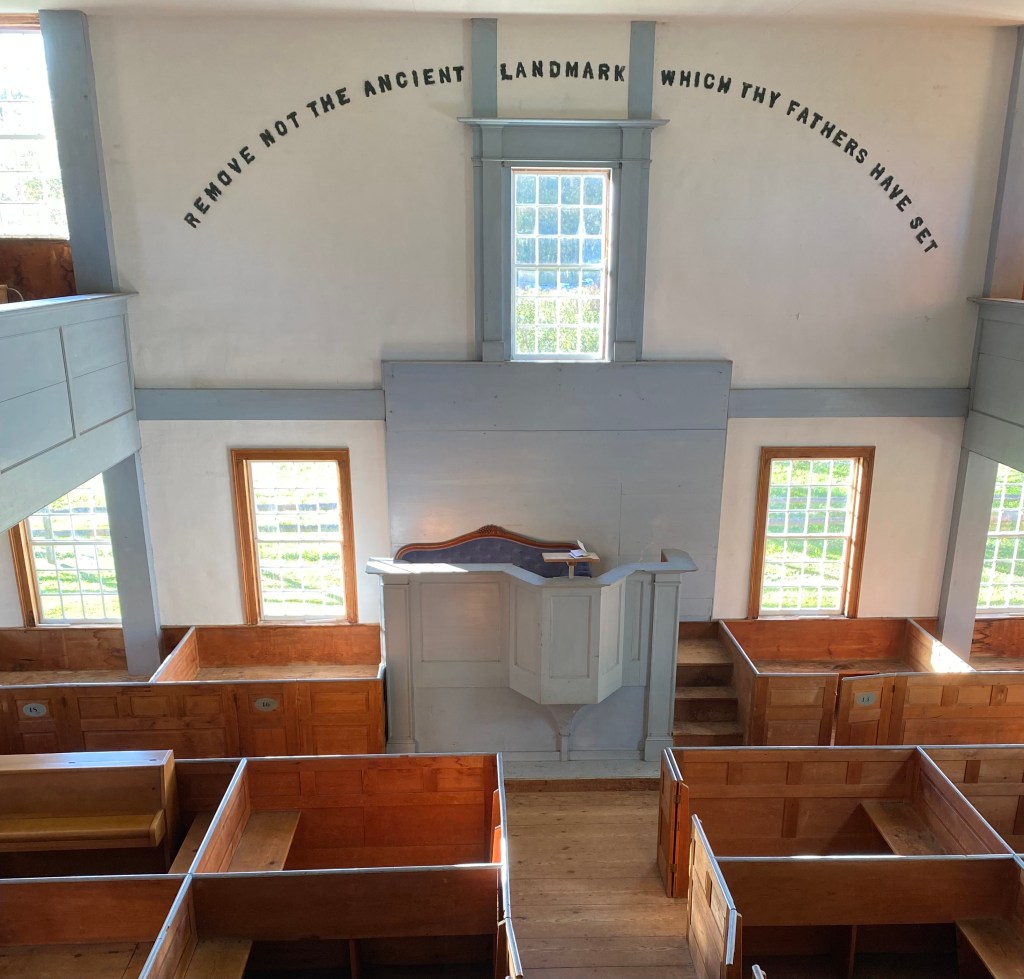
Old West Church, Calais, Vermont, 1823…. The fieldstone foundation was laid 200 years ago. I’ve been tossed a lucky bone, and I’m reading here this afternoon. Recently, I swung by with a friend to check out the acoustics and ended up sitting and watching the sunlight shift through the space. The structure remains in the 19th century with no electricity.

In an interesting way, it seems fitting to do these things in the autumn when the light in our northern realm is shifting so rapidly. On each side, the days shorten. What began in April as a sprinkling on the forest floor of hepatica and trillium and spring beauties has flourished all summer in such a lush and lovely summer. Strangers remark, “What a summer of growth!” as if to make up for these past few years of soddenness, of rain and wildfire smoke from faraway (but apparently not that faraway) places.

At the transfer station, I pull up with my hatchback crammed with that metal lidded can of cat food cans, my bins of used paper and things I no longer want in my house. I’ve been coming here for decades now. On this peach of a September afternoon, the owner and I stand outside his office, our faces up to the sunlight and a circling hawk. I mention that I’d take a month more of these days, but I don’t want to be greedy. He looks at me and says, Let’s just be greedy and want that, anyway.

Autumn is the long weeks of the growing season’s finale, the landscape gold and crimson. But within the landscape are the tiny places where we walk and live: my garden’s pink glads, the neighbor’s blooming roses, the gold flush of the butternut tree I planted as a bare root stick, seven years ago, and the girls laughed at me. The tree stretches far above our heads now, and my girls marvel. Have faith, I remind them; beauty thrives from where we least expect it….

From Carolyn Kuebler’s gorgeous essay about Vermont:

The real, long history of this place goes even further
back, to the beginning of this landform as we know it, about twelve
thousand years ago when the glaciers drew back from the land and
various species, including humans, eventually moved in.

Immensity taps at your life…

Nearing the end of August, the wild around our village house is mightily fortressing. The path behind our house has been given up this summer by friends; those who visit arrive via the street where the grass has broken the pavement, too, crisscrossed the gray with emerald. In the ravine behind our house, the foxes have kitted again this year. Randomly, the youngsters come out to chase each other. My daughter, who unexpectedly met the hissing mama fox, gave up that path a few years back. Only I now claw my way through the blackberry brambles, whistling, scraping my bare knees in some kind of penance for passing through their realm.

This year, while the human world on a great and local level has worked at its less admirable traits, the natural world has flourished. My daughters and I hold the apples and pears, gauging not yet, not yet. All around, a rioting of blossom and vine of what I’ve sown — sunflowers and morning glories, love lies bleeding — and the lushness of goldenrod, wild honeysuckle, creeping cucumber.

Oh, sweet illusion of Vermont’s August, as if stark November will skip her own visit this year….. On this dewy morning, smoke-drenched from wildfires so far distantly north, a favorite poem from Jane Hirshfield.

“Tree”

It is foolish
to let a young redwood
grow next to a house.

Even in this 
one lifetime,
you will have to choose.

That great calm being,
this clutter of soup pots and books–

Already the first branch-tips brush at the window.
Softly, calmly, immensity taps at your life.”
― Jane Hirshfield

The limits of what we do.

Friday night, driving home along a familiar road from visiting friends, I stop by the elementary school. Solstice, the Strawberry Moon, the daylight lingers, and the dusk is long, multiple hues of blue. No one’s there, of course. I follow the path along the wetlands. Shimmering with lilypads and twilight, the water chirrups, sings, buzzes. Fish leap and splash. I loiter, and the dusk closes in. Still, I keep walking, following the path through the brushy woods up a slight hill, so I can get to the other side.

In my twenties, I had a tendency to get lost in the night woods, stumbling off the path. Years before cell phones, we were always searching for flashlights with working batteries, to visit somebody in a remote cabin. But I’m in familiar territory, and I take my time, in this bowl of evening, letting the cacophony of the wild chorus diminish my stringy thoughts.

I haven’t been back here for a good long while, but this school and the town and the library where I worked was a warm place, with its own complicated stories, sure. Those were the years when my life fell apart. I pause, hoping to see the quicksilver flash of a fish. Across the wetlands, a single vehicle rolls along the road. Maybe it’s the passage of time, or the evening’s mellifuous beauty, but I see suddenly that I was following two strands of my story in those years. I was leaving my husband (and for months, I wasn’t at all certain how to do that), and I was also recreating my life (and how exhilarating and hard that was, too.) I’ve written about my struggle with addiction; when I began to lift that veil, my fierce hunger quickened for what I had wanted all along — to pursue my own creative and often dicey life. In this throbbing evening, I sense the limits of language, that words fail here, that to divide creation and destruction into two words, held in two hands, is illusory.

The fish I didn’t see smacked through the water. Fireflies winked around me as I threaded my way back to civilization in the dark.

“Train Ride”

All things come to an end;
small calves in Arkansas,
the bend of the muddy river.
Do all things come to an end?
No, they go on forever.
They go on forever, the swamp,
the vine-choked cypress, the oaks
rattling last year’s leaves,
the thump of the rails, the kite,
the still white stilted heron.
All things come to an end.
The red clay bank, the spread hawk,
the bodies riding this train,
the stalled truck, pale sunlight, the talk;
the talk goes on forever,
the wide dry field of geese,
a man stopped near his porch
to watch. Release, release;
between cold death and a fever,
send what you will, I will listen.
All things come to an end.
No, they go on forever.

— RUTH STONE

In the edge…

Midafternoon as a storm threatens in, I’m at a stretch of lakeshore where I’ve never swum, and I push in. I’m on the prowl for an eagle, which I never find, and the day has grown muggier than I imagined.

What a month of May this has been. My mother’s death ripples through the amazing forsythia and lilac season, through writing and the steady complexity of work I do for the local Selectboard. At a nearby farm, I buy hothouse basil and tomato starts. A woman I know slightly strikes up a conversation. In the past, our lives ran on weirdly similar tracks, involving divorce, sudden visits from the FBI, the miasma of disorientation. Now, we swap mother stories beneath an enormous lilac. I breathe in the blossoms’ scent.

A few years back, I volunteered in my youngest’s elementary school classroom to assist with a nature program that the kids loved. Naturalist and artist, the teacher kept using the phrase “in the edge.” She pointed out that life thrives at the crossing borders of field and forest, of riverbank, the edges of a homogenous world.

I’m in the edge these days. May’s heat notwithstanding, the water is bitterly cold. I swim out with my lousy swimming skills, my garden’s dirt washing away, the storm clouds hammering together over the glassine water, some of the day yet to come. On the shoreline again, sharp stones gouge my soles.

The dark blossomings of chaos…

Again, this metaphor lens (how is it possible not to see the world in metaphors?) Paul and John’s Long and Winding Road, Dante’s gloomy forest, Sylvia Plath’s bees and beekeepers…

I lead a friend into a forest, a piece of Nature Conservancy land on a dirt road. We’re talking, talking, my eyes searching the forest floor for ephemerals (the trilliums folded shut, trout lilies still only leafy, no blossoms yet). I take one wrong turn, a second wrong turn. I backtrack, looking for the narrow stone steps. Our walking and talking — and my eventual smartening up to pay attention — takes us to Chickering Bog. In this pristine place, it’s just us and frog eggs, fat tadpoles, crimson pitcher plants — the confluence of ancient and freshly brand-new.

The strange thing is, I’ve walked to this bog half a dozen times, easily. Yet never in April when the sunlight drops down through the trees’ bare branches, when the winter-fall of broken branches strews over the paths. Or maybe I’ve never been here with this conversation about things tiny and great. The glassy water shimmers so clear the bog’s mucky bottom tantalizes, unreachable, so many centuries of so much life.

At the journey’s end, at the dirt road’s edge, the sprinkled gold coins of coltsfoot, a purple sprig of flowering Daphne.

On the reading front…..

“We must therefore be willing to get shaken up, to submit ourselves to the dark blossomings of chaos, in order to reap the blessings of growth.” — Gregg Levoy, Callings

Necessary Birdsongs.

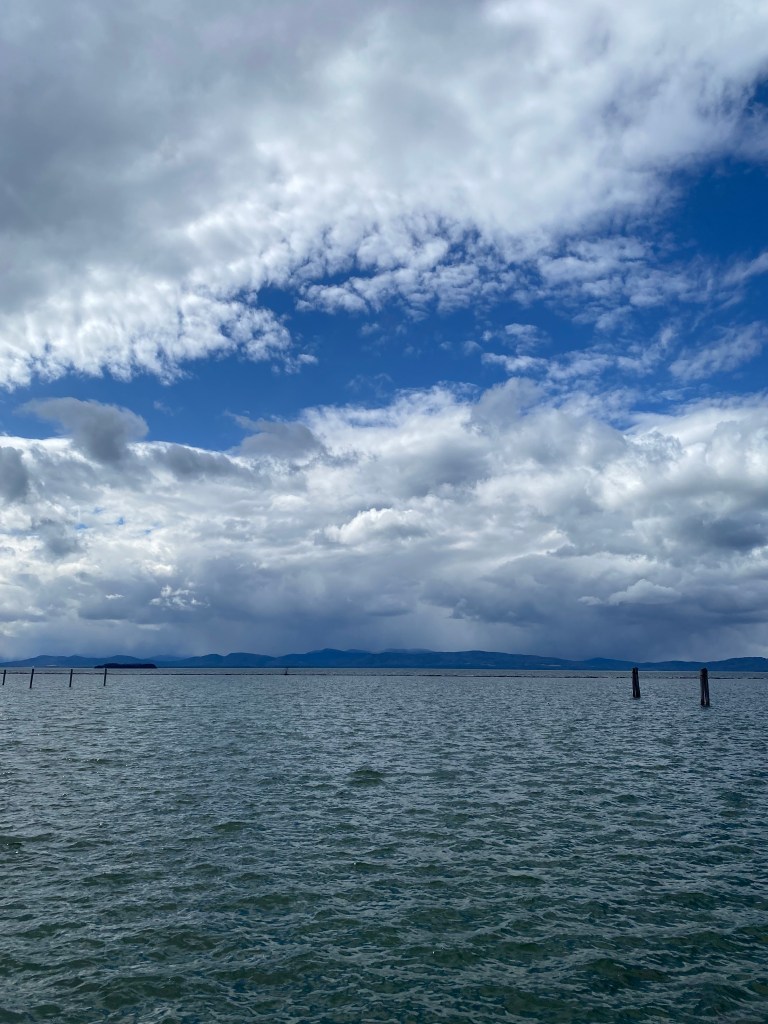
Lake Champlain

Mid-March, the unlovely muddy Vermont: I bend beneath the snarled rose bushes, seeking green nubs pushing through the wet earth. By June, this world will be verdant, lush, those old roses a tangle of green, tiny blossoms each a delicate bouquet of pale pink. These roses, planted by someone doubtlessly long passed over into the other world, ruggedly fence my house, their flowers such a dear sweet fragrance.

In this brown world, I wander to the places where, in springs past, I’ve heard the early songs of redwing blackbirds. Yesterday, I hear these birds, not the full chorus yet, but the warm-up crew. We are well before the yard clean-up and gardening season. The town roads are rutted, hard to travel, and the summer folks have not yet returned. Hidden in this clump of cedars, the blackbirds steadily, without any fuss, go about their blackbird lives. Not so many weeks away, marsh marigolds will blanket these wetlands — dazzling yellow, killer green — but for now, the dun palette of silvery cedar, umber earth, the birdsong melodies yanking us along to spring.