Stormy Spring Fever

Not only the children have spring fever; I’m afflicted, too. In this rainy afternoon, the children are outside, equipped with boots and splashed bright cheeks.

In the woods, the rain lessens. Green trout lily leaves sprinkle the forest floor profusely now, although the coltsfoots’ golden blossoms are folded up, napping away the deluge. In the cold, damp earth, my freezing fingers tugged free a few of my garlic sprouts, their pale white roots clinging deeply in the soil, winding around rouge pebbles. I chopped their savory greens and tender shoots for a salad, a taste of liquid chlorophyll, I imagine.

This is the season of secrets unearthing – last fall’s decaying fungus belly-white, frog eggs fattening near the pond’s stippled surface, the children too big for last year’s summer clothes.

We need the tonic of wildness…. At the same time that we are earnest to explore and learn all things, we require that all things be mysterious and unexplorable, that land and sea be indefinitely wild, unsurveyed and unfathomed by us because unfathomable. We can never have enough of nature.

– Henry David Thoreau, Walden

FullSizeRender.jpg

Woodbury, Vermont

Stormy Seas, Human Choice

Years ago–not that many but still a number–I worked at a business owned by a decent man who was in forties then, and his life was falling apart, in just about every way. He and I spent a great deal of time working and talking together, and at one point, he remarked that the lives of everyone he knew then were falling apart.

I rather blithely replied that my life was not falling apart.

When I think back on myself in those years, I imagine myself as a clipper ship, strongly-built, straight-masted, confidently sailing through sunny blue waters, a fine wind in my sails. I had no idea in those years that boards would spring loose, the ocean harbored darkness and flesh-eating creatures, that sails would rend in a deadly storm. How could I have known that if I sailed far enough, careless without a map or compass, the seas would freeze solid and shatter my wooden hull?

While the footprint of my life is yet on West Woodbury Road in Vermont, the geography of my life now has unfolded and unfolded yet again, into a landscape that extends beyond the garden’s button zinnias and life with small children to the territory of disease and betrayal, of human cruelty and despair:  the realms that as a youth I naively believed I could witness but not sully myself by partaking in. Perhaps the real folly of youth is to believe you can refuse the chalice of human suffering.

As a young woman, one of my beloved books was John Steinbeck’s East of Eden, an enormous novel about the human ability to choose between good and evil. I still have that paperback copy my father gave me one Christmas, marked up in pencil in my girlhood handwriting. Like Walden, that book has arced through my life.

Walking with my daughters and the neighbors this evening, the rural air was rich with the scent of freshly-cut grass and hydrangeas in bloom. The air was warm without cloying, and all around us was the summer’s growth, wild and intertwined and beginning to brown up at the edges and curl with the end of summer. Overhead, the stars came out in the deepening blue sky, a single glimmer at a time.  How sweet it was, with the children happy, but the dark was falling in, and I took my children home.

I believe that there is one story in the world, and only one. . . . Humans are caught—in their lives, in their thoughts, in their hungers and ambitions, in their avarice and cruelty, and in their kindness and generosity too—in a net of good and evil. . . . There is no other story. A man, after he has brushed off the dust and chips of his life, will have left only the hard, clean questions: Was it good or was it evil? Have I done well—or ill?

― John Steinbeck, East of Eden
IMG_8763

Heaven Under Our Feet

Here’s a bit of my Thoreau paper on sense of place – with snow. Then back to weeding the garden.

Imagine Walden a sphere, where all elements within are constantly in motion and inherently connected, from the most minute level – for example, the weight of perch – to the cosmological. Within this Walden sphere, all aspects knit into the natural world…  Standing on the snow-covered plain, as if in a pasture amid the hills, I cut my way first through a foot of snow, and then a foot of ice, and open a window under my feet, where, kneeling to drink, I look down into the quiet parlor of the fishes… Heaven is under our feet as well as over our heads.

DSC01033

Floor, Concord, MA, Masonic Lodge.

July

Here’s the thing about Thoreau and gardening:  Thoreauvian time is distinctly non-linear, perceiving the world through cyclical seasons.  Walden is written as a single-year cycle, with multiple circles within.  As gardeners, we must all, on some level, embrace the world in variations of rebirth, growth, and demise.

Today, my garden bursts in profusion:  white currants, greens, rogue chamomile mixed in with the bee balm.  A woodchuck we saw running by…..

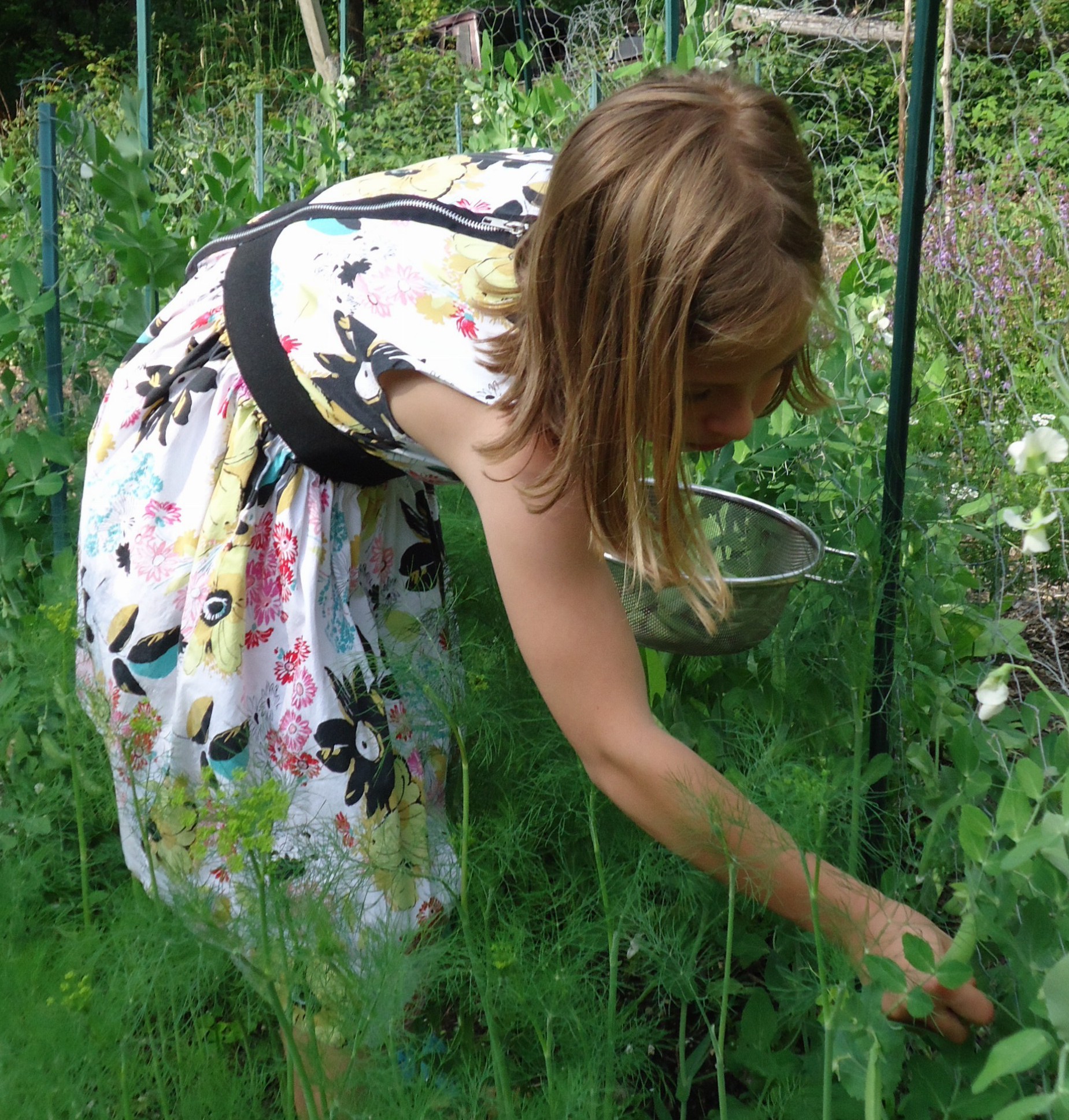
This is the season of a ten-year-old girl picking peas, of dinner cooked over an outside fire, of rain on the sunhat left on the grass while we played an evening game at the neighbors’ house.  Their four-year-old daughter showed us her garden, while her younger brother ran in excited figure eights.  Walking home tonight,  my daughter’s hand in mine, fireworks from Cabot and Morrisville lit up the night sky over our mountain, while fireflies blinked around us.  Our heels struck the dirt road, our guide home in the thick country dark, the frogs peeping and the owls calling, this season of Vermont July.

Children, who play life, discern its true law and relations more clearly than men…  At the same time that we are earnest to explore and learn all things, we require that all things be mysterious and unexplorable, that land and sea be indefinitely wild, unsurveyed and unfathomable by us because unfathomable.

– Thoreau

DSC01005

DSC01011

Love Letter to Walden Pond

Just before noon today, I arrived at my daughter’s soccer camp a few minutes early and picked up Walden where I had left off, at “The Ponds” chapter.  As it was the last day of camp, the session went late, and I sat on the grass, watching the kids circled on the grass around their coach, saying something I could not hear at all, only the laughter in their voices.  From where I sat, I saw the mound of Buffalo Mountain, a dark blue against the lighter hue of a cloudless sky.  This summer’s been a stellar one for butterflies, and even in this chiefly grassy stretch they were busy, the honey bees working, too, on the clover.

Thinking over these pages, I realized this chapter is a lyrical love letter to Walden Pond, an homage to her loveliness, this common pond, the miraculous universe reflected in this patch of water.

Walden is blue at one time and green at another, even from the same point of view. Lying between the earth and the heavens, it partakes of the color of both. Viewed from a hilltop it reflects the color of the sky; but near at hand it is of a yellowish tint next the shore where you can see the sand, then a light green, which gradually deepens to a uniform dark green in the body of the pond. In some lights, viewed even from a hilltop, it is of a vivid green next the shore. Some have referred this to the reflection of the verdure; but it is equally green there against the railroad sandbank, and in the spring, before the leaves are expanded, and it may be simply the result of the prevailing blue mixed with the yellow of the sand. Such is the color of its iris.

DSCF0028

Peony and Walden Pond

I began this blog with the concept that writing matters, and matters so much it’s bone marrow deep.  In these initial few weeks, I’ve written about living in Vermont and what I’m reading.  Have I amused anyone but myself?

These nights, I’m rereading Walden, a book whose spell I first fell under as a high school sophomore.  This reading around, in my forties, Walden‘s lyrical craft re-amazes me, while pushing the limits of radical anti-capitalism.  Any anarchist worth that word should be pencilling up these pages.  Further, I also see how deeply this book  — through my own novice reading — shaped the physical construct of my life.  Perhaps I was naturally inclined to living in rural Vermont; certainly, Thoreau strengthened that inclination.  I am certain the experiences of many others would concur.

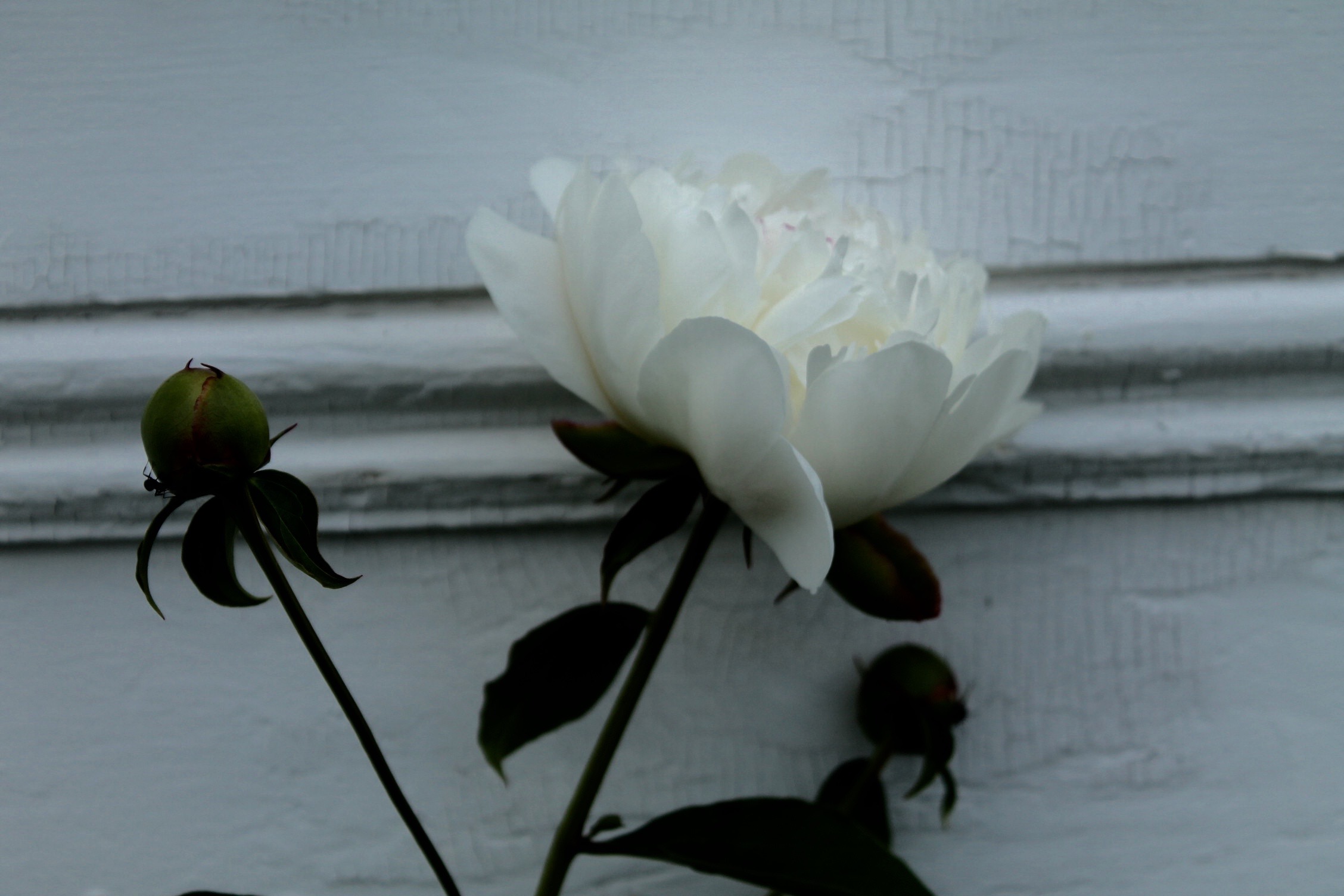
This photo below I saw on my daughter’s laptop and asked for a copy.  She said, No, that’s not so good.  What do you like about that?

What I like is this:  this is a photo of extremes — rocky and fragile, crazed paint on an old house behind just-opened petals, and a great deal in between.  Isn’t that a portrait of Thoreau? Aiming for the core of living — bitter or not — seeking the sublime, and, between all that, eating a woodchuck.

Be it life or death, we crave only reality.  If we are really dying, let us hear the rattle in our throats and feel cold in our extremities; if we are alive, let us go about our business.

Photo by Molly S.

Photo by Molly S.