Art For The People

What I might lamely describe as rain and the middle school girls laughingly referred to as moistiness, we stopped at the two painted silos. Beautifully painted with agricultural scenes, these two silos stood empty by the side of Route 15 for years.

I walked through a puddle-ish field. The girls, impetuous, ran.

I’ve been aching for weeks now for some brightness of color — and here it was — art transforming the landscape.  Around the back of the further one was a barred owl I hadn’t seen. The girls wandered over cement pad around the silo, talking about what might have once been here.

Four more cars had parked around mine. We took one last look and headed off into the mist and rain — the moistiness — again.

In art, either as creators or participators, we are helped to remember some of the glorious things we have forgotten, and some of the terrible things we were asked to endure…

— From Madeline L’Engle’s Walking on Water


Running Away

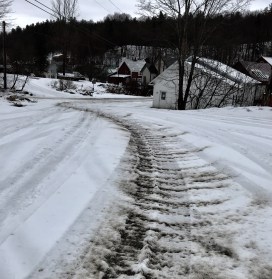
James Joyce’s “The Dead” is one of my favorite short stories, with that remarkable line about falling snow general all over Ireland. In my corner of Vermont, these days, the sentiment generally is enough with the snow for this year. April: season of rain, of snow and ice and, somewhere, beneath all that, struggling green.

I stopped in at the Woodbury school, leaning against the foyer wall while a man who grew up on a farm in the area told me the red-winged blackbirds reminded him of childhood. When he snuck away from farm chores, he headed down to the creek where those dark birds with their signature crimson mark sang.

Ridiculously visually inclined, I rely too heavily on my vision: really, as all my photos attest, the landscape here is yet the monochrome of winter. I’m wrong about this, of course, although I won’t point to any sign of spring at my friend’s request. Too cruel, she says, when sleet falls.

And yet — dumping coffee grounds around blueberry plants, fingering their branches and imagining small, perfect white blossoms, I then close my eyes and listen to the birdsong all around, their rising, sweet melodies.

I watched the first shoots
like wings tearing the soil…

— Louise Glück

IMG_1616.jpg

Woodbury, Vermont

Hardwick, VT, Sign of Spring #6

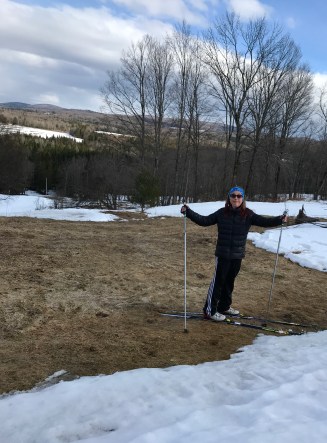
…. kid skis on snow and field.

Easter afternoon, we skied on snow slushy in open areas, in the woods icy and pine-needle-strewn, pausing to breathe after the vigorous workout. Little streams ran along the trail. My friend remarked on the understory greening as our skis scraped along.

At the top of Elinor’s Hill, we stood for a moment, deciding which way to travel, and I remembered the winter our friend skiing alone fell on this long hill, breaking his leg, and lay on the snow, waiting. Now, in the warmth, we skied without gloves, my daughters sillily lying in the middle of the trail, dramatically waving their skis over their heads. Easter, and no one else was around, save for a few stray folks.

Later, I spoke with these friends, two thousand long miles away, and I realized they must have called us when we stood in the snow and open field at the top of that field, remarking, Remember when….?

The snow still claims more than it doesn’t. Later that night, under a nearly full moon, my daughter returned from a moonlight walk, exclaiming at the cold.

Buying leeks
and walking home
under the bare trees.

— Buson

IMG_1463.jpg

Craftsbury, Vermont


Our Lives, Seen and Unseen

A few minutes early to collect the 12-year-old and her friend from track practice, the 19-year-old and I take a walk around a neighborhood circle near the high school, passing a house I considered buying but didn’t.

Full of excitement about her morning, my daughter talks on and on, her happiness as visible as red-breasted robins in a bare-branched maple tree. We pause for a moment before the three-story house, with large original windows on the first and second floors, bordered at the top by ornate stained glass. The owner confessed the windows leaked air profusely but couldn’t bear to replace them. The house is no longer for sale; my daughter and I speculate the family still lives there.

We walk by another house flanked by five sugar maples, the trees young enough to live for many more decades.

Robins, both visible and hidden, sing.

My daughter and I pass these houses and these possible lives our family might have taken but didn’t. Then we’re back at the high school, still in the cold and clear March sunlight, beside a maple filled with robins fluttering their wings, chorusing in the beginning of spring.

I know that I love the day,
The sun on the mountain, the Pacific
Shiny and accomplishing itself in breakers,
But I know I live half alive in the world,
I know half my life belongs to the wild darkness.

— Galway Kinnell

IMG_1393.jpg

Monday Morning, Still Dark

My older daughter cut her literary teeth reading Mercy Watson chapter books to her younger sister — silly stories about a pig who loved stacks of hot buttered toast. We were homeschooling then, and that winter, the girls spread on the rug before the wood stove. Read, the little one begged. One more chapter! 

Monday mornings in March didn’t mean all that much when we were homeschooling. Sap held every bit of meaning for us in those days. Now the older daughter hurries off before dawn to clinicals, full of excitement.

Fed, the cats sprawl on the sleeping younger sister. Fittingly, the striped feline who loves this child best also miraculously appears at the scent of toasting bread, hungry for melting butter.

Another year is gone;
and I still wear
straw hat and straw sandal.

— Bashō

IMG_1371.jpg

And They Brought Pies…

I never went to work with my parents, although (in very different ways) I heard so many stories I know my parents’ occupations, wittingly or not, fed into my young writer self.

My mother worked the night shift as an RN, floating all over the hospital, from pediatrics to the ER, often returning as my siblings and I were drinking orange juice and heading to school. She always had stories — of washing diesel from a child’s hair or an ER doctor who snapped, took a fire ax to a door, and had to be restrained. She told stories of an administration who treated nurses terribly, of family members in the cancer ward who thanked her on Christmas morning.

My older daughter was in the sugarhouse when she was three weeks old, her rosy cheeks slicked with a sugary patina from the clouds of maple steam. Like many Vermonters, the girls’ father and I have done all kinds of things for work, and generally never hesitated to take the kids along.

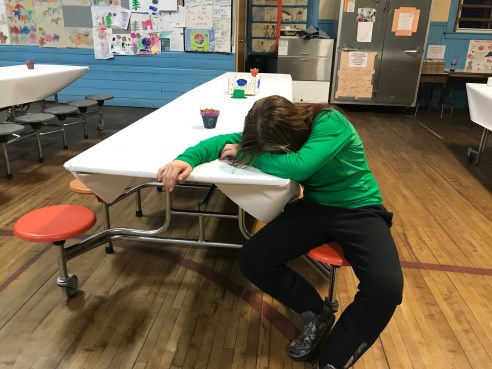
This morning, I’m one working piece of Woodbury Pie Breakfast, one of the best of New England traditions, and late last night, my younger daughter helped set up.

In the dark, I walked back and forth from the school to the library, in the snow beginning to fall again, magically wafting down in the outside lights.   Townspeople I knew and didn’t know carried in still-warm pies in their hands, offering their homemade gifts.

I ate another apple pie and ice cream; that’s practically all I ate all the way across the country, I knew it was nutritious and it was delicious, of course.

— Jack Kerouac, On the Road

IMG_1356

Woodbury Elementary School