The Vermont Season of Pre-Spring

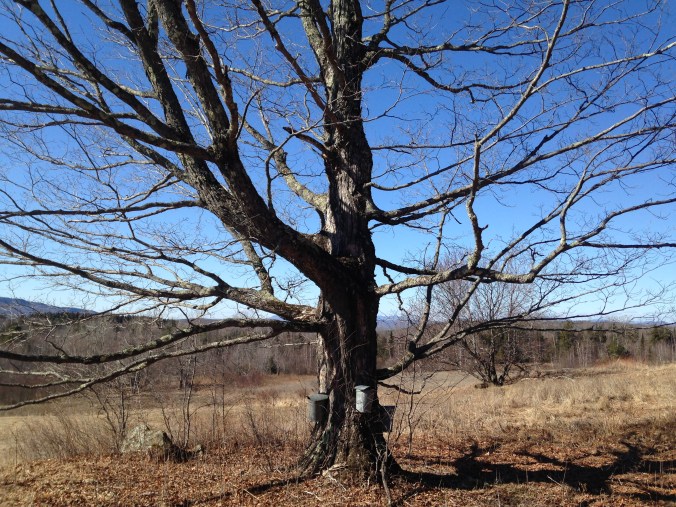
A number of years ago, I conceived an idea that our family’s financial salvation lay in wedding favors. With our maple syrup, colored card stock, a paper cutter, and raffia, I filled tiny bottles with syrup and bow-tied on little cards printed with hopeful things like Julie and Josh, July 8, 2001, Eat, Drink & Be Merry. Or: A sweet beginning. In the long run, my fortune didn’t lie there, but I met interesting people at profoundly pivotal junctures in their lives.

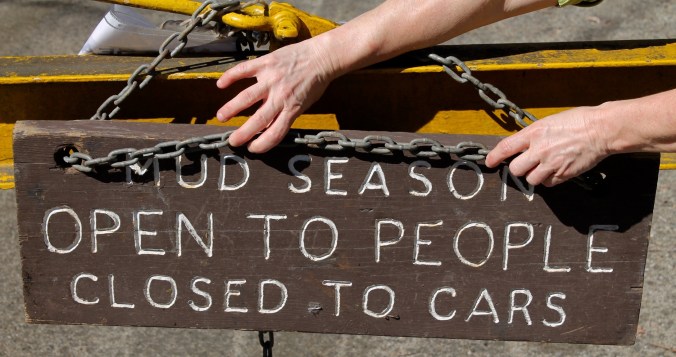
One April, in an intense mud season, a couple unexpectedly drove out to our house. We were deep in the midst of sugaring with a three-year-old. On our back road and driveway – and all around the house where the snowbanks were fiercely melting – lay mud that sucked at our knee-high boots with an audible glop. The winter had been its usual terror, and immense snowbanks mounded all around the house, interspersed by our trodden paths. My gorgeous little girl, with unbrushed hair, walked around shirtless in overalls and mud boots, a yellow plastic sand toy shovel in one hand.

The couple had heard about our wedding favors and had arrived to order in person. He and my husband talked about Ford pickups while I chatted with the woman. She kept looking around, distressed. It’s just so muddy, she kept saying. How do you stand it? Where she cringed from dirt and inconvenience,  I saw sunlight so intensely bright it lay like shining gold coins on the shallow dips of water that spread out all around our house, as though we were a ship on a rippling sea. I knew mud as the world’s thrust from winter to spring, the give from one season to another. My heart lightened with joy at the end of a bitter cold season and the imminence of wildflower season. I knew coltsfoot would shortly bloom.

…Soon it will be the sky of early spring, stretching above the stubborn ferns and
violets.
Nothing can be forced to live.
The earth is like a drug now, like a voice from far away,
a lover or master. In the end, you do what the voice tells you.
It says forget, you forget.
It says begin again, you begin again.

– Louise Gluck, from “March”

FullSizeRender


Sunlight and Sweetness

When my daughter was two, I picked up a copy of Jeffrey Lent’s novel In the Fall in Montpelier’s Bear Pond Books and began reading. My child was on my back, and I stood so long she nudged me with her feet, a way she had of prodding me along when the scenery dulled for her. I bought the book and walked down Main Street, the pages open in my hands.

Reading that novel was like nothing else I encountered. I was scraping and painting the kitchen windows that summer, and I abandoned that work, sitting on the porch steps, reading, reading, while my child ate watermelon, strewing gnawed rinds over the grass. Halfway through the novel, the language became incantatory in my mind, rising and singing. When I finished the book, I studied the paperback cover, pondering the beauty and mysteries of this book, the sheer grace of its enormous hard work. The novel’s ending remains one of my most beloved.

Why I write all this is not just to rave about this novelist (if you haven’t read him, how lucky you are – you can read his books for the first time), but for this:

With vivid and richly textured prose, Brett Ann Stanciu offers unsparing portraits of northern New England life well beyond sight of the ski lodges and postcard views. The work the land demands, the blood ties of family to the land and to each other, the profound solitude that such hard-bitten lives thrusts upon the people, are here in true measure. A moving and evocative tale that will stay with you, Hidden View also provides one of the most compelling and honest rural woman’s viewpoint to come along in years. A novel of singular accomplishment.

–– Jeffrey Lent

Very often a writer’s life is plagued with burrowing doubt and uncertainty, laboring in a society that values tax bracket far above art. And then, sometimes, you feel you might just have hit the mark. Infinite gratitude.


FullSizeRender

March woodpile, Woodbury, Vermont

Town Meeting Day

Vermont Town Meeting Day, upstairs in the elementary school gymnasium, with the kids running riot downstairs in the darkest reaches of the basement, daring themselves to enter the unlit corner around the boiler.

By discussion and voice vote, the town’s yearly business was transacted today. Here’s what we discussed: fire truck lease payments, the school budget, derelict buildings, whether to pave the upper part of the Cabot Road. At times tedious, riveting, and funny, town meeting has an odd quality of mimicking life and is one of the perks of living in a Vermont town. Where else can you stand up and make an impassioned to plea to keep your small school and have neighbors clap? Where else can you also hear about cement culverts and drainage and which garbage bins in the cemetery need emptying? The people are generally civil, the coffee and homemade lunch unlimited, and you can bring your knitting. 

Let us never forget that government is ourselves and not an alien power over us. The ultimate rulers of our democracy are not a President and senators and congressmen and government officials, but the voters of this country.

– F.D. Roosevelt


FullSizeRender

Hearth

This morning, the house grew cold as I let the fire in our wood stove dwindle. When it was nearly dead, I pulled apart the stove pipe and stretched my arm deep down its throat to loosen the rattling creosote. With a shovel, I removed the ashes from the stove, then vacuumed the damper vents at the back, so the air will flow again. In the baffles at the top, I reached between the metal and fireproof insulation and pulled out handful after handful of silty, warm brown ashes, silky as kittens. I kept thinking of Megan Mayhew Bergman’s story “Housewifely Arts.”

This evening, after a day of snow and freezing rain and sleet, our hearth is rich with heat again, the children sprawled luxuriously on the rug. One of the interesting aspects of writing is a tendency to turn things upside down and inside out. Our stove is not merely a source of heat, but also consumer of wood and air, creator of ash, its lungs linked to the chimney funneling through our house. I once spent the greater part of an afternoon with a heating specialist who explained the inner workings of a nearby hospital, the channels of electricity and oxygen and water and waste, the circulatory system of an enormous building, generally unseen but vital.

Maybe it’s a day like this, when winter relinquishes its hold reluctantly, hurling ice at our windows in fury, that brings us back to our hearth again, gratefully.

There is no need to explain to our daughter the death of her first dog. Poppy, better than any of us, understands the urge to have what you must have. She can still wring what she wants from the world. It has listened to her cries and delivered. She still trusts the raw pull of desire. One day it will tear her away from us, take her down a dirt road to a place she does not recognize, and there she will make her home. Away from everything she understands, and close to everything she wants.

– Megan Mayhew Bergman, “The Two-Thousand Dollar Sock”

FullSizeRender

Winter Garden, Vermont, 2016


Sisters

This evening, my older daughter got out of the car in our driveway and exclaimed, This is my favorite kind of moon! Inside, the little girl who had played a basketball game was ravenous. The girls had picked me up from a school board meeting, and the younger one, eating dinner in front of the wood stove, asked why a woman had said, Well, you two are definitely sisters. What does that mean? the younger girl asked.

What does bind a family together? Much more than the shape of a nose, or the hue of hair. Even more, I think, than a keening affinity for the moon, or a struggle to bend art. Our life is composed of many material things: our house, our garden, endless meals and piles of shoes, but also the things we can never hold in our hands. The way we argue fiercely at times but always apologize, how the younger girl laughed so happily this morning when I sleepily put a cup of coffee in the fridge. Oh mom! The way we desire for each other the kind of happiness where you can lie back and let that happiness hold you.

It was the sibling thing, I suppose. I was fascinated by the intricate tangle of love and duty and resentment that tied them together. The glances they exchanged; the complicated balance of power established over decades….

–– Kate Morton, The Distant Hours

IMG_0203

February, Vermont, 2016


Icicles as Building Materials

This afternoon, my 10-year-old daughter studiously collected all the icicles that she could reach from the house’s eaves. She then began her winter project of icicle house-building. The icicles have been slim pickings this year, and not for lack of interest. She cajoled her older sister, who had just returned from running, to stretch up and grab a few more.

Returning from a walk, I stood on the road, listening to my daughters at the house, discussing the different colors of ice. This weather, so pure and cold, reminded me of those long walks I took in those last few weeks before my first daughter was born. Every afternoon, I’d bundle up – me and the unborn baby I carried – and walk in what I remember as an especially sunny and cold winter. More than anything, I was most curious to meet this baby, to see this tiny person’s face: my child!

Our relationship has long since grooved into the varied terrain of mother and daughter relationships, far deeper, far richer, far more full than I ever could have imagined, sprawling beyond any cliched confines.

I have one daughter emerging into young adulthood, the other enmeshed deeply in the middle of her childhood. In the end? Who knows? How will these girls look back upon these years? But I hope they remember the loveliness of these ephemeral ice creations.

I do not miss childhood, but I miss the way I took pleasure in small things, even as greater things crumbled. I could not control the world I was in, could not walk away from things or people or moments that hurt, but I took joy in the things that made me happy.

–– Neil Gaiman, The Ocean at the End of the Lane


FullSizeRender

Mid-February, West Woodbury, Vermont