First Things.

My daughter asks me if I’ve ever almost died — or at least thought I was dying.

She’s lacing her shoes, about to head out for a run. The day has been remarkably warm and beautiful, reaching above fifty degrees.

Three times, I answer: almost drowned when I was a teenager on a canoe trip, your father averted us from a pile up in Seattle, and the anesthesia went awry at your birth.

Later, I walk up to the high school and wait for her. I sit at a picnic table behind the school. It’s the first of all kinds of things again — the first time sitting at a picnic table outside since winter, the first time this spring I’ve seen grass that appears really green. An acquaintance stops to talk, and we swap stories about the school and board, new hires. Her grown son appears, and I can’t help but remember when he was just a little kid, and now he’s all grown up.

When they’re gone, I walk around this building that has meant so many very different things to so many people. Such a long and complicated story, a microcosm of this great big world. At this moment, she and I are both a piece of this story.

My daughter returns. On our drive home, I ask why she wondered about my near-death experiences. She shrugs. Just thought I should know, she answers.

I have the odd feeling she’s gathering intel about me.

Appetite.

Before it’s warm enough, I open the open to our glassed in porch. This porch (nor its upstairs counterpart) isn’t heated. In Vermont’s long winters, we simply close the door and leave the space be. I think of this as a standard New England practice. I store empty canning jars, summer flip-flops, things like old blankets I don’t really want any longer, but nor do I want to cast away.

All day long, doves and cardinals, juncos and chickadees and sparrows, dip and fly around our house. The crocuses struggle upward. I should be cleaning our house, I think, taking a broom to the cobwebby corners before the spring sets in mightily and I’m in the garden as much as possible, happy as I could ever be, the warming soil between my toes.

Now, snow falls intermittently. The robins dig into the earth hungrily.

Consider the tulip,

how it rises every spring

out of the same soil,

which is, of course,

not at all the same soil,

but new.

~ Rosemerry Wahtola Trommer

Writing.

I’m working on my laptop in Hardwick’s Front Seat Coffee when a man who I wanted to sell my house to, a few years back, comes up to me. In those days, he and his wife had a few young kids. The house was creative and cool, but in fairly lousy physical shape, and I believed he had the skills to right the rotten places. Life unspun in a different way, a pandemic set in, and that was that.

He’s now read my book about addiction. When we hug, he smells of woodsmoke. These days, he’s boiling sap outside, making syrup for his family.

When my youngest tells me she doesn’t know why anyone would ever write a book, I tell her there’s no reason at all, perhaps, except that it seems impossible NOT to write the book. Maybe all creativity is this way — that we’re driven to do things that otherwise no rational human would. Thank goodness for the madness of art, really.

After we talk about writing and addiction, he tells me he and his wife bought a house I once knew quite well, and we marvel at the interconnection in our little world. I may see him next week, or not for four years. And then our conversation will undoubtedly begin again.

Promise.

Hurray! A whole day (Covid card and mask required) devoted to a workshop at Jenna’s Promise. I haven’t been to a full gathering in, well, about two years. The workshop was about the future of recovery in the Green Mountain State.

One of the key speakers lifted a blue vase. Her daughter, now passed away from an overdose, had brought home the vase from India. The vase had broken in her luggage on the return flight, and it had sat on a shelf in pieces. The speaker raised the vase and explained how her grandson had suggested they repair the vase with super glue. Together, they mended the beautiful vessel.

The thing about this audience — the recovery crowd — is that the rose-colored glasses have long since shattered for everyone in the room. Any wet eyes are likely to be from tears — from sorrow or laughter — either is likely. Hardly any rational human would disagree that the pandemic broke our world where it was already ailing. While I’ve long since relinquished any belief in magic, I do know the power of super glue. And I do know what’s broken can sometimes be repaired.

(And, I heard the inimitable Johann Hari read….)

April. Spring. Robins mudding those fat-walled nests.

“It isn’t the drug that causes the harmful behavior—it’s the environment. An isolated rat will almost always become a junkie. A rat with a good life almost never will, no matter how many drugs you make available to him…. Addiction is an adaptation. It’s not you—it’s the cage you live in.” 

— Johann Hari, Chasing the Scream

Mixing Memory and Desire.

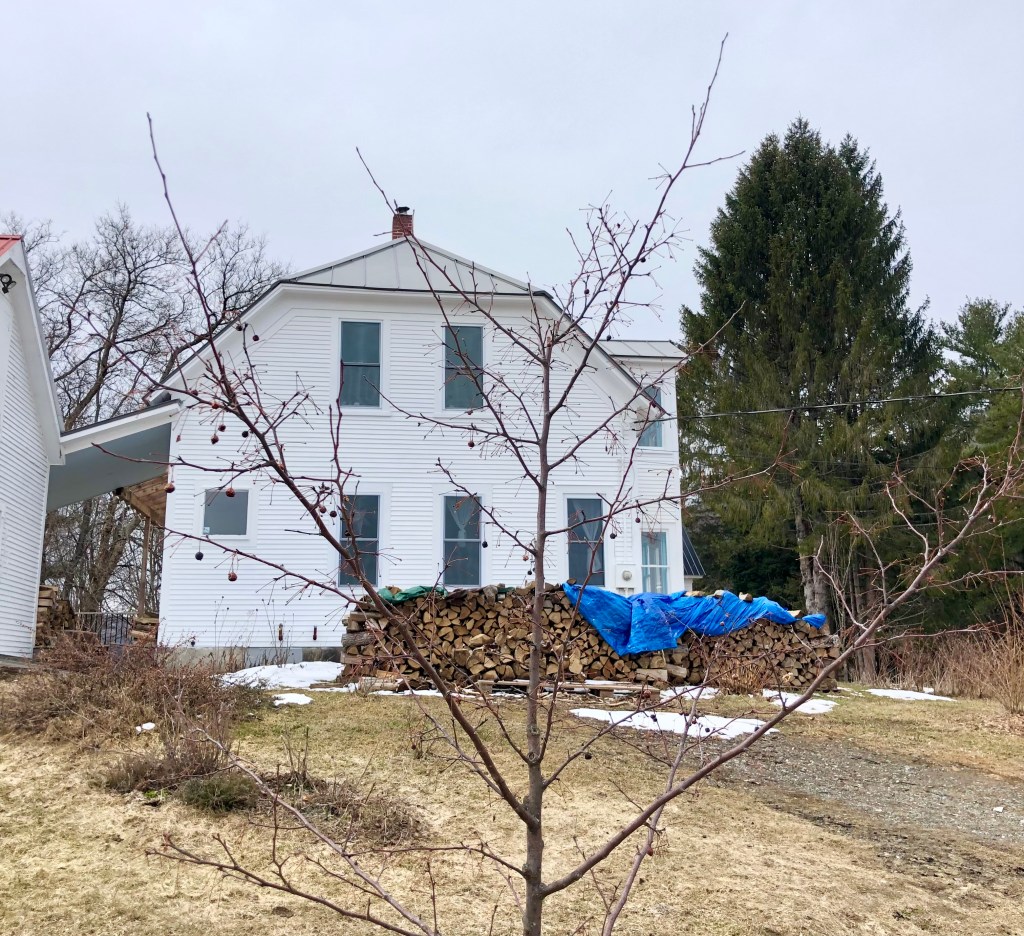
Note the wood smoke from our chimney….

Note this photo was taken yesterday afternoon, when I walked outside and nearly froze the soles of my feet. Note snow surrounded our house this morning….

Note that spring comes hard, hard, in Vermont. Jumping the starting block a few days, I keep thinking of T.S. Eliot’s lines:

“April is the cruelest month, breeding

lilacs out of the dead land, mixing

memory and desire, stirring

dull roots with spring rain.”

The first time I read these lines was in high school, digging into the poetry stacks in the school library, mesmerized by lines like Let us go then, you and I, when the evening is spread out against the sky….

Later, later, spring will bloom in all its tender-petal beauty. But for now…. T.S. Eliot knows the score in Vermont.

Somewhere in March.

Hardwick, Vermont

Mud season is fierce this year. The school busses cease running on some roads. Families share photos of kids waist deep in mud ruts. Time, more than all the gravel in the state, is more likely to true up the roads than anything else.

Mud season is the odd shoulder season in Vermont. The skiing winds down. There’s no good biking. The tourists are all in sunnier southern locations, and Vermonters muddle along.

All day long, the prettiest and lightest snow falls — nothing serious, nothing much at all — just a scattering of the purest white and enough of a chill that the wood stove is welcoming when I come in with cold cheeks and armfuls of wood. I put a quiche in the oven and head out for a walk. The snow has (mostly) melted here now, and so my paths through the fields and woods have opened up again. Behind the elementary school, the turkey vultures circle over my head. They’ve just returned from their winter sojourn, to their long-time nest in a stand of white pines. I know what they want; there’s no secret here.

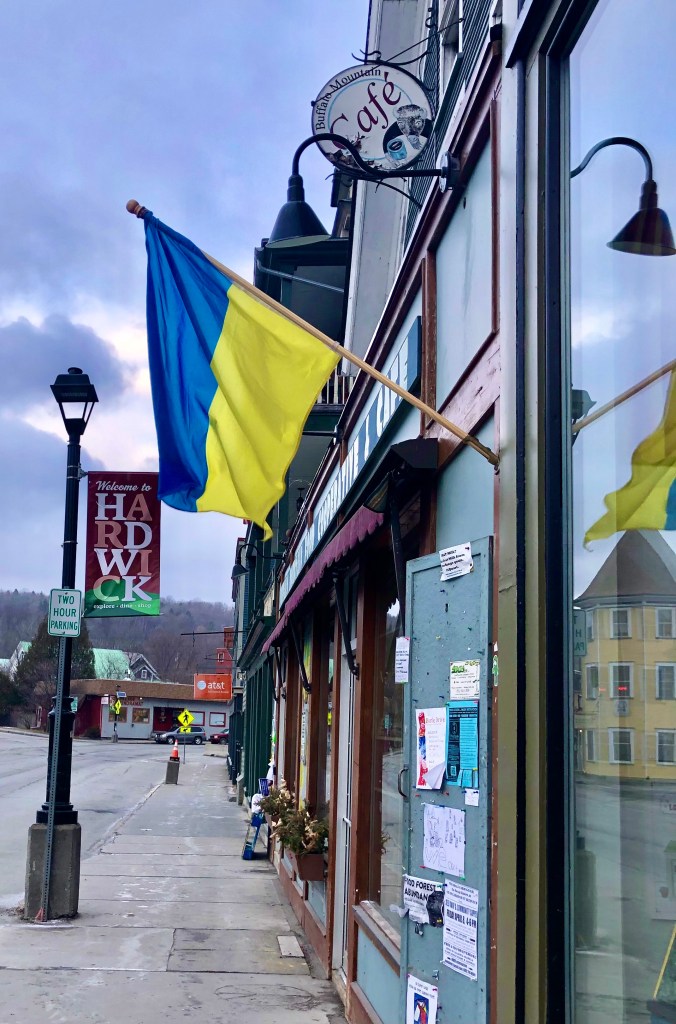
I hurry down the hill and along Main Street. A woman stands outside the laundromat, hands in overall pockets, staring up at the drifting snow. She raises one hand to me. I do the same, round the corner, and head home.