Stopping in the Snowy Forest.

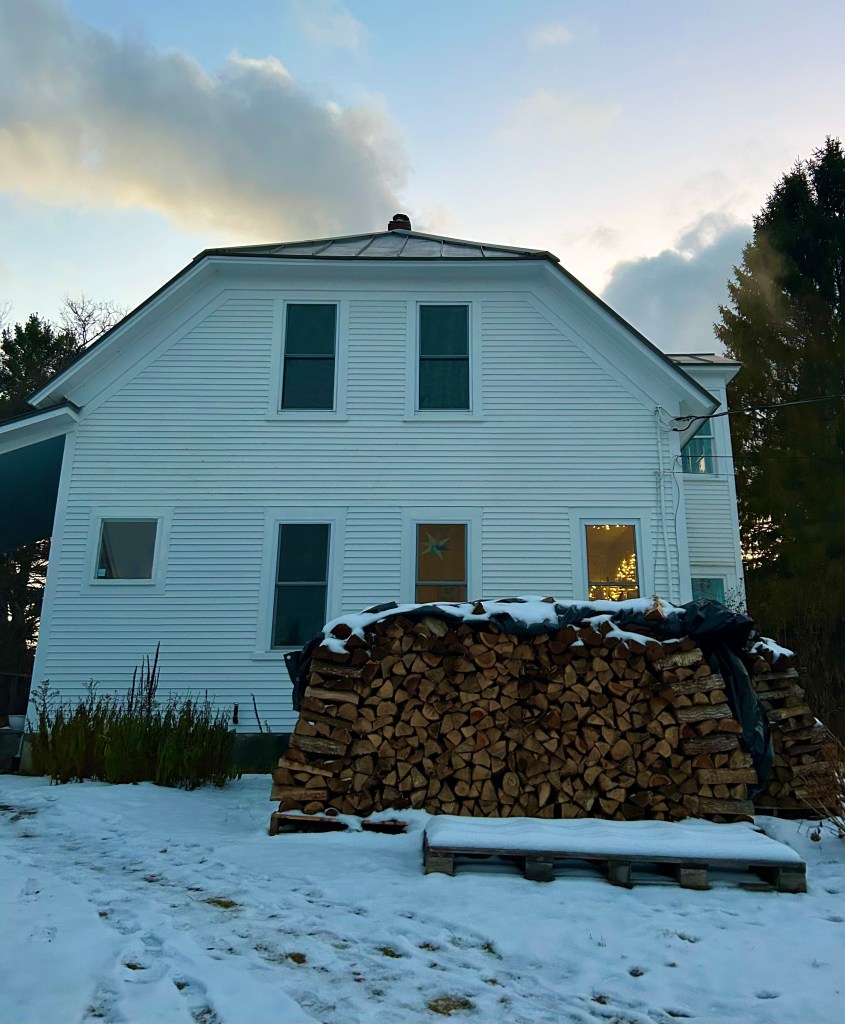
In the woods, I hear voices and pause, thinking a cluster of children might emerge over the hill. Instead, a flock of clangorous geese wings low overhead, then a second V, a third. Town traffic sounds filter into the woods. I am not in the deep wilderness, not so far from high school and road and village, but for this hour, it’s just me and the sweep of wind and drifting snow and the human and dog prints of whoever walked here before me.

As a kid, my father was never one to be daunted by adversity. Evenings, he often set down his coffee cup and took us on walks to the library or around the block, and around the block often meant across a thin-grass soccer field to the woods. Who owned those woods, I never knew. We jumped across the stream and along worn logging roads, past the piles of New Hampshire boulders and stone walls in the forest where fields had dominated not so many years ago. The woods were alive with rabbits and deer, birds and ferns. We wondered about the Natives who lived here and the colonists who cut down the trees, and then the trees grew up again.

On this twilight Monday, I lean against a hemlock, snow in my eyelashes, remembering when my daughters filled their snowsuit pockets with tiny hemlock cones. Intentionally or not, my father instilled love and not fear of the forest in his kids, the understanding that our feet could carry us to unexpected and miraculous places.

Here’s that classic New Hampshire poem threading through my childhood, my daughters’, and so many others:

Stopping by Woods on a Snowy Evening

By Robert Frost

Whose woods these are I think I know.   

His house is in the village though;   

He will not see me stopping here   

To watch his woods fill up with snow.   

My little horse must think it queer   

To stop without a farmhouse near   

Between the woods and frozen lake   

The darkest evening of the year.   

He gives his harness bells a shake   

To ask if there is some mistake.   

The only other sound’s the sweep   

Of easy wind and downy flake.   

The woods are lovely, dark and deep,   

But I have promises to keep,   

And miles to go before I sleep,   

And miles to go before I sleep.

Such a World.

Late afternoon, walking with a friend on the town forest trails and talking all-things-grownup-and-fascinating, her little girl runs ahead of us, stops suddenly, raises her arms in a Y over her head, and exclaims to the woods, “I love this place!”

Relish this.

Slowly, the rain is returning, the streams beginning to flow again. Puddles muck the trails in a few low places. Meanwhile, people ask, “How’s your water holding up?” Word travels of dried up wells. This morning, I stand on my porch in the dark, listening to rainfall patter through the leaves that linger on the trees around my house. The crests of the apple trees hang onto their crowns of gold. We’re at that dipping point, the swing of seasons, the earth yet warm, redolent with this summer’s abundance.

Such a moon —

the thief

pauses to sing. — Yosa Buson

“…music despite everything…”

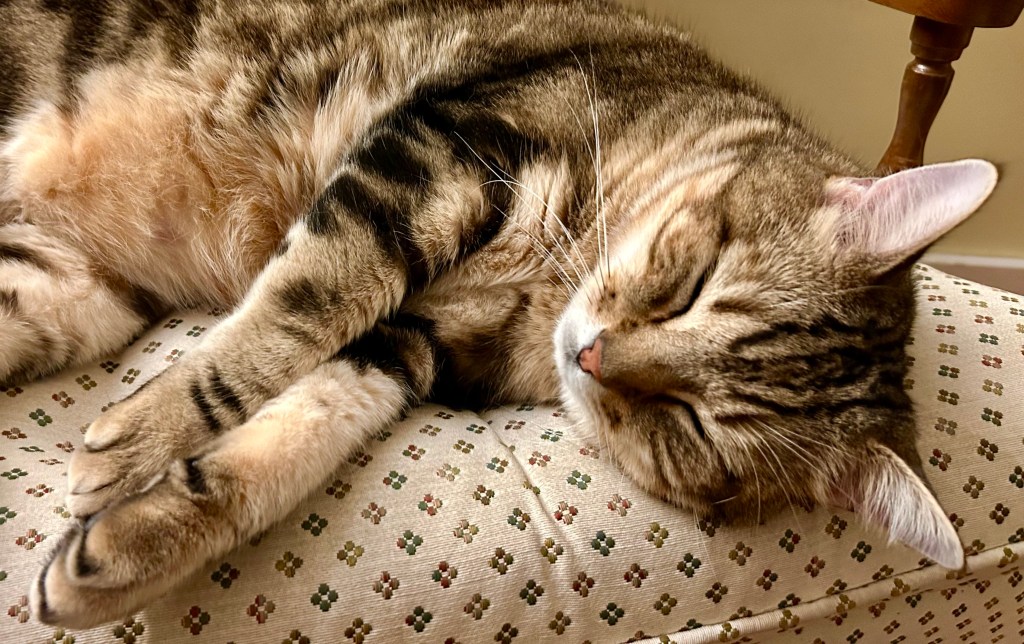
A woman stops me on the sidewalk and offers me a chair. I discover it’s a fine reading chair and bring it home, much to my cat’s delight. Friends track me the hermitess down in the coffee shop where I’ve spread the pieces of my manuscript over a table. We drink cappuccinos and eat jam bars and talk shop. I’m hurtling through the book I’ve called a cancer atlas — how to endure the intertwined suffering of cancer-and-chemo and then what? I tease, write the ending for me, will you? although I’m already there, stitching together mosquito bites and spring ephemerals and sleeping alone in a cold tent while the rain soaks through the tent fly and floor. We share kale soup recipes and marvel at this long dry autumn, the poplars yet holding their gold leaves.

Ever present in my mind is the question I asked the oncologist when I’d finished chemo, endured the surgery, limped my way back to his office. “What now?” And his answer, “Go and live your life,” the old existential question. A koan, a place of delight to be able to ask this question.

On this No Kings Day, while my cats sprawl contentedly before my woodstove, I’m reminded of the dearness of living a human life. That the asking of the question how to live is a many-sided privilege.

We must admit there will be music despite everything.
We stand at the prow again of a small ship
anchored late at night in the tiny port
looking over to the sleeping island: the waterfront
is three shuttered cafés and one naked light burning.
To hear the faint sound of oars in the silence as a rowboat
comes slowly out and then goes back is truly worth
all the years of sorrow that are to come. ~ Jack Gilbert

Put on a dress of flowers…

I spy a young fox on my front yard sniffing the trunk of the pear tree. Someone planted these two fruit trees long before I lived here. The smaller bends into the lilac hedge as if it’d prefer to be a lilac. This one, the taller, shoots high, its branches like an enormous hand raised in greeting.

The fox checks out the cohosh I planted this fall. Dawn is coloring up towards whatever day might emerge. I’m walking around my downstairs rooms, a dress in my hand, headed into work today, to sort out questions I both can and cannot answer, to talk with my office partner about town roads and FEMA, the drying up streams and lakes, about the merits of apple cider vinegar, and grownup kids. We’ll open the screen-less windows wide open in this 100-year-old former school, letting in the sunlight over the dusty sills. Hungry wasps fly in and out. An ordinary day of the things of this world, some humdrum, some irritating, some lovely as this balmy October weather. As for me, broken by cancer, limping back to whatever rude red health I can summon, I think, Put on a dress with flowers.

The fox crosses my neighbor’s pine-cone-strewn grass and disappears down our thin road. A fortuitous sign, I think, for this day.

Ode” by Zoe Higgins

Here’s to everything undone today:
laundry left damp in the machine,
the relatives unrung, the kitchen
drawer not sorted; here’s to jeans
unpatched and buttons missing,
the dirty dishes, the novel
not yet started. To Christmas
cards unsent in March, to emails
marked unread. To friends unmet
and deadlines unaddressed;
to every item not crossed off the list;
to everything still left, ignored, put off:
it is enough.

Crossroads.

I park at a dirt crossroads this weekend beside a former tavern and walk up the hill to the Old West Church. The sunny afternoon speckles through the roadside maples, and I meet others doing what I am, in pairs or singly, and we greet each other, cheerily. At the Old West Church, I hear two terrific poets, but on my walk back to the tavern the line that runs through my head is from a Franz Wright poem, There is but one heart in my body, have mercy/on me, an incantation.

I keep thinking of my dead mother on this radiant Sunday, my mother who pulled her last breath a year and a half ago, hardly a hopscotch jump ago. In my mind, I’m building the architecture of what I’ve tagged as this Cancer Atlas I’m writing, scaffolding this book’s bones. The book is about the here-and-now, about living (at least for now) through a terrible disease, about walking along Vermont’s autumn-gold back roads, about pulling up this summer’s frost-killed pepper plants that produced so bountifully this summer. And my mother? As I work, I think so often of her, this woman both generous and mercurial, the double blade I harbor in my own heart. Gracious, how much she’d enjoy this picturesque walk. She was a woman who loved old churches, was fascinated by adjacent cemeteries, who would have relished the art in the tavern.

At the tavern, I linger in an open doorway, talking with a curator, drinking iced tea from a half-pint jar. My mother would have drunk the wine, feasted on the cured meat and seeded crackers. Dust kicks up in the road. Old friends appear, and we joke about winter’s ferocity. It’s always a crossroads, isn’t it?

“We are created by being destroyed.”
― Franz Wright

Habits of the Heart.

A radiantly sunny September afternoon, I’m at the northern edge of Caspian Lake, an afternoon with the slightest of breezes so the water shimmers and ripples. The summer people have all returned to other places, the local families at work or school, so it’s just me. For the longest time, I stand at the edge of the long dock and watch a bald eagle fly low over the water, then circle back and disappear into the woods.

Where do you find succor?

For years, with little girls, I spent hours with my friends at the public beach on the other side of the lake. Our worlds dispersed now, I haven’t walked there this summer. In no rush on a day that’s already been crammed with people and my to-do list, I take the longer trail back to the road. The usually wet forest is so parched the boardwalk bridges span over dry soil.

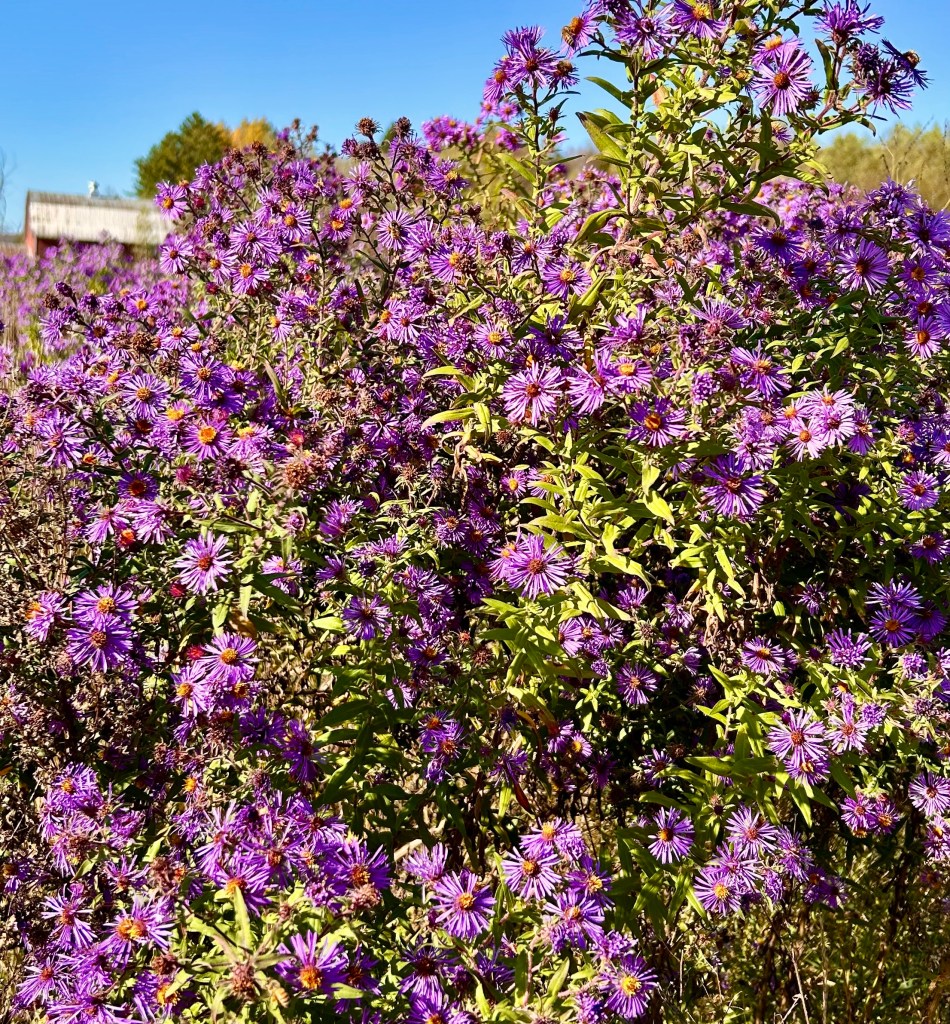
As the afternoon folds down, I take a walk along the river, the path I’ve been following all summer, watching the trout lilies give way to soapwort to the persistent asters. A pickup truck idles across the trail. A woman I knew years ago from a library kids’ group waits for me to pass, then ropes off the trail so she can move her cows from one pasture to another.

On my way home, I stop at the co-op for vinegar and coffee beans and cashews. A stranger says hello in the bulk aisle and reminds me he’d passed me on the trail, he on a bike and me walking in sandals. We talk about the moon and a star named Arcturus. When we part, he says, “See you on the trail — a metaphor for life.” Slow I am these days, as if I’m floating on my back in a warm pond, my eyes open to this flawless blue sky, the undulating water gulping in my ears. Autumn, this heartbeat of beauty, its own true metaphor.

… From this week’s New Yorker:

… what made America great—were “habits of the heart”: the everyday engagement of citizens that sustains institutions by holding leaders to account. Habits fade, but they can also be revived.