I believe in good gloves.

At the Vermont Almanac‘s celebration of volume four, I talk with people I haven’t seen in years — my daughter’s beloved elementary school teacher, a couple who bought a house down the road from where I once lived. As the staff from the center where the celebration was held clean up, ready to head home themselves, I walk out with my former neighbors. We stand for a few moments by a fire burning in a pit, talking about sugaring and our daughters and Vermont dirt roads. Through the wide windows, I watch people wrapping up the remains of cheese and dried sausage. In my house, I am still eating the remains of Thanksgiving’s cheese, the sharp cheddar I used in my friend’s birthday sandwich.

Overhead, stars strained again the clouds.

I’d been asked to read a poem, “Dear Day in Late September,” for poet Kerrin McCadden, who couldn’t attend. I consider this poem a love letter in the tenor of love letters I admire most — elegantly stripped down, mindful of life’s deep sadness and the beauty of our world fat with bees.

On my way home, I think of the line “I believe in good gloves.” As a former sugar maker, I’ve used up countless gloves. With my small hands, I’ve never had a pair of gloves that fit. At Thanksgiving, in a shop looking for boots, my daughter handed me a pair of petite gloves. I nearly laid them to the side (thrift, thrift), but I bought them. Yesterday, wearing these gloves to bring in wood, I realized the gloves fit me perfectly, downy on the inside. Warm, strong, practical. What do you know.

…. I want to tell you I am

thinking about closing up shop for the winter. I am settling

my accounts. Enclosed, please find a brace of birds,

which I hope you will accept as payment against last winter’s

oil bills. There is much to do. Up in the barn, I have spelled

out the name of the man I love with crabapples. It is one way

to know a man’s heart. I believe in his name, though,

like I believe in good gloves. Oh, how we fight the cold

with everything we have.

Kerrin McCadden

Pocket Treasures.

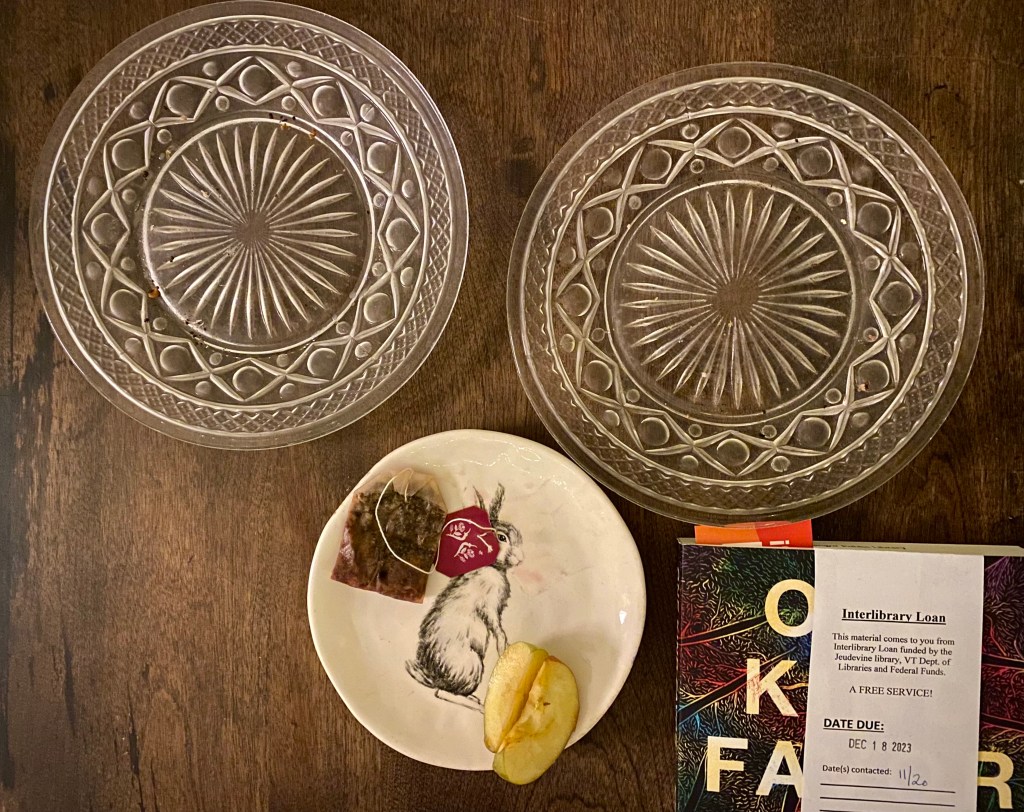
On this Sunday afternoon, my guest departs in the falling snow. When I head out for a walk, the cold has sunk in, deep enough that tendrils of snow cling to the grass and trees branches. The snow bends down last summer’s sunflowers in the garden. I leave my woodbox full, the cats sleeping, plates on the table. I intend only to return a handful of library books, but I head up the hill and around the high school and into the woods where the snow lies deeply and slows me down.

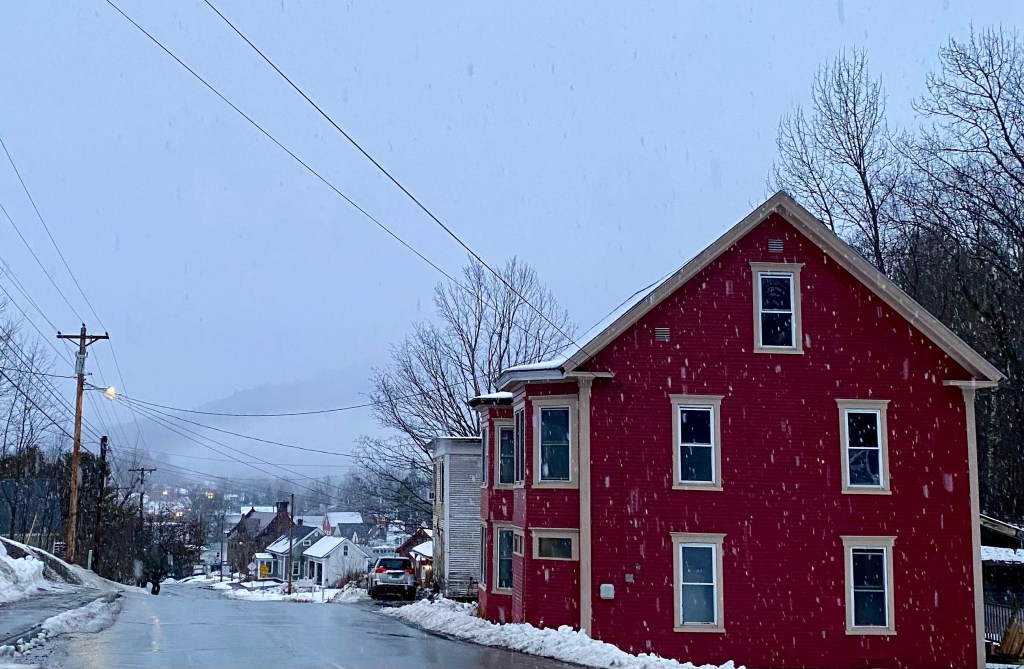
It’s December. Snow circles down, lovely and miraculous, this silent transformation.

Here’s a few lines for winter:

“Treasure what you find
already in your pocket, friend.”
― Ted Kooser

Stitching, in Friends & Wool.

December, and by five o’clock, the dark has hammered in for the night. A friend and I walk to the post office, talking about work and family, laughing as we avoid icy patches glowing beneath the streetlamps. We meet a neighbor walking home with her two children from the afterschool program. The boys have glowing strips wrapped around their wrists, red and green, that draw lines through the darkness as they pinwheel their arms.

We return to my dead-end street where the light glows on my back porch. At the silhouette of mountains across the valley, an immense column of amber light illuminates the night sky. Moonrise. It’s not particularly cold. We linger and watch the stars and planets rub on against the darkness, one by one, and keep talking about those complicated stories of family, of how history bends back upon itself and what this might mean for our children who are in the time of their youth.

Above, stitches of a sweater I knitted for a faraway friend, something I created with pleasure and gratitude, that I’ll box up and mail away. Who knows when I’ll see these friends again. But it’s the only way forward that lends any illumination for me: stitch. When need be, unravel and begin again.

“The products of science and technology may be new, and some of them are quite horrid, but knitting? In knitting there are ancient possibilities; the earth is enriched with the dust of the millions of knitters who have held wool and needles since the beginning of sheep. Seamless sweaters and one-row buttonholes; knitted hems and phoney seams – it is unthinkable that these have, in mankind’s history, remained undiscovered and unknitted. One likes to believe that there is memory in the fingers; memory undeveloped, but still alive.”

Elizabeth Zimmermann

How to Reconcile Contradictions?

The November days end in early darkness. Late afternoon, I close my laptop, comfort the cats with a handful of kibble, and pull on my jacket. The village lights glow: the few restaurants, a garage, a laundromat, the library. When I’ve reach the high school, the darkness spreads ubiquitously through the town forest that spreads up the hillside. Nearly all my life I’ve lived in New England, and yet the profoundness of this late autumn darkness always amazes me.

Later, I’m in the neighbors’ house who need some aid. As we stand talking in the well-lit rooms, I feel the house around us, the century-old vessel of wood and nails, a metal roof. Around us, the wind stirs through the evergreens. I walk back in the dark, my head bent against the cold channeling through the valley. All night, wind howls, the inexorable thrust of our world into winter.

While I read on the floor beside the wood stove, the cats keep me company, thinking their feline thoughts. Eventually, I turn off the lamp, and we three beings watch the fire’s flames through the stove’s glass door. Encompassing us, this profound darkness I will never comprehend. In it, our hearts beat on.

Here’s a few lines from David Truer’s “The Americas They Left Me” I read last night, in The Best American Essays, 2023.

This country is a terrible country, and this country is not…. There is a great ugliness on the land and also a great beauty. This country would and will do its worst at the same time it embodies the most nurturing habits our civilization has to offer. There is no reconciling these contradictions; they cannot be reduced or done away with. I must, we must, find a way to contain both.

The Might of Imagination.

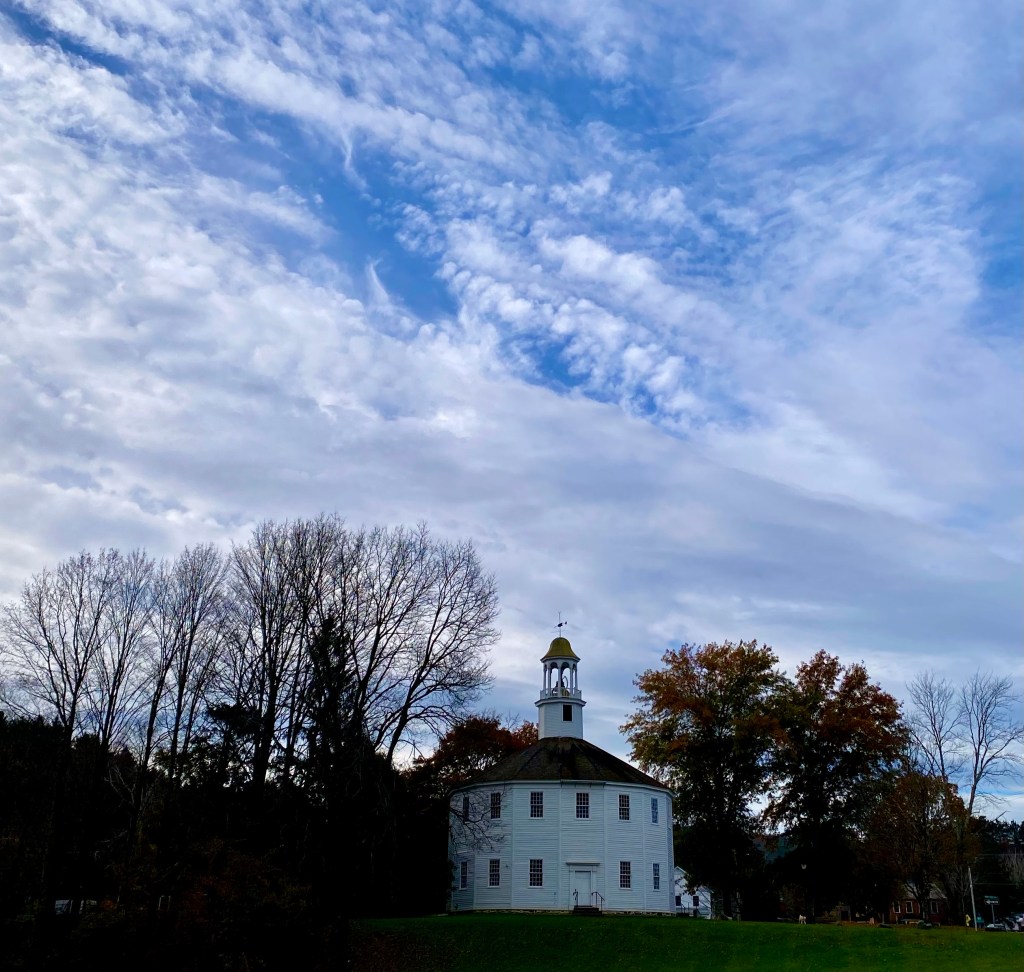
Round Church, Richmond, Vermont

The geese fly overhead in great Vs, chattering in geese-speak as they align themselves, tugging their flock together. In my garden, I rip out the frost-blackened tithonia, the dry fronds of bachelor buttons.

The migratory geese are rhythm, nothing clichéd about their brassy calls. As I steadily work at my annual chores — burying more daffodil bulbs, the candy-like crocuses I’ll happily search for, months from now — I let my body do this work, my boots on the earth, a few spits of rain falling from the clouds, listening, listening.

In the town office where I work, stories surge through, as in any small town. Having lived through scads of my own drama, I know too well how the private seeps into the public, any truth strewn carelessly among chatter. For the most part, I endeavor to do my work and head out; yet, like anyone, I’m always listening, listening, wondering about motive and desire, curious about betrayal and courage, and the ineffable complexities of human behavior. In a conversation with a friend about a couple we jointly know, my friend said, For anyone who’s been following the story, this shouldn’t be a surprise… In a similar vein, I realize I’ve long been quietly following the story of the world where I live.

On my way to visit my daughter, I detour slightly and walk around Richmond’s round barn, shuttered up until dandelion season returns. The afternoon is especially balmy, sunlight bright even in the scarcity of November. I marvel at how mightily humans can create, mixing utility and beauty. How well we can do this.

“Sometimes it seems to me that, in the end, the only thing people have got going for them is imagination. At times of great darkness, everything around us becomes symbolic, poetic, archetypal.”

— Helen Garner

Continuing without a sign.

An inveterate list-writer, at the end of each day, I’m often summing what I’ve done. Somedays, my hands and my hand seem to come up empty. Or my heart has articulated a question.

I pass a few days drinking coffee and talking with my daughters, walking through the woods, along rivers and streams and a rock-throated gorge. They’ve teased me for years about my focus on the gritty and hardscrabble, my fascination with wandering into abandoned cellar holes, my curiosity about abrupt turns in human stories. But when has the world ever not been falling into pieces? There’s this, though: surely at times the world’s misery spins harder and swifter and unbearably more painful.

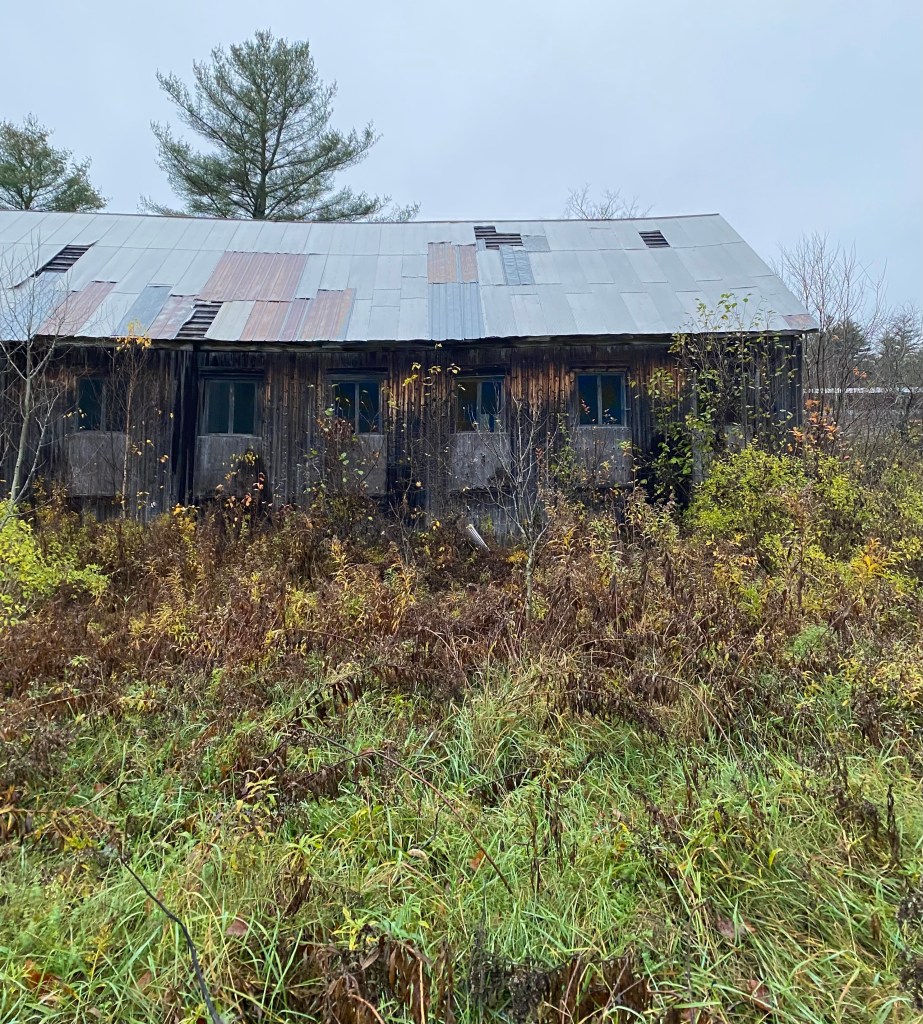
In those cellar holes, gardens of flowers and sustenance once bloomed at doorsteps, their seeds dormant in the soil. Sunday, nearing dark, I brake for wild turkeys meandering across a dirt road. There’s no one around. I pull over and walk down the road to snap a photo, but the turkeys suddenly rush, hearing my footsteps, and I’ve forgotten my phone in the car anyway. I’m at a driveway that bends up the hillside, the house of out sight. Many years ago, the man who lived there offered me his dead wife’s fur coat. He must be long gone, too. I’ve long since lost any sense of who lives there now.

“Matins”

You want to know how I spend my time?
I walk the front lawn, pretending
to be weeding. You ought to know
I’m never weeding, on my knees, pulling
clumps of clover from the flower beds: in fact
I’m looking for courage, for some evidence
my life will change, though
it takes forever, checking
each clump for the symbolic
leaf, and soon the summer is ending, already
the leaves turning, always the sick trees
going first, the dying turning
brilliant yellow, while a few dark birds perform
their curfew of music. You want to see my hands?
As empty now as at the first note.
Or was the point always
to continue without a sign?

— Louise Glück