Birthday Cake.

March 7 is my father’s 87th birthday. My daughter, the oldest grandchild, visited my parents a few days ago and asked what to do for my parents’ birthdays. Cake and flowers. And be sure to eat the whole cake.

At town meeting, on the fly, I had to add a few numbers, tally a total. Writing with my pencil, the 100 or so audience members looking at me, I thought of those childhood evenings when I handed my dad an algebra or calculus problem and asked for help. He always made me sharpen my pencil, align the numbers so the problem made sense, and exhibit some respect for mathematics, please. These three things have stuck with me my entire life.

Every year on my father’s birthday, I think of this Hayden Carruth poem. My father — a man who taught his kids about Arkhipov Day and Ancient Greek philosophy, and spent so many nights in the desert, playing cards with his kids at a picnic table lit by a battery lamp….

Birthday Cake

For breakfast I have eaten the last of your birthday cake that you
had left uneaten for five days
and would have left five more before throwing it away.
It is early March now. The winter of illness
is ending. Across the valley
patches of remaining snow make patterns among the hill farms,
among fields and knolls and woodlots,
like forms in a painting, as sure and significant as forms
in a painting. The cake was stale.
But I like stale cake, I even prefer it, which you don’t
understand, as I don’t understand how you can open
a new box of cereal when the old one is still unfinished.
So many differences. You a woman, I a man,
you still young at forty-two and I growing old at seventy.
Yet how much we love one another.
It seems a miracle. Not mystical, nothing occult,
just the ordinary improbability that occurs
over and over, the stupendousness
of life. Out on the highway on the pavement wet
with snow-melt, cars go whistling past. 
And our poetry, yours short-lined and sounding
beautifully vulgar and bluesy
in your woman’s bitterness, and mine almost 
anything, unpredictable, though people say
too ready a harkening back
to the useless expressiveness and ardor of another
era. But how lovely it was, that time
in my restless memory.
This is the season of mud and thrash, broken limbs and crushed briers
from the winter storms, wetness and rust,
the season of differences, articulable differences that signify
deeper and inarticulable and almost paleolithic
perplexities in our lives, and still
we love one another. We love this house
and this hillside by the highway in upstate New York.
I am too old to write love songs now. I no longer
assert that I love you, but that you love me,
confident in my amazement. The spring
will come soon. We will have more birthdays
with cakes and wine. This valley
will be full of flowers and birds.
Vermont’s fifth season: mud.

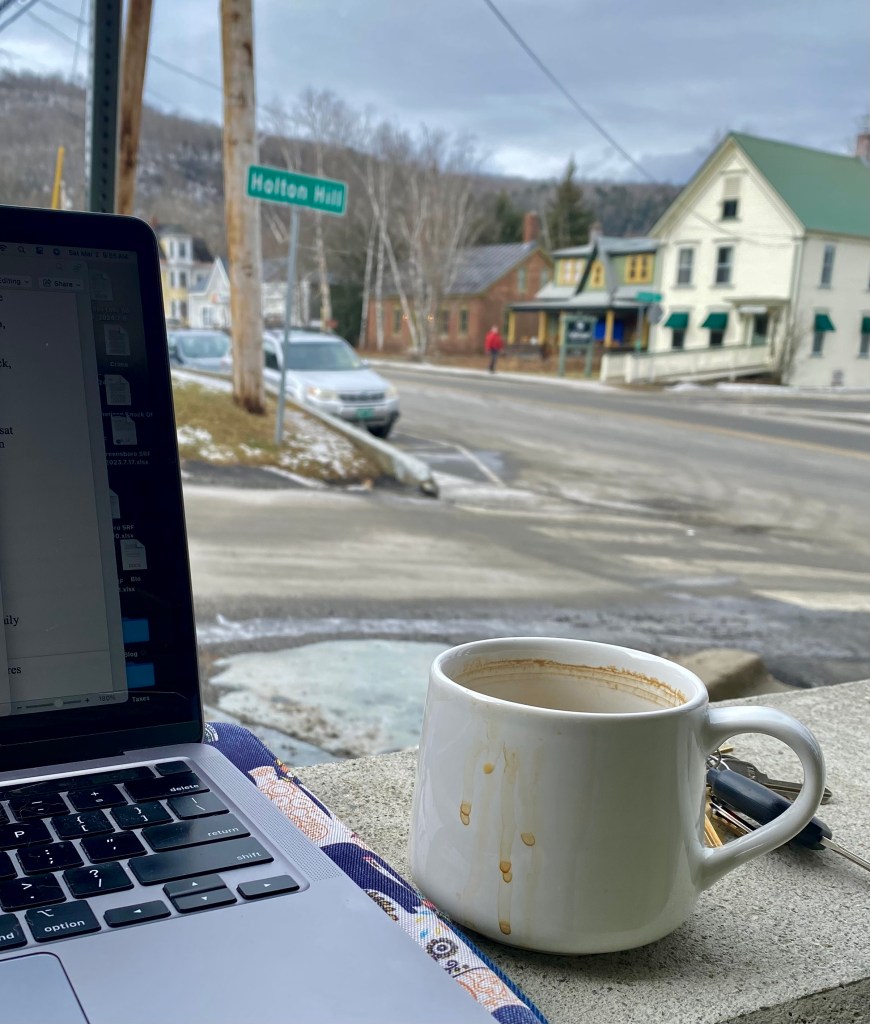
I carry my laptop out the backdoor of Hardwick’s coffee shop. A couple I know pulls up on their fat tire bikes and rave about the biking. There’s an adage in Vermont that the state’s fifth season is mud season. The first week of March is way early for the back roads to break up. Most towns post their roads around March 15, prohibiting heavy trucks, like log or delivery trucks, from destroying already soft roads. Now, towns have already posted these warnings, ribboned with orange survey tape, a sure sign that winter is on the wane.

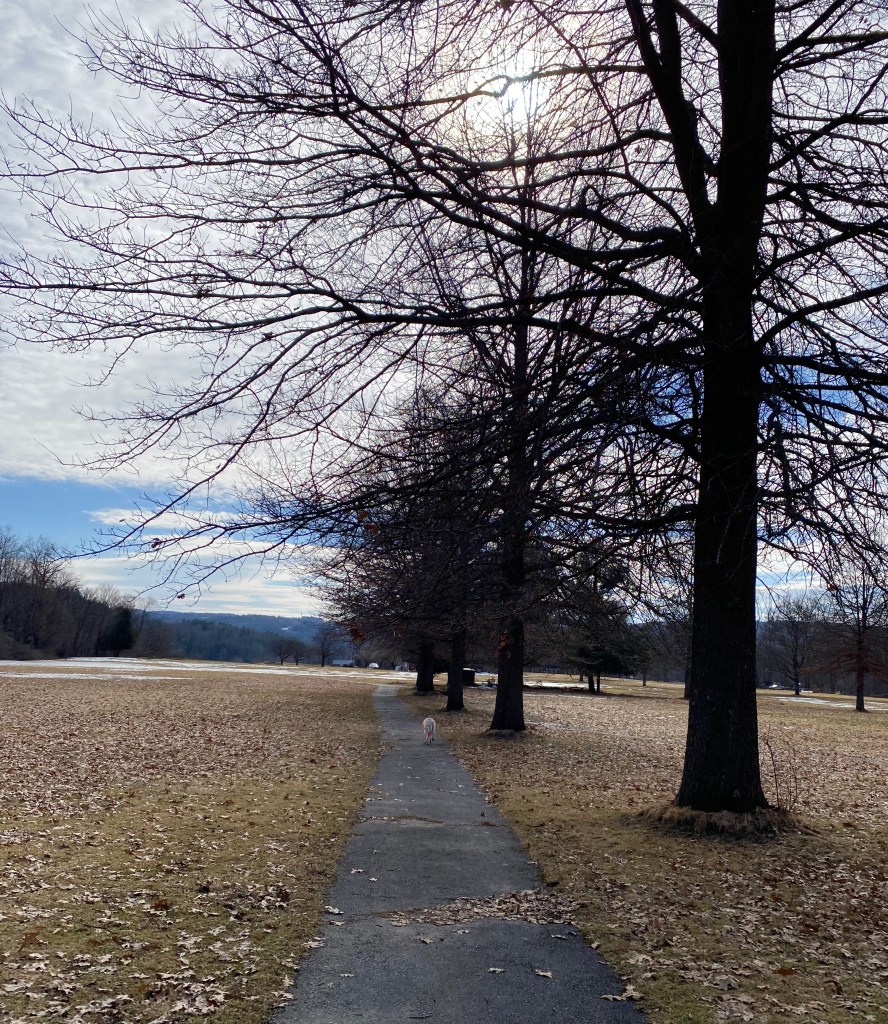
I meet a friend at a former golf course now owned by the city of Montpelier where people let their dogs run. The course is last year’s brown grass, but when I squint I can see emerging green beginning shimmer, pushing back the dull amber. How much the world leans into living.

My oldest daughter calls from New Mexico, on her journey to visit the grandparents. Through our phones, her face glows with desert light. I think of her driving around Santa Fe, this old adobe city and the stunning landscape an infinitely complex story that stretches so far back. Within that human history, my own family story lodges in with its numerous plot points. Ah, family… never a straight line.

T. S. Eliot wrote of that April is the cruellest month, breeding/Lilacs out of the dead land, mixing/Memory and desire, stirring/Dull roots with spring rain. Winter kept us warm… Mud season may be the least loved. But in my mind, it’s the sweetest. Sap runs. The softening ground sucks our boots into its stickiness. Tender green unfurls, strengthens. We move, onward.

January: wonder & diligence.

Twenty-five years ago, on a frigid January night, I went to a birthday party and ate chocolate cake. I would have my first baby in a week, and I had gone at that pregnancy with wonder and diligence, heavy on kale and broccoli, scant on refined sugar. The cake was marvelous.

In this warm January, a friend lingers with me over coffee. Melting snow drips from the porch roof as we talk about travel, making art and making a living, parenting. I’m reminded of a line from Raymond Carver that the mightiest force in his life was his two children, Carver who wrote brilliantly about laundromat hours. Wonder and diligence. Our conversation winds around to The List, the eternal draft of chores and visions, the crossing off and adding on, the drafting and revising, the diligence that strings our days together, a crude framework of parenting.

End of January: the weather is slushy and icy, sunbeams a rarity, hardly the season of wonder. My firewood holds the month’s damp, as if resistant, too, to the lousy weather. I lay chunks of wood beneath my stove, drying them a little before I chuck them in, burn the wood to ash.

My little cat flicks his tail. A cardinal nestles in the mock orange’s bare branches, crimson feathers in the muted world. I lay my hand on my cat’s silky back, murmuring, “Well, what do you know….”

And a Raymond Carver poem:

“Happiness”

So early it’s still almost dark out.

I’m near the window with coffee,

and the usual early morning stuff

that passes for thought.

When I see the boy and his friend

walking up the road

to deliver the newspaper.

They wear caps and sweaters,

and one boy has a bag over his shoulder.

They are so happy

they aren’t saying anything, these boys.

I think if they could, they would take

each other’s arm.

It’s early in the morning,

and they are doing this thing together.

They come on, slowly.

The sky is taking on light,

though the moon still hangs pale over the water.

Such beauty that for a minute

death and ambition, even love,

doesn’t enter into this.

Happiness. It comes on

unexpectedly. And goes beyond, really,

any early morning talk about it.

The true religion, the religion of snow…

I stand at my kitchen’s glass door devouring blood oranges and watching the sifting snow. Blood oranges — could I choose a less local delight? I open the door and cast out the peels for the birds.

The cat Acer sits on my feet, listening to the morning radio news, too. Just over the river, my home state New Hampshire revels in the Presidential primary. Meanwhile, Vermont prepares for its March Town Meeting Day, with the calculations and passion of budgets and petitions. Close an elementary school? Pledge to become a pollinator-friendly town? So much of January in my state is devoted to public meetings and discussion/debate, to a reckoning of the way forward, a jostling for who’s running for what seat — and what seats might remain empty.

Meanwhile, snowy winter has finally arrived, spare and elegant. Fearsome and enchanting. As the days deepen in cold, the light hours increase: no stasis in this world.

A fan of local chicken, bacon, milk, my cat stares at my orange-sticky fingers with disdain. I crunch the orange seeds, too, devouring this sunlight sweet.

Here’s Billy Collins’ poem about shoveling snow with the Buddha:

[Shoveling snow] is so much better than a sermon in church,
I say out loud, but Buddha keeps on shoveling.
This is the true religion, the religion of snow,
and sunlight and winter geese barking in the sky,
I say, but he is too busy to hear me.

Monsters. Childcare.

I stand outside the town office building, eating leftover beet-carrot-garlic salad for lunch, watching the sky alternately break apart in sun or drop rain. If there’s a rainbow, it eludes me. A retired couple who lives up the street walks by, returning from their daily post office walk. We kick around the news: a petition to close the town’s elementary school and how last night’s snow turned to rain.

Slushy, slushy.

The wind kicks up a hint-of-late-February warmth, the way that month can smell of thawing earth, of the gradual thaw-and-freeze-and-thaw that morphs into spring. Midwinter here, the weather out of whack. The afternoon opens into sunlight. The sun’s rare January appearance carries me through the afternoon and into a cheerily ebullient Selectboard meeting, and home again along an icy road, the stars glittering over hayfields, to play cards with my daughter while the cats savor their feline leisure, sprawled before the wood stove.

I lay awake late reading Claire Dederer’s Monsters. Dederer writes:

… the genius is not you. Not me. The genius, as we understand it, is not the person who spends most of her time, and I mean that quite literally, thinking about childcare. My major artistic concern for the past twenty years has been childcare, it has preoccupied me more than any other subject; even now that my children are mostly grown I’m still not sure I managed it well, I lie awake worrying about it, and meanwhile old Pablo was putting out cigarettes on his girlfriend’s face.

Solstice Dandelion.

I stopped into a candy shop in Montpelier to buy chocolate Santas for my daughters. We’ve been visiting this store since my daughters were so young I always held their hands downtown. The owner read my book, and we always talk about writing and family and Vermont small town life. Her store had reopened recently after July’s devastating flood. The rain and snowmelt in the forecast hovered around us as I filled a white paper bag with those bright foil-wrapped chocolates. As I listened, I added chocolate pastilles and more Santas, for her or my daughters or me, for the giving or taking, or maybe both.

This week’s rain likely spared this sweet shop, but towns around us were flooded again. In the town where I work, sections of roads carefully repaired after July’s flood broke again.

Yesterday, I spied a folded dandelion blossom in the town green. I squatted down and stared, not touching this brilliant gold in its emerald set. Overhead, those bunching clouds. A balmy breeze stirring over the lake that by day’s end will whet a bitter cold.

Solstice: hallelujah on this spinning planet.

Less and less surprises us as odd.

— Tracy K. Smith