Monday Morning, Still Dark

My older daughter cut her literary teeth reading Mercy Watson chapter books to her younger sister — silly stories about a pig who loved stacks of hot buttered toast. We were homeschooling then, and that winter, the girls spread on the rug before the wood stove. Read, the little one begged. One more chapter! 

Monday mornings in March didn’t mean all that much when we were homeschooling. Sap held every bit of meaning for us in those days. Now the older daughter hurries off before dawn to clinicals, full of excitement.

Fed, the cats sprawl on the sleeping younger sister. Fittingly, the striped feline who loves this child best also miraculously appears at the scent of toasting bread, hungry for melting butter.

Another year is gone;
and I still wear
straw hat and straw sandal.

— Bashō

IMG_1371.jpg

White Stuff

Snow.

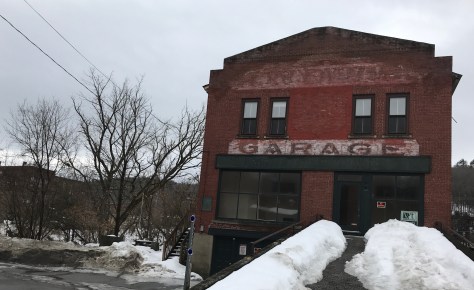
Driving back from Burlington, the interstate is snow-and-slush-covered, and the green Montpelier exit sign is nearly concealed. The conditions are nearly white-out, and I know where I am mostly by the long bridge over the Winooski River. I know the train station at Montpelier Junction is below, and that my family has walked on the railroad trestle over a summer-slow river.

In Montpelier, passersby walk with their faces turned down from the wind and blowing snow.

Then it’s all backroads home for me, driving on unplowed roads over ice-rutted dirt. Where fields loom up, the edges of the road disappear, and I’m driving more by memory than anything else. It’s March, and my snow tires have been hard-used for three or four years now, and I’m fed up with hearing about people’s trips to places with palm trees or, heck, even open water. March is the eternal Vermont month.

In Woodbury, the village that doesn’t even have a store now, I pull into the library to work a little longer before I head back to my daughters. As I walk by the elementary school, I see the children have built an enormous snowman, so tall I imagine adults must have helped with this.

After all that driving, bent over the steering wheel, just me and VPR and that eternal list running through my head — and who will take care of my daughters if I spin off the road and disappear? — the snow falls silently. The flakes twirl slowly, sheltered here from the wind, graceful as the season’s first snowfall. It’s so lovely I can imagine making a day of it, if I would just keep walking.

Nirvana is not something that we should search for, because we are nirvana, just as the wave is already water. The wave does not have to search for water, because water is the very substance of the wave. Living deeply makes it possible to touch nirvana, our ultimate reality….

— Thich Nhat Hanh

IMG_1339.jpg

Woodbury, Vermont

Treasures of the Least Likely Kind

Rough-cut diamonds rain on Jupiter: we learn this at a planetarium presentation in St. Johnsbury.

Afterwards, my daughter and our friends walk out of the Fairbanks Museum — one of my favorite places with its collection of local and exotic: freshly picked flowers in season and an ancient clay vessel for wine, Egyptian mummies and Civil War paraphanelia.

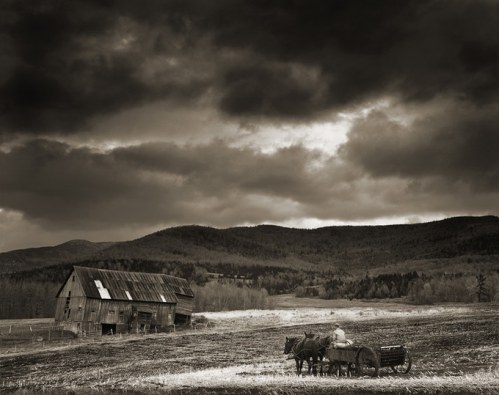
And, a fantastic collection of Richard W. Brown’s photographs temporarily on-display, the real reason we had driven to St. Johnsbury that day.

When my younger daughter was three, we had the head rebuilt of a Volvo station wagon we had bought from someone who likely botched the original job and passed the vehicle to us. A mechanic far out on a back road in St. Johnsbury did the work. My three-year-old and I on a beautiful summer day drove along twisting back roads I had never traveled, and ended up at an enormous windowless garage with a single green door at one end. I knocked; no one answered.

Holding my daughter’s tiny hand in mine, I entered and walked through what seemed to be an Alice-in-Wonderland mechanic’s world of room after room of greasy engine parts. I found the mechanic, a man in his sixties, his face and hands permanently hued with that same black used engine oil, in the labyrinth. The inside to my Volvo’s heart he had wrapped in a cloth. He opened the cloth and showed me the shining silver.

I lifted my tiny daughter, in her yellow and red-flowered sundress, a hand-me-down from her sister. He showed my child the work he had done. He and I spoke for a bit, while I wrote a check. As I turned to leave, he noticed my daughter was staring at a tiny plastic horse on a cluttered desk and told me to take the toy for her. He said the horse had been there for a long time and must have been waiting for her.

In a borrowed car, I followed the dirt roads down to the river, then turned left, toward  home. My little daughter sat in the backseat, that horse clenched in one fist, staring through the window at the landscape passing by. In the back was that rebuilt piece of our car, wrapped in clean cloths.

That Volvo has long since passed out of my and daughters’ lives, in the endless way of consuming minerals and money cars claim. My daughter wore that dress for years, until it was far above her round knees. The horse is likely still in our possession, in a treasure box of childhood mementos. And the mechanic? We never saw him again. But I still hold the kindness of a stranger who paused on that July day to wonder what interested a small, unspeaking child.


Scrambled eggs and whiskey
in the false-dawn light. Chicago,
a sweet town, bleak, God knows,
but sweet. Sometimes….

From Hayden’s Carruth’s Scrambled Eggs and Whiskey
39ec7c5d890ce6aca0c29faaef453547_original.jpg

Richard W. Brown


Dinner Chat

My daughter and I are often eating dinner in the lengthening daylight at the kitchen table, just the two of us with the cats under our feet, and my daughter offering bits of her day — if I listen, and don’t press too hard, what she cares about she slowly spills.

Our conversation drifts into what it means to grow. Through our glass doors, I see the box elders behind our house swaying in this spring-is-coming wind, the Vermont winter gradually eroding. So much of my life I sought stasis — the imagined security of here is where I am. In my daughter, I see this same illusion of when I am grownup, as though adulthood is a kind of plateau.

We linger at the table, with the unwashed dishes and evening chores undone. While she speaks, I think, here, now. The wind curls around our house.

Accept yourself: be yourself. That seems a good rule. But which self? Even the simplest of us are complicated enough.

— From Apsley Cherry-Garrard’s The Worst Journey in the World

IMG_1246.jpg

Caspian Lake, Greensboro, Vermont


Icy Reminiscences

This February reminds me, yet again, of how rapidly our world changes: nearly 70º degrees yesterday, with my daughter reading on the back porch and eating a turkey sandwich, to this nearly colorless day, where the younger daughter and I slide over the ice around our house, tacking to the neighbors’ bare patch of ground beneath her pines.

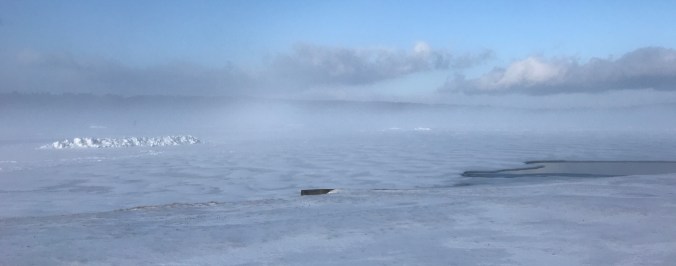
Early today, I drove to Greensboro, pausing in my few spare moments to walk on the frozen beach at Caspian Lake, a soul-spot for my girls and me.

Scene of innumerable sand castles, swimming lessons, watermelon slices, of cold, wonderfully clear water, and the legendary wind that rushes black thunderheads across the water.

Sure, some of days parenting young children I’ll let go from my memory without a tinge of sadness, but I’d keep every one of those beach days. Every last one.

I think one of the primary goals of a feminist landscape architecture would be to work toward a public landscape in which we can roam the streets at midnight, in which every square is available for Virginia Woolf to make up her novels.

— Rebecca Solnit

IMG_1186.jpg

Greensboro, Vermont

Teaser of Spring

Home early from work, I walked to the post office with my daughter, in what Vermonters know as sugaring weather. Streams ran down hillside streets. Birds sang in bare-branched treetops.

This is the first winter I have lived in town in many years, and I’d forgotten how the melting snow recedes, leaving a pointillistic, 3D mosaic of dirt. With her bare fingers, my daughter picked up little bits of snow and tossed them at my knees, and we made a game of kicking those icy bits ahead of us, walking, as she offered me a few little bits of middle school life.

Passing the elementary school with its mountainous banks plowed to the edges of the parking lot, I remembered my own elementary school, where I walked on those ridge tops in an unbuttoned wool coat, mittens swinging from the knitted cord my mother made, tying the mittens tightly to the coat.

My daughter dug her fingers into a snowbank and threw a handful of ice, soft snow, and dirt over our heads.

Learning to trust the possible and to accept what arises, to welcome surprise and the ways of the Trickster, not to censor too quickly — all are lessons necessary for a writer…..Attentiveness may appear to be nothing at all, yet under its gaze, everything flowers. ‘Awakened,’ Dōgen wrote in a poem, ‘I hear the one true thing —/Black rain on the roof of the Fukakusa temple.’

— Jane Hirshfield, Nine Gates: Entering the Mind of Poetry

IMG_1178.jpg

Montpelier, Vermont