May Magic

I’m reading a solid Vermont novel — Ruth Porter’s Unexpected Grace. Porter’s book focuses on everyday people and actions: a woman weeding her flowerbed before a lung biopsy, an older woman traveling on a train, families who care about each other, sometimes awkwardly as families can be.

At a reading a fairly well-known Vermont author gave recently at the local bookstore,  a nonfiction writer in the audience asked why she wrote fiction. The possibilities, he commented, seem endless.

Maybe.  Maybe not.

Fiction reflects life, and those choices are one of the things I find most interesting about fiction. Which way will the woman drinking diet Pepsi turn? How will her marriage weather the loss of her husband’s job?

“….I was just thinking it would be nice if the stars were aligned in my favor. There is magic and mystery in the world. It’s all around us.” She managed to get it out before she had to cough again.

IMG_1963.JPG

Sweet Sowing

Merry, merry month of May.

In the middle of the day, I fold my laptop closed and dig in my garden, shoveling away a long rectangular swath of lawn and pitchforking in manure. In May, the grass is emerald with gold coins of dandelions, and the earth is opened-up black, all wiggling worm and grub, potential for a season’s growth. The chickens investigate my wheelbarrow.

Over the cemetery I can see the valley with its greening mountains and the blue trapezoid of the lake held at the far end, glistening.

While I shovel, I think of a line from the movie The Darjeeling Limited my daughter and I have repeated back and forth: We were supposed to be on a spiritual journey, but that didn’t pan out.

How I laughed when I heard that line, thinking it summed up my marriage, and yet the journey spins on. In May, in Vermont, the icy snow that covers my garden has long since melted. The lilacs are near to blooming. A sweet spot at the moment: savor this.

I love the way this country smells. I’ll never forget it. It’s kind of spicy.

— The Darjeeling Limited


IMG_1860


Evening Meet-up

With two 12-year-olds and a giant dog cage in my small Toyota, I drove along the dirt roads in Woodbury, in search of the woman who said she had chickens. Ignore the no trespassing sign at the foot of the driveway, she told me, a warning for burglars. That part of the Woodbury is mountainous in the small, Vermont way, with curved hillsides cupping homes, and lots of clear running streams and glacier-carved ponds.

It was nearly dusk, and she was outside, waiting for us. The girls eyed the chickens, who were not yet in their houses. Waiting, the woman showed the girls her fluffy chicks, and then we went inside. Her house had an amazing floor made from stones on the property. While the girls waited quietly, the woman and I talked about her relatives who had been in the area since before the Revolutionary War. She showed us a photograph on the wall of her distant relative in a Civil War uniform with his wife, who must have native blood.

The woman’s house was filled with dusky light. She was one of my people, a small woman, and, standing, we were eye-to-eye. I could feel the girls getting antsy for the chickens, but they were quiet, saying nothing. This woman had raised three sons alone in a mobile home on this property, and then built a house about the time the boys moved on and began their own families, cutting a deal with her ex-husband’s child support arrears for more land instead of the  money he owed.

The girls petted her lovely black lab. I stood listening to the unexpected bends of her life, to an autoimmune disease and the loss of a job, and then, she said, the chickens saved her life. Began her on a new track. In the descending gloaming, we walked behind the coops and visited her new bees. For a moment I guessed she would offer to take us further, up that steep hillside I admired where she and her son cleared a field.

But the girls edged toward the chickens. The hens muttered, stepping slowly into their houses for the night. We took four, driving out through the sound of the clattering peepers.

Morning glories
enough thatching
for this hut.

— Issa

IMG_1877

Journeys, More Journeys

Near the end of the last century — which really wasn’t all that long ago — my then-boyfriend and I spent a lot of time driving around the country. We were so young, and time seemed like an endless well we might draw from forever.

The other night, driving to the airport in the descending dusk, I remembered blood-red sunsets as we made our way across the midwest.

I think of the decades of my pre-children life as two-dimensional, although I know that’s not true. But when I became a mother, my own life grew, too, in ways I had never imagined.

In Burlington, I looked for a cup of coffee, but in that end of the city nothing was open but a Shell station where I saw a man bent over, mopping the floor. I stood in the new spring warmth and didn’t go in.

At the airport, two taxi drivers were laughing outside, talking in an accent I couldn’t recognize. Inside, it was just myself for a while, leaning against a wall and reading, and then slowly the airport filled up. Neighbors unexpectedly met each other, and I heard the update about a maple tree, blown over in a recent thunderstorm.

Then from that infinite night sky, my two daughters appeared, one tanned and one sunburnt, bursting with stories of their journey.

The only journey is the one within.

— Rilke

IMG_20180506_135507133.JPG

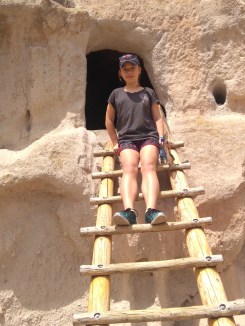
Frijoles Canyon, New Mexico

Zeke, the New Friend

My 12-year-old returns from the southwest with the story of a bobcat who slept in the raingutter in her grandparents’ roof. She’s worried about the wild cat, who she thinks is too thin, unlike her own glossy, well-fed kittens.

The cat is my daughter’s main story of her faraway trip — this wild beast who seems remarkably tame and drinks from her grandmother’s bird bath.

Driving home in the dark, I’m listening to my two daughters’ disparate conversations about enchiladas and pueblo ruins and a stranger’s delayed flight. My daughter in the backseat keeps mentioning Zeke.

Who’s Zeke? I ask.

She answers, We named the bobcat Zeke.

IMG_1767.JPG

This Old Book

Walking with my friend through town, we find a cache of free, reeking-of-basement-mold books — a strange collection of Zen and psychoanalysis and car repair that might have come from my own  jammed shelves.

I pull out a skinny book with no title on its cover, only a black-and-white photograph of a long-haired girl in a white dress on a pile of rubble. An early edition of Brautigan’s The Pill versus The Springhill Mine Disaster.

For the rest of our walk, I hold the book loosely in one hand, past the the old granite cutting sheds, houses well-tended and houses abandoned, through the wet woods and blossoming bloodroot and a hillside of trout lilies just beginning to open. I keep thinking about my second book I’m finishing now, how I’m lacing together the connections within that story: a stolen jar of farmers market cash, a dead dog, a torn crimson scarf.

That night, reading the book, I discover a bookmark jammed in the book’s pages, from the Bedford, NH, bookstore of my childhood.

In a Cafe

I watched a man in a cafe fold a slice of bread
as if he were folding a birth certificate or looking
at the photograph of a dead lover.


— Richard Brautigan

IMG_1779.jpg