Q&A.

My teen and I are in an office filling out paperwork and the last question asks her how apprehensive she is about dental work.

She stares at me. “Why on earth,” she asks me in her reasonable way, “would I reveal anything like that?”

I note it’s a standard question. Her answer: that’s a ridiculous question.

It’s another cold afternoon — a mostly sunny day in Northern Vermont — in a winter where cold has now dragged on well beyond its welcome. We’ve driven a little distance and taken a detour along a river whose middle has thawed. Only its shores are frozen.

A couple of decades now into parenting, I’ve observed children are formed by their parents’ lives — and not, too. She’s driving, and I seem to have taken up residence permanently in her passenger seat — a place I inhabit uneasily and definitely gracelessly. We drive and talk. Youth, I think, repeating the word soundlessly, like a mantra; I’m drawn to its utter ebullience and brashness, like the sunlight we all desperately need.

We remark on the price of gas. Our sheer luck at the happenstance of living in the Shire of Vermont right now. Of the war in cities and villages and homes on the other side of the globe.

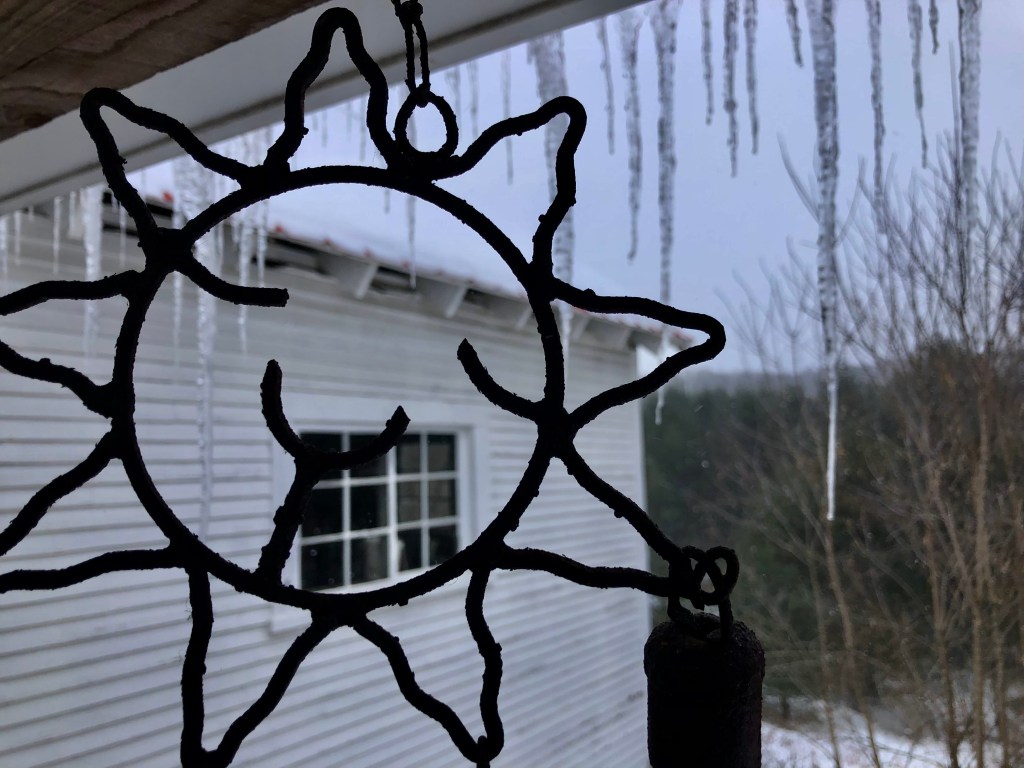
At our house, the icicles on our covered porch are exceptionally skinny and long this year. In the early morning, the ice begins falling in spires that break on the wooden porch. So many questions, and my answers are so poor. Keep asking.

Squall. Blindness.

Hardwick, Vermont

Right before the pandemic shut down the world two years ago, I drove with my youngest daughter to the New Hampshire village when I had spent ten years of my childhood. My family no longer lives there. An old high school flame had contacted me around that time, and I was half-thinking I might look him up some day. My daughter and I parked at the end of the street where I had walked with my siblings countless times, and then past the house where we lived and into the library when I had spent so many hours, dreaming of my life to come.

In a strange, almost sepia-toned kind of way, I felt I had been able to step into that past and see again the sweetness of it — something that seems so often lost in memory.

There’s that famous line from Tom Wolfe that you can’t ever go home again, but these days I’m wondering if that’s because you can’t ever really leave your home. I read that novel in high school, in that beloved library, a great big novel that I devoured with such enthusiasm.

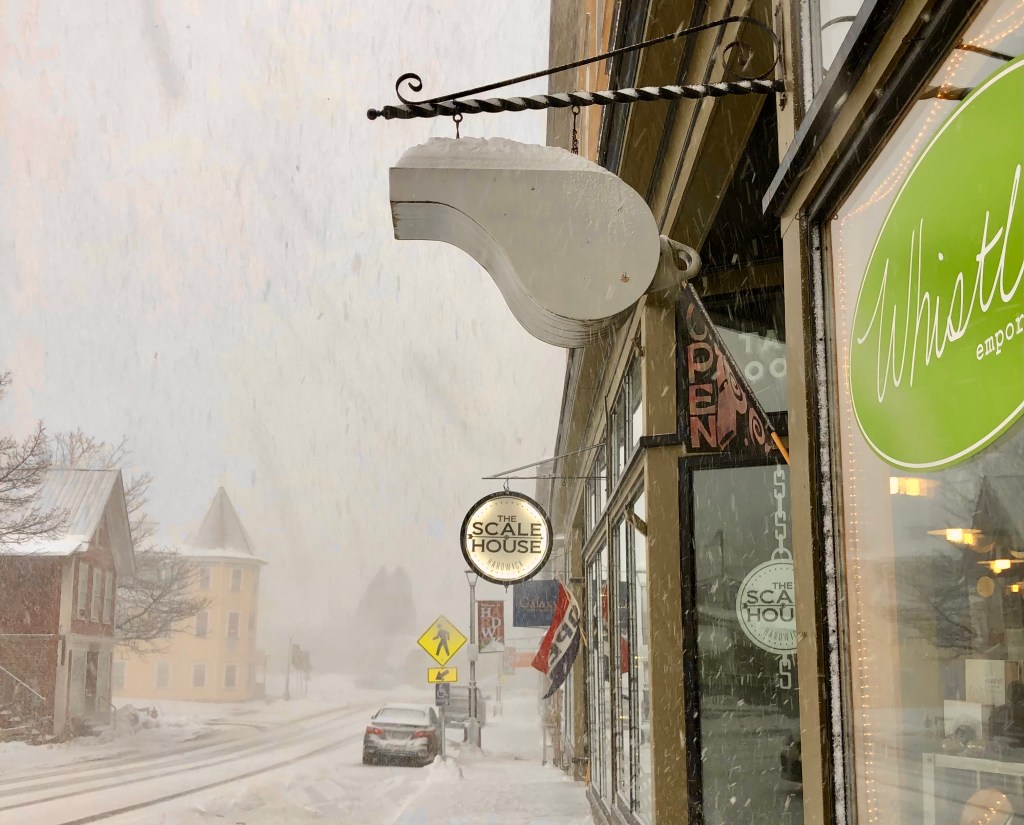
Twenty-five years ago, a young woman driving a Subaru Justy ran into my VW Rabbit in a sudden snow squall, just like the one above. I wasn’t wearing a seatbelt, and somehow miraculously survived wholly intact. The young woman sat in her car, crying, in the middle of the highway, and I stood outside her car, begging her to get out. “I’ve killed you,” she wept. I kept insisting I was fine. I was wearing a blue sweater my mother had knit me, and I spread my arms out wide. “I’m alive.”

Her insurance company gave me three thousand dollars, which my husband and I used to start a sugaring business. Much later, I sold pieces of that business and bought a house in the village. I’m still carrying that squall and that woman with me. I never saw her again. I hope she’s well.

Unexpected Phone Call. Driving.

My friend who has no cell phone (yes, indeed) phones me from someone else’s phone when she needs a ride, due to being “in a pickle.” I don’t get the message, as I’m on the phone with a hard-working journalist who’s graciously writing about my book.

Since it’s my lousy cell phone, I get the message about 20 minutes later, as messages are conveyed to my cell phone via carrier pigeon. I phone the stranger, who’s no help at all, but really darn nice.

I get in my car and go search for my friend, listening to a replay of Vermont Public Radio’s Brave Little State about the housing crisis. I pull into Montpelier and get out to look for my friend right around the time the podcast delves into interest rates and their role in this actual Real Life problem.

My friend is fine and home by then, and I sit on the steps of a closed restaurant and talk to her for a good long while. It’s dark, but not late, and the air is warm. I’m in this tiny little city that smells deliciously of something spicy, not sweet like cinnamon, but spicy like hot chili oil. I’m across from my beloved public library, closed up now, where I worked so many lovely long days, pre-pandemic, with never a thought that those days might cease for me. Since I have no real place to be, and my friend is ebullient to be home and safe, I tell her about the night so many years ago when I stood with my baby just down the street and contemplated renting a room in the inn and never going home. I’ve thought about that night and those crossroads in my life for years now, but when I tell my friend this story now, I imagine that long ago night lifting on little dove wings and fluttering over the roof tops.

I turn off my phone and drive home under the starlight.

Mud. Snow. Ice. What Next?

I met a friend yesterday, and we took a walk we’ve journeyed in various seasons — in bright green spring, in the summer when we admired flower gardens along houses. Yesterday, we walked through frozen mud ruts and sprinkles of rain, the jumbled up season and time of where we are.

On this New Year’s Day, I’m passing along a VTDigger story written by Kevin O’Connor about a Vermont couple’s 4,000 World War II letters. A history lesson and a love story — isn’t that what we need right now?

Kent’s Corners, Calais, Vermont

Happenstance. Here.

Greensboro, Vermont

Christmas Day, in a light, almost-a-cold-mist rain over a few inches of old snow, we took one of our favorite walks in Greensboro, on Nature Conservancy Land at Barr Hill. Flanked by old sugar maples, the path goes through former farm fields and among 19th century stone walls. So this walk feeds my desire for history and also for the cold rawness of today in our faces. We meet not a single soul, not even a crow.

At the top, the view is obscured by clouds, the lake with its summer pleasures of kayaking and swimming occluded by winter.

We may be at the edge of the world, but what does that mean anymore? In our family, we’ve had both wonderful and terrible Christmases. As we drive, we say, remember the time…?

On Christmas evening, we drive, my teenager at the wheel, in search of colored lights. I keep my own entirely adult cynicism to myself, my snarky thoughts about the crumbling American Empire and how long will the boondoggle of electricity keep flowing for us. Instead, I tease my oldest daughter about her headlights. Are the headlights even on? I ask.

In my book interviews, this fall and winter, I’ve repeated over and over, that, by happenstance, each of us arrive in a time and place. The few us walk a downtown street, beneath glowing lights. We pass a gleaming white BMW, its engine running, no sign of a driver. A little further, I stop and read a sign at a creche, acknowledging the small figurines are on unceded Abenaki land.

The rain keeps falling in little bits. The youngest navigates us home, through mist and darkness, despite the poor headlights.

(And thank you, Barre Montpelier Times Argus, for the great interview.)

The night is so cold

even in bed it keeps me

wide awake.”

— Buson

Brief Pause. Sunrise.

Driving into Greensboro this morning, I pull over at the lake. The mist is suffused with crimson from the rising sun. I have the odd sensation I’m walking in an Impressionist painting, shot-through with sunlight and wet, rising dew. A pink bird dips into the water, and I hurry along the frozen shore, wondering at this odd creature.

The bird is a common, ordinary seagull, floating along in this morning, just like me. Thursday morning.

The bottoms of my shoes

are clean

from walking in the rain.”

— Jack Kerouac