Travels into Other Time Zones.

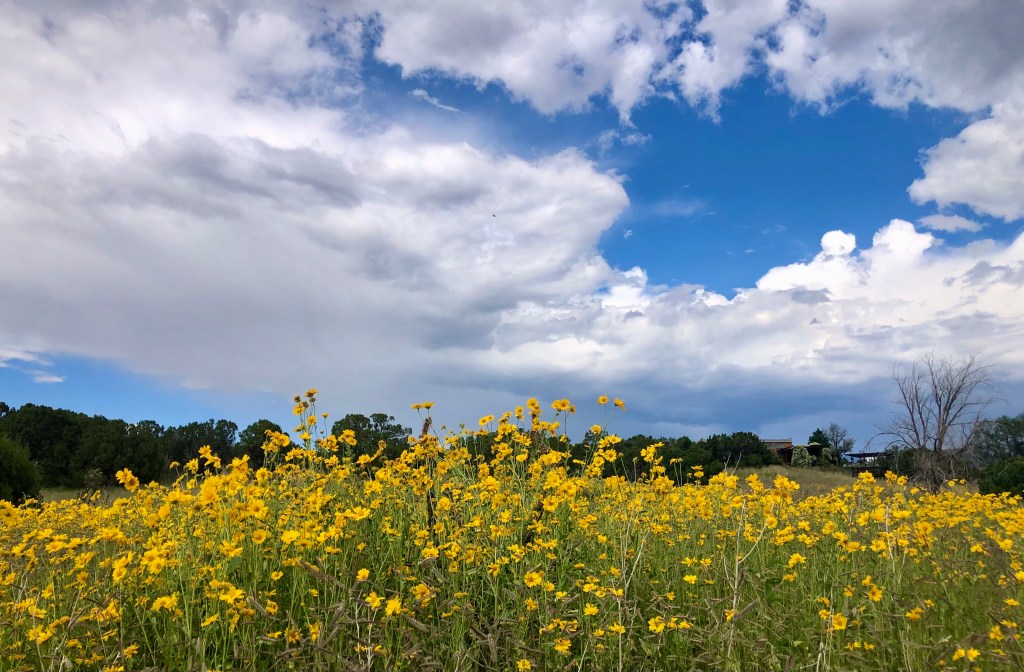
Santa Fe, New Mexico

My seatmate on the flight from Burlington to Denver chats me up. He complains a bit about the travel time, and then we kick around a few thoughts about what travel by Conestoga wagon would have been like. He says, You don’t come back from that trip.

True. This cross country flight is now familiar to me in the strange way of airline travel — through different airports, with people I’ve never met, juggling the odd variables of cancelled flights, rerouted paths, and so much human energy and mass, compelled to travel for so many unique reasons.

Talking, he and I figure out that we know two people in common, well enough that we can name traits we like about these people. A few hours in, I find myself in the same scenario that I’ve been in on prior flights — he pulls out his phone and then we’re talking about the Air BNB he’s about to visit, the friends he’s meeting, and the story goes on from there. True, I’m a captive audience, sandwiched between him and a young woman planning her wedding on a white board. What the heck. I’ve nowhere else I can go, and I’m hardly adverse to a few hours of laughter.

The moment I saw the brilliant, proud morning shine up over the deserts of Santa Fe, something stood still in my soul, and I started to attend. There was a certain magnificence in the high-up day, a certain eagle-like royalty, so different from the equally pure, equally pristine and lovely morning of Australia, which is so soft, so utterly pure in its softness, and betrayed by green parrot flying. But in the lovely morning of Australia one went into a dream. In the magnificent fierce morning of New Mexico one sprang awake, a new part of the soul woke up suddenly, and the old world gave way to a new.”

— D. H. Lawrence

Solo.

Every summer for years now, my daughters and I have gone camping on Burton Island in Lake Champlain. We always bring the same friend of my youngest daughter. Sometimes another friend and sometimes my oldest hasn’t come. This year for all kinds of reasons, I went alone for a night.

I stopped first to visit a friend and meet his friendly sheep. Then I raced to the ferry. Rain and clouds had moved out. The island has no cars, so the atmosphere is particularly sweet. Little kids bike everywhere. A group of teenage boys had set up a small army of tents, bikes, and fishing poles.

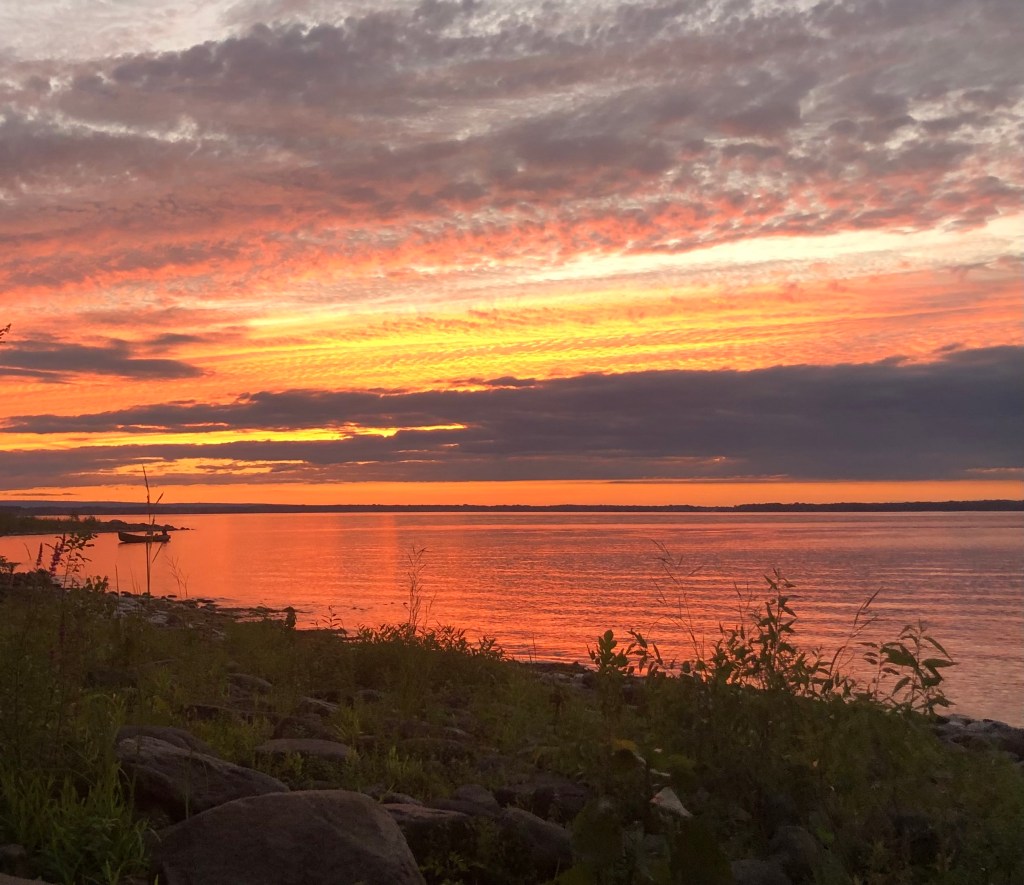
I had brought what I needed for the night: a novel, my knitting, a winter hat, the recently printed out version of my manuscript, and a good pair of walking shoes. If there’s one thing I’ve learned as a single mother, it’s make friends with strangers. Much to my daughters’ annoyance, I often find someone to chat with at soccer games, the co-op, the post office. A kind of survival skill on many levels. But I wasn’t there to chat. I walked around the island on its slate-pebbled shores in the daylight, during the enchanting sunset, and in the dark. As the night fell dark, the tree frogs sang melodiously. I slept dreamlessly under the rising moon. In the morning, I drank coffee and read and read until I packed up my few things and headed back to the ferry.

The island, a state park, is mostly staffed by college kids, who are polite and enthusiastic. The young man on the ferry folded up the wildflower guide he was reading to roll a few bikes on the ferry.

On my way home, I realized next summer I could take my kayak and stay a few nights on Champlain’s islands. I can’t swim to save my life but surely that’s something I could learn.

A few lines from Dan Chaon’s Sleepwalk:

“No doubt, a day of reckoning for mankind is coming, yet even for those of us who accept the inevitability of mass human death, there’s still a cautious hope; we’re waiting to see how Armageddon plays out, keeping an eye open for ways it might turn to our advantage… I’m no evolutionary biologist, but I have faith in our species’ stick-to-it-iveness.”

— Dan Chaon
Norma Fox Mazer & Mark Twain.

As a kid, I wanted to grow up and live on a farm. We lived in a New Hampshire village and spent a few summers driving west and camping from Wyoming to southern New Mexico. National Forest camping was cheap in those days — a dollar or two per night — and we cooked over the Coleman stove and slept in tents. My parents were frugal. They didn’t rent motel rooms, hardly ever bought a cup of coffee, and generally operated on the rule of don’t spend (a learned lifeskill I remain grateful for). My father bent that rule in a Boulder, CO, bookstore when the reading material we’d packed in our green Jeep needed an infusion.

The summer I was ten or so I read Huck Finn and Norma Fox Mazer’s I, Trissy over and over. In retrospect, the books were a good pair for a kid.

Last night just after dark, I walked out to the herb patch for a handful of mint to brew tea. After a long day of high heat and the evening’s dew, the world smelled sweet, alive. I had mowed the lawn in the late afternoon, and I breathed in freshly cut grass.

What was it I had wanted when I dreamed of living on a farm? To be outside as much as possible, to put my hands in the dirt, and to see where the sky meet the horizon. Three things I achieved in one Friday, if little else.

That adolescent me, the girl who was, as I remember her, insecure, unsure, dreaming, yearning, longing, that girl who was hard on herself, who was cowardly and brave, who was confused and determined-that girl who was me-still exists. I call on her when I write. I am the me of today-the person who has become a woman, a mother, a writer. Yet I am the me of all those other days as well. I believe in the reality of that past.

— Norma Fox Mazer

Travels and Home Again.

Portland, Maine

In the bit of time my brother and I drove through Portland recently, we talked about a few things — where to find a good cup of coffee and that my family grew up in the pandemic. Like that — and somehow, not like that. The next morning, with real regret, I sweep up the few things we’ve left around the apartment I’ve rented for a few days, gathering cherries from the refrigerator and sandy towels from the entryway.

At home later that evening, I wander through my garden. The hydrangeas and blueberry bushes I planted five years ago have now begun to thrive — or some of them. With my fingers, I slip off Japanese beetles.

July in Vermont is the season of utter growth, the one shot to rocket forward to the sun. Each day dawns with possibility — swim or don’t swim. Work long hours with an aim of working less on sunnier days. This is summer’s calculus. Slow down, slow down.

“To me, poetry is somebody standing up, so to speak, and saying, with as little concealment as possible, what it is for him or her to be on earth at this moment.” 

— Galway Kinnell

Interlude.

It’s been a long time since my little family and I went anywhere just for fun, to explore coastline or trails. Friday morning finds us sitting beneath an enormous oak tree eating donuts, admiring a salt marsh, and then chatting with a woman about delphiniums in a community garden.

Two years and some into the pandemic, my little family has grown up. We are years past the summer where I took my daughter and a friend canoe camping with a giant teddy bear. Once upon a time, I believed I could keep the chaos of the world distant from my family — impossible, impossible. For these few days, the chaos of the world reigns on while we’ve carved out a small space of Uno and dumplings, rock and sand and ocean, the silliness of leaning over a balcony railing and watching how city folks prize parking spaces.

We’re in a sea of songbirds in these tall maples surrounding our temporary home. As for that chaos — how clearly I remember my own young womanhood and how hungrily I dove into my own share of life, how I embraced the chaos that came my way. I underestimated how hard it would be to shape chaos into creativity; maybe we all misjudges the depths of life. No longer in the Age of Sippy Cups, my daughters beat me at cards. I still win at trivia.

On the Road.

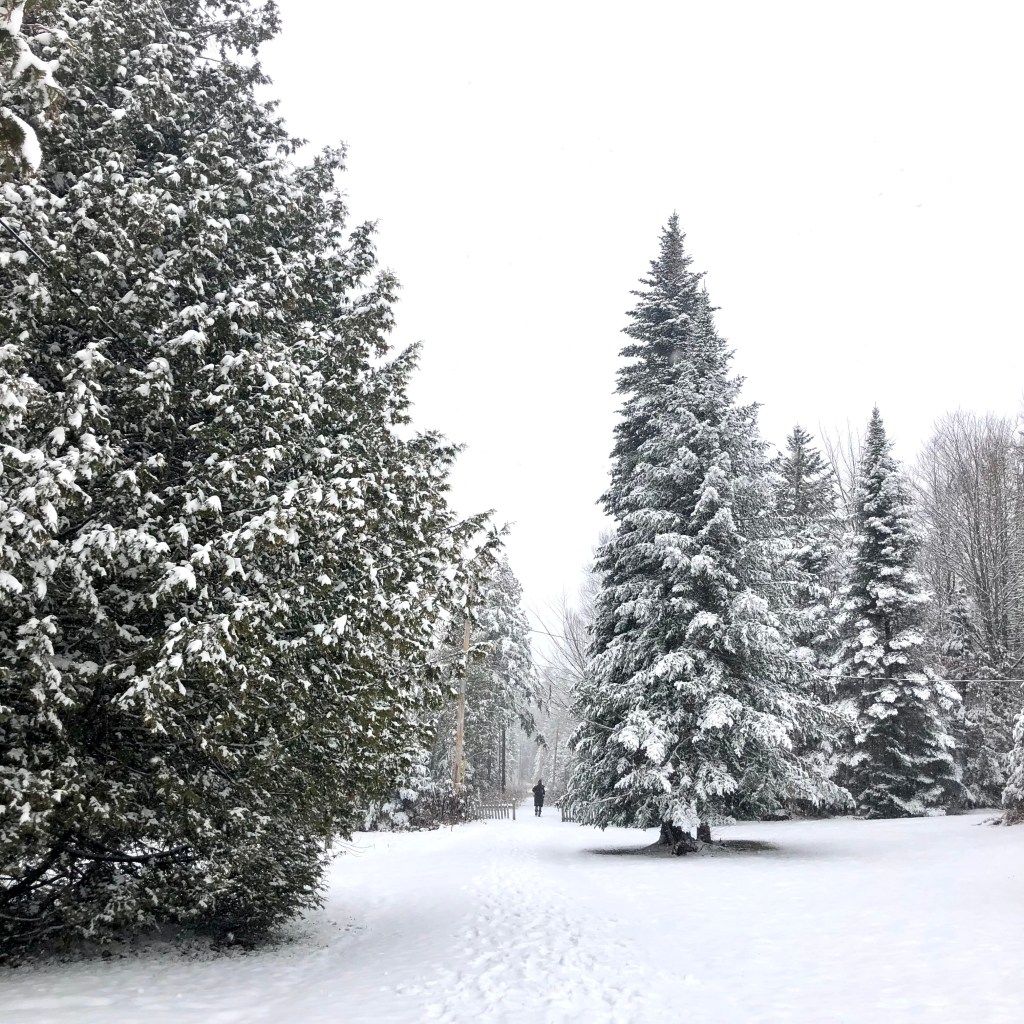
On a rainy Saturday, I pause on an empty road and snap a photo. I’d been listening to NPR’s coverage of the January 6 insurrection, one more plot point along the disintegration of the American Empire.

For June in Vermont, it’s darn cold. I’m wearing a winter hat, and the damp wind reminds me of the ocean, how the salt air cuts into you. Listening, I remembered August 1974 when Nixon resigned. My family was moving that day, and my father, fixated, insisted on setting up our tiny black-and-white television. My sister and I asked what the word resignation meant. My father, dealing with movers and three little children and a curious pack of new neighbors, paused to teach us the meaning of that word and gave a comedic impression of I am not a crook, and then explained what that meant, too.

Decades later, and a whole lot of crooked politics later, I still think of the open road as my family’s version of Huck Finn’s Mississippi River. Not long after we moved that August, my parents drove their three little kids in our green Jeep to the ocean. We had lived in the southwest and never seen the ocean — so much water, so much sky, the impossible proved possible. My father taught us how to fly a kite, its long tail fluttering in the wind.

...Yet I like driving at night
in summer and in Vermont:
the brown road through the mist...
— Hayden Carruth, "The Cows at Night"