Plot Point, Soul Journey.

My older daughter relays that she stopped for brand-new greasy donuts at 3 a.m. with her sister and a carful of teenagers headed to the airport. She parked beside a car with a man, she says, who must have lived through better moments.

We’re waiting for coffee on a Sunday morning jammed with people getting the Sunday vibe going. I make a vague comment about the soulful journey. Despite the eyerolling of my companion, I’m serious. Maybe the man was simply heading from home to work, or vice versa, but 3 a.m. in rural Vermont often means staring at a lonely emptiness where the way down leads to a few single dismal plot points, and the way up — imagination has plenty of material there. I don’t mean this in any jest, having hit a multitude of my own 3 a.m. moments; there’s a sizable respect between me and 3 a.m. Laughter and donuts, of course, are my preferred side of those moments.

April is the Vermont season of patience, of cold and thaw, and cold and more cold, of rain and the remembrance of November, the splendiferous muscle of crocuses. April is the long haul of spring, of faith in the green that tantalizes. Vonnegut writes, “The primary benefit of practicing any art, whether well or badly, is that it enables one’s soul to grow.”

At 86.

I grew up in a family nearly devoid of grown men. No grandfathers, no uncles save one uncle by marriage I met once in California and never saw again. Like any kid, how I grew up seemed just the way of the world.

Every summer, we saw my grandmother and wacky and wonderful aunts and female cousins. In those weeks, the ordinary rules were suspended. We kids lived in our realm, quite happily, while the adults did their endless talking and laughing. In all this, my father headed our rambling crew, whether we were swimming in Maine’s icy Atlantic or visiting a Shaker village. My father taught his three kids to love E. B. White and Shakespeare, to fly a kite and cross country ski. The original YouTuber before YouTube was a thing, my father is a lifelong library aficionado. He taught himself — and so taught us — to paint a house and repair a leaking washing machine, to write a clear sentence, play Hearts, understand mathematics is exquisite, and lean into the happiness of lying on your back under the summer constellations. The list is eternal: use a sharp pencil to solve algebra; chop garlic fine; Plato is sublime; be polite to cashiers; work hard; pay your bills; hike.

If you couldn’t figure out an answer, keep thinking. My god, that’s useful.

I inherited his nose and his utterly irreverent sense of humor. He never indulged his children in the illusion that the world is easy or kind. The summer I was ten, we drove from New Hampshire to Wyoming to Colorado to New Mexico, living out of our green Comanche Jeep and careening back into New England two days before school started. By that time, my sister and I had read his copy of Huck Finn at least twice over and thoroughly kicked around Huck’s aversion to civilization. 86 today, my father is still modeling Thoreau’s behavior of sucking the life’s marrow, grit and all, while savoring espresso.

Sundays too my father got up early
and put his clothes on in the blueblack cold,
then with cracked hands that ached
from labor in the weekday weather made
banked fires blaze. No one ever thanked him.

I’d wake and hear the cold splintering, breaking.
When the rooms were warm, he’d call,
and slowly I would rise and dress,
fearing the chronic angers of that house,

Speaking indifferently to him,
who had driven out the cold
and polished my good shoes as well.
What did I know, what did I know
of love’s austere and lonely offices?

— Robert Hayden, “Those Winter Sundays”

Cars, Coffee, Conversation.

My daughter drives the interstate towards Burlington in the valley that folds along the Winooski River. I’ve driven this stretch of interstate countless times, in all kinds of weather, alone or with children in the backseat eating snacks and talking about something like various shades of blue.

We pass the town where, a few years back, I fiercely negotiated down the price of a Matrix. While my older daughter test drove the car, the owner and I stood on the sidewalk in front of his suburban split-level. He sold restaurant equipment and wasn’t in the least interested in sharing stories about that job. He couldn’t get the Matrix’s hood open, which made me ask how often he checked the oil. My question irritated him. That — and the cash I brought — tipped the price in our favor.

As it turned out, that Matrix never burned a drop of oil. My daughter drove the car for years. Well beyond 200k miles, we sold the car to a man who called himself Saffron Bob. Saffron Bob appeared in a snowstorm, also with cash.

My daughters found his story about growing saffron along Lake Champlain utterly believable. I did not, but I was wrong about that, too.

We stop for coffee. My daughter steps forward and pays. We keep driving and talking, another strand of our story.

Flattening the Road.

I drive home in a pouring snow, remembering when we bought a Toyota pickup years ago, and I drove with four-wheel drive, how the road suddenly flattened out. I’m driving my daughter’s car. In Hardwick, I stop at the auto parts store. Her right wiper is torn. I’ve known the person my daughters call The Auto Parts Man for years. He opens the wiper packages on the counter and then puts on his coat and heads out in the snow and replaces my wipers, too.

It’s the last day of February, and he says he’d rather winter just quit. He laughs and shrugs.

Nonetheless, for the moment, my windshield is clear.

This hill
crossed with broken pines and maples
lumpy with the burial mounds of
uprooted hemlocks (hurricane
of ’38) out of their 
rotting hearts generations rise
trying once more to become
the forest

just beyond them  
tall enough to be called trees  
in their youth like aspen a bouquet  
of young beech is gathered

they still wear last summer’s leaves   
the lightest brown almost translucent  
how their stubbornness has decorated   
the winter woods

— Grace Paley

Traveler, There is No Road.

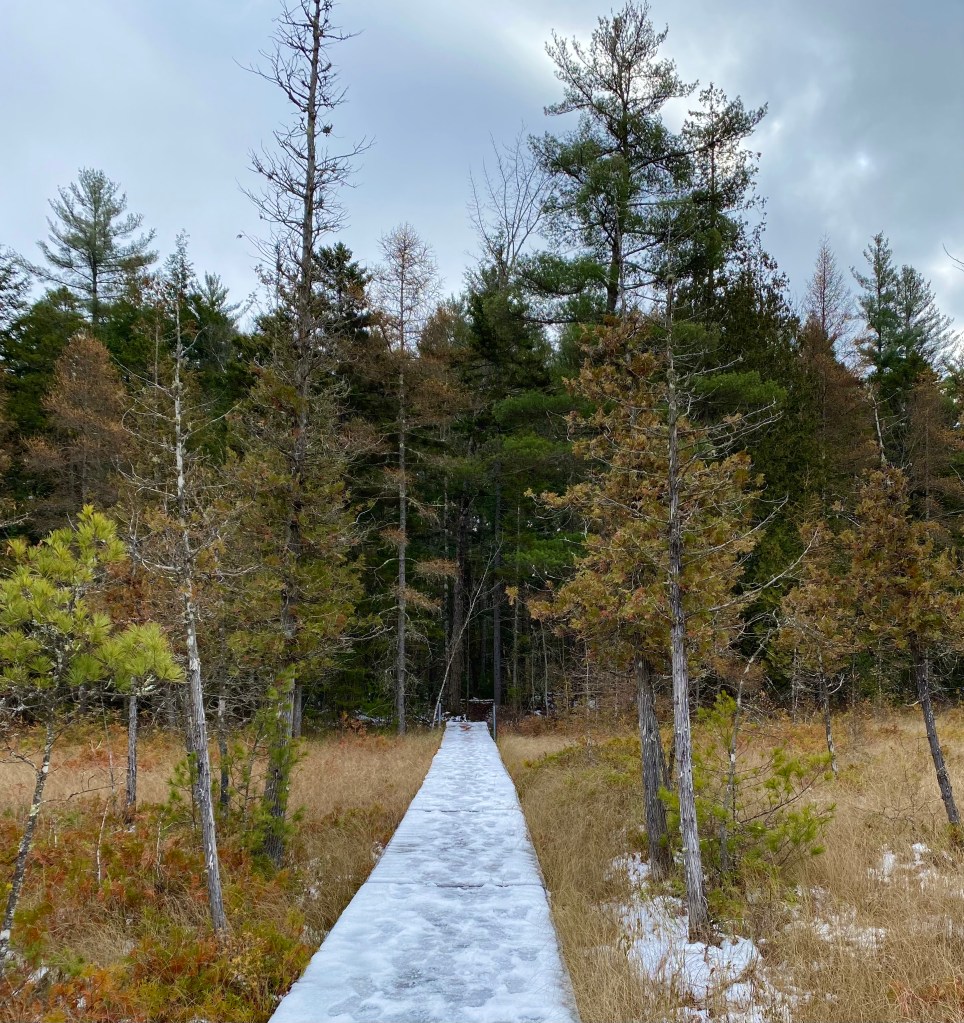
The trail where I ski changes every afternoon. The exposed earth eats away at the snow. The icy patches are harder, or the day has warmed and the snow swooshes mealy beneath my skis. In late afternoon, it’s me and the dog walkers, or two women, always deeply engaged in conversation.

The tech center students have half-tapped the sugarbush. The drop lines hang down in the back section of the sugarbush. The students are gone, too, leaving the tramp of their snowshoes, nothing more. The sunlight comes and goes all day, warm or gloomy. Fresh snow is scant this winter, and the trail’s ice is embedded with a scattering of hemlock and cedar greenery, small things that I fear will snag my skis but don’t.

The streams and rivers are running but the season of frogs is a long way off.

Finished, I clean nubbled ice from my skis with my fingers. A splinter is embedded in my thumb from a piece of firewood, stuck and sore. I press my thumb on the ice, listening for spring birdsong. There’s the sweep of wind, my heartbeat; nothing more.

There’s a reason why King Arthur’s knights were instructed to keep off the trails when searching for the grail, the logic being that if they were on the trail then they were following someone else’s path, so that particular path could not be their true path. Their only hope was to forge their own way through the woods. As Spanish poet Antonio Machado writes: “Caminante, no hay camino/ al andar.” Traveler, there is no road. You make the road as you walk.”

— Stephen Cramer

Mapping, Metaphor, Motherhood.

I forget my map on my desk beside my eternal list (write thankyous, double check FAFSA submission, confirm E and J meeting….) and drive over the Canadian border shortly after sunrise. Luminous crimson stripes the clouds. Almost immediately, the land flattens from Vermont’s hard ridges to industrial ag fields, distantly studded with metal silos. Late December, and the terrain is more gray than white. I stop at a gas station and ask a woman who is emptying her car of fast food wrappers for directions. I don’t understand her accent, the slipperiness of French that eluded me all those high school French classes. She wants me to understand, repeating her directions, one hand waving a crumpled bag. I nod thank you, thank you, and turn back to my salt-crusted Subaru, miserable with my lack of agility with language. Aren’t I a writer?

At a crossroads, I have no idea which road to take, and the world opens up abruptly in dizzyingly wideness.

My intention is to drive to Montreal to meet my daughters. I hate driving the dullness of interstate and fear driving into cities, and I’ve made this infinitely worse by losing my map. For years with young children in carseats, I delivered maple syrup around Vermont, navigating by atlas and rivers, the sun and roadsigns, using my tools of snacks and a box of board books. I once pulled over and lifted a handful of pebbles from a roadside so my toddler could dump pebbles from one paper cup to another, satisfying her tired self.

Now: no map, no cell service, in a town whose name (ridiculously) I never learn, I pull a Streetcar Named Desire card ask strangers to point my way out. A teenager shrugs. An old man can’t hear me. Finally, an electrician in a truck gives me directions. We repeat his directions to each other three times, and then I roll out, my heart not full of faith, precisely, but enough warmth of optimism. May this new year bring out the generosity of strangers and of ourselves. Thank you all for your kindness and curiosity for reading.

You should keep on painting no matter how difficult it is, because this is all part of experience, and the more experience you have, the better it is… unless it kills you, and then you know you have gone too far.

— Alice Neel