Traveler, There is No Road.

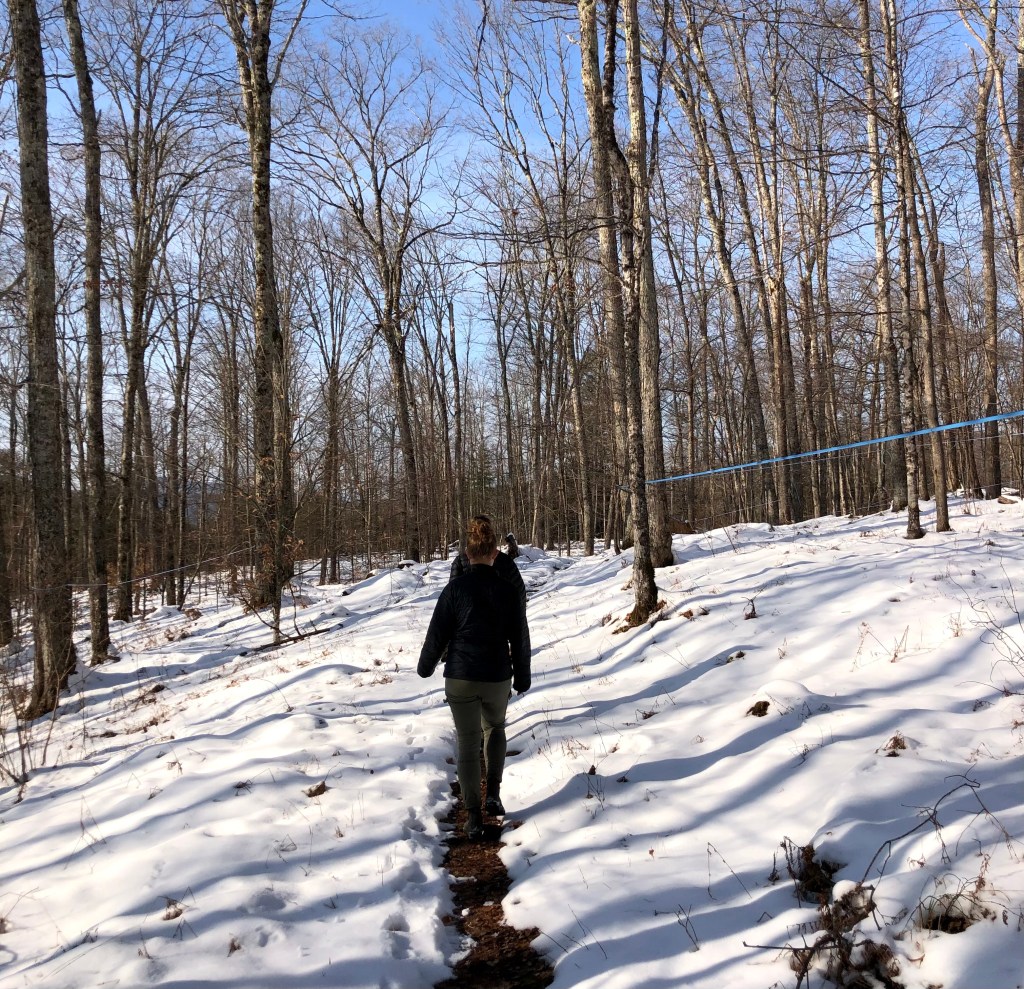
The trail where I ski changes every afternoon. The exposed earth eats away at the snow. The icy patches are harder, or the day has warmed and the snow swooshes mealy beneath my skis. In late afternoon, it’s me and the dog walkers, or two women, always deeply engaged in conversation.

The tech center students have half-tapped the sugarbush. The drop lines hang down in the back section of the sugarbush. The students are gone, too, leaving the tramp of their snowshoes, nothing more. The sunlight comes and goes all day, warm or gloomy. Fresh snow is scant this winter, and the trail’s ice is embedded with a scattering of hemlock and cedar greenery, small things that I fear will snag my skis but don’t.

The streams and rivers are running but the season of frogs is a long way off.

Finished, I clean nubbled ice from my skis with my fingers. A splinter is embedded in my thumb from a piece of firewood, stuck and sore. I press my thumb on the ice, listening for spring birdsong. There’s the sweep of wind, my heartbeat; nothing more.

There’s a reason why King Arthur’s knights were instructed to keep off the trails when searching for the grail, the logic being that if they were on the trail then they were following someone else’s path, so that particular path could not be their true path. Their only hope was to forge their own way through the woods. As Spanish poet Antonio Machado writes: “Caminante, no hay camino/ al andar.” Traveler, there is no road. You make the road as you walk.”

— Stephen Cramer

Mapping, Metaphor, Motherhood.

I forget my map on my desk beside my eternal list (write thankyous, double check FAFSA submission, confirm E and J meeting….) and drive over the Canadian border shortly after sunrise. Luminous crimson stripes the clouds. Almost immediately, the land flattens from Vermont’s hard ridges to industrial ag fields, distantly studded with metal silos. Late December, and the terrain is more gray than white. I stop at a gas station and ask a woman who is emptying her car of fast food wrappers for directions. I don’t understand her accent, the slipperiness of French that eluded me all those high school French classes. She wants me to understand, repeating her directions, one hand waving a crumpled bag. I nod thank you, thank you, and turn back to my salt-crusted Subaru, miserable with my lack of agility with language. Aren’t I a writer?

At a crossroads, I have no idea which road to take, and the world opens up abruptly in dizzyingly wideness.

My intention is to drive to Montreal to meet my daughters. I hate driving the dullness of interstate and fear driving into cities, and I’ve made this infinitely worse by losing my map. For years with young children in carseats, I delivered maple syrup around Vermont, navigating by atlas and rivers, the sun and roadsigns, using my tools of snacks and a box of board books. I once pulled over and lifted a handful of pebbles from a roadside so my toddler could dump pebbles from one paper cup to another, satisfying her tired self.

Now: no map, no cell service, in a town whose name (ridiculously) I never learn, I pull a Streetcar Named Desire card ask strangers to point my way out. A teenager shrugs. An old man can’t hear me. Finally, an electrician in a truck gives me directions. We repeat his directions to each other three times, and then I roll out, my heart not full of faith, precisely, but enough warmth of optimism. May this new year bring out the generosity of strangers and of ourselves. Thank you all for your kindness and curiosity for reading.

You should keep on painting no matter how difficult it is, because this is all part of experience, and the more experience you have, the better it is… unless it kills you, and then you know you have gone too far.

— Alice Neel

Stitches and Snippets.

At night, I knit and read, diligently counting stitches two-by-two before beginning the yoke pattern. I read about witches in 18th century New England, about muddy roads and fieldstone chimneys, about hunger and families and the complicated passions of small communities. About fear and remorse.

Around my house, the wind howls, lifting pine needles and crows’ feathers. November is the season of reckoning and looking towards the new year, of town and school budgets, of placing what you have beside what you want, of financial cost-and-benefit analysis, of a personal reckoning, too.

I remain awake unreasonably late, determined to proceed carefully this time to avoid ripping apart these stitches, anticipating the pattern work, the joining of color to color. Outside, I imagine smoke rising from our chimney, dissipating into the starry sky. A mouse nibbles in the wall. I keep counting.

“Writing a novel is a terrible experience, during which the hair often falls out and the teeth decay. I’m always irritated by people who imply that writing fiction is an escape from reality. It is a plunge into reality and it’s very shocking to the system.” 

— Flannery O’Connor

Last the third Vermont Almanac —one of the loveliest (and most useful) print publications — is out. The Almanac folks are virtually kicking off the third edition at Burlington’s Phoenix Books Thursday night, 7 p.m. You should come!

November.

I must appear half-drowned when I walk into the library, because the librarian asks me just how bad is the weather?

I reach into my jacket and extract a few books, then slip under my sweater the one he hands me. Three-thirty in the afternoon, and a dark rain presses against the windows. The weather reminds me of Ethan Frome, of Walden, of the wildness of Dostoyevsky, the human longing for a hot hearth and candlelight over a bowl of soup.

At home, my cats — self-satisfied as cats are — are pleased they survived the visiting dogs. They’ve regained their places before the wood stove, still slightly disdainful that we’ve allowed in the canines. There’s no one out, the roads nearly deserted, the sky concealed beneath the clouds. A wet wind blows.

At home, I wash the dishes and empty the compost in the bin beneath the apple tree. A cardinal flies into the tree’s thickety branches, a welcome sight.

“There are two ways of spreading light: to be the candle or the mirror that receives it.” 

— Edith Wharton

Days of Little Light.

Night has fallen down all the way by the time I leave work. Just below freezing, the wind cuts up with a taste of wet — the feel of sugaring season but the light is all wrong. It’s a month before the solstice, and now I’ve given into the darkness utterly. The truth is, much as I rail against the scantness of light at this annual time, I relish it, too. This time of year entices us to go deep, soul-search, spread out the cards and see what’s there.

Dark to dark, our days go. My daughter phones on her way to work, two stray cats yowling in her car. She’s bathed these hungry creatures and found a home for them, a tiny bit of kindness in the midst of a complicated world. Ever in her blur, she hands off these cats to a new home, blessing them in her own way, and moves on into her day.

“What does it mean to grow rich?… Is it to retain a capacity for awe and astonishment in our lives, to continue to hunger after what is genuine and worthy? Is it to live at moral peace with the universe?” 

— Barry Lopez

First Snowfall, Again.

In a race with the season’s first impending snowstorm, I drive home from southern Vermont in those numberless hours of the night. I-91 northward to St. Johnsbury is bereft on traffic on an ordinary day. In the pocket of night, it’s me, a few rocketing cars from New York and Connecticut, interspersed long-haul truckers hurrying elsewhere.

I drink espresso and listen to This American Life, and when my attention wanes, Sam Birger and Fresh Air keep me company with Michael Imperioli. In the vessel of my Subaru, swathed with the blindness of night, my radio is oddly intimate.

Somewhere in that stretch, I do what I’ve cautioned my daughters never to do: I stop at a closed rest area and walk up and down the sidewalk vigorously. The night, with its promise of snow rushing in, bites coldly. Two trucks idle. The rest area is lit by lights tinged an orange-yellow, suffused with mist, as if we’re in a nether world, maybe the Underworld, maybe a halfway point between two realms. There’s such a strange, almost heady relief in being this unknown place, the allure of endless miles unfolding before me. My mind is filled with the night’s experiences — an enchanting home, the stories of strangers, a woman who poured out her heart about a funeral she attended that afternoon — the embrace of what’s resilient in our Vermont towns and what’s broken, cracked, fissured. I follow my advice to strangers and take my time, breathing in that damp and diesel-choked air, the freshness of wetlands at the far end of the lot, where the ground has not yet frozen. I wear my wool hat and a thin cotton dress. The night goes on and on.

In the morning, snow falls steadily. My daughter and I drink coffee and eat Helga’s delicious blueberry torte and lemon mascarpone. A shift already, from gray November to winter’s enchanting light.