Duskier and Duskier.

Chickering Bog

My brother and I have this odd (and likely annoying) habit of repeating the same word or phrase back to each other. In a November weekend interlude, he says duskier, which sums up these November days. I toss it back to him — duskier — then add gloaming.

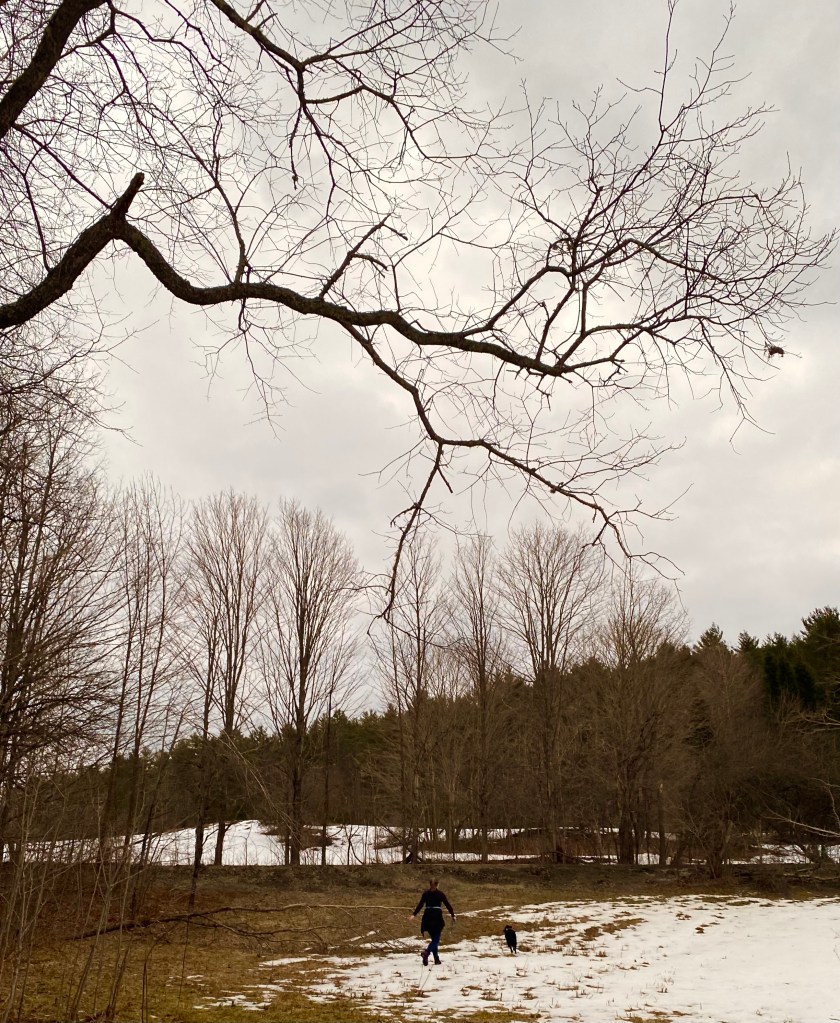
To break the gloom, we walk through woods not far from my house. Little streams run. Somone has built enchanting steps of fieldstones. At the path’s end, a bog stretches out, the tamarcks’ gold faded pale. Spring, summer, the birds sing wildly happy here. Now, the flutter of wings, nothing more.

There’s a place for all of this: silence and settling down, the drawing in for winter.

Come, for the dusk is our own….

— Lucy Maude Montgomery

Continuing without a sign.

An inveterate list-writer, at the end of each day, I’m often summing what I’ve done. Somedays, my hands and my hand seem to come up empty. Or my heart has articulated a question.

I pass a few days drinking coffee and talking with my daughters, walking through the woods, along rivers and streams and a rock-throated gorge. They’ve teased me for years about my focus on the gritty and hardscrabble, my fascination with wandering into abandoned cellar holes, my curiosity about abrupt turns in human stories. But when has the world ever not been falling into pieces? There’s this, though: surely at times the world’s misery spins harder and swifter and unbearably more painful.

In those cellar holes, gardens of flowers and sustenance once bloomed at doorsteps, their seeds dormant in the soil. Sunday, nearing dark, I brake for wild turkeys meandering across a dirt road. There’s no one around. I pull over and walk down the road to snap a photo, but the turkeys suddenly rush, hearing my footsteps, and I’ve forgotten my phone in the car anyway. I’m at a driveway that bends up the hillside, the house of out sight. Many years ago, the man who lived there offered me his dead wife’s fur coat. He must be long gone, too. I’ve long since lost any sense of who lives there now.

“Matins”

You want to know how I spend my time?
I walk the front lawn, pretending
to be weeding. You ought to know
I’m never weeding, on my knees, pulling
clumps of clover from the flower beds: in fact
I’m looking for courage, for some evidence
my life will change, though
it takes forever, checking
each clump for the symbolic
leaf, and soon the summer is ending, already
the leaves turning, always the sick trees
going first, the dying turning
brilliant yellow, while a few dark birds perform
their curfew of music. You want to see my hands?
As empty now as at the first note.
Or was the point always
to continue without a sign?

— Louise Glück

Go on and wonder.

I skip out halfway through a Selectboard meeting and take a backroad home. Since the floods, I haven’t driven these dirt roads. The roads are back together mostly, with rocky channels on either side of the steepest places. At the road’s highest place, I pull over.

August light.

I’d started that morning in jeans and a sweater, working on my back deck while rain splattered down, the morning large with a cold damp breeze that made me wish for socks in my sandals. This evening, I’m wearing a sundress again.

All summer long, we’ve been collecting complaining about the summer in Vermont. First, no rain. Then, too much rain. I have plenty of firewood left from the tepid winter, and then burned fires into the summer.

The evening spreads out radiantly. For this moment, I’m in no rush to head anywhere, so I park and walk down the road a short ways, crickets sizzling in the hayfields. A pickup rolls slowly down the road. The driver, an acquaintance, stops, and we chat for just a moment, about the particular green and blue surrounding us, then he glides away.

Light in August. My father bought me a used copy of Faulkner’s novel for a dime in a used bookstore. I was a teenager, a fanatic of Tolstoy and Dostoyevsky, those immense Penguin paperbacks that were so gratifyingly fat. I kept that copy with me for so many moves, thousands of miles, and I’m guessing I have that version yet, crammed on my bookshelves.

Faulkner’s world is the complexity of past and present, the world jammed against our faces right now, floods and fires. This morning, again, a crimson dawn, curls of fog in the blue valley. My east windows need washing. Get on this, I think, get on this…

“Wonder. Go on and wonder.” 

— Faulkner

Water, Water.

These days, I’m working in a town clerk’s office, Greensboro, Vermont, population approximately 827. With summer folks, the population swells to three times.

Yesterday, the phone rang all day. We propped the door open, and people wandered in with questions.

Can I get to Craftsbury? Which roads are out? I have a dump truck; want me to haul fill? I’ve lost everything; do you have extra clothes, shoes, blankets?

Selectboard members set up a triage system to patch roads where anyone was stuck. Farm roads were prioritized for milk trucks. All day long, Vermont Public Radio updated us. Montpelier, beloved capital city, is underwater, threatened by a dam where waters rose precipitously.

Late afternoon, the selectboard chair rummaged for leftover potato chips from the July 4th celebration. By then, the sun had emerged. The July day was hot, redolent with blooming roses. I had my own petty worries: my car was low on gas, and I’ve kicked a front brake repair too far down the road, and I’ll need to find a mechanic stat, and who I’ll find isn’t yet clear to me. Later, I’ll call my brother and talk about my parents while weeding my neglected garden. For some time, though, we stood in the parking lot, breathing in sunlight, waiting for a contractor to look at one of the town’s paved roads that’s severed in multiple places, the asphalt broken into multiple chunks. When could he get here with an excavator and put that back together?

A friend drove up and told us about mutual friends in a nearby town. They had been out in the stormy night. Travelers on I-89 had been diverted off the interstate and wound up driving through the backroads of a rural town they didn’t know. By flashlight and headlamp, in a driving rain, water roaring down hillsides, the residents directed the strangers to a safe haven, where they weathered the night.

Wild Strawberries under Wildfire Smoke.

In Willey’s — the rambling general store where you can buy electrical supplies, French wine, local produce, bananas and darn near everything else except cigarettes — I turn a corner and find an old friend. She has a sunburn and I think: where have you been? We are both in some kind of rush that we talk, separate, and then knock up against each other again and again. The store is jammed to the ceiling with stuff, but it’s not that large. At the register and then out into the street, we keep talking. She’ll filled with such good energy I want to pocket some of her joy.

Every day, rain falls. Clotheslines droop. My feet are spongy in sandals. The Blundstones my daughter bought me a few years back split at the soles. It makes sense to wear these beloved shoes right down to wet scraps. I open and close the windows — is it hot? is it cold? The garden soaks up the water. The woods are lush and lovely, redolent with wet bark, the tanginess of split leaves.

The wild blackberries blossom profusely, the green berries now knotting. It’s nearly July, the season that means swimming and long lingering evenings watching the twilight drift down. Not so, this year. The pandemic made abundantly clear that we are connected to each other — both neighbors across the street and strangers around the globe — in ways that matter not one whit whether we like it, or not.

This summer breeds contemplation, more November than cusp of July. In that vein, here’s a few lines from the immortal T. S. Eliot in Four Quartets:

... The wild thyme unseen and the wild strawberry,
The laughter in the garden, echoed ecstasy
Not lost, but requiring, pointing to the agony
Of death and birth.

 You say I am repeating
Something I have said before.
 I shall say it again.

Shall I say it again? In order to arrive there,
To arrive where you are, to get from where you are not,
 You must go by a way wherein there is no ecstasy.

In order to arrive at what you do not know
 You must go by a way which is the way of ignorance.

In order to possess what you do not possess
 You must go by the way of dispossession.

In order to arrive at what you are not
 You must go through the way in which you are not.

And what you do not know is the only thing you know
And what you own is what you do not own
And where you are is where you are not...

18th Birthday.

Here’s the thing: 18 years is a whole lot of parenting. 18 years is hardly a heartbeat.

My youngest was born by caesarian at 8:13 a.m. Leaving the hospital a few days later, corn nubs had emerged through the soil. As we drove by farm fields, I admired the new corn, marveling at its beauty. I had seen corn growing my whole life. And yet….

Perhaps that and yet sums up parenting. As a little girl, my youngest wore a green fairy tutu from her grandmother for about two years straight. These days, we are past the days of tiny teacups and Go, Dog, Go. Our family dynamics are now getting down to the hard questions: what does it mean to be a woman? what shall I do with my life? and how many times does sunscreen really need to be applied on a senior skip day at the beach? The questions go on….

blessing the boats

                                    (at St. Mary’s)

may the tide

that is entering even now

the lip of our understanding

carry you out

beyond the face of fear

may you kiss

the wind then turn from it

certain that it will

love your back     may you

open your eyes to water

water waving forever

and may you in your innocence

sail through this to that

— Lucille Clifton