“… a definition of love…”

All afternoon, I work on my back deck. Hummingbirds dart at the hanging nasturtiums, rain sprinkling down around the porch roof. In the late afternoon, I swop jeans for shorts, tie on my shoes, and head out for a run. I run for maybe a mile, no more, then walk in circles, my hands on my hips. The mid-August world is a crazy abundance, hydrangeas and Queen Anne’s Lace reveling in their showiness.

I had thought I would never run again, that kind of energy and strength irremediably sapped by disease and treatment. Yet, this afternoon, I determine, Well, what you do know… Ahead lies a long evening of a Selectboard meeting in a particularly Vermont-vein: the nuts-and-bolts of the town’s daily business of salt and sheriff contracts, what to do about wastewater, and the passion projects of conserving land and eliminating streetlights. A microcosm of the country in a former schoolroom where everyone is on a first-name basis. Like it or not.

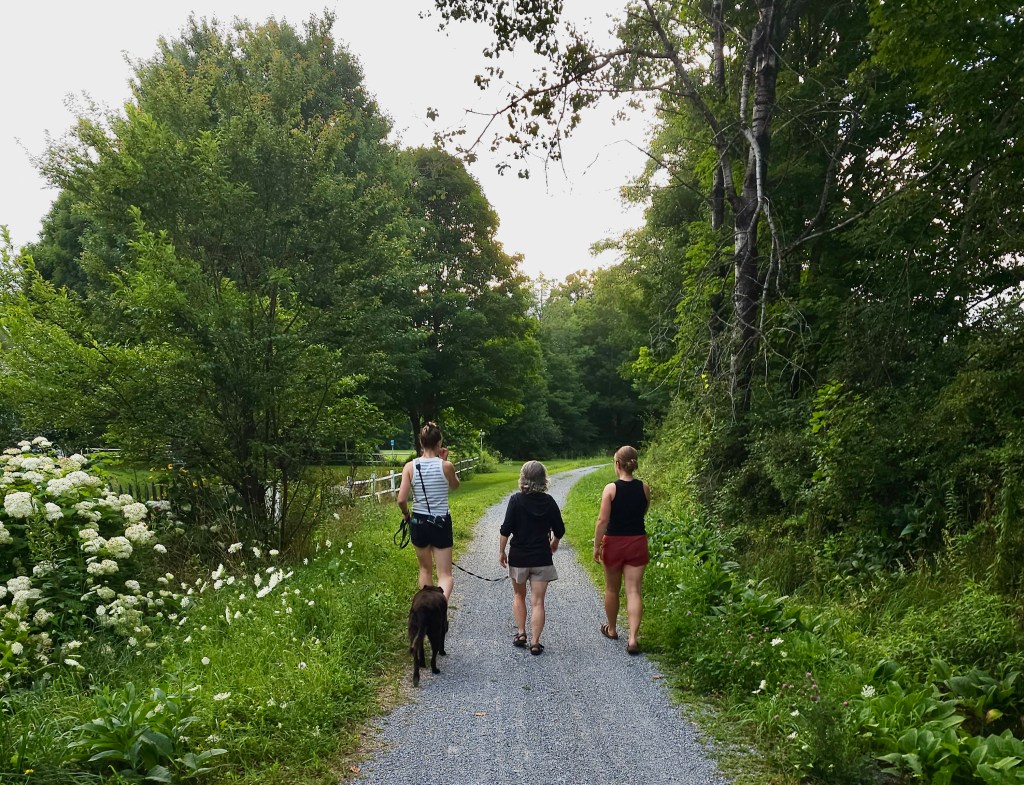
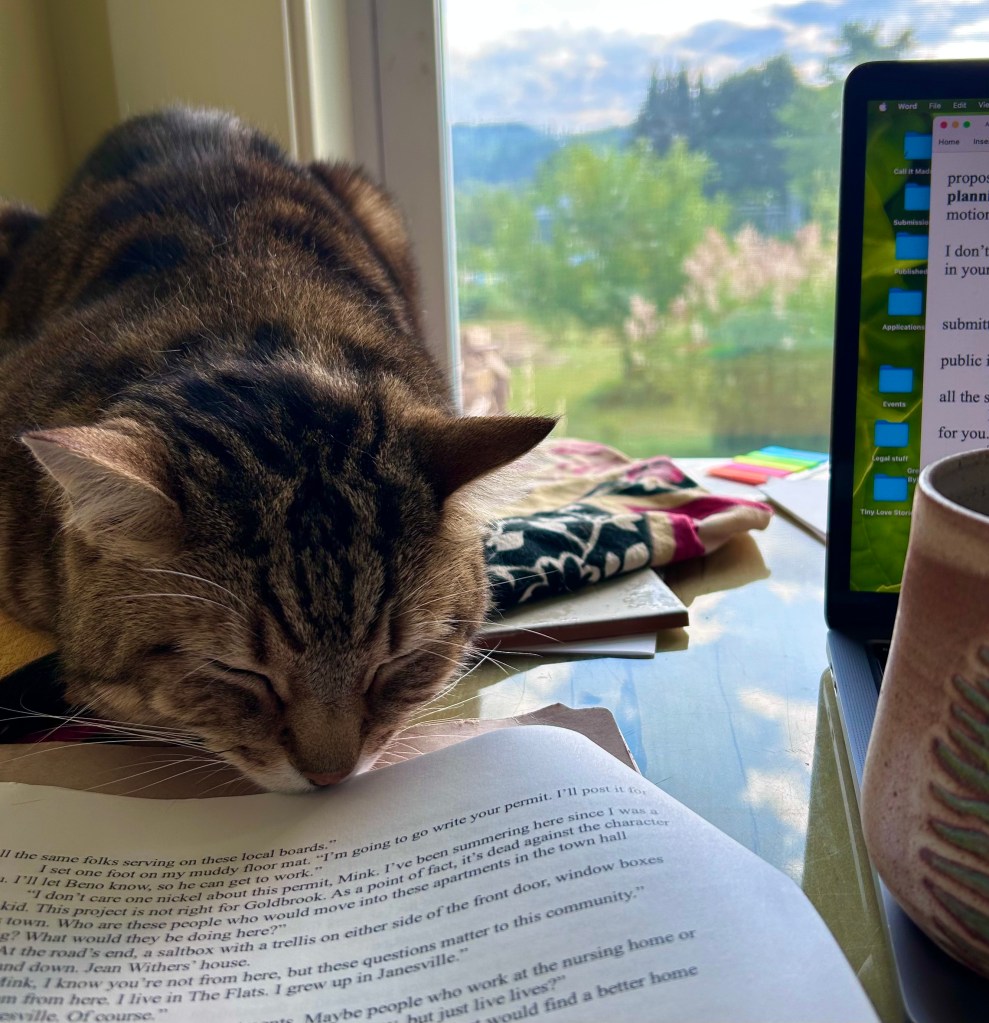
Long past nightfall, I’m home again, lying on the couch and reading Louise Erdrich, cats between my knees, the windows open and the crickets sizzling. Above, photo of myself with beloved daughters. After chemo, my hair returned in ringlets, the straight hair of my childhood replaced by exuberant happiness.

“Green Apples” by Ruth Stone

In August we carried the old horsehair mattress
To the back porch
And slept with our children in a row.
The wind came up the mountain into the orchard
Telling me something:
Saying something urgent.
I was happy.
The green apples fell on the sloping roof
And rattled down.
The wind was shaking me all night long;
Shaking me in my sleep
Like a definition of love,
Saying, this is the moment,
Here, now.
A few known things: sand, evening…

These August days are yet long, lingering exquisitely. Days of heat and sweat. Noon, we drag a picnic table beneath a maple tree, spread out our lunches, eat and talk with the sunlight dappling through the leaves, a small breeze kicking up. The nearby road is busy with pickups laden with ladders and mowers, suntanned arms crooked out unrolled windows, and the vacationers at their leisure. This August day hums magnificently, with that dappled sunlight and cicadas.

I receive an email about my novel Call It Madness from a woman in the middle of the country, not far from where my mother grew up, so many decades ago. We email back and forth a bit about class and working and how those two forces of writing and living can sharpen your eyes, if you lean into it.

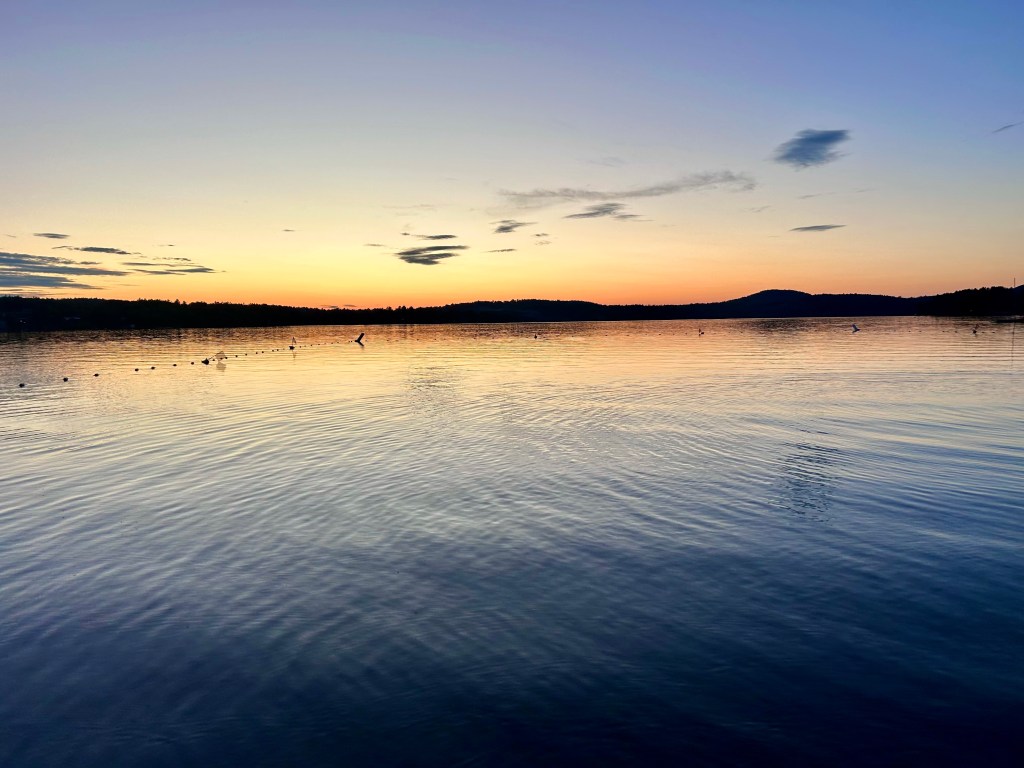
Surviving cancer taught me countless things, too, made me both more tender and more ruthless, two things seemingly at odds but not. The world is a variated unfolding story of cause and effect. In my novel, a man mangles his hand in a sawmill accident. Decades later, his great-granddaughter struggles with the family fall-out of that accident: a farm lost, a penalty of impoverishment. I glean what I can of my own story — the murky details of my past (my mother’s changed name, a story my father shares of remembering his father burning his army uniform in a backyard fire) — and appraise how I fit into the terrain of the world around me. Swimming at twilight, the lake both golden and black, those elegant 1 Corinthians words return to me: When I was a child, I spake as a child, I understood as a child, I thought as a child: but when I became a man, I put away childish things. For now we see through a glass, darkly; but then face to face: now I know in part; but then shall I know even as also I am known.

I’ve been swimming at this sandy stretch for nearly thirty years, once upon a time with children and sand buckets. The water is yet magnificent. Sand clings to my wet bare feet. The day has cooled, refreshing as quaffing water when you are thirsty. The sand scatters on my kitchen floor. Something, I think, I’ll need to sweep. This morning, the sand remains.

July, Sweet and Sour.

I read in the New York Times that Catcher in the Rye turns 75, a novel my mother first shared with me. My parents owned little fiction; our house was mostly filled with philosophy books, David Hume (who I never read) and Plato and Aristotle. In those shelves was jammed a copy of Huckleberry Finn and Salinger’s Catcher in the Rye and Ten Stories, drug-store paperbacks held together with rubber bands. Books I love — and maybe you do, too.

In this lushly lingering month of July — filled with sun and swimming, with work and chores — I’m lucky to have scheduled a dozen readings for Call It Madness, this novel about Vermont and family and how the sodden past shapes our lives. Of all the books that reflects my life, Long Day’s Journey into Night surely ranks at the top. A reader pointed out to me recently that Call It Madness moves forward linearly, but is packed with the past, events that happened decades ago that remain as vibrant as this morning’s news.

I write in the world of cause and effect — our actions always propel consequences — but the past with its radiant joy and unquenchable sadness propels us mightily. Nonetheless, the pear trees previous owners planted in my front yard bear reddening fruit. The bees suck globe thistle. Sunday evening, I walk far along the river, the running water sunk low among exposed rocks. The sunlight lingers — so much light in these days sugary with freshly-mown hay. I’d like to pocket a handful of July and return in January: humans, we can launch ourselves to the moon but July-in-January is impossible. Nothing to do but quaff the present while it exists.

hydrangeas
pale blue in the rain
blue in the moonlight

By Masaoka Shiki | Translation by Lucien Stryk

Singing a Love Song, Swimming.

It’s nearly 8 in the evening by the time I step into #10 Pond, the sun slipped down around this narrow pond surrounded by mountains, my only company two teenage girls who stand on the shore talking about a mother’s car—these girls and a loon calling.

I part the still waters and swim out. Despite raging heat elsewhere on the globe, Vermont’s summer holds a chill, and by the time I swim back, I’m cold. On the shore, the girls have disappeared, and under the twilight sky it’s just shivering me toweling off water, pulling on a sweatshirt. All afternoon, I’ve thought of this water, of the sky turning from blue to black, of the mud beneath my bare feet, the loon chorus. It’s been a day of work and laughter, nothing rotten that I’d like to leave at the bottom of the pond; nonetheless, July moves along, the relentlessness of time. I crave these moments of water and sky, of reading beneath the apple tree’s shade, dinner near the garden, as much sun and wind and, yes, cold water as I can bear. Sustenance.

“But some nights, I must tell you,
I go down there after everyone has fallen asleep.
I swim back and forth in the echoing blackness.
I sing a love song as well as I can,
lost for a while in the home of the rain. ”
― Billy Collins

Eating Roses.

I’ve just finished stacking a fallen-down section of woodpile when a friend texts and asks if I’m interested in a twilight walk. Heck, yes. With my thumb and fingernail, I snip a rose and carry the fragrant pink beauty cupped in my hand as I walk towards my friend’s house, trailing tender petals.

We meet at a halfway point between our house. To my surprise and delight, she eats the rose.

In the lingering light — June’s gold and green beauty — we walk along the rail trail and pause at the bridge over the river. Leaning on the railing, we talk about all the things — family and money and loneliness — while the river runs over and around the boulders and bends around the forest, heading through the village.

Darkness drifts down when I finally head home through the scent of clipped lawns, the roses along the Catholic parsonage, the seduction of garlic from the downtown restaurant, its door propped open, a woman rubbing a cloth over the bar.

Vermont June. Mighty, magical month.

And…. book launch for Call It Madness, this Tuesday, 7 p.m., hosted by the Galaxy Bookshop at the Jeudevine Memorial Library’s amazing addition. If you’re around, come!

Lucky.

August is exceptionally hot this year, the rivers so low they can be crossed by foot. In the woods, streams have dried to rock beds. In Montpelier, the state’s tiny capital, I walk by a store with bright bowls in the window and think, My mother would love this store. She passed over a year ago, and yet I still catch myself thinking that she might appear around a corner, her purse tucked under her arm, amused at me. Of course I’m not gone…

My father, the physicist, schooled his three kids early on about entropy. In a week where things repeatedly broke — the hot water heater leaking, the Jetta refusing to start in the rain — he made jokes that we were in a High Entropy Zone. So, this lovely August, with the chorusing crickets and the waning red moon — I’m determined to suck each day to its marrow. Sandwiched around work and the steadiness of washing dishes and so on, I’ve pushed aside space for swimming and ice cream, for lying under the apple tree and studying a spider spin her web. The entropy of living keeps on, as it does.

In the years when I was raising my own young daughters, our days zigzagged from bowls of blueberries to bath time. The days were endless, and the years rushed by. Now, my girls newly grown, I relish the silence and crave their company. Lucky I am, so lucky, to be alive this summer, this month, these days. All day long, I walk around with my tender heart cradled in my hands, wounded and raw from cancer, from weeks of hospitalization, from the knife of mortality pressed against my windpipe. August: the season of great loveliness, the intimation of winter. The reminder to love where and what we are.

Hitch Hiker at a Truck Stop

The hitch hiker asks to look at

the palms of my cold hands

and thanks me for unfolding them

on the frost-edged

picnic table between us.

While I look at his downcast eyes

trying to see if he sees,

nearby truckers stare

at his narrow face,

long blond hair.

He asks me if I garden,

rips a scrap of newspaper

and folds it up

into a tiny origami

package for anise seed.

Here, he says,

seed I gathered in Oregon,

plant it in Colorado.

I always have a garden, he adds,

I plant and leave to others.

He tells me he has no sex;

when you ride in the righthand seat,

you have to nod your head

without listening.

Face pressed to the window,

he can see the lacquered edges

of the earth.

So I imagine him 

practicing calligraphy

on truck windows,

recommending honey and vinegar

in a glass of water

every morning.

Mad, mad, mad.

A yellow warbler,

the moon at the bottom of the stream.

Out on the highway

he is raising his thumb again. ~ Mary Crow