Launching, Laughing (and Learning)

Stronger than espresso, spring roars into Vermont this Sunday afternoon.

Busy, busy, those singing robins building their nests. Busy me, emptying ash buckets and raising mud-soaked pallets from a wood pile burned to cinders back in January.

But it’s the kids who are most fiercely passionate about their work: it’s the opening of the Trampoline Season, requiring a search under the basement stairs for a missing spring, socks with gripping marks dug from a drawer, a stepladder precariously sunk in a snowbank as a launching pad for jumping.

The kids intend to grow six inches taller this year. They have work to do. And they are out there, doing what needs to be done in the realm of childhood. Finally: spring is on board with their plans.

Here’s a few lines from my late-night reading:

Questions about happiness generally assume that we know what a happy life looks like. Happiness is often described as the result of having a great many ducks in a row – spouse, offspring, private property, erotic experiences – even though a millisecond of reflection will bring to mind countless people who have all those things and are still miserable.

– Rebecca Solnit, The Mother of All Questions


FullSizeRender

Primordial Ooze

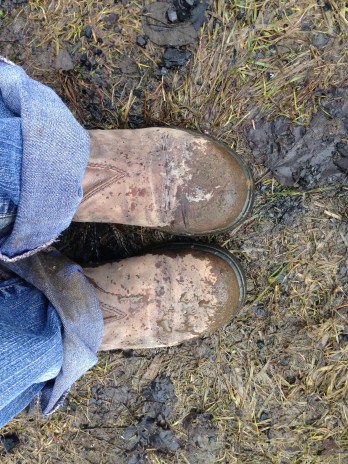
If there’s one overarching image for springtime in rural Vermont, mud might be it.

With this rain, we’re deep in the season now, rutted roads and marshes of mud surrounding the house, bleeding up through melting snow. Come, come, bring us the woodland trilliums and spring beauties.

Restacking my fallen woodpile in the shed, assessing what remains, I find a hard-used outgrown child’s scooter, the green ball from our croquet set, a valuable cache of birch bark I’d stashed for kindling, and the center row of wood that was mud-covered when I’d stacked it.

The firewood had been delivered on a sunny August afternoon by a young woodcutter who dumped it in piles around the shed. A quarreling neighbor, in a fit of pique, had used his tractor to shove one of my piles into the mud. Now, that neighbor’s moved on. I lifted a piece of wood and banged it against the woodshed, loosening the dried mud.

How’s that for a literary metaphor in one piece of maple? The craziness of human relations, the sullying of sacred hearth, metamorphosis of mud, and that spinning cycle of change and unending Becoming.

Spring is not a season of Hallmark pastels in my world, but tiny treasures of crocuses  and snowdrops, the memory of my teenage daughter as she stepped out on the porch when the young woodman arrived that August afternoon. She was cooking dinner and carried a clove of garlic and a sharp knife. Welcome, she said to woodcutter, with her wide smile. We’re glad to see you.

Really, the fundamental, ultimate mystery — the only thing you need to know to understand the deepest metaphysical secrets — is this: that for every outside there is an inside and for every inside there is an outside, and although they are different, they go together.

– Alan Watts

IMG_0499

Squishy Season

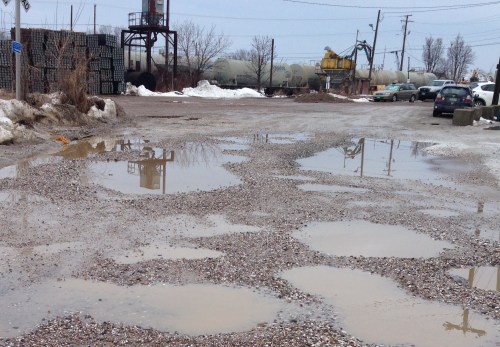
‘Tis the season of mud in Vermont. I once had a neighbor (now relocated back to an enormous city) who hated mud. Her daughter and my daughter were both little then, with rubber boots and pink raincoats decorated with kitties, and the girls adored splashing in March and April puddles, digging with sticks in the ditches along our roadsides, and baking mud cakes in kitchens they built with fallen branches, on carpeted floors of pine needles. Sweet days.

The girls spent many more hours at my house than at hers, shedding their filthy and soaked clothes on our porch and sprawling before the wood stove to warm up, eating popcorn and drinking honeyed tea and giggling. Sweet days.

Let us settle ourselves, and work and wedge our feet downwards through the mud and slush of opinion and tradition, and pride and prejudice, appearance and delusion, through the alluvium which covers the globe, through poetry and philosophy and religion, through church and state, through Paris and London, through New York and Boston and Concord, till we come to a hard bottom that rocks in place which we can call reality and say, “This is and no mistake.”

– Henry David Thoreau, Walden

FullSizeRender

Burlington, Vermont

One More Reason to Like Vermont

Vermont’s Congressional delegation came to our local high school yesterday, Hazen Union in Hardwick – Bernie Sanders with his mighty vehemence and voice, Leahy with his longevity, and Welch with his even-handed thoughtfulness. Welch joked that Vermont’s delegation could meet in an elevator – and does.

But Bernie was the one who got the packed gymnasium cheering loudest. He began with acknowledging that these are tough times, strange days indeed, but, nonetheless, he said, I woke up feeling pretty good this morning. To his loyal crowd of fellow citizens, this boundless optimism shone: the steadfast belief in goodwill, the persistent faith in a moral universe.

All of us share this world for a brief moment in time. The question is whether we spend that time focussed on what pushes us apart, or whether we commit ourselves to an effort – a sustained effort – to find common ground, to focus on the future we seek for our children, and to respect the decency of all human beings.

– Barack Obama

FullSizeRender


Break That Cliche: Writing Lesson from the Kids

My ten-year-old came downstairs the other morning dressed in shorts although it was only 39 degrees. No. I immediately said. But it might warm up, she insisted.

In this afternoon’s rain, the kids have headed down the road to the neighbors’ trampoline because it’s fun in the rain, apparently, even in a cold May rain.

These Vermont kids, like the unfurling leaves in my apple trees, are vigorously unstoppable with their own flowing sap. At ten and eleven, the world is as new to them as this magnificently unfolding spring. Lacking rigid expectations, why not leap in the rain? – Although I did notice the girls had the foresight to pull on extra pairs of socks.


The artist, and particularly the poet, is always an anarchist in the best sense of the word. He must heed only the call that arises within him from three strong voices: the voice of death, with all its foreboding, the voice of love, and the voice of art.

– Federico Garcia Lorca

IMG_1184.JPG

Vermont dusk

Commune Scene

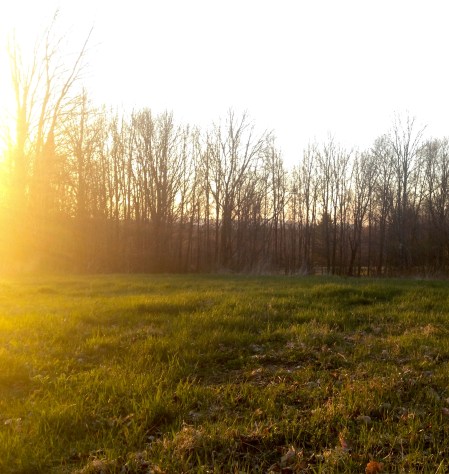
Green, green, green! Last night, reading about Vermont’s commune scene in the 1970s, I had to laugh about hippies coming to Vermont in the glory of summer, and then finding winter a different reality altogether. In a Vermont spring, every day, the black earth yields violet, buttery gold, emerald green.

Working in the garden in the late afternoon, I can fully imagine the hippie joy at this green paradise. Come the snowy season, though, and the idealism must have quickly faded. Having written a book about Vermont and youthful idealism, having given my own blood to this black and sometimes cold earth, on a day like today, Vermont is well worth enduring the stay. Today, I can pass on the Huck Finn advice.

(The back-to-the-landers of the 1970s) were acting, in part, on a characteristically American assumption that if things get bad where we are – too hectic, too dangerous, too messy – we can simply decamp to a new frontier and start again, that all we need to begin a new venture or even create a new society is a new piece of land.

– Kate Daloz, We Are As Gods: Back to the Land in the 1970s on the Quest for a New America

FullSizeRender.jpg

Woodbury, Vermont