Rivers’ Roar.

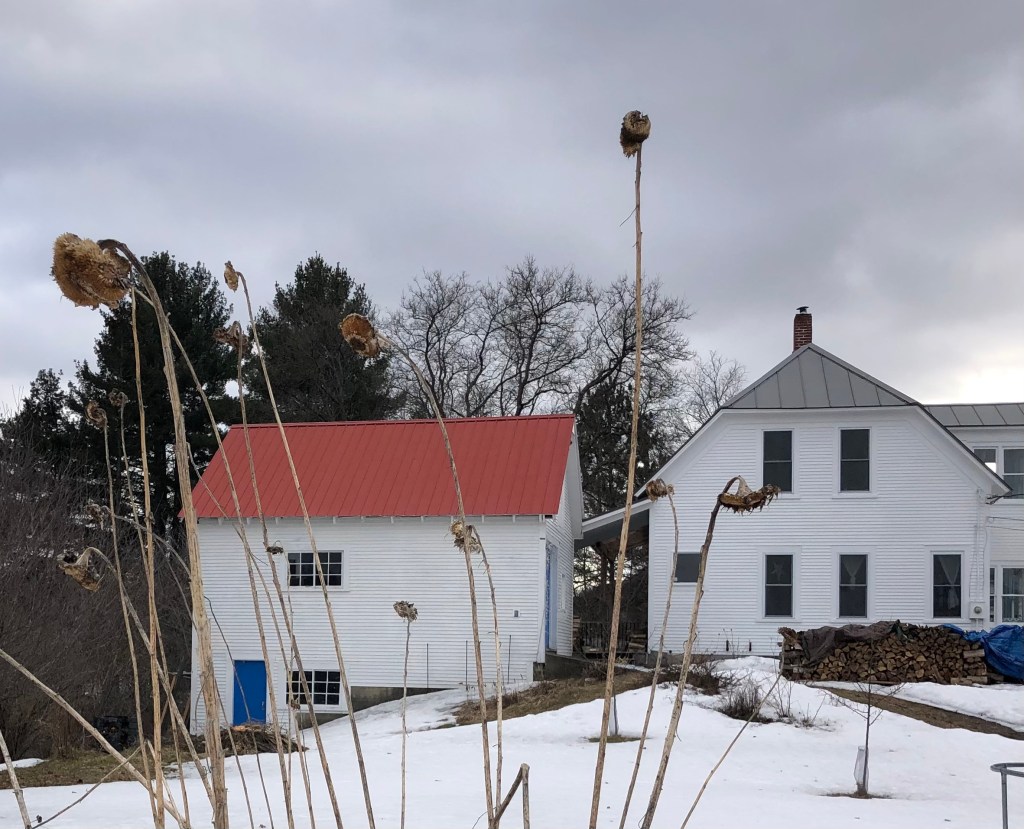
Caspian Lake, Greensboro, Vermont

The rivers are running again. I pause on a Sunday morning run, on a large bridge state money funded for the rail trail project. The river roars in spring lust. People can — and do — drown in April. This season is as fierce as winter.

The countdown has begun, the green steadily eroding the brown.

A year ago, my family was quarantined with my daughter’s positive Covid test. Yet unvaccinated, I lay awake at night, wondering why I hadn’t yet written a will, why I hadn’t added my oldest to my skimpy bank account. During the day, I painted the inside of our porch windows a brilliant blue and listened to Derek Chauvin’s trial for the murder of George Floyd.

When the jury verdict was read, our quarantine had ended. My youngest and I were sitting my car, listening to the radio, waiting for her soccer practice to begin on a cold evening. A V of geese flew over the wet field.

Years fly by. Sure. But that year doesn’t seem like yesterday. It was one full year. While my daughter played soccer, I walked among the cedars along the river, watching the remaining pieces of ice dislodge and wash into water.

…. In other news, grateful for two lovely review of Unstitched in Montpelier’s The Bridge by Tom McKone and for Tyler Orion Glauz-Todrank’s review in Lucky Cloud Books.

Green and Brown.

Greensboro Grange, Vermont

A flock of singing red-winged blackbirds kept me company yesterday on my short walk from the village along the frozen lake. Summers, sprawling houses fill with people from other places, more urban areas, but in this nether zone of late winter/early spring — the mud realm — it’s just me and the rain and the birds.

Of all the seasons in Vermont, this odd one seems the most miraculous to me. Out of dull brown, last year’s frost-killed season, tiny nubs of green appear. So much promise. Every year, this surprises me.


Some springs, apples bloom too soon.

The trees have grown here for a hundred years, and are still quick

to trust that the frost has finished…

You could say, I have been foolish. You could say, I have been fooled.

You could say, Some years, there are apples.

~ “Gather” by Rose McLarney

Next Steps.

A fierce year for mud in Vermont — the schools send home notices that the busses cannot run. My friends in southern Vermont live in a town where the schools have closed up for a few days. Heck, why not? A basketball game has spread Covid around through the community again, anyway.

Back from my visit to my parents in New Mexico, I work long days, catching up. On the phone with a stranger, I share a little of my trip, and he tells me about his mother. Listening, I stare through the window at the snowflakes fluttering down, little spits of flakes swirling in a gray sky. Then he clears his throat and advises me on my next steps.


Pain Management
by James Silas Rogers

One day, in your forties or fifties,
you will start to think that life is turning
into a long string of small extinctions.
You will feel the word gone rise inside you
and might even say it aloud, quietly, the way
you would say it if the house had been robbed
and, months later, you reached for an item
you never knew was missing, thought had been
in a drawer the whole time: Gone. Add these
to the workaday wrong turns you half-knew
were coming from the start-you know: the shy
girl with trusting eyes with whom
you did not sleep, the dad who let you down—
and you will begin to think that if you started
crying now, you might never be able to stop.
But that doesn’t happen.
What happens instead is you make a cup of tea.

You sit on the front porch, and there you look
at spindly asters on a September afternoon:
flowers with ragged edges that are barely petals,
a color from somewhere down the spectrum
after blue-the same blue of cold skies
in early winter. And behind them,
the deep green of bloomless morning glories.

Sweetness

Rain.

This May has been exceptionally beautiful, with a profusion of blossoms and warmth. Living in a village now, we reap the benefits of lingering outdoors in the evenings, with no black flies gnawing our bare skin.

In this vaccinated world, a headiness rears, too. My daughters are suddenly gone, this way and that, one grown up, the other nearly so.

In the evening, I sit on the covered back porch, breathing in the scents of lilacs and rain.

The drama of spring unfolds around all of us, blessedly so, this year.

Signpost

Earth Day gives us snow in Vermont, that poor man’s fertilizer.

In a lightly falling snow, I lean against a school building, talking on the phone to my brother while my daughter plays soccer. Snow drifts in flakes about the size of a nickel, some melting on the pavement, others accumulating on tree branches and the toe of my boot.

The phone connection is stunningly clear — a surprise in rural Vermont.

As the snow falls, we wonder at the happenstance of circumstances — how the fall of a family member might have gone disastrously awry. Our conversation wanders beyond that, to the Chauvin trial, and the bystanders on that terrible day who, by happenstance, were present, and the teenage girl who pulled out her phone and shared her witness’s eyes with the world.

We’re in no hurry to hang up, and my brother suggests that, if Washington D. C. achieves statehood, the flag’s tidy stars will be kicked out of kilter. Vermont should succeed, he says.

After I hang up, I lean against that wooden wall. A fat robin lands in the snow, seeking a worm. My daughter and two friends walk across the parking lot, laughing, their braided hair damp with melted snow, their cheeks and bare knees bright red. It’s spring.

Mighty Wildflowers

Blue squill reappears in our front yard and over the hill behind our house, in the thickets of wild raspberry canes — tiny flowers that sprinkle color in our landscape that is otherwise brown dirt and gray mountain.

In the rough patches of roadsides and rocky ditches, coltsfoot springs up. Along the brick school gymnasium, I discover blooming dandelions.

These tiny flowers, some no larger than my thumbnail, are mighty tough. There’s a lesson here, I know, as I crouch in that tangle of thorny vines, admiring a clump of starflowers. That lesson might be as simple as the determination of the world’s beauty. Who planted these flowers, I don’t know. But every spring I’m grateful for that gardener who lived here and who so loved these spring gems.

The first of a year’s abundance of dandelions

in this single kernel of bright yellow

dropped on our path by the sun, sensing

that we might need some marker to help us

find our way through life…

— Ted Kooser, “Dandelion”