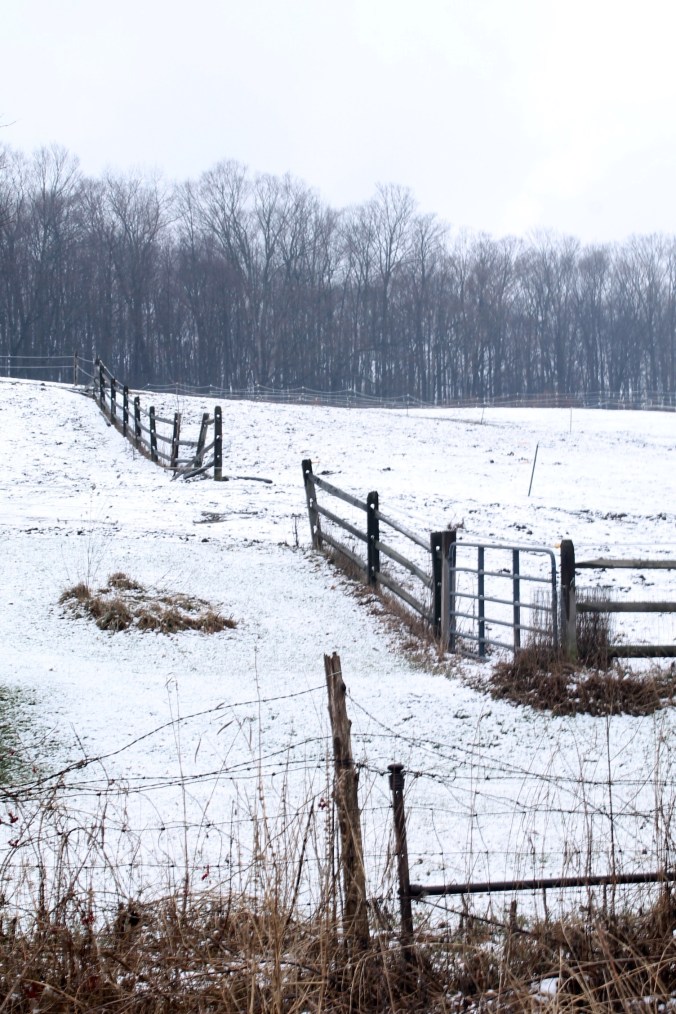
Martenitsa, or Bulgarian Spring

Years ago, I worked with a Bulgarian family who, every March, made little yarn dolls of red and white wool. Red for the heat of summer, white for winter. We were all friends at that workplace, and everyone wore those little gifts of martenitsa dolls until they frayed. Then, our Bulgarian friends insisted, spring was here.

Spring may come quicker in Bulgaria than it does in Vermont.

With snow falling today, the little girl left her forest fort alone, reading library books by the wood stove and eating popcorn.

Another way, perhaps, to think of martenitsa is as a great leveler: even winter’s savage teeth will yield to the persistence of spring.

But not yet… not quite yet… Vermont’s version of martenitsa is maple sugaring. Fire, sap, sugar: all eventually overtaken by budding.

The value of doing something does not lie in the ease or difficulty, the probability or improbability of its achievement, but in the vision, the plan, the determination and the perseverance, the effort and the struggle which go into the project. Life is enriched by aspiration and effort, rather than by acquisition and accumulation.

– Helen & Scott Nearing, The Good Life
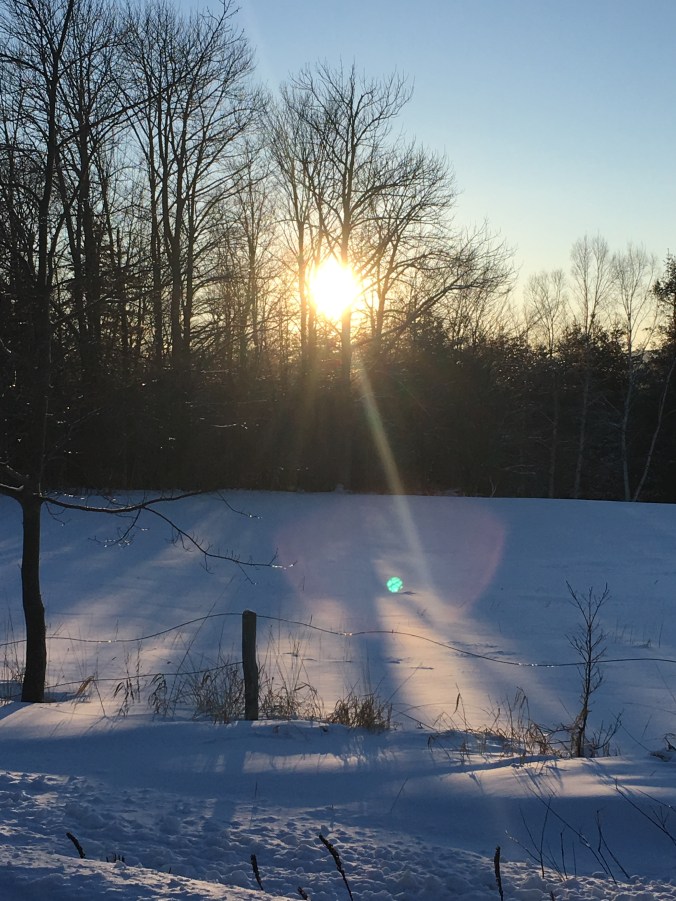
IMG_0888

Woodbury, Vermont/Photo by Molly S.
 

A Starlit Night

Last night, my daughters and I walked the neighbor’s child home in the dark. We had been outside for a while, playing a variation of tag with flashlights and laughter, resulting in the older daughter slipping on ice and lying elbows-down in mud. With the flashlights off, we walked along the muddy road beneath the starlight. The night was balmy for mid-March, suffused with the scent of thawing earth: a rich odor so pervasive it was a constant companion. The moon, a white curve, shone a pure, yellow-white light.

On the way home, we saw our house through the bare hardwoods, the strings of little lights the girls nailed along the eaves twinkling. We passed just one house along our road where a single light shone; they must have been gone. It was just the girls and the star-and-moonlight and the mud and I. The peepers are not stirring yet, and none of the woodland creatures called. Beneath our boots, the earth shifted, softening, giving up its winter frost. My older daughter said, I could walk forever, on a night like this.

This morning, watching a single robin tugging at our lawn, I thought of my older daughter, and how, before long, this girl will be on her womanly journey, walking different patches of earth – in boots, or sandals, or heels – beneath this same exquisitely beautiful sky. I opened the window and listened for birdsong, relishing the season we’re in.

What a strange thing! to be alive beneath cherry blossoms.

– Issa

FullSizeRender

Vermont, Mach 2016

The Sweet Spring Season

Signs of spring:

The school busses won’t travel on the backroads due to impassably muddy stretches. The superintendent sends an email: Drop off your kids to meet a bus at the corner barn…

An enormous flock of singing blackbirds in a single maple tree beside the post office.

Steam from the sugarhouse sweetening cold fog; April’s come early, this year.

April is the cruellest month, breeding
Lilacs out of the dead land, mixing
Memory and desire, stirring
Dull roots with spring rain…
In the mountains, there you feel free.
I read, much of the night…

– T.S. Eliot, The Waste Land

FullSizeRender

Hardwick, Vermont/Photo by Molly S.

The Vermont Season of Pre-Spring

A number of years ago, I conceived an idea that our family’s financial salvation lay in wedding favors. With our maple syrup, colored card stock, a paper cutter, and raffia, I filled tiny bottles with syrup and bow-tied on little cards printed with hopeful things like Julie and Josh, July 8, 2001, Eat, Drink & Be Merry. Or: A sweet beginning. In the long run, my fortune didn’t lie there, but I met interesting people at profoundly pivotal junctures in their lives.

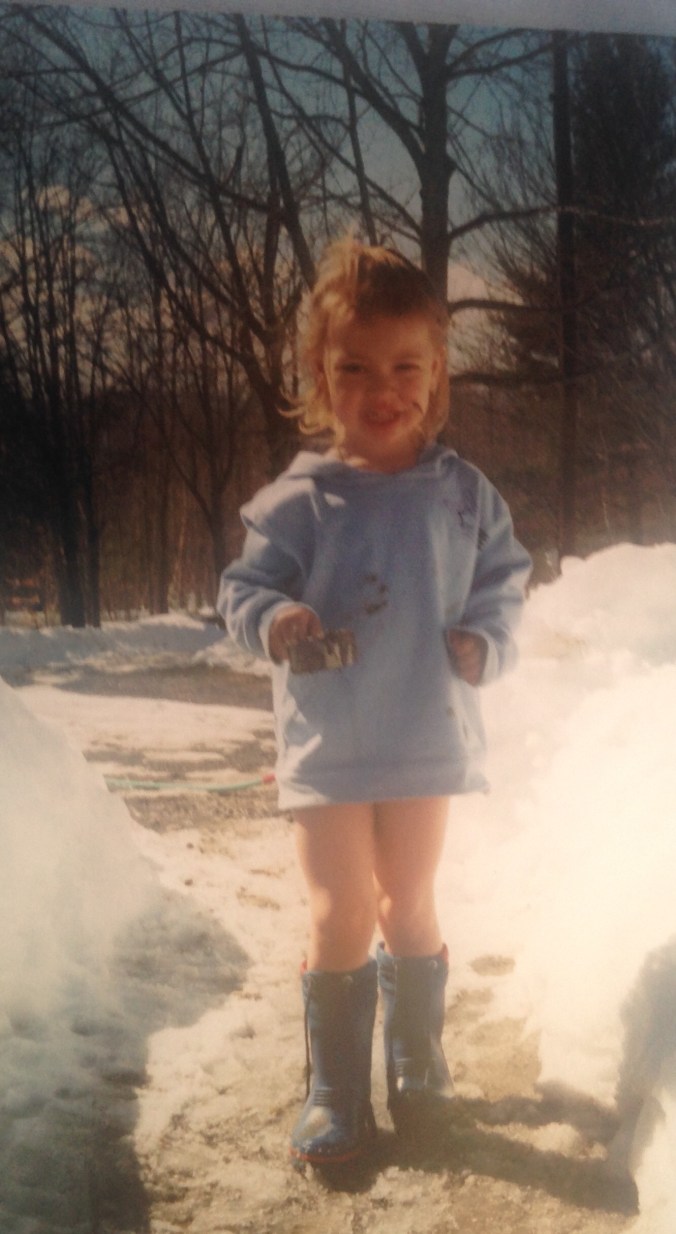
One April, in an intense mud season, a couple unexpectedly drove out to our house. We were deep in the midst of sugaring with a three-year-old. On our back road and driveway – and all around the house where the snowbanks were fiercely melting – lay mud that sucked at our knee-high boots with an audible glop. The winter had been its usual terror, and immense snowbanks mounded all around the house, interspersed by our trodden paths. My gorgeous little girl, with unbrushed hair, walked around shirtless in overalls and mud boots, a yellow plastic sand toy shovel in one hand.

The couple had heard about our wedding favors and had arrived to order in person. He and my husband talked about Ford pickups while I chatted with the woman. She kept looking around, distressed. It’s just so muddy, she kept saying. How do you stand it? Where she cringed from dirt and inconvenience,  I saw sunlight so intensely bright it lay like shining gold coins on the shallow dips of water that spread out all around our house, as though we were a ship on a rippling sea. I knew mud as the world’s thrust from winter to spring, the give from one season to another. My heart lightened with joy at the end of a bitter cold season and the imminence of wildflower season. I knew coltsfoot would shortly bloom.

…Soon it will be the sky of early spring, stretching above the stubborn ferns and
violets.
Nothing can be forced to live.
The earth is like a drug now, like a voice from far away,
a lover or master. In the end, you do what the voice tells you.
It says forget, you forget.
It says begin again, you begin again.

– Louise Gluck, from “March”

FullSizeRender


Hearth

This morning, the house grew cold as I let the fire in our wood stove dwindle. When it was nearly dead, I pulled apart the stove pipe and stretched my arm deep down its throat to loosen the rattling creosote. With a shovel, I removed the ashes from the stove, then vacuumed the damper vents at the back, so the air will flow again. In the baffles at the top, I reached between the metal and fireproof insulation and pulled out handful after handful of silty, warm brown ashes, silky as kittens. I kept thinking of Megan Mayhew Bergman’s story “Housewifely Arts.”

This evening, after a day of snow and freezing rain and sleet, our hearth is rich with heat again, the children sprawled luxuriously on the rug. One of the interesting aspects of writing is a tendency to turn things upside down and inside out. Our stove is not merely a source of heat, but also consumer of wood and air, creator of ash, its lungs linked to the chimney funneling through our house. I once spent the greater part of an afternoon with a heating specialist who explained the inner workings of a nearby hospital, the channels of electricity and oxygen and water and waste, the circulatory system of an enormous building, generally unseen but vital.

Maybe it’s a day like this, when winter relinquishes its hold reluctantly, hurling ice at our windows in fury, that brings us back to our hearth again, gratefully.

There is no need to explain to our daughter the death of her first dog. Poppy, better than any of us, understands the urge to have what you must have. She can still wring what she wants from the world. It has listened to her cries and delivered. She still trusts the raw pull of desire. One day it will tear her away from us, take her down a dirt road to a place she does not recognize, and there she will make her home. Away from everything she understands, and close to everything she wants.

– Megan Mayhew Bergman, “The Two-Thousand Dollar Sock”

FullSizeRender

Winter Garden, Vermont, 2016


Winter: the Whale’s Belly

Our kitchen was forty-two degrees this morning. I leaned over the range and chipped a ridge in ice along the bottom of the window, and thought this is getting a little ridiculous. And I forgotten cream for the coffee. Often, in these morning – no Biblical scholar, not even a church-goer – I think of Jonah in the belly of his whale.

But then, home again from a basketball game, the wind blowing snow in our faces, my older daughter sang out, You can tell the light’s coming back! 

Indeed. Through translucent clouds, the day was yet bright, the moon a glowing gem tucked above the bare branches of maple trees. After a frozen day, the end was such a lovely place, with traces of snow falling, the white all around pure and white, and the light familiar and beckoning as that long-off spring.

...Winter is for women ----
The woman, still at her knitting,
At the cradle of Spanis walnut,
Her body a bulb in the cold and too dumb to think.

Will the hive survive, will the gladiolas
Succeed in banking their fires
To enter another year?
What will they taste of, the Christmas roses?
The bees are flying. They taste the spring.

– Sylvia Plath, "Wintering"

IMG_9644

Photo by Molly S./North Bennington, Vermont