The Vermont Season of Pre-Spring

A number of years ago, I conceived an idea that our family’s financial salvation lay in wedding favors. With our maple syrup, colored card stock, a paper cutter, and raffia, I filled tiny bottles with syrup and bow-tied on little cards printed with hopeful things like Julie and Josh, July 8, 2001, Eat, Drink & Be Merry. Or: A sweet beginning. In the long run, my fortune didn’t lie there, but I met interesting people at profoundly pivotal junctures in their lives.

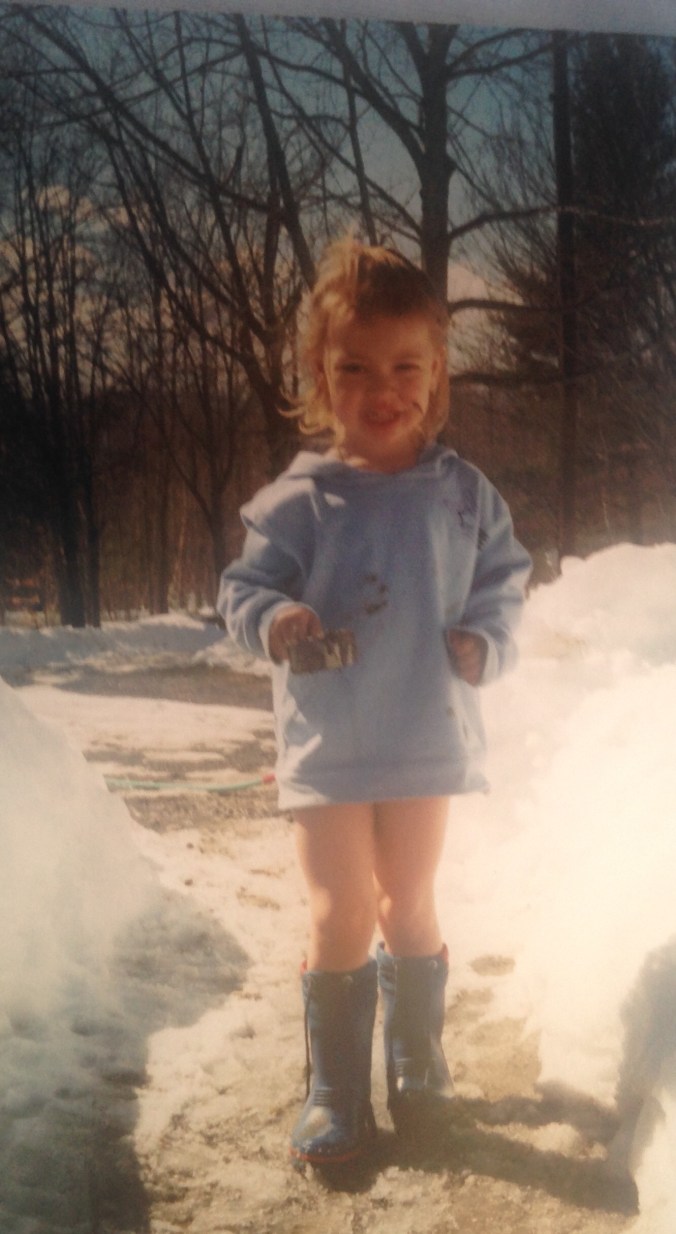
One April, in an intense mud season, a couple unexpectedly drove out to our house. We were deep in the midst of sugaring with a three-year-old. On our back road and driveway – and all around the house where the snowbanks were fiercely melting – lay mud that sucked at our knee-high boots with an audible glop. The winter had been its usual terror, and immense snowbanks mounded all around the house, interspersed by our trodden paths. My gorgeous little girl, with unbrushed hair, walked around shirtless in overalls and mud boots, a yellow plastic sand toy shovel in one hand.

The couple had heard about our wedding favors and had arrived to order in person. He and my husband talked about Ford pickups while I chatted with the woman. She kept looking around, distressed. It’s just so muddy, she kept saying. How do you stand it? Where she cringed from dirt and inconvenience,  I saw sunlight so intensely bright it lay like shining gold coins on the shallow dips of water that spread out all around our house, as though we were a ship on a rippling sea. I knew mud as the world’s thrust from winter to spring, the give from one season to another. My heart lightened with joy at the end of a bitter cold season and the imminence of wildflower season. I knew coltsfoot would shortly bloom.

…Soon it will be the sky of early spring, stretching above the stubborn ferns and
violets.
Nothing can be forced to live.
The earth is like a drug now, like a voice from far away,
a lover or master. In the end, you do what the voice tells you.
It says forget, you forget.
It says begin again, you begin again.

– Louise Gluck, from “March”
FullSizeRender


Hearth

This morning, the house grew cold as I let the fire in our wood stove dwindle. When it was nearly dead, I pulled apart the stove pipe and stretched my arm deep down its throat to loosen the rattling creosote. With a shovel, I removed the ashes from the stove, then vacuumed the damper vents at the back, so the air will flow again. In the baffles at the top, I reached between the metal and fireproof insulation and pulled out handful after handful of silty, warm brown ashes, silky as kittens. I kept thinking of Megan Mayhew Bergman’s story “Housewifely Arts.”

This evening, after a day of snow and freezing rain and sleet, our hearth is rich with heat again, the children sprawled luxuriously on the rug. One of the interesting aspects of writing is a tendency to turn things upside down and inside out. Our stove is not merely a source of heat, but also consumer of wood and air, creator of ash, its lungs linked to the chimney funneling through our house. I once spent the greater part of an afternoon with a heating specialist who explained the inner workings of a nearby hospital, the channels of electricity and oxygen and water and waste, the circulatory system of an enormous building, generally unseen but vital.

Maybe it’s a day like this, when winter relinquishes its hold reluctantly, hurling ice at our windows in fury, that brings us back to our hearth again, gratefully.

There is no need to explain to our daughter the death of her first dog. Poppy, better than any of us, understands the urge to have what you must have. She can still wring what she wants from the world. It has listened to her cries and delivered. She still trusts the raw pull of desire. One day it will tear her away from us, take her down a dirt road to a place she does not recognize, and there she will make her home. Away from everything she understands, and close to everything she wants.

– Megan Mayhew Bergman, “The Two-Thousand Dollar Sock”

FullSizeRender

Winter Garden, Vermont, 2016


Winter: the Whale’s Belly

Our kitchen was forty-two degrees this morning. I leaned over the range and chipped a ridge in ice along the bottom of the window, and thought this is getting a little ridiculous. And I forgotten cream for the coffee. Often, in these morning – no Biblical scholar, not even a church-goer – I think of Jonah in the belly of his whale.

But then, home again from a basketball game, the wind blowing snow in our faces, my older daughter sang out, You can tell the light’s coming back! 

Indeed. Through translucent clouds, the day was yet bright, the moon a glowing gem tucked above the bare branches of maple trees. After a frozen day, the end was such a lovely place, with traces of snow falling, the white all around pure and white, and the light familiar and beckoning as that long-off spring.

...Winter is for women ----
The woman, still at her knitting,
At the cradle of Spanis walnut,
Her body a bulb in the cold and too dumb to think.

Will the hive survive, will the gladiolas
Succeed in banking their fires
To enter another year?
What will they taste of, the Christmas roses?
The bees are flying. They taste the spring.

– Sylvia Plath, "Wintering"

IMG_9644

Photo by Molly S./North Bennington, Vermont

December

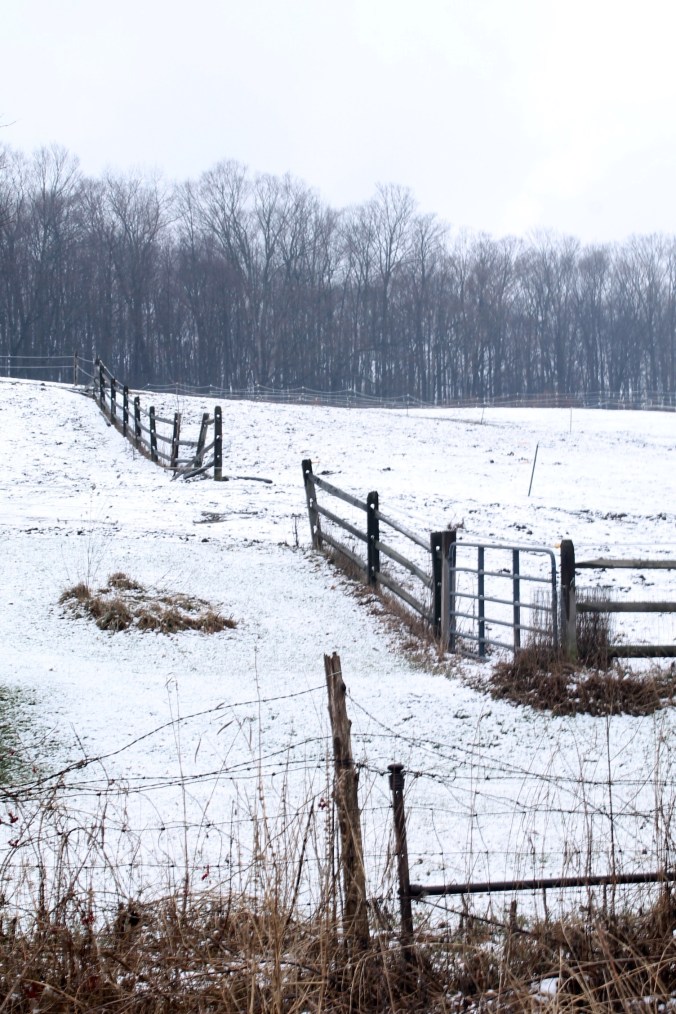
Spring, now so far away, comes with an urgency in Vermont, a breaking up of frozen roads, hail that reluctantly gives way to rain, coltsfoot – the first flowers – that thrust up through the gnarliest of patches: roadsides and where the gravel is beaten hard.

This season, too, comes with its own severity: every day, a little less light, a little more dark. What are the words I drag with me as I enter this season? Forget gray. Discard dimness. This is a world turned upside down, where the snow-covered ground exudes light, the trees pull in on themselves, myriad creatures put their heads down to sleep. The night sky is studded with white quartz. The clouds sink down into the earth. The garden rests. My callouses mend.

We have come too far together toward the end now
to fear the end. These nights, I am no longer even certain
I know what the end means.
— Louise Gluck
FullSizeRender

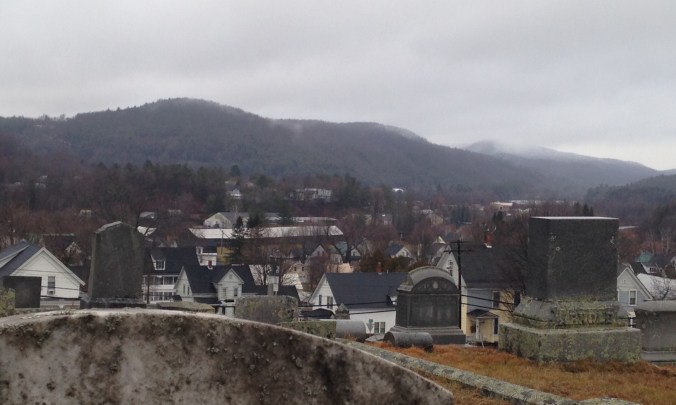
Hardwick, Vermont


The Dark

Early this morning, not long after dawn, robins swooped by my kitchen window, flying busily with their beakfuls of twisted straw, tangled weeds, a red streamer from my daughter’s birthday.  Bending over the sink, I peered up through the window where these robins are resuccitating the nest beneath the bedroom’s balcony.  What possessed these creatures to appear again?  The girls and I have been banging in and out of that back door for weeks, even moving a refrigerator with great effort and noise.

I’m certain these birds appeared just this morning; I would have noticed them earlier.  It pleases me to think of this robin couple scouting out this thrice-used, well-mudded nest, choosing it while I slept, dreaming or not, just a few feet away.  Will eggs be laid and hatched?  Will the fledglings live?  None of this has come to pass yet.  But the night has borne us this robin family.

In the same way, the seeds in my garden are using the soil’s cover and night to germinate and sprout.  Too often, we fear the dark, with our easy reliance on electric light.  A real joy to rural living is the starlit nights and the nocturnal animal world.  I often step out on the balcony with my younger daughter before she goes to bed.  Listen, we say, what’s happening now?  These late spring, early summer nights are such a pleasure. With the windows open, the nightsounds flow through the screens.  Last night, a moth found its way through a broken screen and lay on my wrist while I read, so delicate it was hardly a presence, and yet its beige wings slowly folded and unfolded, before it rose and took flight.

The short night;
the peony opened
during that time.

–  Buson

IMG_5851

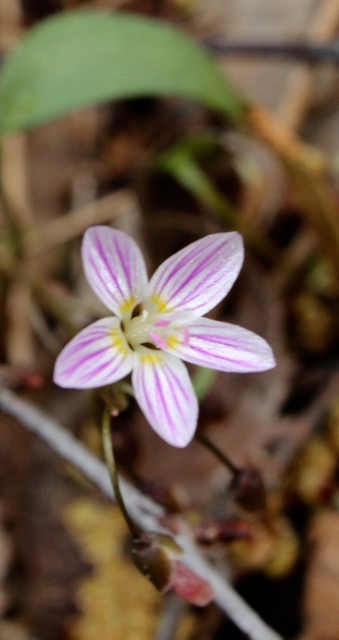
photo of spring beauty by Molly S.


Let the Road Rise Up to Meet You

Spring in all its urgency:  the Vermont winter finally (at long last!) has been slayed by the face of the earth turning round to the sun.  Almost a few days ago, hard-edged filth-ridden glaciers of snow hunkered beneath the roof eaves on the house’s northern side.

Now the peepers sing in their insistent frog party.  The trilliums thrust away last fall’s dried leaves, pressing upwards with their burgundy blooms.  A cluster of spring beauties sprang up overnight in the forest behind our house.

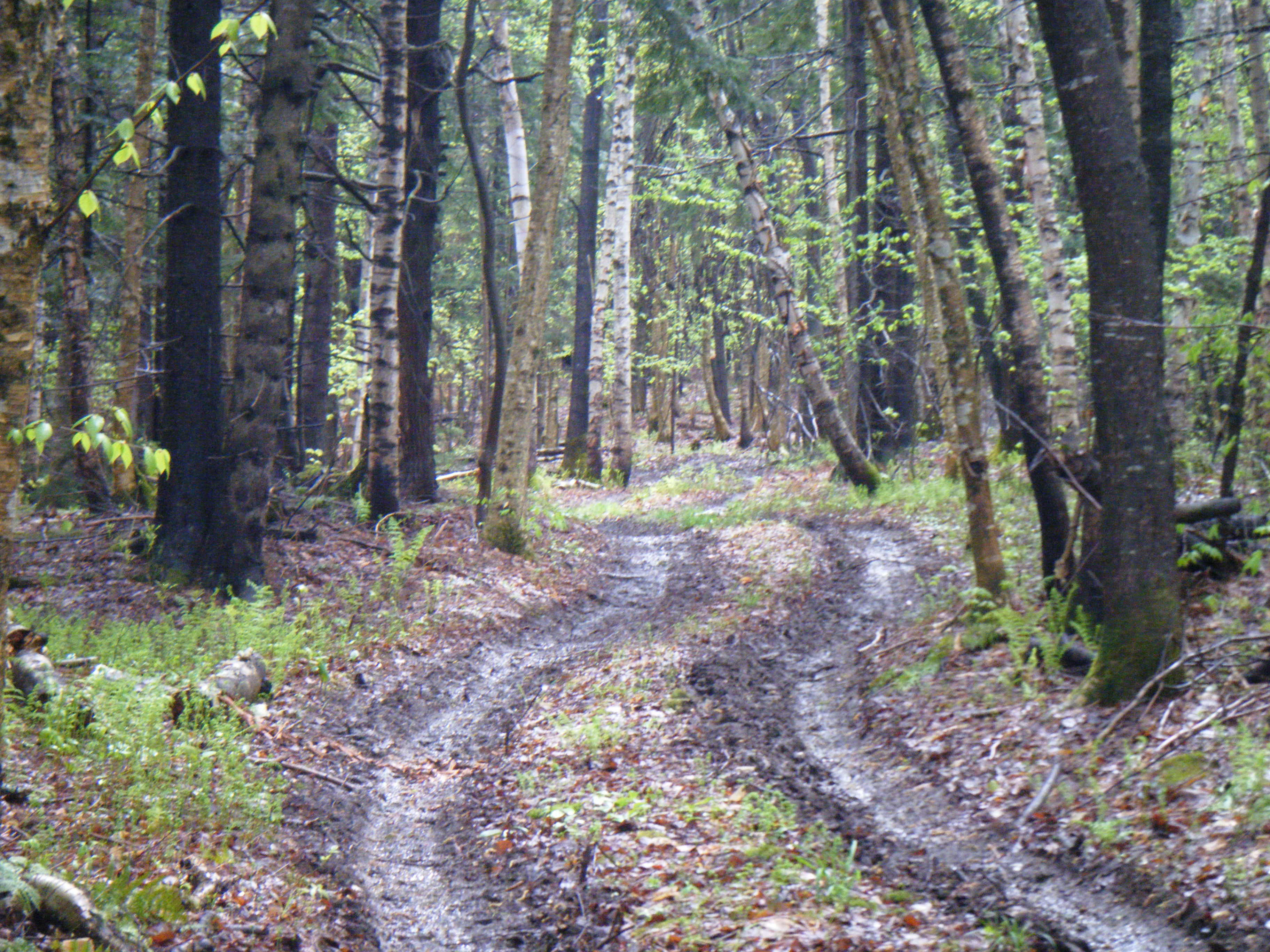
Polly Young-Eisendrath, in her exquisitely wise new book, The Present Heart, writes about our individual human journeys; how the road rises up in ways we’d never imagine to meet us along the way.  This muddy forest road, with the green literally surging in overnight, rises to me.  This afternoon, I knelt on one garden-soiled knee and pressed my face near to the scents of humus, of rot and renewal, of decay and growth:  of spring.

DSCF9817