Monday Morning, Back to Work

When my little daughter was three, one morning in the kitchen she noticed the orange day lilies had opened their buds, and she ran upstairs to her sister, calling, Willies! Willies, sissy!

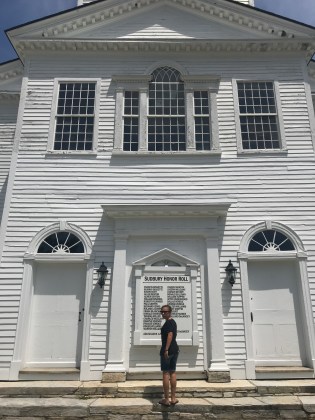
Yesterday, driving around Vermont — perhaps in an attempt to shake off a funk — day lilies bloomed everywhere, colorful masses along the roadside and white clapboard meeting houses and tiny shacks with fantastic views of green and blue mountains.

Fully into July now, I know our summer will be filled with work — some terrific and some not so — with the family complexities of single parenting, of keeping our life not only cohesive but creative. There’s lists of things I’d like to do — climb the Underhill route to Mansfield’s summit, paint the trim, plant two fruit trees — but lying in bed this morning, listening to the songbirds crack open the daybreak, I decided to par this down to one single thing: swim in the pond until the water grows cold and hostile. I lay there thinking that’s free to do, and then wondered when I had lost the sense of free in this life might be.

… (the day lily is) coarse and ordinary and it’s beautiful because
it’s ordinary. A plant gone wild and therefore become
rugged, indestructible, indomitable, in short: tough, resilient,
like anyone or thing has to be in order to survive.

— David Budbill, from “The Ubiquitous Day Lily of July”
IMG_2518.JPG

Sudbury, Vermont


Good Humor

My dad had this phrase when I was a kid — a high-entropy day — a confluence of crazy, falling-apartness. All those years we sugared, March was high-entropy: we endured ice storms, broken machinery, illness, unexpected expenses.

In snowy and muddy Vermont March days, I always fooled myself into believing June was nothing but sweetness.

June, yesterday, green and gorgeous, and around us: chaos — all the factors of work and extended family, wound through with the golden chicken who got into the neighbors’ garden. At the end of the day, I stood in our upstairs glassed-in porch, threading through a work problem on the phone, watching birds dart around our house. Little tiny birds I didn’t know dove into an enormous, flowering mock orange tree.

When I came downstairs, where my girls were at the dinner table, they showed me a three-line text from their MIA parent, the one who hasn’t so much as given his girls a piece of bread in years — travels with father — and I laughed. Here’s the epitome of family life, maybe of human life: a baffling and incredibly painful mystery. What the heck does any of this mean?

I write this not so much because it’s my story, but because I see this reflected over and over in the families around me: that the harder years of parenting through adolescence, through parental desires met and unmet, bring to the forefront those tensions between what’s best for the one, and what’s best for the family.

My girls and I kept eating and talking. I fed our cat a bit of bacon from my fingers. The windows were all open, and the scent of the roses drifted in. We kept talking about the day’s chaos, and then we kept laughing and laughing. It’s the only antidote I know — laughter — to the hardness of family life, to just the plain-out strangeness of what might seem so simple.

Then we went out to talk to the chickens, too.

IMG_2273.jpg

Female House

The summer my second daughter was an infant, the season was particularly hot and sticky — at least in my memory it was. That summer I just didn’t do certain things — I washed clothes and probably even folded them, but I rarely put them away.

Domestic chaos? Maybe. But I knew I would never have another baby, the  irreplaceable sweetness of a nursing infant in arms.

We were at Dartmouth Hitchcock Medical Center that summer with our 6-year-old for a very minor procedure, and my then-husband and I took turns walking up and down the hospital hallways with an infant. At one point, I stood swaying with my sleeping baby from foot to foot, reading the posters on the wall.

One watercolor was a purple hyacinth blossom with the words beneath: Choose joy.

When I drove away from the hospital, with all four of us, and crossed the river back into Vermont, I was so light-hearted, so happy. It was such a minor thing that had occurred, and we were all together and well.

Now that infant daughter is a teenager, the oldest daughter a young woman. Like all families, we’ve lived through the gamut of happiness and grief and rage. Every now and then, I remind myself, slow down, breathe deep, and finger the strand of life that’s joy.

You might as well answer the door, my child,
the truth is furiously knocking.

— Lucille Clifton, Good Woman: Poems and a Memoir 1969-1980

IMG_2193.jpg

Dinner Chat

My daughter and I are often eating dinner in the lengthening daylight at the kitchen table, just the two of us with the cats under our feet, and my daughter offering bits of her day — if I listen, and don’t press too hard, what she cares about she slowly spills.

Our conversation drifts into what it means to grow. Through our glass doors, I see the box elders behind our house swaying in this spring-is-coming wind, the Vermont winter gradually eroding. So much of my life I sought stasis — the imagined security of here is where I am. In my daughter, I see this same illusion of when I am grownup, as though adulthood is a kind of plateau.

We linger at the table, with the unwashed dishes and evening chores undone. While she speaks, I think, here, now. The wind curls around our house.

Accept yourself: be yourself. That seems a good rule. But which self? Even the simplest of us are complicated enough.

— From Apsley Cherry-Garrard’s The Worst Journey in the World

IMG_1246.jpg

Caspian Lake, Greensboro, Vermont


Daughters

When I was a young woman, I immersed myself in experiences — live in a tipi, race an old Saab on an interstate, travel around the country sleeping in the back of a diesel Rabbit — but all as experience, without a context. Maybe that’s one of the main things I’ve gained as a parent — how to see the years-unfolding shape of our lives, the pattern of habits, the emotional tenor. Where are we weak? Where do we flourish?

Now, as my daughters — one exiting adolescence and the other entering — step into claiming their own lives, I watch the shape of the lives they’re creating, different than mine, and yet inseparable.

Late Prayer
Jane Hirshfield

Tenderness does not choose its own uses.
It goes out to everything equally,
circling rabbit and hawk.
Look: in the iron bucket,
a single nail, a single ruby--
all the heavens and hells.
They rattle in the heart and make one sound.


IMG_1231.jpg

Lake Eligo, Vermont

Tales from Library Land

When I was vacuuming tiny gold stars from the library’s rug yesterday, in the hour when the tired after school kids were getting picked up and before the adult readers appeared, I noticed the carpet, hard-worn when I arrived as the sole employee, was even more shabby. A splotch of yellow paint, snips of pink yarn, dog hair that perpetually sloughs off a few small patrons. The carpet has been used by all sizes of feet.

The walls are covered with kid art, colored paper chains hang from the ceiling, donations for the pie breakfast book sale line the walls.

Although I was so tired I considered lying down on the floor before the reading group, the adults arrived with incredible enthusiasm. The kids made popcorn and kicked a soccer ball in the other room, with a strange sound like someone banging her head against a wall I (futilely) tried to ignore.

I heated water for tea. What do goals mean in a lifetime, anyway?

Here’s one of mine: heat water for a thousand cups of tea in this one-room library.

I have always imagined that Paradise will be a kind of library.

— Jorge Luis Borges

IMG_1163.jpg

Craftsbury, Vermont