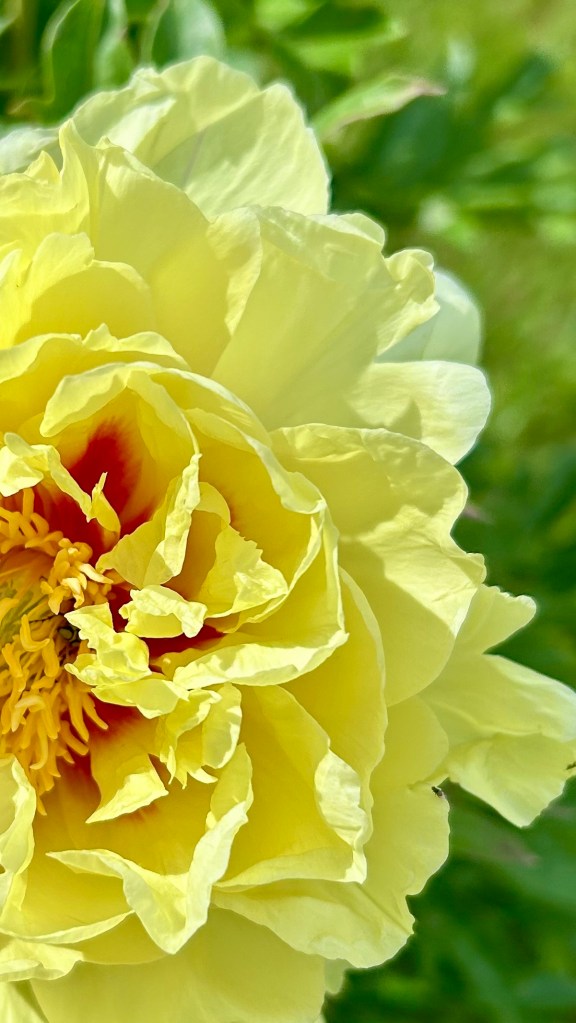
June’s Snow.

We eat on the back deck of a little restaurant in Plainfield, Vermont, home of the former Goddard College, its campus now morphing towards its next phase. In Plainfield, there’s hand-lettered LOVE signs everywhere, a sense that people are doing interesting things like writing novels in verse in treehouses, and folks say hi when we pass on the sidewalks, as if they know us. And maybe they do. Tiny Vermont.

Rain sprinkles around the table’s umbrella. Overhead, leaning back, I spy a puzzle piece of blue sky, a horn of the half moon.

Solstice, the longest day of the year, fragrant with roses, a serenade of toad songs. Afterwards, we walk along the river, then uphill, where the floods in the past few years cut the hillside, rammed silt and rock into houses that remain, people-less, doubtlessly waiting for FEMA money that may or may not arrive, an excavator, another breaking. We turn and wander through higher ground, where gardens flourish green and pink. Hammocks are strung for summer reading in porches.

June’s ineffable loveliness.

In the long twilight I drive home, my tires splashing through puddles where rain has fallen hard and missed us. Around Woodbury Lake, the mist layers among the emerald hills, the sky’s deepening blue, sunset gold. Beloved Vermont, relishing her own beauty. I don’t pause, the radio off, only me and my own stray thoughts. I drive north on this road where I’ve traveled for so many years, in so many kinds of weather, passing the place of the terrible recent accident, the unspeakable tragedy, and then I’m in little Woodbury village again. Wetlands and church and school and post office. Fog trails around me.

I’m not at all a churchgoing woman, but the phrase yea, though I walk through the valley of the shadow of death clangs through me, resonates in my soul and body like a bell’s clapper. The dearness of this life, so easily torn.

At home, in the thin wisps of light, I wander through my garden, the campion white, the mock orange blossoms June’s snow. Through my neighbors’ windows, laughter spills.

“Peonies at Dusk,” Jane Kenyon

White peonies blooming along the porch
send out light
while the rest of the yard grows dim.

Outrageous flowers as big as human
heads! They’re staggered
by their own luxuriance: I had
to prop them up with stakes and twine.

The moist air intensifies their scent,
and the moon moves around the barn
to find out what it’s coming from.

In the darkening June evening
I draw a blossom near, and bending close
search it as a woman searches
a loved one’s face.

To Know the Dark.

This is the season of scant light, the day’s heart sooty at best.

Oh, the darkness, keeper of so many secrets. My garden’s soil where rough-edged chard and calendula seeds germinate, where tree roots clench and foxes den. In the summer, the night sounds sing of lust and procreation, hunger and scavenging. The night is the realm of star and moonlight, of the mysteries of creation and romance. And more—in all those hospital nights I endured this past winter, I often woke drenched in nightmares, disoriented. Gasping, I whispered that I was still here, still part of this world. A hospital at night is a ship full of humans, listing its way through uncharted territory.

This morning, crossing over gradually into the days of longer light, into this winter that has barely begun to breathe its life, I carry my glowing ash bucket outside and stand in the cold. Below me, the village lights sprinkle through the valley. My neighbors, early risers, too, have not yet snapped on their kitchen lamp. The wind stirs, and I shiver, barefoot in my Danskos, my hearth divided between stove and bucket, inside and outside, a small thing to consider. I keep standing, keep shivering, my blood running hot.

To go in the dark with a light is to know the light.
To know the dark, go dark. Go without sight,
and find that the dark, too, blooms and sings,
and is traveled by dark feet and dark wings. ~ Wendell Berry (of course)

December, Holy/Unholy/Holy Season

Anyone who lives in a northern climate must inevitably come to some reckoning with the descent into this month’s darkness, the steady whittling away of daylight at either end, noontime oftentimes scrubbed to a soapy haze.

To my surprise, this month began on an ascent for me, an elevator rise at the end of November, crammed into a silver metal box on a gurney with my weeping daughters and brother, and an anesthesiologist who might have drawn the short straw to collect the patient in the otherwise sleeping hospital. He was actually assured me he was a much better anesthesiologist than a gurney driver. Bring me back safely to these people, I pleaded.

Here at Dartmouth, I’m in a major medical facility (of which I’ll someday write much more). There’s no illusion that this is giant Health Care. Within this, my tiny 4’8″ body and the fraughtness of grave disease and uncertainty, and so so many patients. Yet all these interwoven days and nights, I’m surrounded by an arch of kindness, by skilled and unskilled staff who labor so patiently. I’m humbled by this secular holiness. The respect is repeated among colleagues here, aiding each other (and all us needy patients) with their own thank you, thank you as they work together.

A friend, driving home to Vermont from family Thanksgiving, leaves me Time of the Child by Niall Williams. Late into the night I read, taking these hours to relearn the slow joy of novel immersion. Sleep, sleep, I urge myself, and yet Williams’ world entrances me. Here’s line from this novel that an elderly Irish country doctor remembers from his doctor father: “The sick are ourselves, was a thing his father had said. When you stop understanding that, take your name off the wall and throw your bag in the river.

…. Whatever way this month transpires — for rise or for misery — and it’s all holy, isn’t it, this sacred and profane mixture of spirit and blood and bowel. The journey itself we take together is the gem.

Although I will say, I was ineffably joyous to return from that dismal night and see my curved-to-exhaustion people. After all, I am in the only one in our household who devours the cold leftover French fries with gusto. Why would we waste cold potatoes?

Thank you again, all.

Solstice Dandelion.

I stopped into a candy shop in Montpelier to buy chocolate Santas for my daughters. We’ve been visiting this store since my daughters were so young I always held their hands downtown. The owner read my book, and we always talk about writing and family and Vermont small town life. Her store had reopened recently after July’s devastating flood. The rain and snowmelt in the forecast hovered around us as I filled a white paper bag with those bright foil-wrapped chocolates. As I listened, I added chocolate pastilles and more Santas, for her or my daughters or me, for the giving or taking, or maybe both.

This week’s rain likely spared this sweet shop, but towns around us were flooded again. In the town where I work, sections of roads carefully repaired after July’s flood broke again.

Yesterday, I spied a folded dandelion blossom in the town green. I squatted down and stared, not touching this brilliant gold in its emerald set. Overhead, those bunching clouds. A balmy breeze stirring over the lake that by day’s end will whet a bitter cold.

Solstice: hallelujah on this spinning planet.

Less and less surprises us as odd.

— Tracy K. Smith

Hello, Darkness, my old friend.

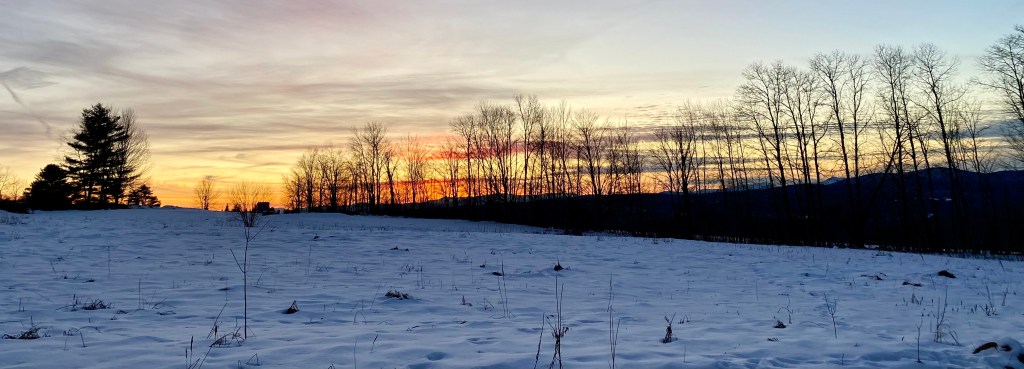
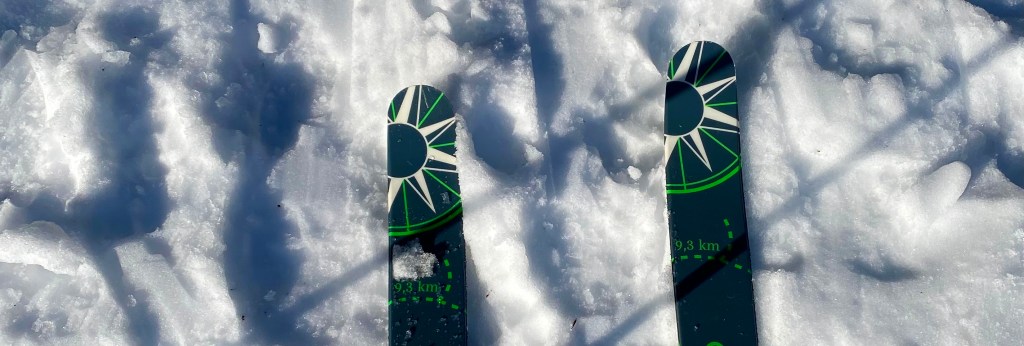
Heading towards the winter solstice, the days are cropped short. I ski in the woods. The next afternoon, after a spurt of warmth, I remove my skis to navigate around patches of tree roots, the exposed carpet of pine needles.

By 4:30, darkness envelopes us, velvety and broken only by our brief human endeavors of a line of twinkling holiday lights, streetlamps, parking lots lit up like precious jewels. Like a wild creature roused by these warm December nights, I prowl through the village and along the river.

Returning home one late afternoon, I pause beside Woodbury Lake. A crescent moon illuminates the blue-black sky, the outline of its orb a faint round: a promise of January’s full wolf moon. Twilight’s but a few moments, molten gold rapidly consumed by the unstoppable night.

I remind myself that December is the time of descent, that the darkness I eyed so warily in October is now my mellifluous friend. I’ve been here before, in so many seasons of my life — dissatisfied and cracked, heart-full, my eyes attuned to starlight. Living into December and the solstice and the winter stretching ahead means stepping into the world’s great vessel, full of so much.

Here’s an article about the world’s first seed bank forwarded to me by a reader.

Strange Bed

The forecast for this Vermont Christmas is 100% rain, which pretty much sums up the year 2020.

From work, I take home a donated cat bed, lined with a downy fuzz and nearly new. When I set it on our living room floor, our cats approach with caution, sniffing, and then begin growling, doubtlessly sensing some former occupant.

A dog? Or simply some stranger?

All evening, our pampered house cats pace around the bed, suspicious. But, in the morning, I see our tabby Acer curled up in the bed’s center, sleeping, paws over shut eyes, tail tucked beneath his chin.

And so it: 2020 and on into 2021. Wherever each of you are, dear readers, I hope you take some comfort in this strange bed of where we are, as our planet slowly turns back toward the light, again.

Cutting with the ax,
I was surprised at the scent.
The winter trees.

— Buson

Hardwick, Vermont