Keeping On….

I drive home from a Selectboard meeting with my friend the moon who hangs over the dark mountain ridge, a creamy misshapen teardrop shot-through with crimson. It’s me and her. The clouds have scrimmed low enough that the Milky Way does not join our duet.

My house glows when I return home. The girls have chopped up the cherry tomatoes I left on the table and added these sweet chunks to couscous they bought in Santa Fe and cooked on their camping trip (and why do I never cook couscous, anyway?) The girls are familiar with the town and the people where I work. I tell stories about who’s there and what’s happening — the nuts-and-bolts of local truckers who’ve appeared for the bid openings, hoping to score more work — a man who lives nearby, has no electricity, comes to use the internet, and wanders in and out, curious, offering a few comments. People are angry about all kinds of things, the sheriff’s there and then not-there, a man yells, the chair regains control, decisions are made, bids are granted, that FEMA word with its trailing uncertainties rises and falls. There’s a pause about a bridge washed out in last year’s flood with a replacement price tag that’s beyond comprehension. A board member and I whisper commiseratingly about the days when we shared homemade cookies at meetings while kicking around decisions. He’s heading fishing this week.

The girls eat up my stories, share their own stories of their day. In the humid night, we stand on the back deck, listening to the foxes bark in the ravine, the crickets sizzle away these final summer days. The girls head out for a walk, in search of the moon and some adventure. My cat follows me as I walk around the house picking up dropped socks and empty bowls, clattering forks in the kitchen sink. Forget about national politics for a bit. It’s the same human stories: the mixture of ego and thrumming anger, a knight-like determination to serve others, the uncertainties of how do we get along?

The foxes keep at it. Eventually, I sleep, too, wake in the murky darkness, fed my cats, and then I keep on, too….
Messy democracy.

So this whole democracy thing? Since we’re in an election year and all?

I work in a small town for a Selectboard. Monday morning, I pull into work (late, again), and a Selectboard member is eating a blueberry muffin as fast as he can in the parking lot, a muffin I’m certain the town clerk made. I get out and make some comment roughly along the lines of it’s a good thing I don’t do drugs anymore because Your Town….

He counters with, Let’s get serious. What’s your cucumber and zucchini situation? I’m coming back at noon with four full boxes.

Monday morning, it’s revealed that people have stolen signs. People have written letters to the Selectboard and newspapers and the Sheriff about the theft. People arrive in the office with dogs and laptops and questions, eat muffins and disappear. I walk outside with the phone. It’s possible that the thief arrives. It’s also possible there’s some laughter. Or maybe I’m making all this up.

Democracy is messy, chaotic, often brutal. People arrive who look as though they’ve slept in ditches for their entire adult lives and complain about the flood. People complain about their neighbors. People run for election. In all of this, I take off my shoes and walk around barefoot. I do all the things I’m supposed to do and I keep wondering if I’m doing any of these right. I give an old woman a bottle of water. I am always trying to leave, disappearing into the asters around the lake, into the rooms upstairs where it’s just me and the wasps and the open windows. I am always trying to sew the pieces of my life together. Sometimes I crumple paper and throw it at my coworkers, which is not really at all charming or funny.

As a writer, I learned from reading. I learned so much from sugaring — the majesty of the world, the inarguableness of cause and consequence. I learned joy and love as a parent. I learned grief as a broken wife. Working for a small town, I’ve learned the peculiar American craziness of little towns and politics, of gossip. How to spy cowardice and when to lean against the courageous.

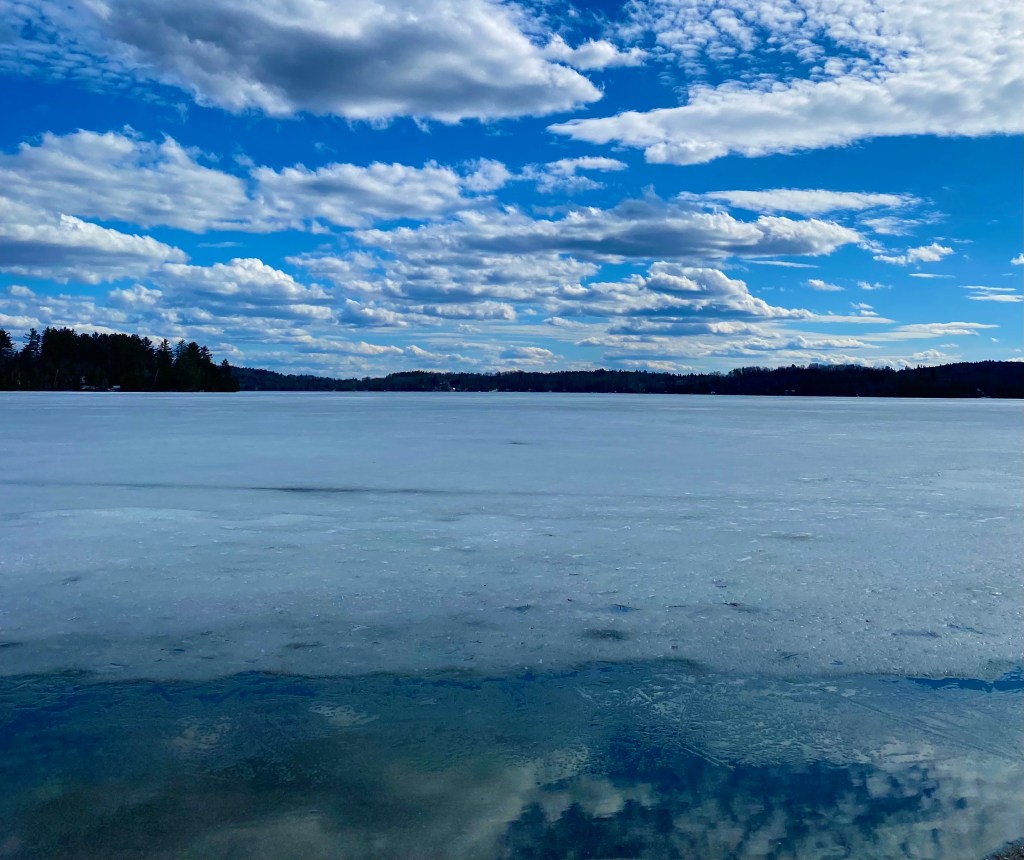
There’s not one damn thing perfect about any of this. Here I am as usual, half in, my head and heart filled with my garden gone rampart with rudbeckia and coneflowers. But we’re all that way…. July is the season of joy, January the season of despondence and loneliness. In the heart of midwinter, I leap from the snowy shore to the frozen lake. Far out, I sometimes lie down in the middle of the day, the ice a bed between my bones and the sludgy lightless waters. Overhead, the infinity of the heavens.

But today it’s Good Old July. In the afternoon, I walk with a woman along the forest trails she’s cut. She’s eased white quartz from the soil. The rocks gleam, as if freshly scrubbed with rain.

Pay it forward: a debt.

In the local coffeeshop, a stranger kicks up a conversation, and we bat around our mutual appreciation for this early summer – the blossoms profuse. He buys his order and adds my coffee, too. Pay it forward, he says, and vanishes into the morning.

I take my coffee to the courtyard down the street, empty at this time of day. Ahead of me, after this bench work stint, the day sprawls. I move from eddy to eddy.

In the late morning, a friend I haven’t seen in a few years calls. I’m now in a dim basement room. As we talk, our conversation dips into the past. I feel as if I’m lifting silty strands of stories, stringing them through my hands, searching for clues to tie pieces together.

All day long, I ponder our conversation, how the actions of one person ripple through friends and acquaintances, shift through strangers’ lives, how I’ve always been interested in this since I was a teenager, holed up in my parents’ hammock, reading John Steinbeck’s East of Eden. Later in the day, still stuck on this, I stack firewood, listening to news about the Trump trial. In the hot June sunlight, the freshly cut wood is redolent with sap. An earthworm wriggles. The neighbor boys bike into my driveway, circle around through the grass, ever curious about whatever mundane thing I’m doing. Overhead, those turkey vultures circle their late afternoon sweep, ever hungry. Little snapshot of my terrain.

I believe that there is one story in the world, and only one. . . . Humans are caught—in their lives, in their thoughts, in their hungers and ambitions, in their avarice and cruelty, and in their kindness and generosity too—in a net of good and evil. . . . There is no other story.

— John Steinbeck

Playing cards, considering remains.

In the darkness, I slide the barn door shut. The world is redolent with cut grass, the wet earth where I watered grape vines. Embers flicker in the fire pit; low laughter moves through the night. June, oh loveliest June, endless varieties of leaf and blossom.

On a hike, we meet a stranger from Maine, and we swap stories about climate change and marriage. He sees my brother’s dog has no water, and shares what he’s carried for his dog. The afternoon gleams with storybook colors of emerald, cobalt, gold. We drive to the lake, to the general store, to a brewery where we sit outside. My brother drinks beer. My daughter and I sip lemon sodas from stemmed glasses, so sweetly yellow I imagine my hand cups sunlight.

I have my mother’s ashes in my possession. Our conversation bends back again and again to her ashes and her life, and the very different relationship that each of us had with her. Lacking a religious framework, I’m treading in open water. My mother, in fact, might have been fiercely opposed to the chain of circumstances that landed me keeper of her remains, or not. I am her second daughter, her match in stubbornness.

All day long, this tender beginning to June, we do the things we love to do. We drink coffee and eat buttered toast, play cards. The sunlight crosses over my house. The day is both chilly and hot. The days spin on, rich with the illusion that there is no finality. Mercy, I think, shutting the barn door to keep the raccoons from the recycling. Another day, the nightsongs of frogs serenading.

On Gaslighting.

Via email, my daughter’s school sends me a survey. The survey poses a question about what I desire for my student. The question is phrased in a way that reminds me of a question I was recently asked, by someone I hardly know. The question was unique; the questioner asked specifically about me and my life, and how I saw my life in the wider context of the town.

I’ve been thinking of that question since that conversation, returning to it in odd moments while opening my post office box or washing the oatmeal pot. It’s a question we might all want to be asking ourselves — not just what would improve our individual lives, but how do we understand ourselves in the landscape of where we live. Or maybe this is simply April musings, cusp of a storm that could go either way, rain or snow or perhaps simply wind, sweetened with the scent of thawing soil.

Here’s a few lines from a New Yorker article that seem contemporarily apt….

Gaslighting essentially turns its targets against themselves, she writes, by harnessing “the very same capacities through which we create lives that have meaning to us as individuals,” such as the capacities to love, to trust, to empathize with others, and to recognize the fallibility of our perceptions and beliefs. This last point has always struck me as one of gaslighting’s keenest betrayals: it takes what is essentially an ethically productive form of humility, the awareness that one might be wrong, and turns it into a liability.

Leslie Jamison

‘Soon it will be the sky of early spring…’

Wild February!

At noon, I stand talking to the road crew in a sparkling snowfall. I wax on about the prettiness of snow on the emerging earth. The crew, who’s endured the strange vagaries of mud season in December, the fickleness of Vermont’s winter weather made weirder by climate change, humor me with a nod.

Fifty degrees and rain forecasted for today, followed by more, followed by bitter cold, then rain and wind, the sun I lean towards…. Late winter, again, and I remember when I could distinguish the years: the spring we boiled sap from March 1 to the 31st. The year we made 540 hard-earned gallons, two of us and a five-year-old, and I wore through three pairs of gloves carrying in wood and feeding the arch.

Walking around my snow-scattered garden, I envision where I will plant the bare root Japanese lilac I’ve ordered, for me or someone else to admire and love. The path down to my compost is both icy and soft mud, the conundrum of winter reluctantly losing its teeth to spring. The true joy is the inevitability, the earth’s order to proceed from twinkling snowflake to downy crocus, the planet’s sheer opinionlessness regarding skunks and black flies.

The road crew and I kick around a few more pithy remarks about government corruption, and then we head along….

From my one of my favorite Louise Glück poems, March:

The sea doesn’t change as the earth changes;
it doesn’t lie.
You ask the sea, what can you promise me
and it speaks the truth; it says erasure.

Finally the dog goes in.
We watch the crescent moon,
very faint at first, then clearer and clearer
as the night grows dark.
Soon it will be the sky of early spring, stretching above the stubborn ferns and
violets.