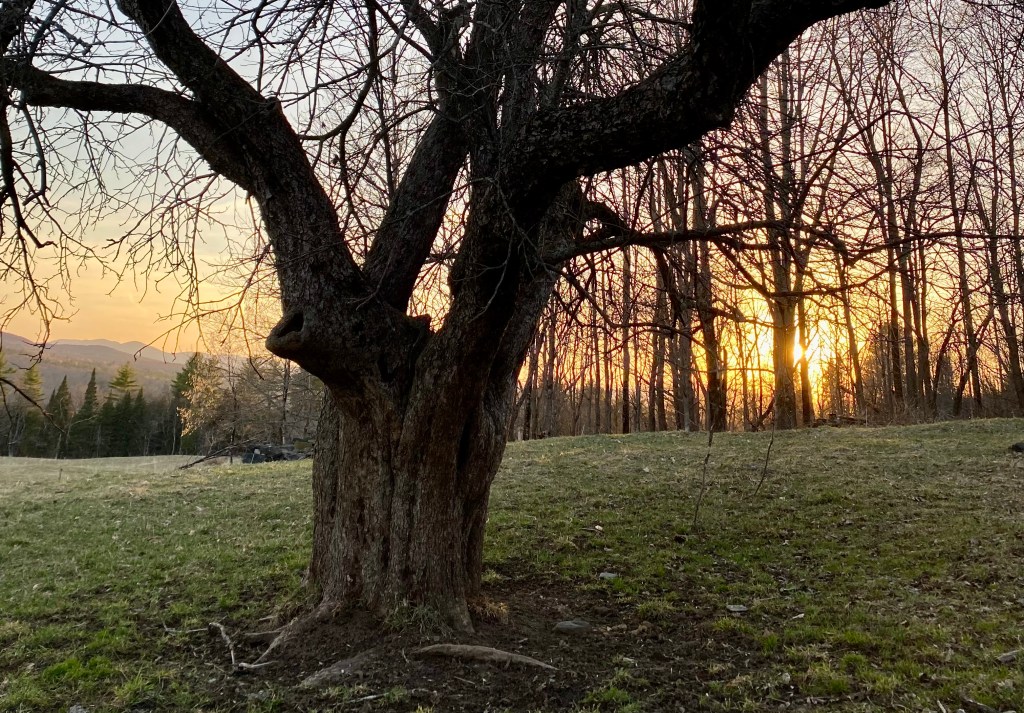
‘Soon it will be the sky of early spring…’

Wild February!

At noon, I stand talking to the road crew in a sparkling snowfall. I wax on about the prettiness of snow on the emerging earth. The crew, who’s endured the strange vagaries of mud season in December, the fickleness of Vermont’s winter weather made weirder by climate change, humor me with a nod.

Fifty degrees and rain forecasted for today, followed by more, followed by bitter cold, then rain and wind, the sun I lean towards…. Late winter, again, and I remember when I could distinguish the years: the spring we boiled sap from March 1 to the 31st. The year we made 540 hard-earned gallons, two of us and a five-year-old, and I wore through three pairs of gloves carrying in wood and feeding the arch.

Walking around my snow-scattered garden, I envision where I will plant the bare root Japanese lilac I’ve ordered, for me or someone else to admire and love. The path down to my compost is both icy and soft mud, the conundrum of winter reluctantly losing its teeth to spring. The true joy is the inevitability, the earth’s order to proceed from twinkling snowflake to downy crocus, the planet’s sheer opinionlessness regarding skunks and black flies.

The road crew and I kick around a few more pithy remarks about government corruption, and then we head along….

From my one of my favorite Louise Glück poems, March:

The sea doesn’t change as the earth changes;
it doesn’t lie.
You ask the sea, what can you promise me
and it speaks the truth; it says erasure.

Finally the dog goes in.
We watch the crescent moon,
very faint at first, then clearer and clearer
as the night grows dark.
Soon it will be the sky of early spring, stretching above the stubborn ferns and
violets.
Are you for real?!

The other night, I’m leaving a meeting in the high school library devoted, more or less, to hashing out what community means (nothing to be solved in a few hours). In the parking lot, a woman says Goodbye, Brett — and quicksilver, I shout, Are you for real?!

As the other folks empty out of the school into the spitting snow, she and I talk beneath the ghostly streetlamp. Very quickly, it’s clear to me how utterly wrong I am about this woman. What I believed was true was not. I once ate chocolate covered strawberries in her house with my youngest daughter. The woman packed up a bowl of these delicacies for one sister to give to another.

In ten minutes, we are speaking animatedly of matters of our hearts. We’re both shivering by then in the damp snow. We hug and head to our homes.

I don’t know what’s happening in the rest of the country, and I surely can’t speak for anyone else, but how glad I am that I called out in anger. And how much more grateful I am that she took the time to listen to me, to lend me her shoulder, and I could do the same for her. Indeed: real.

A community… is the knowledge that people have of each other, their concern for each other, their trust in each other, the freedom with which they come and go among themselves.

— Wendell Berry

What’s in the News, What’s Not.

No fooling here — no glossing over — in the past month there’s been two homicide/suicides, neither a domestic, all gunshot wounds, (that’s a total of four souls), right around where I live, then an early morning drug raid a few minutes’ walk from my house. I live in a middle class town, shabby around the edges, a little more spiffed up on some streets. In the evenings, I sometimes walk by the house my daughter’s friend bought. In the dark, he’s often on the roof, hammering or sometimes lying on his back, staring up at the stars. We talk for a bit, and I urge him, be careful.

I write this not out of salaciousness, but more to mark where I am, what’s happening in my state. Malcolm Gladwell wrote that planes never crash because of one reason. Likewise, there’s not one word, one single reason, one sole cause for any of this. These deaths and this raid isn’t my story, but it’s a piece of my story as our lives are all interconnected, the net that holds us together only as reliable as the weakest knots. Yet, as a whole — as a town, a state, a country, as the human story — we keep on.

On this balmy November afternoon, the elementary school kids run on the grass in their t-shirts. Magical insects hover — what my daughters called blue-glass bugs. Later, I stand talking with a friend in the grocery store. I’ve run out of the house, sockless in my Danskos, to replenish the coffee I finished that morning. I met this woman when I was writing Unstitched, so whenever I run into her, we keep talking and talking. What a joy it is to see her glowing and alive, this woman who had a life harder than anyone should ever endure. When I come out, darkness has fallen. The crescent moon hangs over the town, luminous.

Water, Water.

These days, I’m working in a town clerk’s office, Greensboro, Vermont, population approximately 827. With summer folks, the population swells to three times.

Yesterday, the phone rang all day. We propped the door open, and people wandered in with questions.

Can I get to Craftsbury? Which roads are out? I have a dump truck; want me to haul fill? I’ve lost everything; do you have extra clothes, shoes, blankets?

Selectboard members set up a triage system to patch roads where anyone was stuck. Farm roads were prioritized for milk trucks. All day long, Vermont Public Radio updated us. Montpelier, beloved capital city, is underwater, threatened by a dam where waters rose precipitously.

Late afternoon, the selectboard chair rummaged for leftover potato chips from the July 4th celebration. By then, the sun had emerged. The July day was hot, redolent with blooming roses. I had my own petty worries: my car was low on gas, and I’ve kicked a front brake repair too far down the road, and I’ll need to find a mechanic stat, and who I’ll find isn’t yet clear to me. Later, I’ll call my brother and talk about my parents while weeding my neglected garden. For some time, though, we stood in the parking lot, breathing in sunlight, waiting for a contractor to look at one of the town’s paved roads that’s severed in multiple places, the asphalt broken into multiple chunks. When could he get here with an excavator and put that back together?

A friend drove up and told us about mutual friends in a nearby town. They had been out in the stormy night. Travelers on I-89 had been diverted off the interstate and wound up driving through the backroads of a rural town they didn’t know. By flashlight and headlamp, in a driving rain, water roaring down hillsides, the residents directed the strangers to a safe haven, where they weathered the night.

The Past, Rising, Falling.

The news here is that the peepers have returned. In the evening, I walk past the two ballfields where the little kids and then the big kids are playing baseball, and up the hill where pavement turns to dirt. Right at the edge of town, there’s a neighborhood where people are living rough. Along the roadside, I spy empty milk cartons and a clear plastic bag jammed with Christmas bows. There’s a swathe of hemlock and cedar, and then the fields and maples begin.

A few days before, I was writing in the local coffee shop when a woman I once knew fairly well stopped in. She sat down with her latte, and we talked for a little bit about the nursery school we once started and where our kids are now.

Then she turned the conversation and acknowledged that something lay between us. I closed my laptop and slid it in my backpack. We spoke about a fire, a burned construction site, a rekindling of the fire, and losses to both our families. It’s early morning yet. We’re in a corner by the window. The baristas are laughing at the counter, and no one can overhead our words. Quickly, we pair up our memories, and it’s shocking how our memories sync of that time. Until we diverge. We pause at the mention of the third family. I have about a 100 questions I want to ask. My shock appears mirrored in her eyes. She’s forgotten all about her coffee.

How do you ever understand the past? We’ve both divorced, moved houses and towns, raised children, created new working lives. And yet there it is, running like a subterranean stream, the past.

Her acquaintance walks in, and she stands up. I slip my notebook in my backpack, say goodbye, have a nice day to the barista, and walk down the sidewalk to the post office.

Small Citizen.

A few streets over, the neighbors are out with their little girl. She’s wearing a helmet and holds the handles of a pink bike that I’m nearly certain is new to her from the cautious way she thumbs the handgrips, as if still thinking through what this might mean. This alone is good news for this windy April day, a girl and her bike and an imagination sparking in her eyes. As I pass by, I wave, but the girl is in her world, and the adults are bickering about dog shit under the front yard’s single tree. I laugh because, well, what else? Been there, on both sides of that equation. When I return from the post office, the girl is making long slow circles in an empty street, the adults are leaning against a fence, sharing a cigarette, and the sun promises to shine all afternoon — cold, brisk, exactly what we expect in Vermont’s April.

And, for no reason at all, one of my favorite poems….

Citizen of Dark Times

by Kim Stafford

Agenda in a time of fear: Be not afraid.
When things go wrong, do right.
Set out by the half-light of the seeker.
For the well-lit problem begins to heal.

Learn tropism toward the difficult.
We have not arrived to explain, but to sing.
Young idealism ripens into an ethical life.
Prune back regret to let faith grow.

When you hit rock bottom, dig farther down.
Grief is the seed of singing, shame the seed of song.
Keep seeing what you are not saying.
Plunder your reticence.

Songbird guards a twig, its only weapon a song.