“Quite Serious”

My neighbor runs out his back door, shouting and waving his arms. I’m working on my upstairs glassed-in porch. He cranks up the volume on VPR’s Morning Edition. I’m guessing he hopes the young woodchucks burrowing beneath his deck aren’t NPR fans.

Like my neighbor, I am a VPR fan. This morning, news of Iran dominates the air. As I labor to join noun to verb, I notice my heart beating at Steve Inskeep’s words. Eventually, I leave my cat sprawled on the windowsill and head downstairs to wash the dishes. I’ve listened to NPR my entire life. Heck, the radio was probably playing when my parents brought newborn me home from Presbyterian Hospital in Abuquerque. Little these days is good news.

This winter, I’ve written in this space about my obsessive struggle to remain among the living on this planet. Only now—two surgeries, six rounds of chemo, 11 hospitalizations later—do I realize the diciness of my determination to live. A few weeks ago, driving with my daughter, she showed me a lawn where she cried on a bench because I believed my mother would die. Every day now, as I begin by feeding my two cats and drinking coffee, I carry this winter, those months of spitting distance from my grave, within me. As at the beginning, my greatest worry was/is my daughters. So many months later, I understand how my life is connected intrinsically to so many others. That what lies before my eyes are the twig tips of stories.

In my younger, brasher years, I might have written about politics and conflict, but the Mideast is a place I’ve never been, with people I’ve never met, for whom I will never speak. Too, I’ve knocked around this planet long enough to know that violence changes the world, irredeemably. That the combination of deceit and anger and hubris wrecks destruction. And that cruelty wrought can never be undone. We hurtle onward. I keep listening.

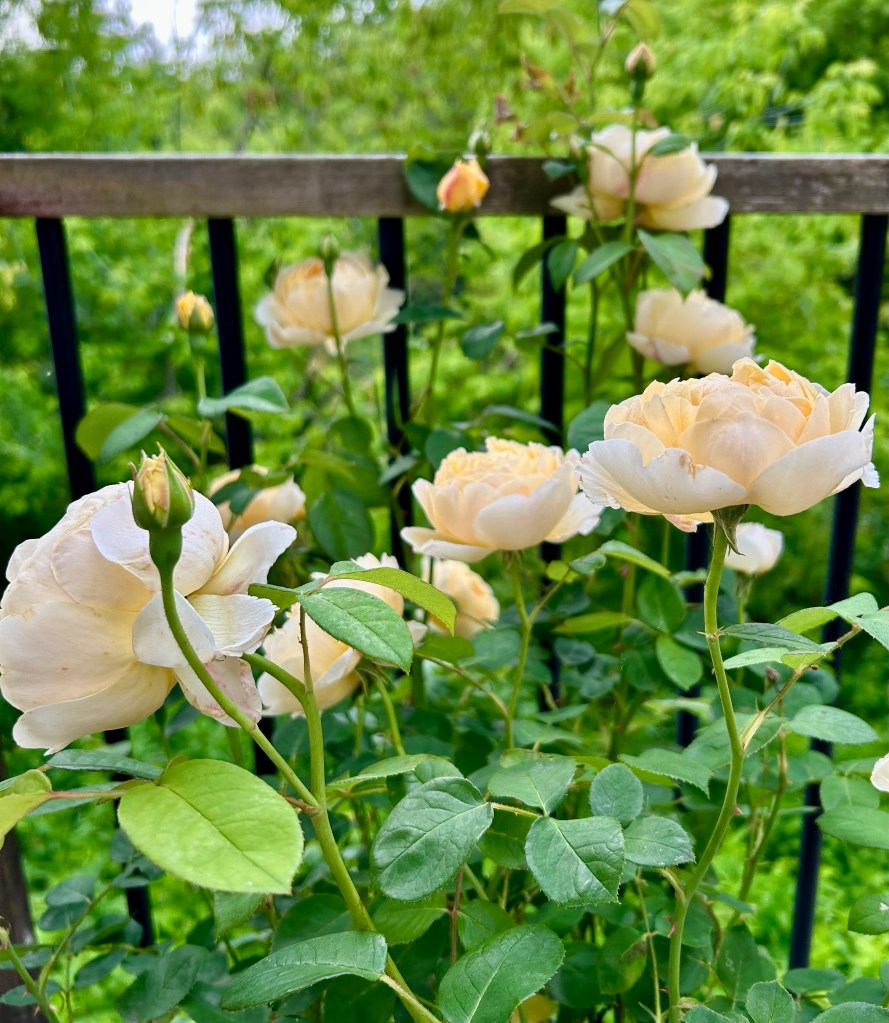
June, and pink roses bloom against my house, planted by someone I never knew, perhaps the woman known as Grandma Bea buried in the adjacent cemetery’s crest. My daughters climb a mountain with a view of Vermont’s shimmering Lake Champlain and the emerald patchwork of farms stitched together. They return with a gift for me, a thorny rosebush with fragrant blossoms that fill my cupped hand. In the evening, shortly before dark, I walk in my bare feet, the long grass already cool with dew. High heat is predicted, the planet is surely burning up, but this ruby-and-gold sunset drags in a coolness. Lush, so lush this month. The butternut tree I planted stretches towards the apple someone else carefully cultivated and noted in pencil on the barn’s bottom wall. A record someone held dear.

In 1956, Allen Ginsburg wrote: “America this is quite serious.”

June

Hello, roses!

The day I bought this house, I realized roses bloomed beneath the dining room windows. Of all the things I scrutinized when house buying — location and purchase price and paint — I never considered these old, overgrown rose bushes. So early in the season, Japanese beetles haven’t yet set in with their hunger. The blossoms emit the sweetest fragrance, drifting around the back of the house.

Hello, gorgeous and ineffable summer.

There will never be more of summer
than there is now.

Alex Dimitrov

IMG_7974

Rosebush

This afternoon, between the end of school and the beginning of work, I went running, my little girl ahead on her bike.  Down the dirt road we went, and then she circled back to me as we approached a small camp where a man stood in the road.  My child was afraid of the dog there, and she rode closely beside me.

I stopped running and said I was sorry to hear about his wife.

He told me they had celebrated their nineteenth wedding anniversary on the first, and then last week, they ate dinner together and fell asleep.  He told me he woke in the morning and washed dishes, and when he checked on her, still in her recliner, she had passed.

The couple hasn’t lived in that camp for years.  They moved down to the bottom of our road, in an old farmhouse wrapped with plastic to the keep the wind out, painted pink in one section, green in another.  The acres have substantial mounds of cowshit, junked vehicles in piles, all manner of debris with all kinds of people coming and going.  He considered his occupation “junking,” and had told me in 2008 his occupation had gone all to hell.  In the spring, their pasture is verdant long before anywhere else.

The camp, on its footprint of property, has had a revolving door for years with a series of single men and one winter a woman with two young children.  With no water or plumbing, the cabin is surrounded by piles of exactly what we’re never sure.  Large things like soiled mattresses and campers, a shower stall, salvage windows, and piles and piles of human food garbage.  Built in a dank hollow, the camp has always exuded to me the desperateness of hard-up and hardscrabble people, on the fringe, looking to stay away from the law.  Who in this extended family owns what property, or if it’s even owned or rented, has always been unclear to me.

This neighbor and I have never been on poor terms.  He recalled, today, talking to me years ago, when the road often held only myself and my daughter in her stroller.  When she was three or so, she asked me how he could eat corn-on-the-cob, as he had only one front tooth.

Today, he watched his grandson mow a patch of tangled weeds, telling his story, his eyes tearing.  Tomorrow, he’ll plant a rosebush and bury her ashes.

I said what little I could, that she hadn’t suffered at least.

He shook his head just once and said, I don’t  know.  It was in the night, you know, and no one thought that was going to happen, you see.

The little girl and I continued down the road.  When I returned, I lifted my hand and waved, running, and he hollered to me, These weeds can some grow!

O my neighbor, may your rosebush bloom beautifully.

And did you get what
you wanted from this life, even so?
I did.
And what did you want?
To call myself beloved, to feel myself
beloved on the earth.

– Raymond Carver

DSCF9978