Under the kitchen vinyl.

While the radio carries in terrible news, the carpenter tears off the vinyl on my kitchen floor. I run my hands over the worn maple boards that are revealed to the daylight again. In one corner, a rotten board where perhaps the sink leaked. The carpenter cut out those pieces, and I look down at the basement’s graveled floor. In another corner, there’s a blackened place where perhaps a woodstove once charred the flooring. He and I stand there, considering, wondering about who once lived in this house. I wonder about their patterns of heat and sustenance, these people who passed from this world, decades ago.

When the carpenter leaves, I vacuum, then sit on the cold floor while the cats sniff curiously. I rub my hands over these boards bruised from living and speculate that I can sand and polish this small space, quicken it again.

I began this project with a desire to take down a wall, open a room, and chase away the dismal memories of illness, to acknowledge that, indeed, this is the house where cancer devoured my body, tore at my flesh and mind. I survived. To continue surviving, I must revise my life, change my patterns of living.

I know a few of the names of the people who lived in this house on a village hillside. Now, barefoot on these cold hard-worn floorboards, I sense the mysterious stream of connection that runs between the dead and myself and those who will someday live here, when I have moved on myself, to other earthly or unearthly places. Who laid this floor I’ll never know, but I’ll put my hands and my muscle to it, lend my energy towards restorative beauty, towards the scantness I can do.

I am beginning to understand that healing is not about returning to what was, but about accepting the change and adapting to the brokenness. This is happening all around us, for people, for the land. People have done damage to the earth and to each other that can’t be undone. We can lament what was, but that won’t help us take care of what we still have. In fact, it might just hold us back. Nature herself keeps giving and never giving up. ~ Helen Whybrow. The Salt Stones

Mired in fog.

I hole up for the weekend reading Wallace Stegner, a pastoral novel about friendship and mortality, about the pre-internet world when complicated events unraveled perhaps not more kindly but more slowly. Vermont March is the season of live-or-die, the fits and starts of spring, jagged with driving ice, whirling snow, delirious sun.

I drive home from a dinner out in a fog so thick that the car before me pulls off, turns on flashers, and maybe simply intends to wait it out. It’s not late, but there’s no one else out, the wind throwing twigs at my windshield, the radio jingling Lou Reed. I’ve not driven in a fog so profound since I was in my twenties, living in the wooded spine of the Green Mountains, in the years when I was brash with youth and amor. The edges of the road vanish. I pull over at the spring with its pipe where people gather water, and I stand just outside the beam of my headlights, the nearby stream gushing against what remains of its winter ice. I surely can’t stay here for the night, shivering, on the edge of my own mad solitude. The way back, the way forward, all around: pathless, and surely a metaphor for this time.

I’m still shaken to the core by lymphoma, by chemo, by the surgeons who sliced me open and removed those physical scars so I might live. I’m here for this moment, flesh over my slender shoulders, my now bony hips that once carried two babies, and flesh—well, so easily ruined. I spent most of last March in one ED or hospital room or another. While the world spun on, I leaned into treatment, propped up by dear ones, who ferried me to remission.

Now, shivering, nearly blind with fog, I turn off my car and the headlights. The fog wraps around me. I drink it in.

“In the gnostic gospel of St. Thomas, Jesus says, “If you bring forth what is within you, what is within you will save you. If you do not bring forth what is within you, what is within you will destroy you.” — Andrew Solomon

Knock down a wall, survive for a bit

The advance copies of my novel that will be published at the end of June, Call It Madness, sprinkle out into the world. I print postcards and mail those, too. Email me your mailing address (brettstanciu@gmail.com), and I’ll drop a postcard. The novel will be published June 30, and summer events slowly add up. I imagine sultry July, steamy August, spaghetti strip sundress, tumblers of ice water.

The novel is divided into sections of place: an apartment, a pantry where the protagonist Avah hides, the roadside Blue Lion Motel where Avah tracks down her mother, and Echo Lake—a great gossamer spill, a fat layer of ice…

Places define us. Unbelievably, I am now nearly a year out from chemo. All that long last winter I huddled on my couch, too sick to feed my own woodstove, I kept thinking, I think the kitchen wall removed. I want the small rooms of this old house opened. Now, a year later, holding what will be forever-fatigue in one hand and my strengthening return to health and merriment in the other, I hire a carpenter to remove a wall of early 20th century two by fours and lathe. I return to my dusty and torn-up house in the late afternoon, step in, and think, This is how the house is meant to be.

With the mind of a novelist, I wonder at the calculus of human decision-making: the mixture of numbers, of cost and house value, a stacked rationality. Take that arithmetic, and add to it my fierce desire to re-imagine my future where my garden bounty of jalapeños and garlic meets kitchen cleaver, where I revise another book at my kitchen table, where illness is swept from my house by the spring wind rushing through the open windows, smudging my rooms with the fecund scent of mud, the castanet jingles of mating frogs.

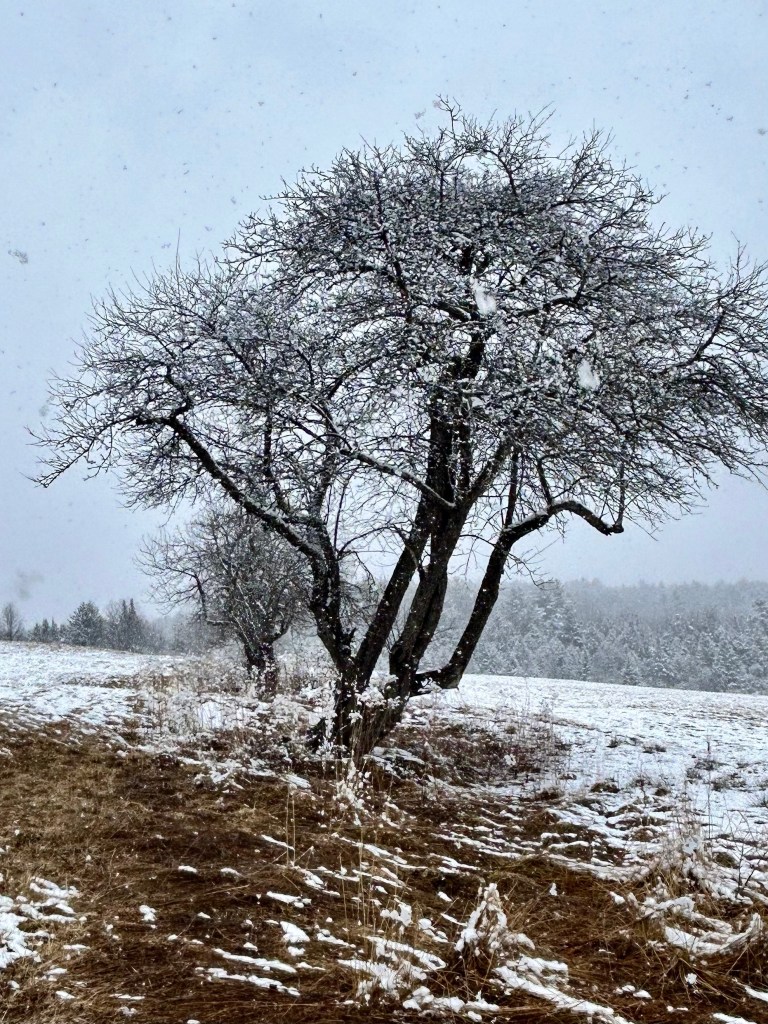
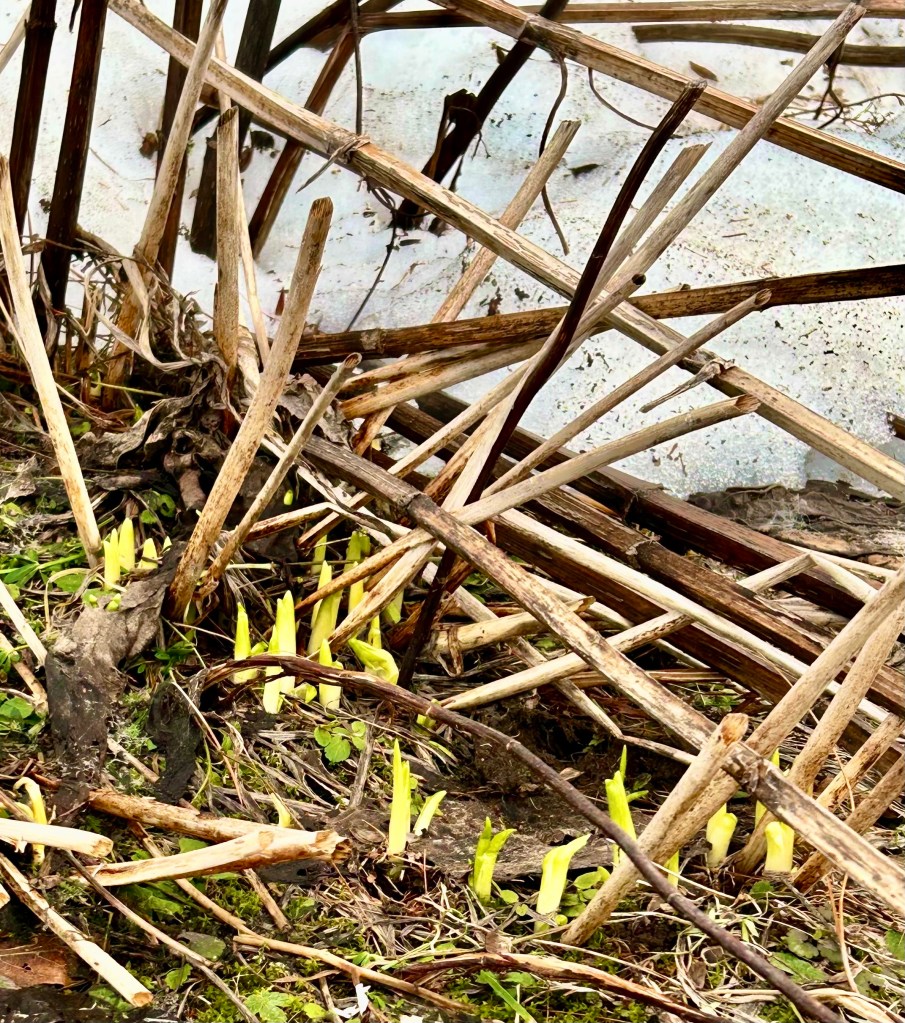
Vermont spring: thaw, fresh snow this morning, stove ashes sprinkled on the icy paths, robins. All the things.

“Survival, it is called. Often it is accidental, sometimes it is engineered by creatures or forces that we have no conception of, always it is temporary.” — Wallace Stegner, Crossing to Safety

The truth is erasure.

Saturday morning, I chip at my day’s list, persistent: my thousand creative words, email that shouldn’t linger, the house chores of wood and compost. On the nearby trails, I ski and later drink coffee with my beloveds, and we ponder construction that will tie up this town, Hardwick, until the sundress-wearing season. At home again, I finish the 2025 taxes, stow things in boxes, preparing for a carpenter who will remove a kitchen wall and put a window in my kitchen. This plan I hatched while I was marooned in my house for months, struggling through chemo. Now, this winter, I wondered, Am I mad? Will I still proceed? But opening the heart of my house to the view of the village seems a hopeful act, a kind of creative resistance against dismal five-year survival statistics, an act of beauty in contrast to the darkening world.

I abruptly need the sky and the muddy earth beneath my boots. I consider phoning this friend or that friend to walk with me, but I doubt anyone will jump at the sudden request. On this ridgeline road, I see a friend who quickens my blood. We walk and talk for bit about the things that nourish my winter-worn soul: about the unexpected in our lives, about writing and doubt, an April event of poetry and art and food. About what Bashō called “the journey itself is home.”

She heads home, and I keep on along the maples. All winter I’ve walked here. One frigid January, I’d gone too far and considered flagging a stranger in a car for a ride, but I didn’t. I kept on, as we all do. An eagle spreads its wings over a hayfield then disappears over a treeline. Blackbirds sing. A skunk waddles along the road. The snowbanks are above my head. The creature and I consider each other. Then, on our respective sides of the road, we each ease along. When I look back, the skunk is hurrying along, too.

Another spring. So many years I’ve lived through a New England winter, so many springs, and yet each March arrives as a surprise, a fresh reckoning. The wind smells of the opening earth. Twilight will soon be nestling in, and I’ll be home again, feeding my cats and the woodstove, eating a blood orange. A friend plans to visit, and we’ll keep each other company. Better to think of the days without names or numbers. Wiser to place these with a friend’s name, with skunk, puddle, blood moon.

You ask the sea, what can you promise me
and it speaks the truth; it says erasure.

… Nothing can be forced to live.
The earth is like a drug now, like a voice from far away,
a lover or master. In the end, you do what the voice tells you.
It says forget, you forget.
It says begin again, you begin again. ~ Louise Glück

Shift in POV.

(photo G Stanciu)

My daughter sends word and photos of walking on Lake Champlain, frozen hard. I send word back, Be mindful! For those of us who love to swim and lounge on lakes and ponds, walking on the ice in the dead of winter is exhilarating, a flip in view in these cold months.

11 degrees this morning when I rise in the dark and shovel ashes from the woodstove while the cats mewl a protest for breakfast. I’m still thinking of those photos, and how it feels to have the cold air descend on your cheeks and walk that border between hypothermic water and all that sky. In a troubled winter I worked in a nearby town, I’d walk on the lake’s ice at noon and lie down and stare up at the sky. There were a few ice fishing shanties, never a sign of anyone, just me and the crows, all ice and the limitless sky and whatever the heavens had to offer. Sometimes spitting snow, sometimes endless blue, sunlight without warmth.

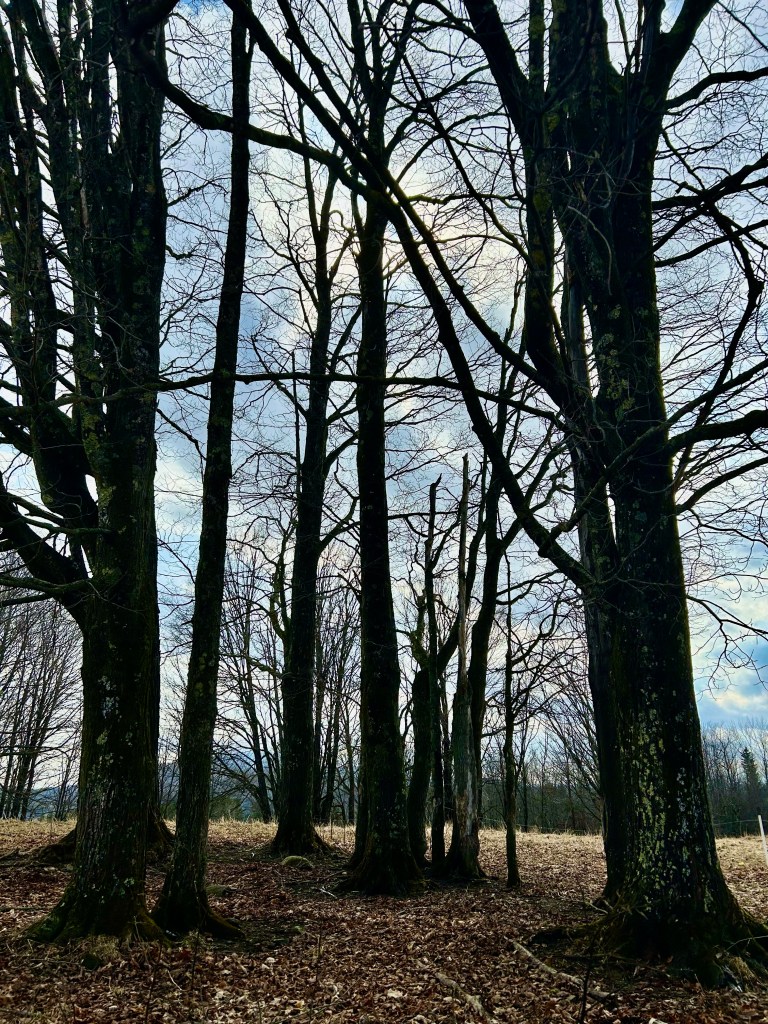
Heart of February. The skiing is excellent. A friend who I’ve known forever picks me up, and we walk along an ice-and-sand-strewn road. Below, the valley where the Black River and Route 14 is hidden in the folds of mountains. We look across and muse at the snow we can see on the mountains’ forest floor, how the bare trees reach up towards the sky.

Full moon:
my ramshackle hut
        is what it is. — Issa

Plunging through….

I drive a friend home, and we linger in my car, talking. She asks me what makes an individual an individual. Early evening, darkness wraps around us, my headlights off, the day’s dripping icicles frozen again. The juncos and cardinals and finches that nip at my feeders have settled silently for the night. I am at the place of near-wordlessness again. I’ll be home again soon, too tired to brew tea, longing to lie down and let sleep wash over me for the night.

Nonetheless, we talk about memories and habits, the nature babies carry into this world, the inescapability of genetics. I lean forward and rest my forehead on the steering wheel.

Cancer, that relentless instructor, reshaped my appreciate for the common noun and verb—for the tangible—drove me inescapably into my body, far from ideology into the ineffable appreciation of swallowing water, the comfort of visiting friends, sunlight on my face.

In northern Vermont, we are again in the prolonged season of start-and-stop-and-start again, the loosening from ice on back roads, the freeze again, the steadily warming and lengthening light. On this road, I meet an acquaintance and his sweet little dog. We walk together for a bit, speculating about schools and consolidation and possibilities that perhaps will never transpire. Meanwhile, the dog sets her small muddy paws on my knee. I crouch down and rub her velvety ears. The cold breathes from the dirt road, the turning earth’s exhalation.

“… this life is not a gate, but the horse plunging through it.” — Jane Hirshfield