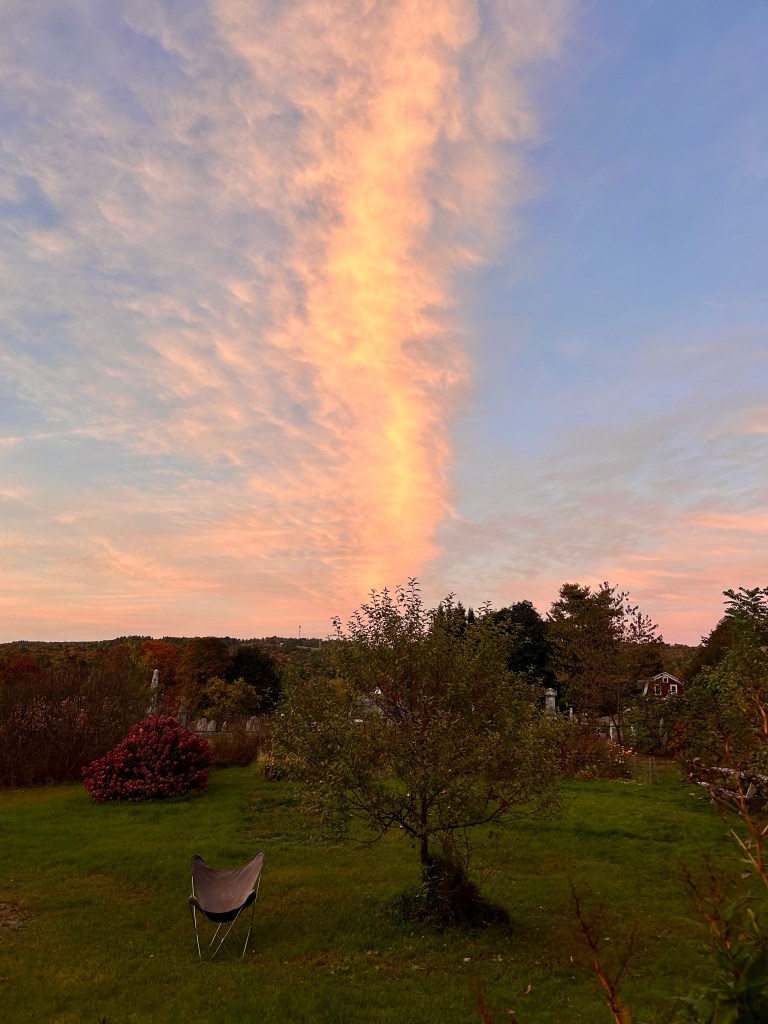
Wild Apples: Details of Living.

The red of my friend’s daughter’s hair matches this autumn—sunshot red—remarkable. Walking along a dirt road flanked by immense maples, abundant with purple asters, the child races forward, drags behind, curious as heck about the world as she gathers stones from the road and wonders if we might follow this inviting path in the woods. Where does it go?

She’s curious, too, about me and what I might say. My dog loves to bite. (The dog does not.) She holds out her hand to illustrate that it looks like mine. Walking, talking with my friend who’s doing her own fascinating unique adult things, a line from Dr. Paul Kalanithi’s book When Breath Becomes Air returns to me. Holed up in my hand-me-down chair from another friend, nearly incoherent with fatigue by the working week’s end, I’ve just reread this little gem. “There is a moment, a cusp, when the sum of gathered experience is worn down by the details of living. We are never so wise as when we live in this moment.”

In ways, the book is a meditation on that Buddhist proverb, for advice post-enlightenment: “Chop wood, carry water.”

One result of what appears to be a permanent stamp of intermittent fatigue (not a sleepiness alleviated by a nap) is a double-edged parsimony and generosity. I’ve refining a few simple sentences in email and meetings—that’s all I have for this—but I also often ignore the hours; I lose track of time in ways I never allowed myself before.

My friend climbs an apple tree and shakes the fruit loose. Her daughter considers an apple seriously. The tree was planted years ago and has now gone wild, unpruned, its branches an immense tree bouquet. The apple’s skin is crimson, tart, the flesh sweet. The child rubs her thumb over a bump in the skin and then bites into the apple. She eats gleefully.

If I timestamped this, I’d note, somewhere in Vermont, late September, gnawed apple cores tossed back into the wild.
The Garden You Can Reach.

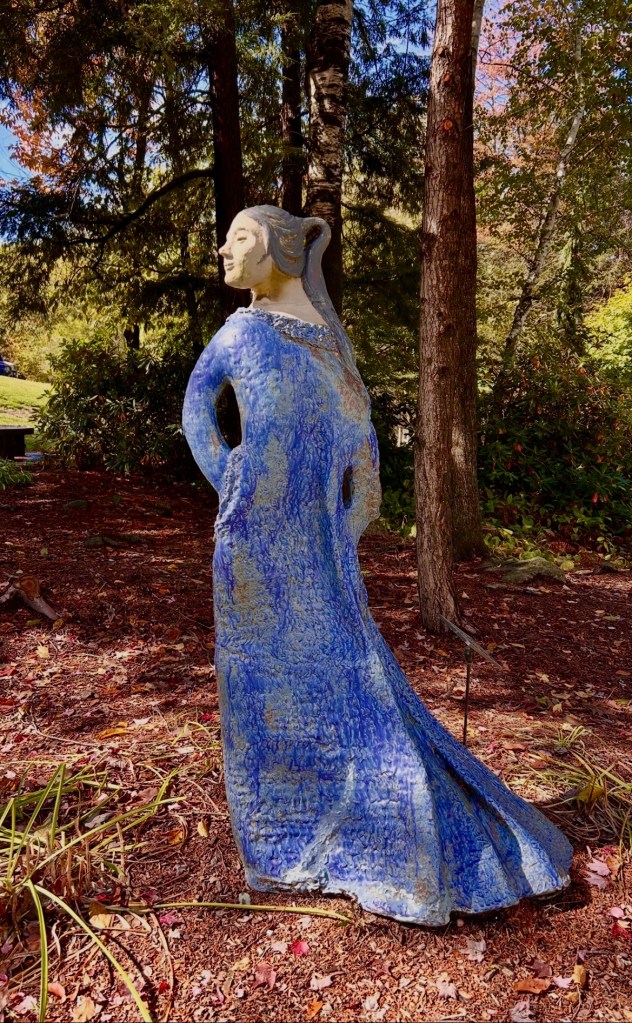
Blue Lady, above, Dartmouth Hitchcock campus, the statute the DHMC nurses had told me about — elusive woman — when I was marooned in a hospital bed. The 2025 May afternoon before my second, brutally painful surgery, my daughters walked me outside, and we sat on a bench beneath a blooming apple tree. Mother’s Day. Visitors arrived with bouquets and flowerpots. I hadn’t the strength to walk around the building.

The next month, visiting again with my daughters for a follow-up visit, we walked slowly on a path, in the time between surgeon and oncologist consults. We passed the wooden playground that I had seen from the windows of the last room where I stayed. And then there she was — the Blue Lady. Those two weeks I’d passed in that room — in the many rooms where I stayed that winter and spring — she’d stood through the snow and the rain, the sunlight, in an evergreen forest, so nearby.

At Dartmouth again, yesterday (gratefully for no emergency), a leukemia survivor shares his story, a man stricken with disease in his thirties. He says the most remarkable thing: that his disease was the worst and the best thing that ever happened to him. His words make me tremble, this mirror of my own thinking. Afterwards, I step outside in the chilly September sunlight and lean against the building. Wracked by the disease and treatment’s fatigue that transforms my bones utterly inconveniently into stone, I’ve forced myself to make this drive down the interstate. Within me, at all moments, I hold that cleaver of lymphoma.

On this Sunday morning, near to the equinox, that’s about all. Remember, tend to the part of the garden you can reach.

Illumination of Constellations.

On the way home from a conference in Montpelier, I stop at #10 Pond. Late afternoon, there’s no one around, and I open my laptop and work, perched on a rock. For a good long while, it’s just me and two curious loons swimming by, the September sunlight dropping over the hillside full of hovering gravity-defying dust and damselflies.

A stellar autumn day.

I hadn’t intended to swim, but the afternoon turns sweaty. The water’s temperature hovers at perfection, the morning’s chill vanished this late in the day. Afterwards, I stand on the shore’s mud, drying off. A stranger appears and wades in. The sunlight moves between us, a great creature.

We talk about the clear water and the leaves turning gold, and waking in the post-midnight wee hours. The nights are cold, and we agree that we close our windows, now, to keep some warmth in our houses for the morning. A young mother and two small children scramble down the bank. The youngest child runs into the pond, splashing, hands outstretched.

19 years ago to this day, my youngest and I were at the ER, when my husband had a chainsaw accident. All’s well could be the pronunciation, nearly two decades later, but is that so? Another of these questions that only I seem to ponder—how much of our difficulties were caused by us, how much by fate? An impossible question with no answer. A human, not a loon, koan.

Mid-September, a day balmy-sweet. I drop my damp towel and wade out. I fear I may not swim again this year, maybe never, but as I stroke out further than I have this summer, far beyond shore, I let those fears sink down to the pond’s hidden bottom.

Much later, the day’s heat lingering, I lie on my splintering picnic table beneath the Milky Way and let the words wash out of my mind, sink down through the grass and sandy soil, the realm of worms and grubs and groundhog burrows. The constellations illuminate the darkness.

Metaphor.

In a whirl of what I call doubt, I hole up, sequester myself from the clanging world and the roaring news that AI has escaped the sandbox and my own gnawing worries about how, anyway, am I spending my allotment of mortal days/weeks/hopefully years?

I wake hours before that that glowing rim of dawn rises over the cemetery, my fine silent neighbors, and begin the work of joining word to word, noun to verb. Writing, I return again to that morning nearly two years ago, when I stood at my bedroom window staring down at a mock orange bush. The upper branches had been broken when the house painter’s ladder fell on the bush’s crown. I had learned the evening before that I had metastatic cancer, later revealed as stage four lymphoma. I stared at the jagged branches and realized I might die that winter.

It was the morning of the 2024 Presidential election, which had and has disastrous consequences for so many people, but that morning, consequences were heading in a markedly different direction for me and my family.

Now, two years later, the place I live on the globe—northern Vermont—again bends towards the shorter, darker days. It won’t be all that long before snow settles in around us. The mock orange yet needs trimming. But the work before me is to write hard into metaphor: to parse the layers of mortality, of human good and ill will, the brokenness and beauty of the world through this human tool.

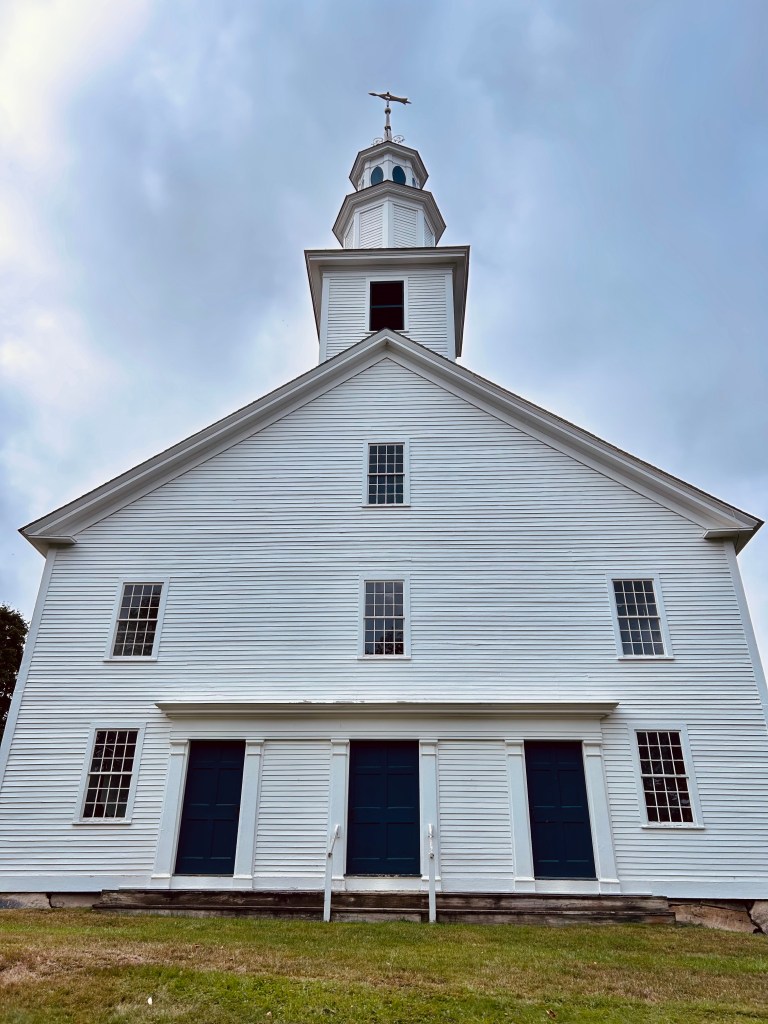
As for the photo above…. the Old West Church in Calais, September home to Words Out Loud, one of my favorite annual literary events.

We don’t suffer from a shortage of metaphors, is what I mean. But you have to be careful which metaphor you choose, because it matters. If you choose the strings, then you’re imagining a world in which you can become irreparably broken. If you choose the grass, you’re saying that we are all infinitely interconnected, that we can use these root systems not only to understand one another but to become one another. The metaphors have implications. Do you know what I mean?”
― John Green

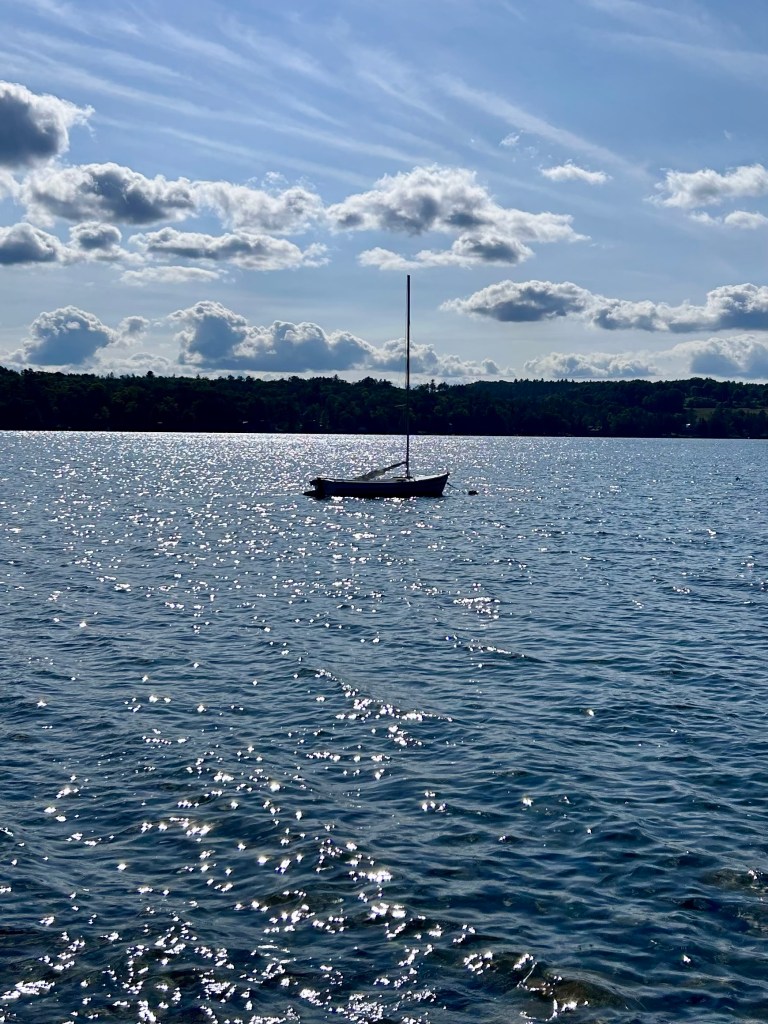
Solitary Sailboat.

I make a difficult phone call to a family member. Late afternoon, the perennial sunflowers stretch above my head in my garden. I’ve walked barefoot from my house through the grass that’s already cooling in the shadows to my garden, the soil warm from the day’s sun and so dry it’s verging near dusty. Afterwards, there’s a second call, then a third. I find two zucchinis that need picking, an onion I’d forgotten beneath the tansy. I gather these.

I’ve had this worldview of cause and effect: make a decision, or not a decision, and the consequences creep up or roar upon you. No stasis in this world. A selfish view. Meanwhile, of course, the transient world churns along, F. Scott Fitzgerald’s ceaseless waves, the pollinators feasting lustily on these sunflowers whose petals are already beginning their autumn wilt-and-drop.

September: a month jammed with color and sadness, the fleetingness of this life. Two years ago, disease was rampaging in my blood. I did not yet know this, while already my ailing body was sailing me into faraway seas. That journey was me in a solitary life raft, cold winter starlight drenching my eyes. Swimmers tossed over the edge of that rickety inflatable boat the things that kept me alive: medicines of all kinds, tiny bowls of hot soup, books and money, the hands that propped me up and guided me on walks, the company of voices. Meals and kindness that sustained my daughters, and so sustained me.

Overhead, the bluest of a Vermont sky. I answer my phone again. What luck, immensity of good fortune, to be enmeshed in wildly unknown world, relishing fatty marrow.

Into My Own

One of my wishes is that those dark trees,
So old and firm they scarcely show the breeze,
Were not, as ’twere, the merest mask of gloom,
But stretched away unto the edge of doom.

I should not be withheld but that some day
Into their vastness I should steal away,
Fearless of ever finding open land,
Or highway where the slow wheel pours the sand.

I do not see why I should e’er turn back,
Or those should not set forth upon my track
To overtake me, who should miss me here
And long to know if still I held them dear.

They would not find me changed from him they knew—
Only more sure of all I thought was true. ~ Robert Frost

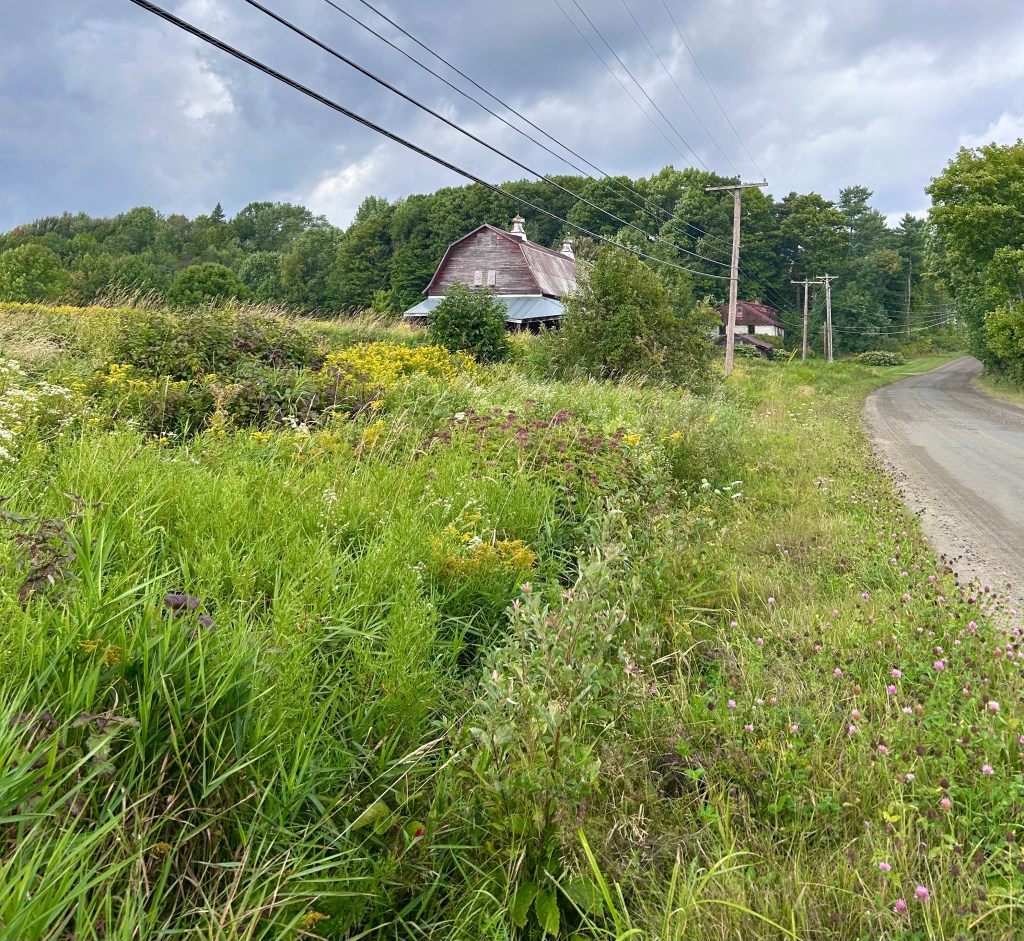
Tangled Wild.

A little rain falls when I’m done with work for the day, nearly seven in an evening filled with August’s sultriness. There’s no one in the electric department parking lot where I swap jeans for running shorts, and then head on the stony trail through the woods and down to the river.

August, the growing of weed and tended garden finished for this season. The apples are reddening. The blackberries that remain on the vine burst with juice, sweetness on the verge of rot.

I cross the river. Raindrops pebble its slow surface. I loop behind the old yellow barn that houses a warehouse of local cheese, then circle around the osprey nests where the Black River pools behind an old dam. My t-shirt is damp with sprinkles of rain and my sweat. Grateful I am to a friend who appeared with a glass cup of echinacea this week. In the spring, I’d mused that, a year out from cancer treatment, that was as far back as I would come. “Really?” she mused quietly. “You might question that.” Now here I am, running around the edges of this village, along this rain-kissed goldenrod.

Anne Sexton wrote about “the awful rowing towards God,” a poet I read in grad school, a woman crazed by not one simple cause. For so many years, I clenched my wooden oars, my rowboat with my children circling in eddies, plunged through rapids, in a journey breathcatching sometimes from fear and uncertainty, sometimes through the sheer awesomeness of the vaulting night sky, the companions of swimming dolphins.

Much as I chafe against a linear view of time, I see myself running around the brackish reservoir, then along the gentle slope back to my car and the mason jar of water I’ve left there to quench my thirst. I run with my whole story a whirlwind in my body and mind, known and unknown. Surely, as we rush headlong forwards, we’re always going backwards, too. And yet we row on, the work of this mortal life.

Oh, Anne Sexton, with her unhappy demise. Two years ago, I often ran along this path and discovered wild grapes down an embankment. The rain paused, I scramble through weeds. The grapes are there again this late summer. I gather these sweetly tart beauties in the hem of my t-shirt. Eating, I walk along the path, studying the soot-stained clouds. My friend with a new baby in a stroller appears around a bend. I offer this young mother a handful of grapes, and she spits seeds into the trailside milkweed. Sweaty from August and running, I bend down to admire the babe. Scuttling clouds are reflected in the child’s luminescent eyes, her smile quicksilver as a rainbow trout in a rushing mountain stream.

As the African says:
This is my tale which I have told,
if it be sweet, if it be not sweet…
This story ends with me still rowing. — Anne Sexton