Nurses.

If you don’t know nurses, you will, or someone you love will. In my past year of cancer-and-chemo appointments, of those dozen hospital stays, in variations of days to weeks, the nurses were my very best friends. Nurses cajoled me to eat chicken soup and drink water (even a sip, just try); they were kind to me and looked out for my daughters. They taught us the ropes of the hospital ship: the habits of doctors and surgeons, how to adjust a bed and order food, find the light switches, turn up the room’s heat, find warm blankets. They offered orange juice and sandwiches to my daughters and hotel vouchers. The nurses told me I would live.

Nurses taught me about IVs, how not to bend my arm, what downstream occlusion meant, and when I must absolutely ring immediately for a nurse. They helped me to shower when I couldn’t stand, and never laughed when I said I forgot I had no hair. But they did tell funny stories and made me laugh. When I had a terrifying reaction to a chemo drug that was absolutely necessary for me to endure, a nurse sat with me for hours.

There was that terrible ED visit when I couldn’t stop throwing up from pain, and I was too weak to talk, and the nurse stayed long after his shift ended, holding my hand while I cried. There was yet another awful stay in the ED, those three nights in the room with the beige metal walls and the heat that wouldn’t turn off, and the nurse and the MD together figured out a pain med plan that brought me back to my body, that made the cancer bearable again.

Another nurse helped me get discharged on a spring day when I pleaded to go outside and see the apple blossoms, to have sunlight and wind on my face; she arranged for my daughter to sit with me on a bench and sip hibiscus tea, and she arranged for the hotel room where I slept all afternoon and then traveled in the morning across the road again, back to the cancer center for more chemo. She did this to help me heal. The chemo nurses tend the frail and the hopeful, the recovering and the dying. I had no port, so my arms were bruised and scabbed from months of sticking, and these fine nurses turned my forearms over and over and never failed me. Who in your life never fails you? They took such care.

I could write on and on. The nurse that first visit to the ED, who knew from a scan that I had metastatic cancer before I did. He walked in my room and looked at my daughters with such compassion. We did not know, but he did. He knew the hardship that lay ahead of my dear daughters.

The nurses, unfailingly, cared me as one of their own. I have notes in my journals, names and stories of strangers who cared so tenderly for me and my daughters, but really what I have is gratitude, admiration, and such sorrow for the unnecessary murder of one of our tribe.

Holy Nightsky.

10 degrees on a starry night, my daughter phones me while I’m cramming more wood in the stove. She’s on a dark-soaked back road, the northern lights resplendent, and urges me to go in search. Up Bridgeman Hill, she tells me, with the ridgeline view.

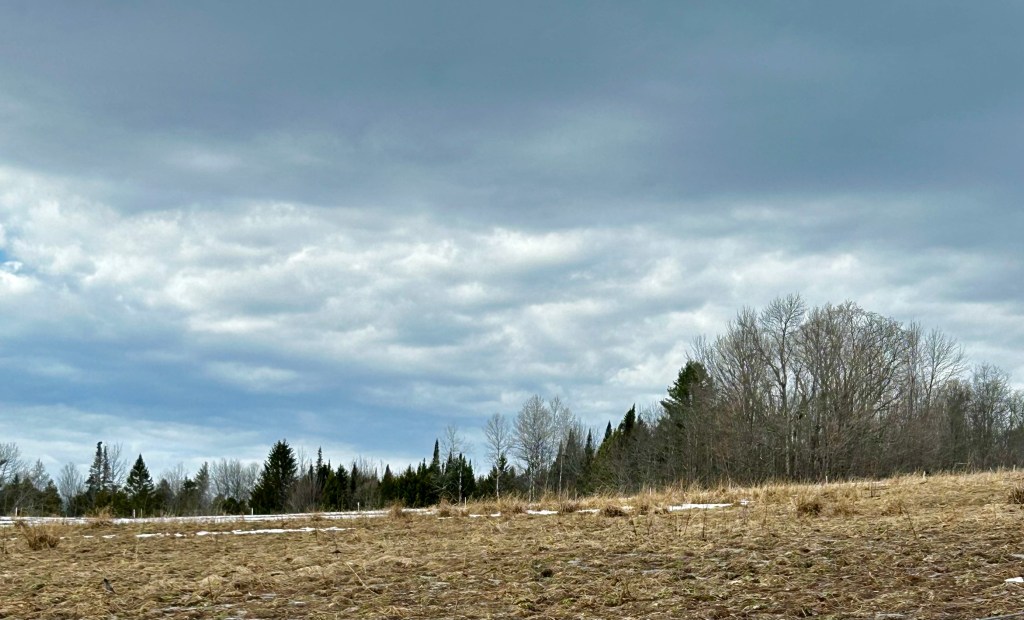
So, bundled in coat and hat, I drive through the little village and up the hill where the town lights cannot touch. In my headlights, wind scatters snow gathered from the wide hayfields, winter dormant. I pull over at the hill’s crest where two farms join. I get out of my car and walk down the road. The limitless sky gleams ruby and emerald, an immense shaft of white light luminescent. In the east, the black spreads profoundly, the stars so radiant I imagine I could reach out and grasp these gems.

John Donne wrote that illness is a “holy room.” My oncologist taught me that we are all the ailing; if not now, to come. Mortality’s cut makes zero discrimination. A cancer diagnosis gained me admission to inner chambers. Unwanted—let me reiterate again, I did not request admission. But I hung up my coat in the anteroom and set my hiking boots against the wall, and I walked barefoot and thirsty into the nexus, me and that fiercely multiplying lymphoma. The lymphoma and me — one of us was not going to survive this go-round.

In the night’s darkness, the rushing wind tore at my cheeks and hurled ice in my eyes. In the distance, a cow barn glowed with light, a scatter of houses in the valley. Around me, that immense and mysterious beauty over small human beings, at whatever mundane chore or decency or devilment we conjure, be it the evening milking or washing supper dishes or plotting a wrong against another.

The sharp-clawed cold shoves me back towards my car, back towards the village and my hot woodstove, my little house in the great holy room of this planet, this universe, this precise moment.

“It seemed like I was doing something ludicrous, trying to build a permanent work of literature out of broken little whimpering bits about the most ephemeral experiences when I was still mostly broken and half-ephemeral myself.”
― Anne Boyer

Landscape, Here, There.

Late afternoon, the January darkness chasing away the chickadees at the window feeder, a friend phones about a film at a nearby arts center. Turns out, the film is about the broken-upness of relationships in America. Post-lymphoma, post-chemo, my energy by day’s end is something I can cup in one hand, a diminishment never illuminated by a nap. Grateful for the nudge and the company, I fill my woodbox, feed my cats.

It’s been a day of plenty here—of yoga and work, of slush on the roads and mush falling from the sky, a softness that threatens to harden overnight to ice. Midafternoon, I drop my car for an oil change and open my laptop in the waiting room. A stranger sits down in the otherwise empty room and drops his tablet on the table between us. I’ve kept much of this blog off the political realm, although surely any reader perceives my alignment is not with the aggressor in power. The stranger begins talking in a way that’s not angry but maybe more mystified about what’s happening in the country, the prohibitions about who can come in, with real consequences.

He’s newly retired. When I ask what he did for work, he says you don’t want to know, but oh I do, and so he begins unspooling his life. He worked for the fed’s immigration service. Military service, 19 nineteen moves, a residency in Germany during the Cold War, four grown children, one of whom is estranged. He says again, as if baffled, she kind of went nuts over this Trump thing.

The windows reveal spitting snow. He’s at a crossroads, that weighty retirement time. What will he do now? He says he’d like to put his hands to some good, maybe a Habitat for Humanity project. I close my laptop. He grew up in very rural Vermont, and he shares an accident that happened to him as a teenager, how it defined his life. Midafternoon, the light is as sooty as twilight. As a writer, I’m always looking for junctures: which way will a character act now? But I know, of course, that we meet crossroads every day. Crab at the post office woman? Curse the town snow plow driver? And I know well my own fallibility and hesitation. But I also understand how our lives and choices are enfolded into our culture and nation, that, as we live by the law of gravity, we live also by the constrictions of time and place. As for the country…. an immense crossroads. A collective atlas is under dispute.

Driving home in the snow that may or may not amount to much besides a dusting of ambiance, my friend’s son phones from a Texas freeway, lanes choked with rushing traffic. My headlights slice through the darkness. On either side lie hayfields, snowed in for the winter. The stars are swallowed in dense clouds. A year ago, another phase of terrible things that happen to cancer patients was barely beginning in my life. I didn’t yet know that there would be so many rushing drives down the icy interstate to the ER, all those grim hours when my daughters and I wondered which was this was going to shake out. Disease is a fierce and demanding instructor. The first lesson I learned, as I smartened up quickly, was to ask What’s real? What’s happening? even when I didn’t want to know the terrain of the landscape.

Because here’s something else that’s true. In the day-to-day trenches of adult life, there is… no such thing as not worshipping. Everybody worships. The only choice we get is what to worship…

Look, the insidious thing about these forms of worship is not that they’re evil or sinful; it is that they are unconscious. They are default-settings. They’re the kind of worship you just gradually slip into, day after day, getting more and more selective about what you see and how you measure value without ever being fully aware that that’s what you’re doing. And the world will not discourage you from operating on your default-settings, because the world of men and money and power hums along quite nicely on the fuel of fear and contempt and frustration and craving and the worship of self. Our own present culture has harnessed these forces in ways that have yielded extraordinary wealth and comfort and personal freedom. The freedom to be lords of our own tiny skull-sized kingdoms, alone at the center of all creation. This kind of freedom has much to recommend it. But of course there are all different kinds of freedom, and the kind that is most precious you will not hear much talked about in the great outside world of winning and achieving and displaying. The really important kind of freedom involves attention, and awareness, and discipline, and effort, and being able truly to care about other people and to sacrifice for them, over and over, in myriad petty little unsexy ways, every day. That is real freedom. ~ David Foster Wallace

No Restitution.

As a child, I went rarely to a physician: once for strep throat, secondly when I was eighteen for a required physical to enroll in college. I had a smallpox vaccine in sunny Santa Fe, surely one of the last in this country as my younger brother skipped this one. My mother brought her three kids to elementary school clinics for DPT and polio vaccines in gloomy Manchester, New Hampshire. We were healthy kids, and my mother, an RN, believed firmly in keeping healthy kids out of the medical system.

As a 21st century cancer patient and now survivor, I inhabit a different world. Through the Dartmouth-Hitchcock portal, I message my oncologist (my oncologist? this pairing of words still makes me cringe), who kindly replies. My recent bloodwork results are “unrevealing.” I’m reading Geraldine Brooks’ Caleb’s Crossing, a gift from a friend, set in the 1600s, and I study that “unrevealing” word, pondering its roots. I have a slightly-above-average vocabulary, and yet this disease has shoved me against so many words I’d never encountered. For instance, salpingectomy: removal of a fallopian tube.

Among much else, I’ve observed how my oncologist (again, that wincing) uses language: use words precisely for what is known and what is not known. The precision of oncologist and surgery saved my life; yet, I was never given the illusion that all is known. For now, on this cold morning, crossover between a full moon already waning and the rising sun barely quickening the horizon, I’m well. Which arrows to the heart of the human condition. The nascent day stretches long, an infinity of possibilities.

“There is no restitution for people like us, no return to days when our bodies were unscathed, our innocence intact. Recovery isn’t a gentle self-care spree that restores you to a pre-illness state. Though the word may suggest otherwise, recovery is not about salvaging the old at all. It’s about accepting that you must forsake a familiar self forever, in favor of one that is being newly born. It is an act of brute, terrifying discovery.”
― Suleika Jaouad (in all her awesomeness….)

“beyond the face of fear”

I’m at the dentist for an X-ray of a front tooth that’s gone sour three times before — two failed root canals and one beastly apico — which also equals pain, more pain, and so many dollars. We compare the X-ray to the one taken six years ago, just before the pandemic, around the time when my brother and I were marveling at drone footage of empty cities in China. The tooth looks pretty darn fine. I explain that I recently endured chemo, and I’m off every which way. I no longer seem to know this body. Plus, the added layer of paranoia.

He says simply, Chemo will do that. He offers me antibiotics. I’ve had enough antibiotics in the past year to reasonably heal a village, or at least a hamlet, and I pass.

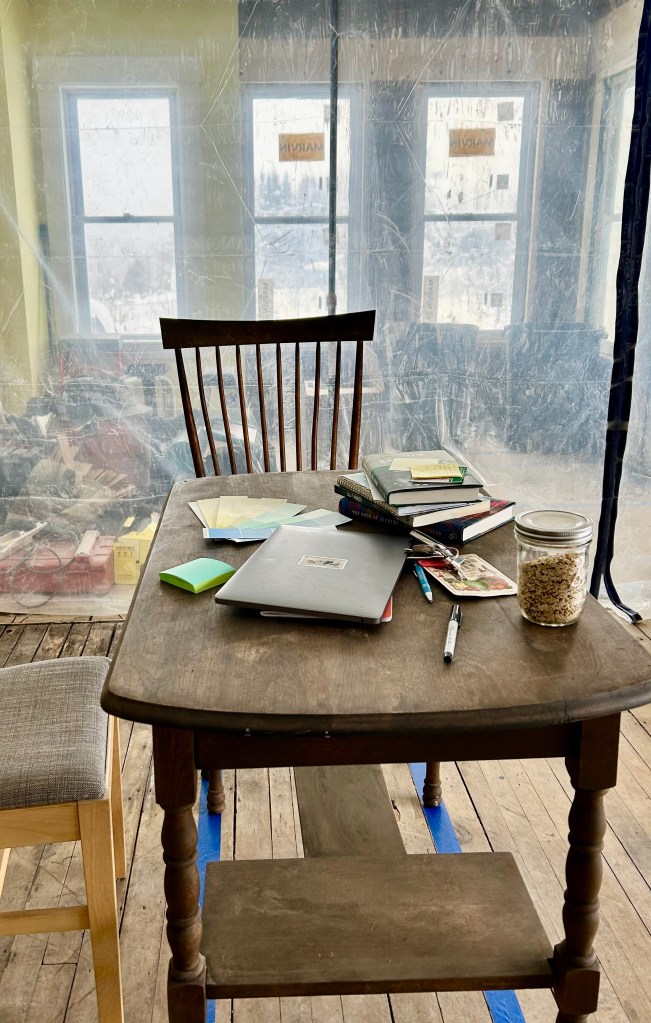
The very last day of December, the day is cold and sparklingly sunny. I work at my kitchen table for a bit, and when the sun shifts around, I drive to a nearby town to return library books. It’s the holiday season yet, and the library is nearly empty and quiet. The librarian and I have known each other for years now. We were once farmers market colleagues. Eventually, I buckle down and work hard for a good long while. When I leave, twilight is just beginning to settle in. The library is warm, and the staff is setting up chairs and cushions. Parents and little kids troupe in, their cheeks glowing with the afternoon cold.

On my way home, I drive up to the ridgeline and take the walk I learned from my poet friend Mary. The cold sinks its teeth into me as I hurry along. The gibbous moon appears and vanishes in the scrim of clouds. All summer and far into the autumn I felt surrounded by a holy veil, a phosphorescence, trial by devastating disease and the violence of chemo and surgery, a trial I survived. I counted each moment as a lucky gem. Slowly, my pockets began to fill with the world’s detritus, with those nagging financial fears, the inevitable disappointment of relationships, the ever-present terror of relapse a knife against my gullet. In plain words, the stuff of living.

Walking, I studied the horizon as the blue deepened, pure ineffable winter, and the night cloaked me. I passed a few farmhouses with little twinkling lights. I was so cold and yet I did not turn back. Instead, the winter night flooded into my heart. My whole adult life I’ve been a crepuscular woman, seeking the radiant edge of sunrise and sunset, reveling in twilight, the majesty of the starry heavens. I’ve transformed grit and solitude into books. Enduring lymphoma made me wary of those recesses in my soul. I relied on others for sustenance and heat, for clean clothes, for glasses of water, in the way of very young children. Both my beloveds and strangers kept me alive. But slowly I’m beginning to admit that the coarser and rougher shades in my soul kept my body alive, too.

All of this is to say that a heartfelt seemingly casual chat and a walk into the cold night quelled my uncertainty, steadied me again. At home, I’d let my woodstove fire burn dead so I could unscrew the back plate and clean the ash-choked metal filters. My ruined hands could not hold the wrench. So I shoveled out the coals, set a match to birchbark, and lit a fire. Good enough for now. Soon, I’ll summon the energy to ask for stronger hands…..

Last and certainly not least, you readers have poured such love towards me this year. I’ve been sparse in writing here as I struggle to find footing in my changed world. Thank you for your patience. Thank you for reading. And may this new year shine joy for all of us, in the universe’s mighty and myriad ways.

A dear poem from Lucille Clifton:

blessing the boats

may the tide

that is entering even now

the lip of our understanding

carry you out

beyond the face of fear

may you kiss

the wind then turn from it

certain that it will

love your back     may you

open your eyes to water

water waving forever

and may you in your innocence

sail through this to that

Another Plot Point.

A friend inquires if my summer’s adrenaline, the post-chemo and post-surgery and cancer-remission wave of energy has waned, and, indeed, that has, the winter and cold and what’s called fatigue but is actually a lifeless bleak plain setting up quarters in my household.

Winter is a reckoning time. In a strange kind of way I begin to see the pieces of my life jostle into a pattern — childhood and college years and those years in my twenties when I ran back and forth across the country and then to northern Vermont, how I built a marriage and house, the young mothering years of children and friends, how we taught ourselves to sugar and run a business and I taught myself to write. Then I broke that life apart and took the children, created a new life, kept writing books, learned to view the world askance to keep danger from our door. Danger slunk in anyway. The world, indeed, is cause and effect, not a linear straight-shot but a dense sphere. Surely the human story is the same for you and me, with its endlessly profound and terrible and awesome variations.

This morning, the harsh cold has relented, just the slightest, snow sifting down, the blue dawn pushing away the night’s darkness.

I’m encouraged to seek “protective factors” which I glean as my daughters’ merriment, a purring cat on my chest as a I read by the woodstove, a walk with a friend on a snowy road. My heart longs for the season of those #10 Pond swims, with friends or without, the sun hot on my bare knees. Spectator to the loon world. Not iced coffee but hot coffee. Now, these days of small light. In a considered burst of optimism, I mail a carpenter a check in a card with snowy evergreens and seal our agreement. Come when the weather splits and put two more windows in my house. Open the view of the valley and the village. Another plot point.

What would people look like

if we could see them as they are,

soaked in honey, stung and swollen,

reckless, pinned against time? — Ellen Bass