Like this cold September (what? covering gardens already?), reading Knausgaard is both exasperating and mesmerizing. Does he really live in a house with small children and can write about minutiae?
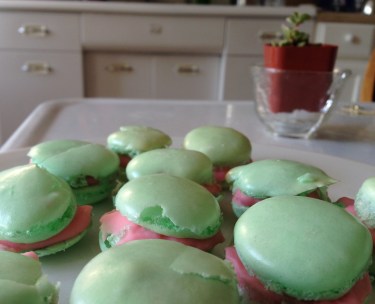
Reading at the kitchen table, my bare toes rub over the sugary effluvia of lime-green macaroon making on the floor. I keep reading.
The children wander in for more macaroons, my daughter’s afternoon vision yielding these quarter-sized airy sandwiches with a pink sweet filling. While I was in the other room, trying not to listen while tediously working on a paid project, the girls, left to themselves, experimented with baking whipped egg whites (Wow, that’s weird), periodically carrying in a baking sheet of baked samples, the hot sugar still bubbling from the oven, asking my unskilled opinion. In the end, they assembled two dozen uneven tiny cakes, dripping filling. Extremely satisfied, they stand back. Look.
Writing this, I realize (again) our life is all minutiae. Maybe that’s the gem of having children – tiny things mixed in with cosmologically-sized love – Blake’s world in a grain of sand.
Check out this sentence about ancient triceratops and reading to children at bedtime.
That petrol (in a puddle) was extracted from crude oil, which was brought up from reservoirs deep under the ground and consisted of transformed organic matter from a time when human beings didn’t exist, only dinosaurs, those gigantic but simple creatures, and when trees and plants too were larger and simpler, and that it was the prehistoric force of that zoological and biological matter which now unfolded around us, all this made sense – the kinship between the bulldozer and the dinosaur was obvious to any child – but not the connection between the power of petrol and the mysterious beauty of the small trembling rainbow swirls in the many puddles of the 1970s.
Karl Ove Knausgaard, Autumn


 Stony Soil Vermont