Put on a dress of flowers…

I spy a young fox on my front yard sniffing the trunk of the pear tree. Someone planted these two fruit trees long before I lived here. The smaller bends into the lilac hedge as if it’d prefer to be a lilac. This one, the taller, shoots high, its branches like an enormous hand raised in greeting.

The fox checks out the cohosh I planted this fall. Dawn is coloring up towards whatever day might emerge. I’m walking around my downstairs rooms, a dress in my hand, headed into work today, to sort out questions I both can and cannot answer, to talk with my office partner about town roads and FEMA, the drying up streams and lakes, about the merits of apple cider vinegar, and grownup kids. We’ll open the screen-less windows wide open in this 100-year-old former school, letting in the sunlight over the dusty sills. Hungry wasps fly in and out. An ordinary day of the things of this world, some humdrum, some irritating, some lovely as this balmy October weather. As for me, broken by cancer, limping back to whatever rude red health I can summon, I think, Put on a dress with flowers.

The fox crosses my neighbor’s pine-cone-strewn grass and disappears down our thin road. A fortuitous sign, I think, for this day.

Ode” by Zoe Higgins

Here’s to everything undone today:
laundry left damp in the machine,
the relatives unrung, the kitchen
drawer not sorted; here’s to jeans
unpatched and buttons missing,
the dirty dishes, the novel
not yet started. To Christmas
cards unsent in March, to emails
marked unread. To friends unmet
and deadlines unaddressed;
to every item not crossed off the list;
to everything still left, ignored, put off:
it is enough.

Crazy-Making.

Yesterday, my oldest and I made that drive again down I-91 that flanks that Connecticut River. My knitting in my lap, I counted exits, St. Johnsbury first exit, then the second, the third that heads east to New Hampshire’s White Mountains, the fourth Barnet, which I took when I stayed at Karmê Chöling. We talked about fall colors and a meatball recipe and family, of course, all the way down to exit 13, the Norwich and Hanover exit, where we stopped for coffee and scones, as if a good luck charm. Coffee and sweets, not a dash to ER. We watched the time, careful not to be late for what I hoped would be a mere routine check-in.

All summer this day has hovered in my mind — what will this day reveal? — but this past week this coming journey was as near to me as something I held in my hand as I went about my days, doing what needs to be done. The day before, talking with friends, the fear of this day erupts and I hear myself on the verge of screeching, nearly crying. All summer, I’ve relished my good life, learning to walk again and eat again, to read on my back porch in that hand-me-down butterfly chair. To marvel that I am not in pain. That I might sleep and reasonably expect I might wake in the morning exactly as I want, in the pre-dawn darkness drink milky coffee and write. That I will witness the unexpected autumn buds on a yellow rose bush open, these final velvety blossoms of the season.

At Dartmouth, we wait again in 3K, in the cancer center. I am no longer one of the pallid-gray-faced chemo patients, hobbling, enduring. How desperately I never want to return here. My oncologist gently reminds me that he’d assured me I’d pull through this winter, even as I was admitted again and again and again, a dozen times. Add to that, more ER visits.

Later, a friend asks about the scan’s sign-off, but the only rules that matter are what the hidden mysteries of my blood and flesh reveal. The markers are that the lymphoma has not returned. I know that the reaper’s scythe heads towards me as that inarguable blade poises over each of us. But not this day for me. Not yet.

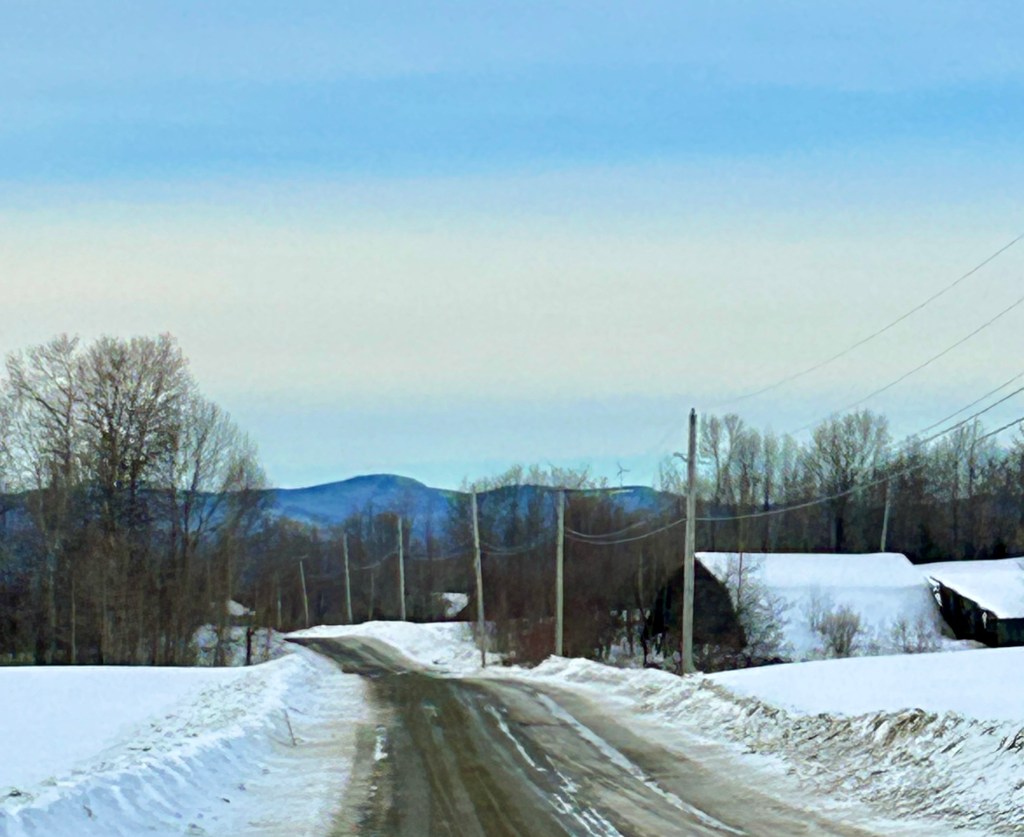
Driving home, people crowd the interstate bridges with RESIST signs. As our car sails beneath the metal and steel, we wave. I’d told the oncologist that my wellness plan was four-fold: eat real food, walk, do my work, and try not to go crazy.

He said, This is crazy-making. Just do your best.

There is only one heart in my body, have mercy
on me…

Thank You for letting me live for a little as one of the
sane; thank You for letting me know what this is
like. Thank You for letting me look at your frightening
blue sky without fear, and your terrible world without
terror, and your loveless psychotic and hopelessly
lost
with this love

~ Franz Wright

Crossroads.

I park at a dirt crossroads this weekend beside a former tavern and walk up the hill to the Old West Church. The sunny afternoon speckles through the roadside maples, and I meet others doing what I am, in pairs or singly, and we greet each other, cheerily. At the Old West Church, I hear two terrific poets, but on my walk back to the tavern the line that runs through my head is from a Franz Wright poem, There is but one heart in my body, have mercy/on me, an incantation.

I keep thinking of my dead mother on this radiant Sunday, my mother who pulled her last breath a year and a half ago, hardly a hopscotch jump ago. In my mind, I’m building the architecture of what I’ve tagged as this Cancer Atlas I’m writing, scaffolding this book’s bones. The book is about the here-and-now, about living (at least for now) through a terrible disease, about walking along Vermont’s autumn-gold back roads, about pulling up this summer’s frost-killed pepper plants that produced so bountifully this summer. And my mother? As I work, I think so often of her, this woman both generous and mercurial, the double blade I harbor in my own heart. Gracious, how much she’d enjoy this picturesque walk. She was a woman who loved old churches, was fascinated by adjacent cemeteries, who would have relished the art in the tavern.

At the tavern, I linger in an open doorway, talking with a curator, drinking iced tea from a half-pint jar. My mother would have drunk the wine, feasted on the cured meat and seeded crackers. Dust kicks up in the road. Old friends appear, and we joke about winter’s ferocity. It’s always a crossroads, isn’t it?

“We are created by being destroyed.”
― Franz Wright

Touching the Earth.

Right at the solstice, frost.

My garden planting this spring was a combination of friends who appeared and weeded and planted, of the sunflower seeds I sowed and the woodchucks ate and I replanted and the woodchucks devoured again, of volunteer calendula and love-lies-bleeding and towering gold sneezeweed, and the pepper plants from a friend that produced in enthusiastic abundance.

Hurray for the garden. These evenings when I light the first wood stove fires of the autumn, my cats chew shreds of birchbark, sprawl before the warm stove. Hurray, they purr in their cat way.

Season’s change again, so familiar and yet different, each day fresh and welcome. Season’s change for me, too, some days filled with friends and colleagues, other days I hole up and get my work done. Writing now about cancer, I imagine holding this keen awareness of my mortality, of the perishable world, in my hands: a tender-eared rabbit, a vicious rat, or maybe simply a handful of sunlight.

In the deep fall
don’t you imagine the leaves think how
comfortable it will be to touch
the earth instead of the
nothingness of air and the endless
freshets of wind? And don’t you think
the trees themselves, especially those with mossy,
warm caves, begin to think
of the birds that will come – six, a dozen – to sleep
inside their bodies? ~ Mary Oliver

Moonrise, More.

Barn door view.

An old friend unexpectedly appears at my door one evening as I’m folding laundry. We sit on my back porch and drink hot honeyed tea and watch the just-beyond-full moon slowly rise. September, the night’s chill creeps in around us. I grab my hat and coat and brew more tea.

All this fall, I’ll be thinking of a year ago, when I was getting sicker and sicker, with no real understanding why until that terrible night in the ER when a scan revealed cancer, so much cancer. Heading towards a year later, I’m admiring the moon sail over the mountain ridge and up through the trees. We keep talking and talking. It’s not so much the words that stitch us together but our chuffing breath that hangs in clouds between us, a howling neighborhood dog, a rustle in the ravine of a wild creature.

After my friend leaves, I wander around the moonlit garden, hands in my coat pockets, the tall amaranth a shadowy forest beside the closed four o’clocks. Frost is not far in the offing.

Inside, a daughter has texted me….. where are you?… Outside, breathing in the moonlight. Still here.

Instructions on Not Giving Up

More than the fuchsia funnels breaking out
of the crabapple tree, more than the neighbor’s
almost obscene display of cherry limbs shoving
their cotton candy-colored blossoms to the slate
sky of Spring rains, it’s the greening of the trees
that really gets to me. When all the shock of white
and taffy, the world’s baubles and trinkets, leave
the pavement strewn with the confetti of aftermath,
the leaves come. Patient, plodding, a green skin
growing over whatever winter did to us, a return
to the strange idea of continuous living despite
the mess of us, the hurt, the empty. Fine then,
I’ll take it, the tree seems to say, a new slick leaf
unfurling like a fist to an open palm, I’ll take it all.

~ Ada Limón

Autumn’s Radiance, Fine Medicine.

Before dawn, rain patters, a splatter through the open windows. The singing frogs are still at this hour. The rain moves through lightly. All summer: drought, drought, not likely to be relieved any time soon. In the town forest, beneath the soaring pines, the scent of the hot soil reminds me of the desert, a strange thing in northern Vermont. In the garden, the peppers, the sneezeweed, the Love Lies Bleeding relish the dry weather. By September, the garden will do whatever it’s going to do this year. Early autumn, colors burst. The hydrangea, so pink the large blossoms appear overly dyed, the coreopsis and compass flowers great bursts of little-kid-yellow, swaying with feasting bees.

Autumn, and I’m reliving last year’s descent into illness. A year ago, I was in a clinic’s office, asking what was wrong with me. I was sent away, and I went back to my toiling work, my sleepless nights. A month later, I returned again, thinner and weaker. Again, I was sent away. Shortly afterwards, I was in the ER and dosed with opioids. A scan revealed “unexpected severe neoplastic disease,” nothing that I’d conjured.

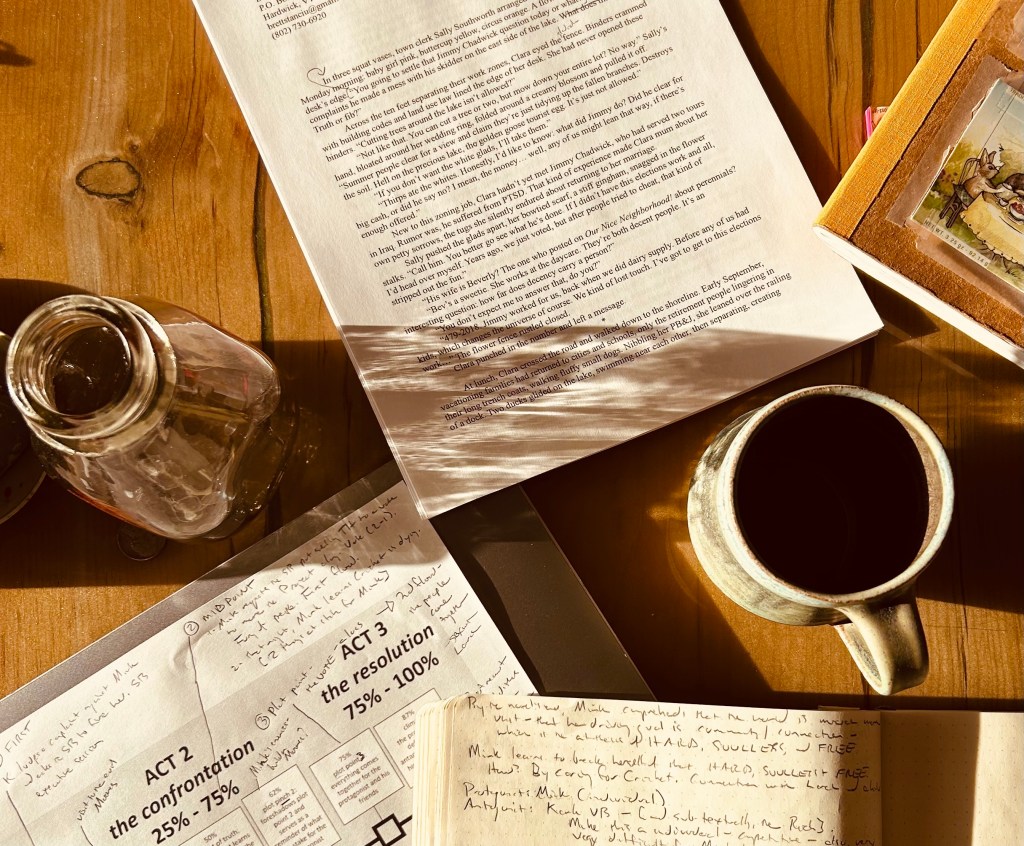
This fall, my novel heading towards an ARC for next summer’s publication, I reread my journal and the hospital notes and began writing a book about cancer. I’ve relied on my memory, that fickle creature, so rereading the notes from two hospitals is a vocabulary builder (so many medical words brand-new to me) and illuminating. This and then this happened. Our bodies and the world are known through numbers, like this drought, the inches of rain we need and the inches of rain to cure, a climatology record. Likewise, the hospital notes are records of lesions in centimeters and pulse in numbers and drugs in millimeters — my story’s elements. But, so, too, are the pears on our trees, plumper and sweeter than I’ve tasted in the eight years I’ve lived here. I pluck a weighty fruit from its branch, stand in the dusky-night yard, and watch the nearly full moon rise.

This week, driving to a friend’s house, I spy #10 Pond shimmering through the trees. The sheer unbidden beauty of the pond pulls me to a stop. I get out and stand on the dusty roadside, the crickets sizzling. A day like any other random day, a slip of a few afternoon hours. But here I am, still stitched into this evolving story.

“When I realized the storm
was inevitable, I made it
my medicine.” ~ Andrea Gibson