Something Else.

About a year ago, a friend and I hung out laughing in her car beside Lake Champlain. Early November, by 6 p.m. it was dark as a buttoned-up pocket. The lake lapped against the shore. We joked about the pan I held of the worst cornbread I’d ever baked and the potluck we skipped, the polite and surely erudite chat we’d missed. Ah, whatever…. Twenty plus years ago, we were young mothers, driving around in my old car or her old car, our toddlers in carseats. The kids sometimes bickered if nap time neared, sometimes spun tales about Mopsy bunny driving a dump trunk or wondered aloud if maybe the mothers would relent for creemees.

My friend’s kids and my kids — they’re all grownup now. Are their stories more fun now than the cups of sand and lake water they used to serve us on the beach? Those countless gritty root beer floats.

So a year ago… a kind of throwback, this time without the kids. She ran a stop sign. I insisted we walk out to the ferry launch, and the bitter wind was dreadful. We stopped and bought Thai noodles and kale, and my friend ate like a normal person, while I stared at her and wondered what on earth was wrong with me. I was convinced I had mold poisoning from a work exposure, and we kept laughing and laughing. Then she said, “What if it’s Lyme disease? What if it’s something else?”

It was something else, of course. A few days later, I was hospitalized, turning dreadfully towards septic. That winter, as I endured chemo, as things went from really bad to worse, I sometimes thought back to those hours of silliness, how rapidly my life altered. As a young mother in those years, I did not yet know this. I did not yet comprehend that the world does not go on and on and on.

Knowing this now, in my soul and body, does it make the laughter sweeter?

Yes, indeed.

But just when the worst bears down
you find a pretty bubble in your soup at noon,
and outside at work a bird says, “Hi!”
Slowly the sun creeps along the floor;
it is coming your way. It touches your shoe. ~ William Stafford

100 Daffodils.

In this balmy late autumn, I walk with new acquaintances in an oak forest where I’ve never wandered. Oaks are sparse in the woods where I generally walk, these lovely-leaved beauties, the ground beneath them strewn with acorns, some broken, their centers chewed out.

I’m with other women who are unwillingly on a journey similar to mine — cancer and chemo, the shock of our worlds slashed apart. Our conversation drifts to the kindness of friends and strangers, and the flip side of kindness — a kind of harshness: why can’t you get on with your life since the chemo is finished? (a raw impossibility) and didn’t you eat enough kale? For the record, when my daughters were young, I grew three kinds of kale in my garden, fifty plants to carry us through the winter, fenced from the foraging deer. All that kale, so carefully tended, and yet, here’s the luck of your draw: cancer.

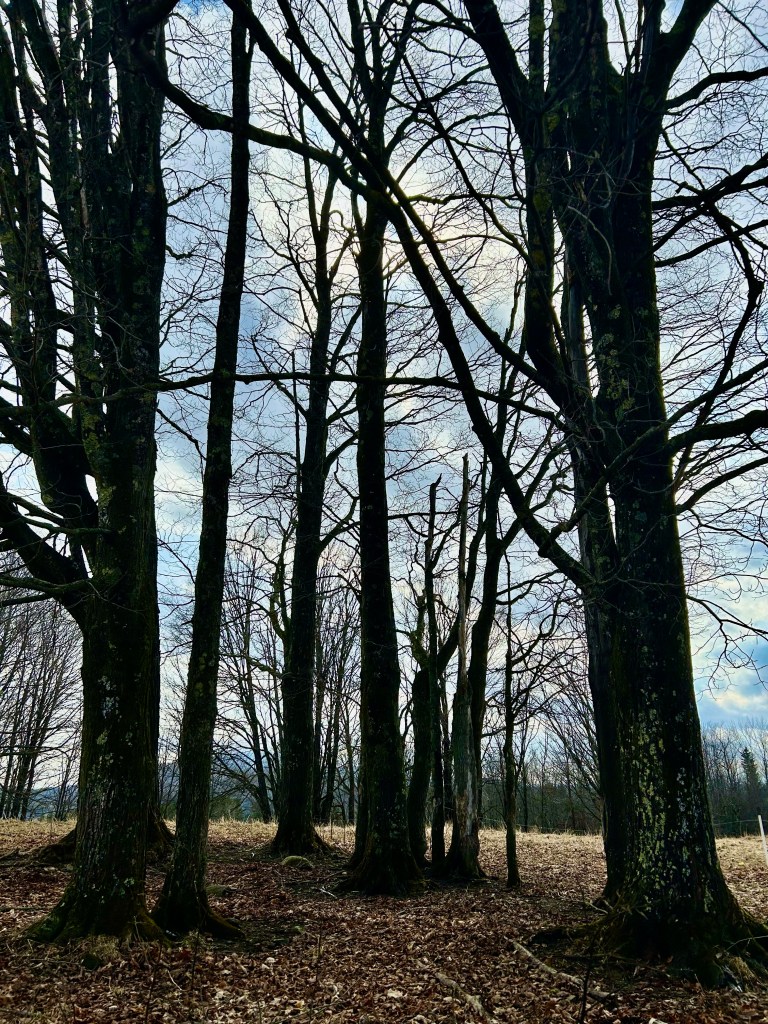
It’s a rare kind of privilege to walk with these women, listening, offering snippets of my own story. On this cloudy afternoon, these woods are light-filled through the barren branches, the poplars and beeches still shimmering patches of gold. One woman ventures, “All nature has scars.”

Every year, I dread this season of dwindling light, the creeping-in edgy cold, the giant fist of winter readying. And yet every late autumn, the falling leaves enchant, the wood stove’s warmth soothes, the moon gleams its crescent cut-out in the starry sky.

Writing this book about cancer has pushed me to read and gather facts and history, the scientific low-down. And yet, simultaneously, I appreciate more and more the great mystery of this universe. A friend counsels me that I can hold two things in one hand: knowledge and uncertainty. But these, too, are beyond numbers; this world’s mysteries are multitudes. My sister once remarked that cancer is the great leveler: it’s humbling. On a recent chilly morning, I planted one hundred daffodil bulbs: a meager offering to this sweet place where I live. The story behind these spring beauties will surely sink down and vanish into the sandy soil.

Auto Mirror

In the rear-view mirror suddenly
I saw the bulk of the Beauvais Cathedral;
great things dwell in small ones
for a moment.

Adam Zagajewski, translated from the Polish by Czeslaw Milosz and Robert Hass

Such a World.

Late afternoon, walking with a friend on the town forest trails and talking all-things-grownup-and-fascinating, her little girl runs ahead of us, stops suddenly, raises her arms in a Y over her head, and exclaims to the woods, “I love this place!”

Relish this.

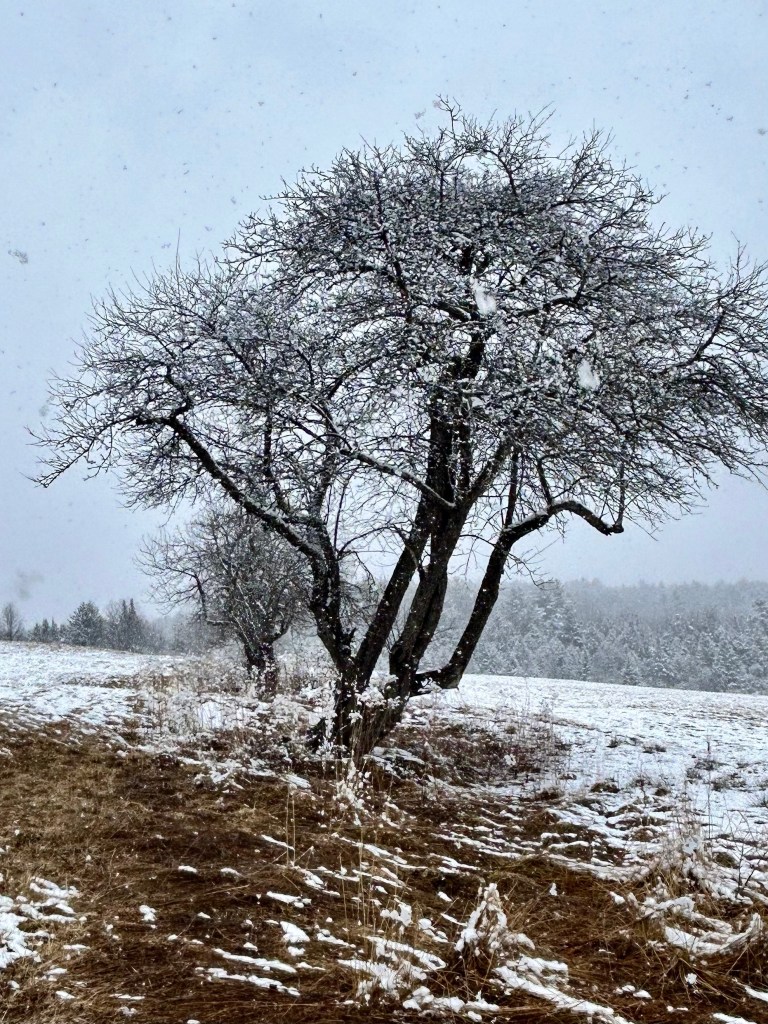
Slowly, the rain is returning, the streams beginning to flow again. Puddles muck the trails in a few low places. Meanwhile, people ask, “How’s your water holding up?” Word travels of dried up wells. This morning, I stand on my porch in the dark, listening to rainfall patter through the leaves that linger on the trees around my house. The crests of the apple trees hang onto their crowns of gold. We’re at that dipping point, the swing of seasons, the earth yet warm, redolent with this summer’s abundance.

Such a moon —

the thief

pauses to sing. — Yosa Buson

“…music despite everything…”

A woman stops me on the sidewalk and offers me a chair. I discover it’s a fine reading chair and bring it home, much to my cat’s delight. Friends track me the hermitess down in the coffee shop where I’ve spread the pieces of my manuscript over a table. We drink cappuccinos and eat jam bars and talk shop. I’m hurtling through the book I’ve called a cancer atlas — how to endure the intertwined suffering of cancer-and-chemo and then what? I tease, write the ending for me, will you? although I’m already there, stitching together mosquito bites and spring ephemerals and sleeping alone in a cold tent while the rain soaks through the tent fly and floor. We share kale soup recipes and marvel at this long dry autumn, the poplars yet holding their gold leaves.

Ever present in my mind is the question I asked the oncologist when I’d finished chemo, endured the surgery, limped my way back to his office. “What now?” And his answer, “Go and live your life,” the old existential question. A koan, a place of delight to be able to ask this question.

On this No Kings Day, while my cats sprawl contentedly before my woodstove, I’m reminded of the dearness of living a human life. That the asking of the question how to live is a many-sided privilege.

We must admit there will be music despite everything.
We stand at the prow again of a small ship
anchored late at night in the tiny port
looking over to the sleeping island: the waterfront
is three shuttered cafés and one naked light burning.
To hear the faint sound of oars in the silence as a rowboat
comes slowly out and then goes back is truly worth
all the years of sorrow that are to come. ~ Jack Gilbert

Put on a dress of flowers…

I spy a young fox on my front yard sniffing the trunk of the pear tree. Someone planted these two fruit trees long before I lived here. The smaller bends into the lilac hedge as if it’d prefer to be a lilac. This one, the taller, shoots high, its branches like an enormous hand raised in greeting.

The fox checks out the cohosh I planted this fall. Dawn is coloring up towards whatever day might emerge. I’m walking around my downstairs rooms, a dress in my hand, headed into work today, to sort out questions I both can and cannot answer, to talk with my office partner about town roads and FEMA, the drying up streams and lakes, about the merits of apple cider vinegar, and grownup kids. We’ll open the screen-less windows wide open in this 100-year-old former school, letting in the sunlight over the dusty sills. Hungry wasps fly in and out. An ordinary day of the things of this world, some humdrum, some irritating, some lovely as this balmy October weather. As for me, broken by cancer, limping back to whatever rude red health I can summon, I think, Put on a dress with flowers.

The fox crosses my neighbor’s pine-cone-strewn grass and disappears down our thin road. A fortuitous sign, I think, for this day.

Ode” by Zoe Higgins

Here’s to everything undone today:
laundry left damp in the machine,
the relatives unrung, the kitchen
drawer not sorted; here’s to jeans
unpatched and buttons missing,
the dirty dishes, the novel
not yet started. To Christmas
cards unsent in March, to emails
marked unread. To friends unmet
and deadlines unaddressed;
to every item not crossed off the list;
to everything still left, ignored, put off:
it is enough.

Crazy-Making.

Yesterday, my oldest and I made that drive again down I-91 that flanks that Connecticut River. My knitting in my lap, I counted exits, St. Johnsbury first exit, then the second, the third that heads east to New Hampshire’s White Mountains, the fourth Barnet, which I took when I stayed at Karmê Chöling. We talked about fall colors and a meatball recipe and family, of course, all the way down to exit 13, the Norwich and Hanover exit, where we stopped for coffee and scones, as if a good luck charm. Coffee and sweets, not a dash to ER. We watched the time, careful not to be late for what I hoped would be a mere routine check-in.

All summer this day has hovered in my mind — what will this day reveal? — but this past week this coming journey was as near to me as something I held in my hand as I went about my days, doing what needs to be done. The day before, talking with friends, the fear of this day erupts and I hear myself on the verge of screeching, nearly crying. All summer, I’ve relished my good life, learning to walk again and eat again, to read on my back porch in that hand-me-down butterfly chair. To marvel that I am not in pain. That I might sleep and reasonably expect I might wake in the morning exactly as I want, in the pre-dawn darkness drink milky coffee and write. That I will witness the unexpected autumn buds on a yellow rose bush open, these final velvety blossoms of the season.

At Dartmouth, we wait again in 3K, in the cancer center. I am no longer one of the pallid-gray-faced chemo patients, hobbling, enduring. How desperately I never want to return here. My oncologist gently reminds me that he’d assured me I’d pull through this winter, even as I was admitted again and again and again, a dozen times. Add to that, more ER visits.

Later, a friend asks about the scan’s sign-off, but the only rules that matter are what the hidden mysteries of my blood and flesh reveal. The markers are that the lymphoma has not returned. I know that the reaper’s scythe heads towards me as that inarguable blade poises over each of us. But not this day for me. Not yet.

Driving home, people crowd the interstate bridges with RESIST signs. As our car sails beneath the metal and steel, we wave. I’d told the oncologist that my wellness plan was four-fold: eat real food, walk, do my work, and try not to go crazy.

He said, This is crazy-making. Just do your best.

There is only one heart in my body, have mercy
on me…

Thank You for letting me live for a little as one of the
sane; thank You for letting me know what this is
like. Thank You for letting me look at your frightening
blue sky without fear, and your terrible world without
terror, and your loveless psychotic and hopelessly
lost
with this love

~ Franz Wright