Autumn Mysteries.

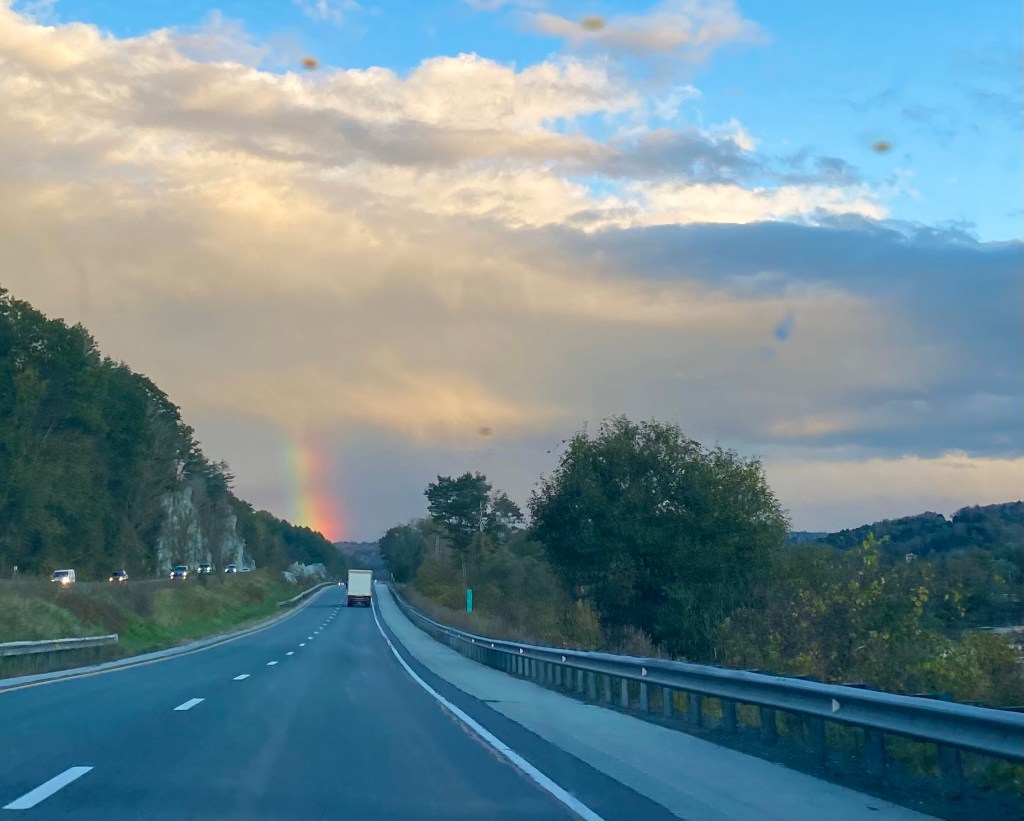
Around a bend in the interstate, a rainbow leg glows. I’ve handed over the keys, and I’m in the passenger seat, knitting forgotten in my lap, as we hurtle along the pavement, rushing over bridges that rise over the Winooski River. Mid-October, dark is not far in the offing. I’m texting my daughter at home who’s feeding the cats and stirring the embers in the wood stove. It’s hopeless to tell my daughters that not so long ago whether someone was home or not was a mystery. Domestic life relied on a vein of faith.

Has the world less mystery now? Surely not. This autumn rainbow beckons us. Around us, an infinity of things we will never understand.

Between us, there’s a bit of discussion about which exit to take, but my driver humors me. There’s those maples before the gold-domed statehouse I want to see, the silver maple beside the library that holds its green longest. By then we’re laughing about a little joke between us — bulk foliage and bulk syrup — tossing those words back and forth for no clear reason at all except for a moment of pleasure.

Autumn: the swinging door between summer’s glory, the myriad folds of winter.

Above the fields,

above the roofs of the village houses,

the brilliance that made all life possible

becomes the cold stars.

Lie still and watch:

they give nothing but ask nothing.

From within the earth’s

bitter disgrace, coldness and barrenness

my friend the moon rises:

she is beautiful tonight, but when is she not beautiful?

— the incomparable Louise Glück, “October”
Starlight Walking, a Pause, a Choice.

Walking back from a library program after dark, I cut through the cemetery. The cemetery is unlit, and I’m walking slowly, staring at the Milky Way sprawled overhead, the enormous immensity of the cosmos. In the dark, I hear a cough. I haven’t been paying attention. At first, I think the cough has come from the person smoking on the balcony not far from me, in the house chopped into apartments at the dead-end road, or the people coughing might be around the gap in the fence surrounding the cemetery. I’m headed that way; the gap leads to the woodsy path that will lead me home. That particular place in the path often has trash – Little Debbie’s wrappers and empty Twisted Tea cans.

So here’s the thing: I’m not at all afraid. Despite the village around me, the night is deep. I’m well-hidden, so concealed I stand there thinking, staring up and seeing a shooting star.

I’ve written a fair amount about being a single mother, a broken half, the jilted family, the rage of abandonment. But it’s equally true that I’ve been single for so long now in a society that seems so devoted to coupleness, that I rarely speak of my solitary life. I know very few single parents, at all, for whatever reason. So this night, I do what I’ve taught myself all these years: I drink in my fill of starlight, that piercing Ursa Major hung over the black horizon of the mountains, let her drench me with her power. I make my choice and retrace a few steps, see my friend and her partner on the street below driving along in the dark, friends who would have happily given me a ride, had I asked. But these nights are still balmy and the bitter cold hasn’t set in yet.

Round Earth.

Autumn reminds me the earth is a globe. The days shorten; dusk draws in earlier. The shadows hold a chill.

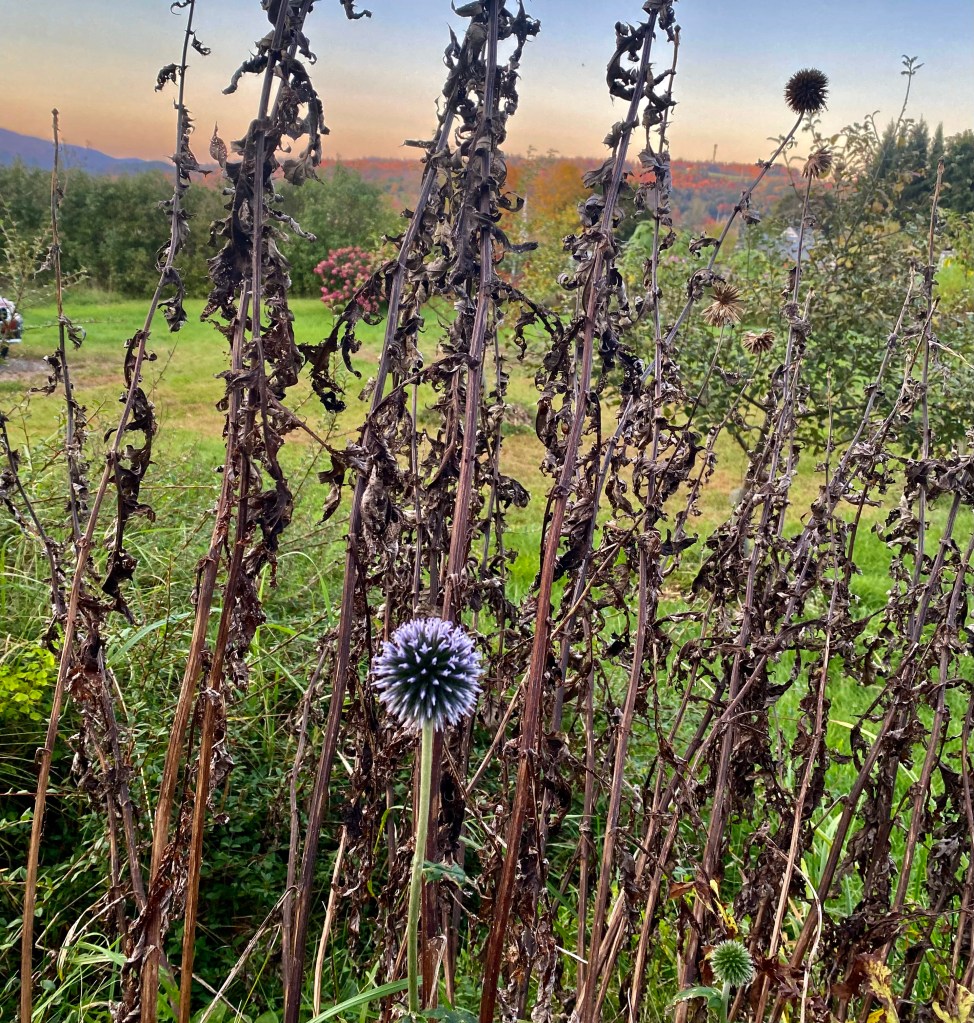
This year, purple asters spread prolifically — along roadsides, in the woods, in seemingly random sprigs around my house. The flowers flank the two pears in my front yard that someone planted years ago. One tree mightily growing, the other a persistent dwarf.

Autumn is the season of so it goes. What passed for summer this year is finished, the harvest wrapping up. In its own way, perhaps, the most poetic of all season.

Someone goes by wearing a hood
in his own darkness
not seeing the harvest moon

— Buson

… two million naturally occurring sweet things…

On this last Wednesday in this August… a few lines from Ross Gay:

Sorrow Is Not My Name

—after Gwendolyn Brooks

No matter the pull toward brink. No

matter the florid, deep sleep awaits.

There is a time for everything. Look,

just this morning a vulture

nodded his red, grizzled head at me,

and I looked at him, admiring

the sickle of his beak.

Then the wind kicked up, and,

after arranging that good suit of feathers

he up and took off.

Just like that. And to boot,

there are, on this planet alone, something like two

million naturally occurring sweet things,

some with names so generous as to kick

the steel from my knees: agave, persimmon,

stick ball, the purple okra I bought for two bucks

at the market…

      —for Walter Aikens

Wild Strawberries under Wildfire Smoke.

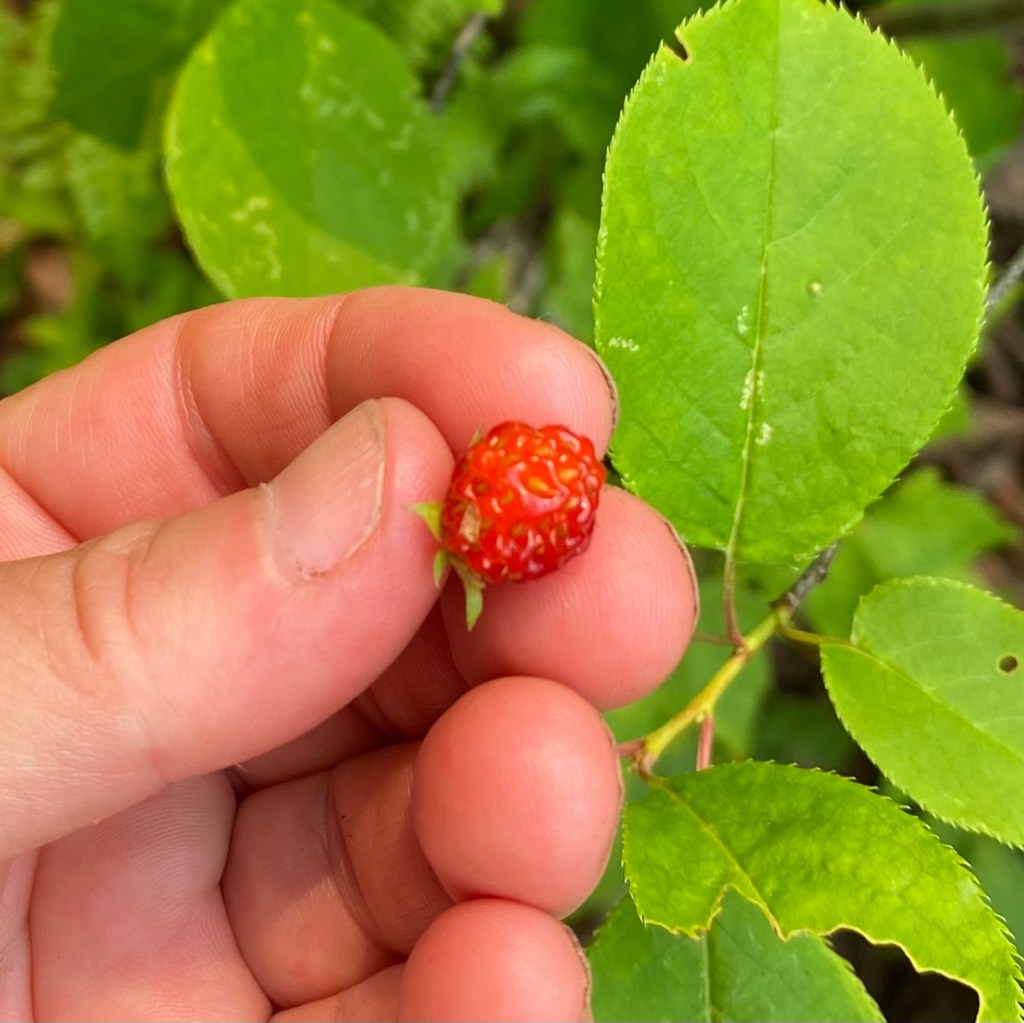
In Willey’s — the rambling general store where you can buy electrical supplies, French wine, local produce, bananas and darn near everything else except cigarettes — I turn a corner and find an old friend. She has a sunburn and I think: where have you been? We are both in some kind of rush that we talk, separate, and then knock up against each other again and again. The store is jammed to the ceiling with stuff, but it’s not that large. At the register and then out into the street, we keep talking. She’ll filled with such good energy I want to pocket some of her joy.

Every day, rain falls. Clotheslines droop. My feet are spongy in sandals. The Blundstones my daughter bought me a few years back split at the soles. It makes sense to wear these beloved shoes right down to wet scraps. I open and close the windows — is it hot? is it cold? The garden soaks up the water. The woods are lush and lovely, redolent with wet bark, the tanginess of split leaves.

The wild blackberries blossom profusely, the green berries now knotting. It’s nearly July, the season that means swimming and long lingering evenings watching the twilight drift down. Not so, this year. The pandemic made abundantly clear that we are connected to each other — both neighbors across the street and strangers around the globe — in ways that matter not one whit whether we like it, or not.

This summer breeds contemplation, more November than cusp of July. In that vein, here’s a few lines from the immortal T. S. Eliot in Four Quartets:

... The wild thyme unseen and the wild strawberry,
The laughter in the garden, echoed ecstasy
Not lost, but requiring, pointing to the agony
Of death and birth.

 You say I am repeating
Something I have said before.
 I shall say it again.

Shall I say it again? In order to arrive there,
To arrive where you are, to get from where you are not,
 You must go by a way wherein there is no ecstasy.

In order to arrive at what you do not know
 You must go by a way which is the way of ignorance.

In order to possess what you do not possess
 You must go by the way of dispossession.

In order to arrive at what you are not
 You must go through the way in which you are not.

And what you do not know is the only thing you know
And what you own is what you do not own
And where you are is where you are not...

Ordinary Contentment.

Standing on the street in Greensboro Village, a pickup truck with a trailer full of hay slowly passes by, creaking through the tight curve. In the sultry sunlight, I wait, a shower of chaff drifting over my face, blinding me for just a moment. As I close my eyes, I see one sunburned arm waving through the open pickup window at me.

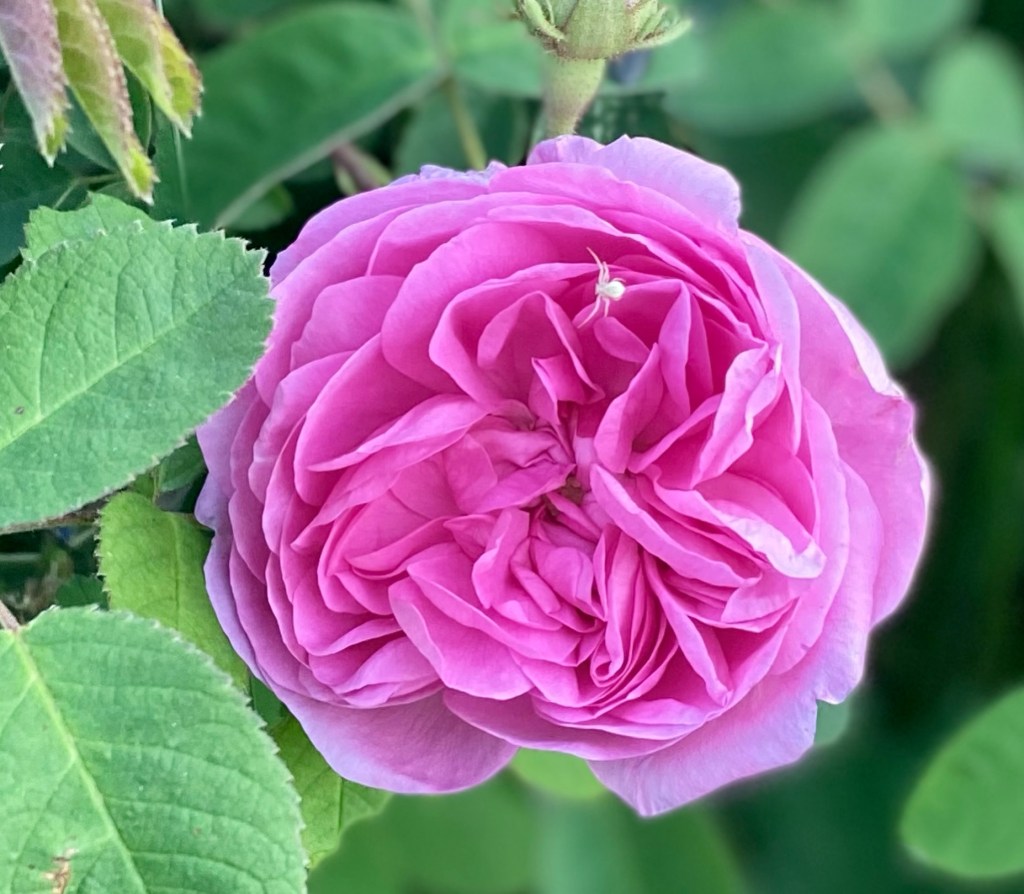
June. There’s plenty adversity that happens in this month, I’m sure, but the roses are blooming, the fields freshly shorn and growing again, the fledgling robins already swooping from the nest.

Some lines from the incomparable Jane Kenyon this Friday afternoon:

High on Nardil and June light 
I wake at four, 
waiting greedily for the first
note of the wood thrush. Easeful air 
presses through the screen 
with the wild, complex song 
of the bird, and I am overcome

by ordinary contentment. 
What hurt me so terribly 
all my life until this moment? 
How I love the small, swiftly 
beating heart of the bird 
singing in the great maples; 
its bright, unequivocal eye.