Re-teaching loveliness.

Photo above is evidence of my loose approach to living with cats, an approach my visitors either embrace or wonder, what’s up with the cats on the counters? Brush stroke by rag wipe, I proceed with my kitchen project. I am a woman who craves order. Keeping my kitchen in cardboard boxes is not my SPARK JOY go-to; nonetheless, I persevere.

With added windows, I am relearning the light in my kitchen. Sure as anything, the metaphor of this project does not elude me. A year ago, a friend visited me in my Dartmouth room, bringing knitting and butterscotch pudding. Before she left, she walked me around the hall, 150′. We walked that loop twice? Through the window, the green and rain filled the day.

A year later, novel writing and paintbrush washing, property taxes and weeding, the Monday morning plan for a week’s work. The metaphor of this has not escaped me. In the co-op, reaching for broccoli, a long-ago acquaintance startles when he sees me.

I’d heard you were dead, he says.

Not yet, I laugh. Squeaked through, for now.

A year ago, I’d envisioned a kind of ease for myself; surviving lymphoma had made me invincible to misery in certain ways—a disinterest in petty bullshit, a newfound ability to let the little bickering struggles that seem to plague our time, or maybe simply our human nature, fall with the dust and debris on the kitchen floor. But what rose, instead, with sharpened teeth, were those existential questions: how does meaning structure my life? Who’s with me? Where to tap happiness, that old true word?

Walking home, I cough and touch the lymph nodes in my neck. Has that mighty disease returned? I’m at the kids’ ballfield, where the turkey vulture roost in the surrounding woods. Evening, the thrush sing. Holding these two things — the thrush’s melody, the circling vultures — I head home. Where the cats wait for me on the kitchen counter.

The bud

stands for all things,

even for those things that don’t flower,

for everything flowers, from within, of self-blessing;   

though sometimes it is necessary

to reteach a thing its loveliness… ~ Galway Kinnell

“… spring’s thousand tender greens…”

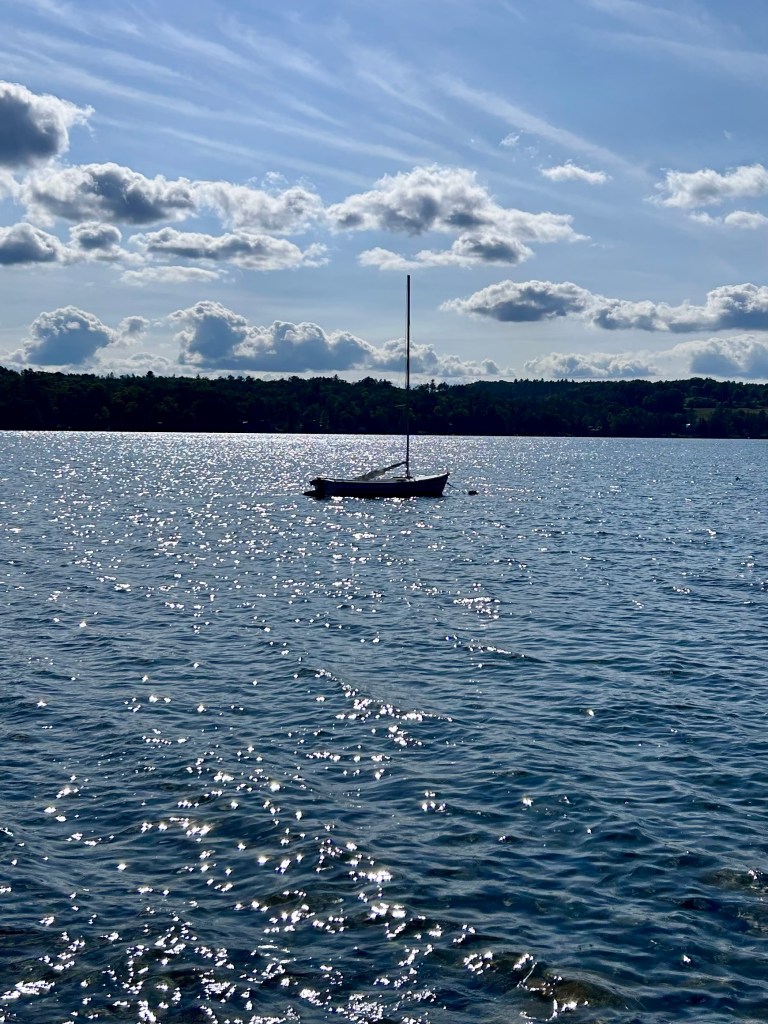
Two sleek loons swim and dive in the lake while I stand on the shore, listening the conversation about mean water level and stones and a grandfather who bought this property, back in the years when no phones reached here, and travel to the lakeshore was by foot or by hoof or a wooden-spoked wheel.

Chilly, I pull my sweatshirt hood over my head. A story about this summer cottage is that it was a farmhouse. Not so long ago, the landscape was cleared around this lake, and farms stretched down to the water. In the winter, ice was sawed into great chunks and shipped via train, cushioned in sawdust, to faraway homes.

In my own home, the carpenter has finished. I keep on with my paintbrush, call a daughter for reinforcements. A year ago, just out of surgery, I could stand only as a wilting flower stem, crooked over in pain. Sequestered in a hospital, I longed for cold rain on my face. Now, on this breezy afternoon, the wet wind burrows behind my neck. Later, at home, I feed my woodstove. There’s nothing permanent, but for now, this.

… I longed for spring’s thousand tender greens,

and the white-throated sparrow’s call

that borders on rudeness….

Jane Kenyon

Bear, darker than midnight.

I’m walking up a fourth-class road when I spy a black shape moving along the upper end of the nearby hayfield. Vermont divides its roads into categories, from the interstates to dirt roads to the little-used former farm or forest roads that are snowed-cover in winter, mud-rutted in spring. I stand beside a wild apple tree, the blue view of the Worcester Mountains over my shoulder, and admire this bear, darker than midnight against the field’s glossy emerald. When green kindles in Vermont spring, it flourishes.

This place I’ve never walked, although I’ve seen maps and heard stories. The road treks uphill through the forest and dips down where Caspian Lake gleams, realm of summer visitors, but for the time, still the territory of the locals.

I find what I’m seeking and also what I’m not: the labor-dense stone walls whose once-upon-a-time fields are gone to forest, moss-covered cellar holes, twisted rusty remains of farm equipment. Peepers chorus. An old farmhouse with an enormous veranda on a hill must have once had a royal view of the lake, and endured bitter winter winds. Someone has tried to cut the wild reclamation from the house and mostly failed.

In the sunlight, I linger, wondering who lived here, their stories silent. The two-story house has large dormers and many windows; it’s not a fly-by-night, tossed-up structure. On my way home, I pause where I saw the bear, searching, but of course the bear has moved on. Three ducks fly low over my head. The earth exhales its sweetness of thawing mud, the turning-over of last autumn’s leaves, this summer’s great promise.

“Deep in the forest a call was sounding, and as often as he heard this call, mysteriously thrilling and luring, he felt compelled to turn his back upon the fire and the beaten earth around it, and to plunge into the forest, and on and on, he knew not where or why; nor did he wonder where or why, the call sounding imperiously, deep in the forest.” — Jack London

Tick-Tock, Cooper’s Hawk.

At the local general store, I buy an analog clock for twelve dollars, find a single AA battery in my desk drawer, and, tick tock, done. The clock is the kind my parents always had in their kitchen, pre-digital craze, where you’d watch the minute hands while, say, boiling an egg.

The clock reminds me of those countless hours in a hospital bed, pondering not a baking apple pie but the length of a minute. How long that minute hand needed to click around a circle.

Late Saturday afternoon, a friend and I walk through the woods towards Stannard Pond, in search of ramps and something else more elusive, lung-fulls of serenity, perhaps, in this forest where the autumn sunlight falls down, the branches unleaved in April, the cedars silvery. We find patches of those wild leeks, carpets of trout lily leaves, two spring beauties that have not yet opened. My friend spies these; I crouched and gently cup one folded blossom in my hand, gentle with its thread of a stalk. Soon, the forest floors will be covered with these gems. For now, I contemplate this white-and-pink loveliness, wrapped in emerald.

Driving down that mountain’s back road, I spy a Cooper’s hawk on a wire. This steep road was ravaged by flood a few years back, and folks are rebuilding, small boxes of dwellings without siding. Persistent. In my bones, I’m both worn and enlivened, the road dust and sunlight billowing in through the open car windows. Tick-tock, the slowness of a moment.

“Things take the time they take.” ~ Mary Oliver

Gravy

In the town where I work, the summer folks haven’t yet returned. By chance, on a rural road around the lake, I meet a builder. “Hey!” he calls to me, and I can hear the surprise in his voice. You’re alive? I am, indeed, yes.

Around us, a sugar snow melts. Sunlight falls through the trees that are a month out, at least, from this year’s first nubs of leaves. Behind him, the silent snow-covered lake. We kick around, as Vermonters do, what it’s like to live in our Green Mountain state right now, how hot passions run, how immediately aid is given to a neighbor in need. What it’s like to live in the crumbling of the American Empire, a madman at the helm. In a copse of cedars, blackbirds chorus.

Precisely one year ago, I could not walk outside my house alone. Ravaged by cancer and chemo and hunger, I was so weak I trembled, on the verge of falling. A rattle of bones, scraps of flesh.

On this clearing day, on my way home, I stop by the co-op and buy two pears. I lay these on the seat of my car and dart across Main Street to the post office. Without realizing it, I’m running. As I leap onto the sidewalk, I marvel at the pleasure of movement, the sun in my short hair, my cheeks wind-burnt from a recent long walk along a muddy backroad. I took the time to stand before a tree of chittering goldfinches.

All this week I’ve been reading Robert Frost, perhaps my mother’s favorite poet. A poet who wrote of stone walls and apple picking and the ineffable darkness of human life. But here’s a poem to celebrate today, this day, no matter where or who you are, by Ray Carver who knew the great symphony of life, too.

Gravy

No other word will do. For that’s what it was. Gravy.
Gravy these past ten years.
Alive, sober, working, loving and
being loved by a good woman. Eleven years
ago he was told he had six months to live
at the rate he was going. And he was going
nowhere but down. So he changed his ways
somehow. He quit drinking! And the rest?
After that it was all gravy, every minute
of it, up to and including when he was told about,
well, some things that were breaking down and
building up inside his head. “Don’t weep for me,”
he said to his friends. “I’m a lucky man.
I’ve had ten years longer than I or anyone
expected. Pure gravy. And don’t forget it.”

Natural resurrection.

I am reminded of spring by the quality of the air . . . It is a natural resurrection, an experience of immortality. ~ Henry David Thoreau

Friday begins raw and shivery. I’ve shed my long underwear and regret it. By mid-afternoon, the sun’s emerged. I park along a muddy road and hike up through a soggy pasture to the stone cellar holes. A hundred years ago, a farm must have been rooted on this hillside, bracing against winter’s snowy wind, full of summer sun. A view of mountains and the Lamoille River Valley. Sugar maples dominate what remains.

As I approach, robins flutter, fly, resettle, their singing unbroken. I tie my coat around my waist, cram my hat in my pocket. At home, green nubs of lilies and crocuses emerge, just beginning their greening. Among the lilacs, I look for those daffodils.

Mighty spring, season of healing. The winter’s debris of compost and spent woodpile and last fall’s unclipped perennials emerge. Every year, spring rushes in with a surprise. A certain reminder of mortality, but so lovely, so marvelously endearing…