Stopping in the Snowy Forest.

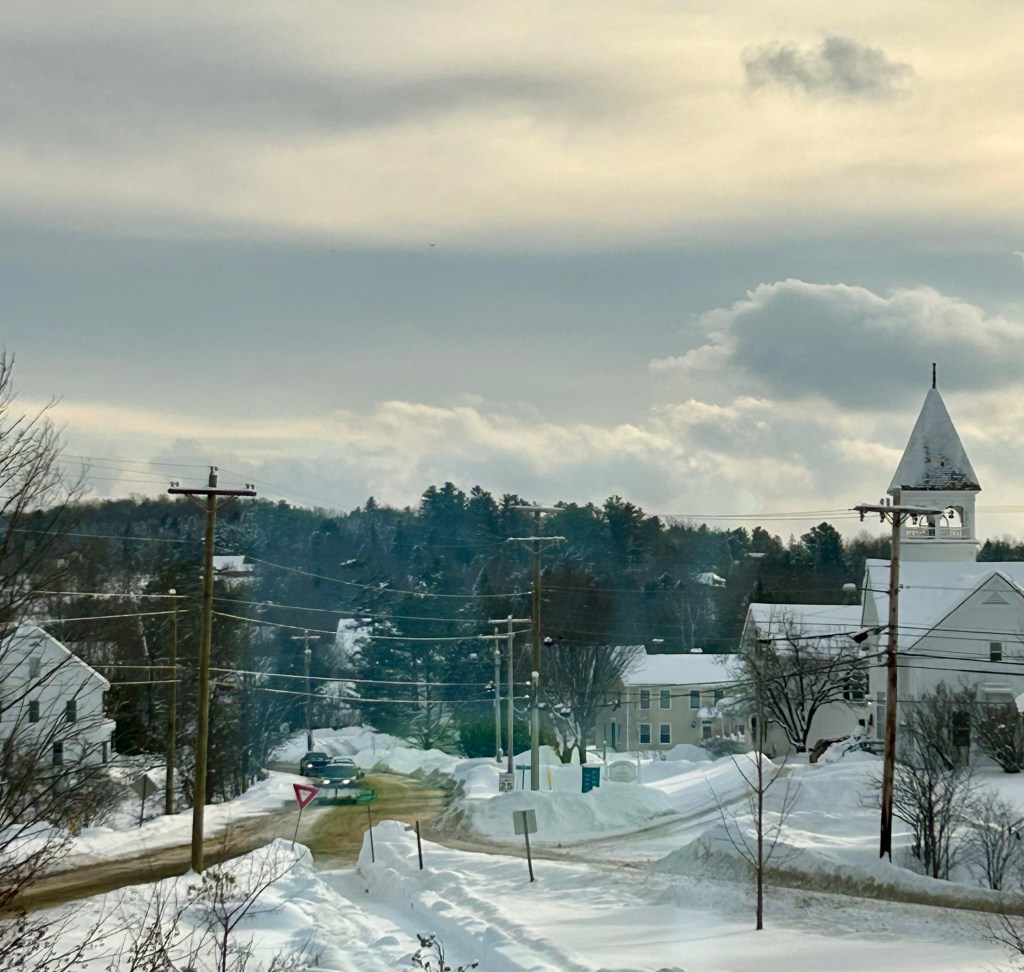
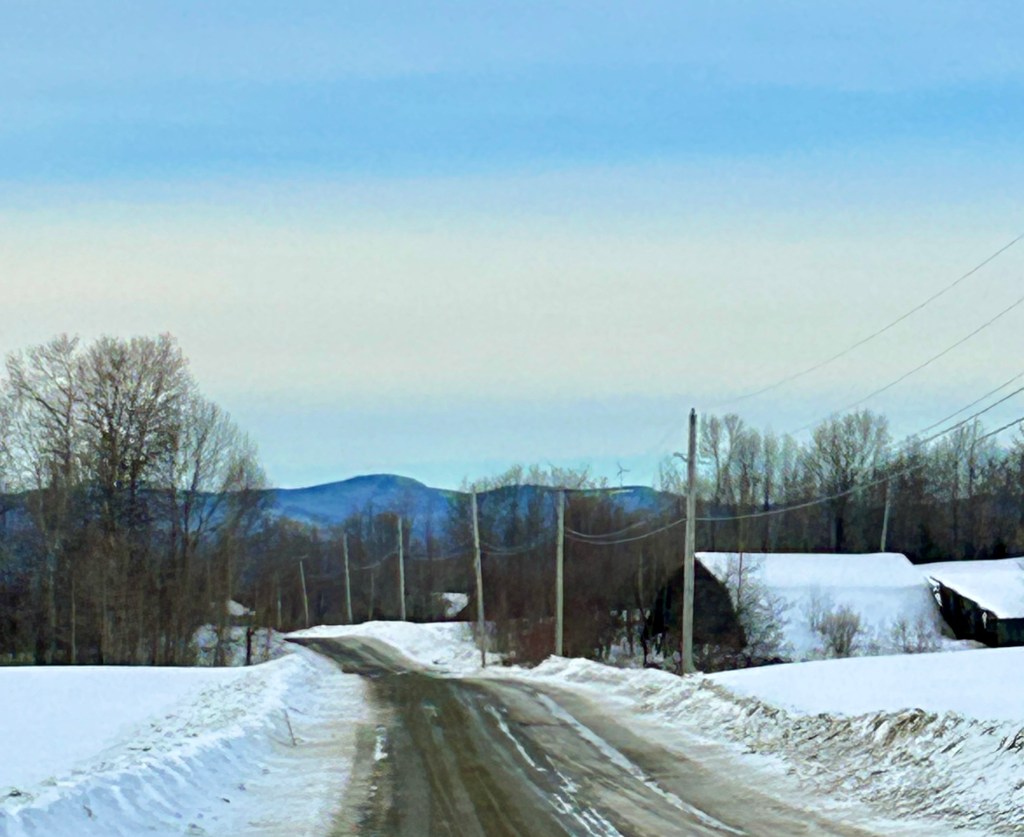
In the woods, I hear voices and pause, thinking a cluster of children might emerge over the hill. Instead, a flock of clangorous geese wings low overhead, then a second V, a third. Town traffic sounds filter into the woods. I am not in the deep wilderness, not so far from high school and road and village, but for this hour, it’s just me and the sweep of wind and drifting snow and the human and dog prints of whoever walked here before me.

As a kid, my father was never one to be daunted by adversity. Evenings, he often set down his coffee cup and took us on walks to the library or around the block, and around the block often meant across a thin-grass soccer field to the woods. Who owned those woods, I never knew. We jumped across the stream and along worn logging roads, past the piles of New Hampshire boulders and stone walls in the forest where fields had dominated not so many years ago. The woods were alive with rabbits and deer, birds and ferns. We wondered about the Natives who lived here and the colonists who cut down the trees, and then the trees grew up again.

On this twilight Monday, I lean against a hemlock, snow in my eyelashes, remembering when my daughters filled their snowsuit pockets with tiny hemlock cones. Intentionally or not, my father instilled love and not fear of the forest in his kids, the understanding that our feet could carry us to unexpected and miraculous places.

Here’s that classic New Hampshire poem threading through my childhood, my daughters’, and so many others:

Stopping by Woods on a Snowy Evening

By Robert Frost

Whose woods these are I think I know.   

His house is in the village though;   

He will not see me stopping here   

To watch his woods fill up with snow.   

My little horse must think it queer   

To stop without a farmhouse near   

Between the woods and frozen lake   

The darkest evening of the year.   

He gives his harness bells a shake   

To ask if there is some mistake.   

The only other sound’s the sweep   

Of easy wind and downy flake.   

The woods are lovely, dark and deep,   

But I have promises to keep,   

And miles to go before I sleep,   

And miles to go before I sleep.

The Survivable.

It’s dark as the inside of my fist at five o’clock. I’m driving into spitting snow, my brand-new studded snow tires grinding. My companion and I are talking about all kinds of things — how language shapes our worldview and the personalities of tuxedo cats and dentists. I’m driving more by faith than anything else, not particularly fast, headlight beams filled with snow. As if cued, a deer waits in the forested roadside. I slow, then stop, people and deer staring at each other. Then the deer vanishes into the woods.

On this backroad, I’ve passed no other vehicle save a UPS truck, so I wait for a moment for the deer to return, for a companion to leap across the road.

My passenger says, apropros of some conversational thread, that I’ve shed bad karma in my months of cancer treatment, of struggling to survive. My devotion has always been my pencil or keyboard, not the meditation cushion. And yet…

I roll my car forward through the swirling snow. I’ve long adhered to that ancient Aristotelian notion that action defines character. When I realized I had cancer, a year ago, I was rapidly veering towards sepsis. I could not indulge any opinion. To survive, I had to strip away illusion. What were the facts? What was the wisest way forward? None of this was simple.

Cancer narrowed my world. Through weakness and the possibility of a fatal infection, I was confined to my few downstairs rooms, to Emergency Rooms, and hospital rooms. But unexpectedly, cancer widened my life, too, gave me the gift of friendships forged in rough experiences, reinforced for me that this world is propelled by cause-and-effect, that actions have consequences, and that I often grasp only the slenderest knowledge.

New England November drives us into the season of early darkness, blackness so profound our eyes struggle to navigate. When I left Dartmouth-Hitchcock after that last long stay, I felt old, aged in bone and flesh, and concurrently, miraculously restored to my twenties, those years when my lust for living and creating was ravenous and I did not yet comprehend the immutability of time. At the end of this evening drive, I stand for a few moments in this velvety and freezing darkness, snow hissing on the hot car hood, a slender strand of white lights twinkling in my kitchen window. I clench my mittens in my cold hands. Around me, beguiling night.

“When you survive something that was thought to be unsurvivable, the obvious is gained. You have your life—you have time. But it’s only when you get there that you realize your survival has come at a cost.”
― Suleika Jaouad

And last… my story “Tiny Towns” appears in the new collection: 2050: Vermonters Take a Swipe at the Future. Reading tonight in St. Johnsbury….

Something Else.

About a year ago, a friend and I hung out laughing in her car beside Lake Champlain. Early November, by 6 p.m. it was dark as a buttoned-up pocket. The lake lapped against the shore. We joked about the pan I held of the worst cornbread I’d ever baked and the potluck we skipped, the polite and surely erudite chat we’d missed. Ah, whatever…. Twenty plus years ago, we were young mothers, driving around in my old car or her old car, our toddlers in carseats. The kids sometimes bickered if nap time neared, sometimes spun tales about Mopsy bunny driving a dump trunk or wondered aloud if maybe the mothers would relent for creemees.

My friend’s kids and my kids — they’re all grownup now. Are their stories more fun now than the cups of sand and lake water they used to serve us on the beach? Those countless gritty root beer floats.

So a year ago… a kind of throwback, this time without the kids. She ran a stop sign. I insisted we walk out to the ferry launch, and the bitter wind was dreadful. We stopped and bought Thai noodles and kale, and my friend ate like a normal person, while I stared at her and wondered what on earth was wrong with me. I was convinced I had mold poisoning from a work exposure, and we kept laughing and laughing. Then she said, “What if it’s Lyme disease? What if it’s something else?”

It was something else, of course. A few days later, I was hospitalized, turning dreadfully towards septic. That winter, as I endured chemo, as things went from really bad to worse, I sometimes thought back to those hours of silliness, how rapidly my life altered. As a young mother in those years, I did not yet know this. I did not yet comprehend that the world does not go on and on and on.

Knowing this now, in my soul and body, does it make the laughter sweeter?

Yes, indeed.

But just when the worst bears down
you find a pretty bubble in your soup at noon,
and outside at work a bird says, “Hi!”
Slowly the sun creeps along the floor;
it is coming your way. It touches your shoe. ~ William Stafford

100 Daffodils.

In this balmy late autumn, I walk with new acquaintances in an oak forest where I’ve never wandered. Oaks are sparse in the woods where I generally walk, these lovely-leaved beauties, the ground beneath them strewn with acorns, some broken, their centers chewed out.

I’m with other women who are unwillingly on a journey similar to mine — cancer and chemo, the shock of our worlds slashed apart. Our conversation drifts to the kindness of friends and strangers, and the flip side of kindness — a kind of harshness: why can’t you get on with your life since the chemo is finished? (a raw impossibility) and didn’t you eat enough kale? For the record, when my daughters were young, I grew three kinds of kale in my garden, fifty plants to carry us through the winter, fenced from the foraging deer. All that kale, so carefully tended, and yet, here’s the luck of your draw: cancer.

It’s a rare kind of privilege to walk with these women, listening, offering snippets of my own story. On this cloudy afternoon, these woods are light-filled through the barren branches, the poplars and beeches still shimmering patches of gold. One woman ventures, “All nature has scars.”

Every year, I dread this season of dwindling light, the creeping-in edgy cold, the giant fist of winter readying. And yet every late autumn, the falling leaves enchant, the wood stove’s warmth soothes, the moon gleams its crescent cut-out in the starry sky.

Writing this book about cancer has pushed me to read and gather facts and history, the scientific low-down. And yet, simultaneously, I appreciate more and more the great mystery of this universe. A friend counsels me that I can hold two things in one hand: knowledge and uncertainty. But these, too, are beyond numbers; this world’s mysteries are multitudes. My sister once remarked that cancer is the great leveler: it’s humbling. On a recent chilly morning, I planted one hundred daffodil bulbs: a meager offering to this sweet place where I live. The story behind these spring beauties will surely sink down and vanish into the sandy soil.

Auto Mirror

In the rear-view mirror suddenly
I saw the bulk of the Beauvais Cathedral;
great things dwell in small ones
for a moment.

Adam Zagajewski, translated from the Polish by Czeslaw Milosz and Robert Hass

Such a World.

Late afternoon, walking with a friend on the town forest trails and talking all-things-grownup-and-fascinating, her little girl runs ahead of us, stops suddenly, raises her arms in a Y over her head, and exclaims to the woods, “I love this place!”

Relish this.

Slowly, the rain is returning, the streams beginning to flow again. Puddles muck the trails in a few low places. Meanwhile, people ask, “How’s your water holding up?” Word travels of dried up wells. This morning, I stand on my porch in the dark, listening to rainfall patter through the leaves that linger on the trees around my house. The crests of the apple trees hang onto their crowns of gold. We’re at that dipping point, the swing of seasons, the earth yet warm, redolent with this summer’s abundance.

Such a moon —

the thief

pauses to sing. — Yosa Buson

“…music despite everything…”

A woman stops me on the sidewalk and offers me a chair. I discover it’s a fine reading chair and bring it home, much to my cat’s delight. Friends track me the hermitess down in the coffee shop where I’ve spread the pieces of my manuscript over a table. We drink cappuccinos and eat jam bars and talk shop. I’m hurtling through the book I’ve called a cancer atlas — how to endure the intertwined suffering of cancer-and-chemo and then what? I tease, write the ending for me, will you? although I’m already there, stitching together mosquito bites and spring ephemerals and sleeping alone in a cold tent while the rain soaks through the tent fly and floor. We share kale soup recipes and marvel at this long dry autumn, the poplars yet holding their gold leaves.

Ever present in my mind is the question I asked the oncologist when I’d finished chemo, endured the surgery, limped my way back to his office. “What now?” And his answer, “Go and live your life,” the old existential question. A koan, a place of delight to be able to ask this question.

On this No Kings Day, while my cats sprawl contentedly before my woodstove, I’m reminded of the dearness of living a human life. That the asking of the question how to live is a many-sided privilege.

We must admit there will be music despite everything.
We stand at the prow again of a small ship
anchored late at night in the tiny port
looking over to the sleeping island: the waterfront
is three shuttered cafés and one naked light burning.
To hear the faint sound of oars in the silence as a rowboat
comes slowly out and then goes back is truly worth
all the years of sorrow that are to come. ~ Jack Gilbert