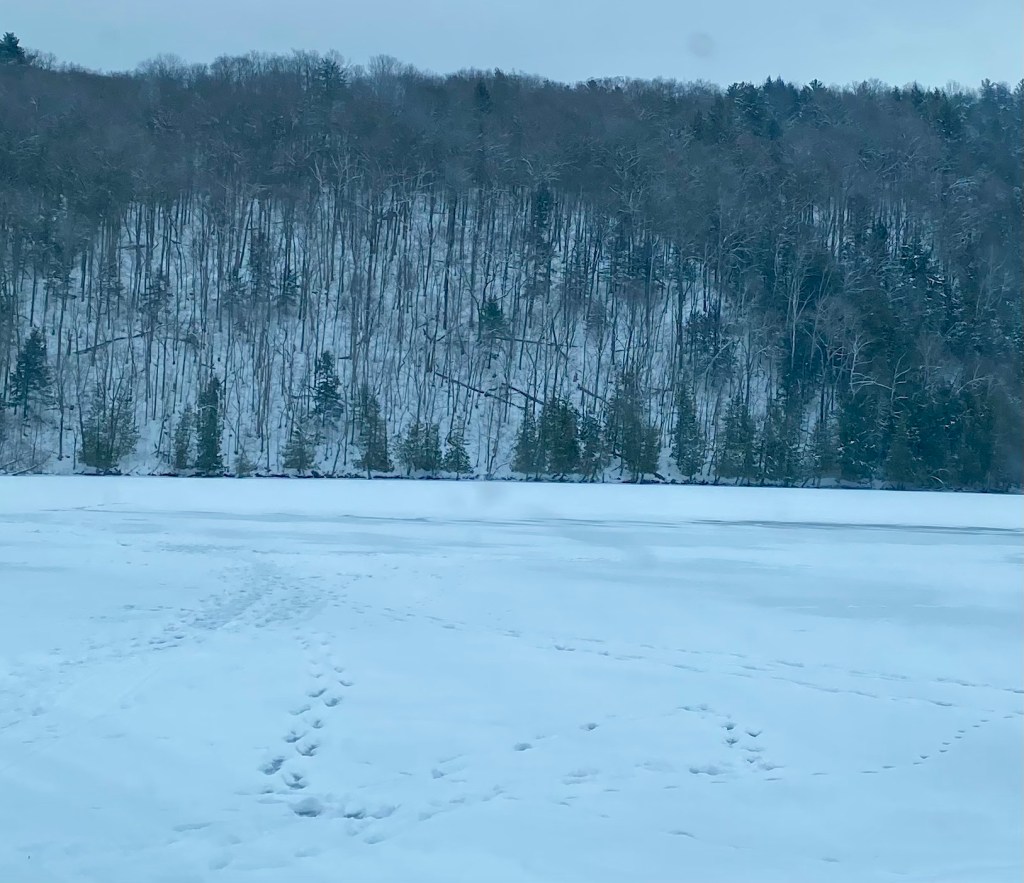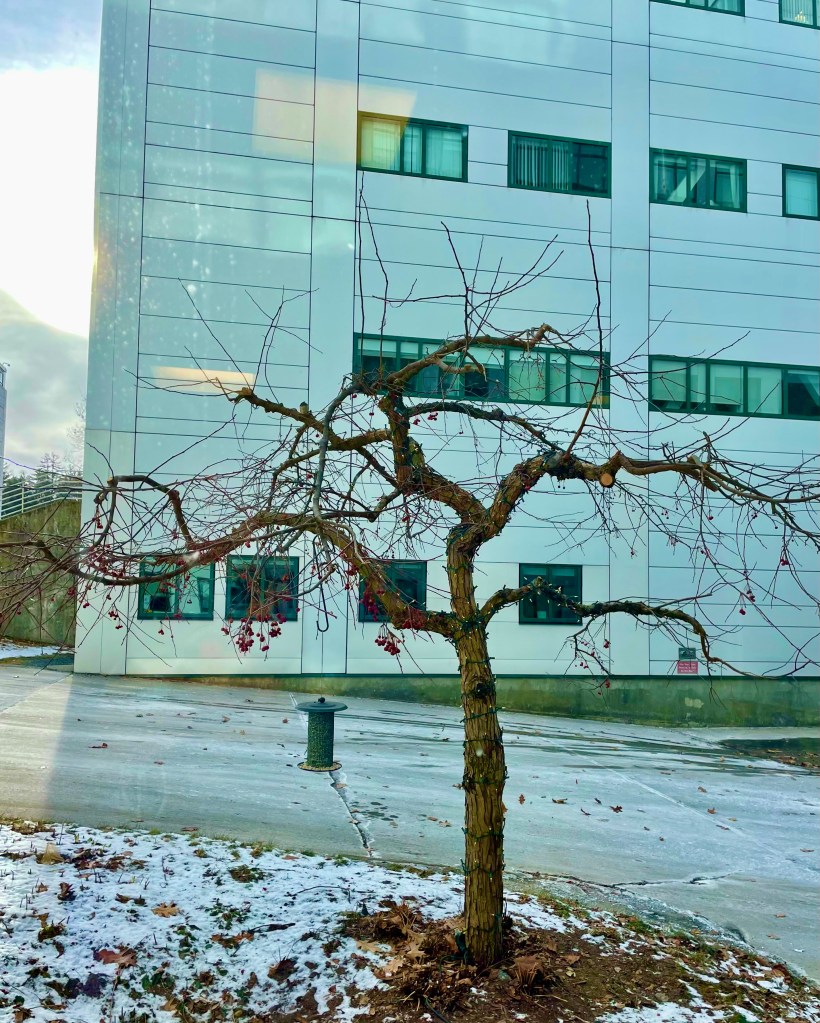
Evening gathering….

In the spring, I moved my remaining hollyhocks into the fenced vegetable garden to save these flowers from feasting groundhogs. Spring, summer churned along. Now autumn, my garden still blooms its rainbow. Gathering tomatoes and basil for dinner, scraps of birch bark and kindling to start a fire, I pause for a moment in the drizzle, soaking in the delicate petals, the mist brushing in for the night, the trees already doing each their own foliage thing — some gold and orange, some already shaken down to bare twigs, others green, green, as if in defiance of winter.

Across the valley, the coyotes call, once, twice, as if testing their voices.

I snip bunchy orange marigolds for my table, their centers spicy. Overhead, the geese are always winging away these days, gathering their Vs, heading for their winter quarters, elsewhere. The clustered sunflowers, in their different heights and states of disarray from gold petal to curled brown leaf, rustle with the fat little chickadees dipping in and out, scavenging. Oh, sunflowers, so easily grown: scattered seeds, my palms pressing soil, water and sunlight. For me and the birds I imagine I sow these beauties, but of course that’s not true at all. The sunflowers are the waving prayer flags of my garden, this small territory.

The neighbor boys pile their sweatshirts and run in their t-shirts, the smallest hustling in and out of the lilac bushes, hide-and-seek. Rain pitters on leaves. A T.S. Eliot line runs through my memory, that graceful dismal poet, “…music heard so deeply/That it is not heard at all…”

A few snippets of autumn.

We are every experience we’ve ever had…

A sunny morning, I’m at a place I’ve never been before, a sizable post-and-beam gallery at the end of a road. A fenced vegetable and flower garden shines orange and gold. A marble bust smiles mysteriously.

I love this about Vermont: these unexpected pockets of mighty talent. The woman’s house is built around the gallery — a beauty of wood and stone and glass. We talk for a while, and we discover that her artist parents were from the same midwest area as my father — Detroit — and then she opens the gallery and takes me in. Let me say here: I’ve been around the block a few times, seen my share of museums and art; I’m also feeling this sunny morning like the dirt road my Subaru tires pounded into, driving uphill.

The gallery ceiling soars in a peak. The wooden space holds the owner’s and her deceased parents’ work. She allows me walk through the metal sculptures wordlessly. Then I stand beside an oil portrait of a woman wearing a black and red dress that reminds me of a velvet blouse I bought for a friend, many years ago, when she graduated from college. The woman in the painting rests her chin on her fist.

The owner looks at me. “It’s always the females who are drawn to her.”

“She’s me.” Woman of a thousand and one sleepless nights, bread baker, hearth tender, the woman who swam under the luscious full harvest moon. Woman hard as these back roads, fragile as coreopsis.

We walk upstairs and finish the tour. Before I leave, though, I stand again before this portrait, a long soulful moment. “Gracious,” I say, “gracious.”

“…we are everything, every experience we’ve ever had, and in some of us, a lot of it translates and makes patterns, poems. But, my God, we don’t even began to touch upon it. There’s an enormous amount, but we can touch such a little.” – Ruth Stone

Cutting grass at night…

I’m finishing mowing the front lawn when my neighbor opens her door and hollers, “Hey, there!” across her driveway. Save for a series of apartments in my twenties, I’ve never lived so close to another house and moved here, in fact, from a house that was surrounded by wilderness.

She’s a darn good neighbor. Twilight fattens to darkness as we talk about small things — a mutual friend who visited her, red roses blooming yet by her door. My pink cottage beauties have long since dried up.

I’ve lived long enough now in this town to have experienced the meanness of catty gossip and the kindness of strangers; nothing different from any other town or city, I suppose, simply the variety of human behavior, the tenor of thinking that makes me satisfied to be standing here in this dew-dampening grass, listening. A fallen pear that’s split by the mower blade bleeds its sweetness into the evening.

It’s a harvest full moon night, diminished by the eclipse and then returned. I sleep with the windows wide open, the moonlight on my curled cat who’s sleeping in his own cat way, more dream than rest, busy at his own cat magic. Here, too, I can hear the traffic on route 15, coming and going, going and coming. At 3:30 a.m., the traffic stills. The tree frogs sizzle on.

As a girl, we traveled summers in a green jeep and slept in tiny nylon tents. Waking in the night on those cross-country trips, I’d hear the interstate. So curious I was to know where everyone was headed. I repeated all that again in my hungry twenties. For a summer, we lived near the river in St. Johnsbury, Vermont. Every night, the train whistle bleated mournfully, passing through. Here I am now, in my fifties, lying awake, listening. The scent of the grass I cut that evening drifted into our house. In the moonlight, my cat lifts his head, questioning. “We’re here,” I counsel, “all’s well.” He tucks himself back into his curl. The moon and the frogs keep on. A milk truck rumbles by, pushing us towards day.

Two autumns…

I leave the garden to do its final hallelujah of the season, the tithonia and sunflowers and cosmos fraying now, the basil still slipping into my cooking pot. September 11, the morning I stood in my sun-filled kitchen watching my toddler tricycle around the table, listening to public radio and wondering what was happening. My youngest was not yet born. Now, 23 years later, my daughters and I text during the debate. My cats are curled at my feet, in their usual, wise cat-disdain way, thinking their feline thoughts, savoring like any smart creature the warmth from the wood stove.

On my evening walk, I meandered the long way home. A half moon hung in the sky, sweet as maple pudding, so near I imagined I could reach out and lay my fingertips on its smooth sheen. Early autumn. So much more to come.

for me going

for you staying—

two autumns

– Buson

Hard, Sweet Pears.

The couple who owned this house before me planted two pear trees in the front yard. The runt leans into the lilac hedge, as if hiding its crown. The taller has expanded into a pear tree version of pirouetting ballerina. Late afternoon, after pulling out withered lily leaves from the flowerbeds, I pluck two hard sweet pears and head over to the neighbor.

She’s created an unusual little garden with little pools of running water, so the delight is for your ears, too. I hadn’t realized it was the anniversary of her husband’s passing. We sit in her garden while the sun sinks down, talking about random things — work and the school board and gardens. The little boys across the street bike into her driveway. She’s parked as far back as possible to give the children a little more space on our tiny street.

When chilly shadows cover the garden, I stand, throw my pear core into her weeds, say goodnight. The boys have been called in for the night. As the cold edges in, mist thickens in the valley below. I watch how those cloud layers drift, cushioning the village, layered work just for the night. Then I pick another pear for breakfast.

Some days I find myself wondering how I’ve landed in this town, what random circumstances drove me here. There’s that trite old phase that the only constant is change, but of course that’s not true, either. All around us flow the steadiness of children, of loss, of those ripening pears.

September: such a pretty, sweet month.

Blackberry Eating

By Galway Kinnell

I love to go out in late September
among the fat, overripe, icy, black blackberries
to eat blackberries for breakfast,
the stalks very prickly, a penalty
they earn for knowing the black art
of blackberry-making; and as I stand among them
lifting the stalks to my mouth, the ripest berries
fall almost unbidden to my tongue,
as words sometimes do, certain peculiar words
like strengths or squinched,
many-lettered, one-syllabled lumps,
which I squeeze, squinch open, and splurge well
in the silent, startled, icy, black language
of blackberry-eating in late September.

Immensity taps at your life…

Nearing the end of August, the wild around our village house is mightily fortressing. The path behind our house has been given up this summer by friends; those who visit arrive via the street where the grass has broken the pavement, too, crisscrossed the gray with emerald. In the ravine behind our house, the foxes have kitted again this year. Randomly, the youngsters come out to chase each other. My daughter, who unexpectedly met the hissing mama fox, gave up that path a few years back. Only I now claw my way through the blackberry brambles, whistling, scraping my bare knees in some kind of penance for passing through their realm.

This year, while the human world on a great and local level has worked at its less admirable traits, the natural world has flourished. My daughters and I hold the apples and pears, gauging not yet, not yet. All around, a rioting of blossom and vine of what I’ve sown — sunflowers and morning glories, love lies bleeding — and the lushness of goldenrod, wild honeysuckle, creeping cucumber.

Oh, sweet illusion of Vermont’s August, as if stark November will skip her own visit this year….. On this dewy morning, smoke-drenched from wildfires so far distantly north, a favorite poem from Jane Hirshfield.

“Tree”

It is foolish
to let a young redwood
grow next to a house.

Even in this 
one lifetime,
you will have to choose.

That great calm being,
this clutter of soup pots and books–

Already the first branch-tips brush at the window.
Softly, calmly, immensity taps at your life.”
― Jane Hirshfield