Hard, Sweet Pears.

The couple who owned this house before me planted two pear trees in the front yard. The runt leans into the lilac hedge, as if hiding its crown. The taller has expanded into a pear tree version of pirouetting ballerina. Late afternoon, after pulling out withered lily leaves from the flowerbeds, I pluck two hard sweet pears and head over to the neighbor.

She’s created an unusual little garden with little pools of running water, so the delight is for your ears, too. I hadn’t realized it was the anniversary of her husband’s passing. We sit in her garden while the sun sinks down, talking about random things — work and the school board and gardens. The little boys across the street bike into her driveway. She’s parked as far back as possible to give the children a little more space on our tiny street.

When chilly shadows cover the garden, I stand, throw my pear core into her weeds, say goodnight. The boys have been called in for the night. As the cold edges in, mist thickens in the valley below. I watch how those cloud layers drift, cushioning the village, layered work just for the night. Then I pick another pear for breakfast.

Some days I find myself wondering how I’ve landed in this town, what random circumstances drove me here. There’s that trite old phase that the only constant is change, but of course that’s not true, either. All around us flow the steadiness of children, of loss, of those ripening pears.

September: such a pretty, sweet month.

Blackberry Eating

By Galway Kinnell

I love to go out in late September
among the fat, overripe, icy, black blackberries
to eat blackberries for breakfast,
the stalks very prickly, a penalty
they earn for knowing the black art
of blackberry-making; and as I stand among them
lifting the stalks to my mouth, the ripest berries
fall almost unbidden to my tongue,
as words sometimes do, certain peculiar words
like strengths or squinched,
many-lettered, one-syllabled lumps,
which I squeeze, squinch open, and splurge well
in the silent, startled, icy, black language
of blackberry-eating in late September.

Immensity taps at your life…

Nearing the end of August, the wild around our village house is mightily fortressing. The path behind our house has been given up this summer by friends; those who visit arrive via the street where the grass has broken the pavement, too, crisscrossed the gray with emerald. In the ravine behind our house, the foxes have kitted again this year. Randomly, the youngsters come out to chase each other. My daughter, who unexpectedly met the hissing mama fox, gave up that path a few years back. Only I now claw my way through the blackberry brambles, whistling, scraping my bare knees in some kind of penance for passing through their realm.

This year, while the human world on a great and local level has worked at its less admirable traits, the natural world has flourished. My daughters and I hold the apples and pears, gauging not yet, not yet. All around, a rioting of blossom and vine of what I’ve sown — sunflowers and morning glories, love lies bleeding — and the lushness of goldenrod, wild honeysuckle, creeping cucumber.

Oh, sweet illusion of Vermont’s August, as if stark November will skip her own visit this year….. On this dewy morning, smoke-drenched from wildfires so far distantly north, a favorite poem from Jane Hirshfield.

“Tree”

It is foolish
to let a young redwood
grow next to a house.

Even in this 
one lifetime,
you will have to choose.

That great calm being,
this clutter of soup pots and books–

Already the first branch-tips brush at the window.
Softly, calmly, immensity taps at your life.”
― Jane Hirshfield

A sense of urgency…

My youngest and I are watching a track-and-field race in the Olympics when a commentator remarks that a runner needs to up her sense of urgency to medal. In the humid night, the fan whirring through the crickets’ amped-up August songs, I keep riffing on the sense of urgency… My god, what does that actually mean?

Early August, and I always remember Hayden Carruth’s poem “August 1,” its line: The world is a/complex fatigue. Which perhaps sums up these days, so humid the yellow coreopsis flowers gleam, the cats sprawl on the kitchen floor, hungry for coolness. This summer has been fat with growth, the butternut and walnut trees I planted seven years ago spreading into their own canopy, already offering shade for me to lie beneath, as I read in the late afternoons.

Someday, perhaps, I’ll look back at this year as it’s own of kind of waiting — which way will this world tip? Even as I’m busy, busy with my urgency of work and gardening, my perpetual lists, of finish these three projects and then paint the back of the house, the outside world burrows in. Some of this is our own story, as my daughter heads back to college soon, but some are my own observations — the two battered cars crammed along the riverbank from the last flood, the perpetual national dialogue — and my wondering, which way might this go?

Urgency, raw want. At the farmers market, I see my daughters’ father across the field, appeared again from wherever he’s hidden. I hold a hot cardboard box of dumplings while the market crowd swirls around me. I turn to talk with a friend and when I look back again, he’s disappeared. Meanwhile, dumplings and curry in my hands: the urgency of eating, the words and life we’ll share over this savory meal, this evening, these moments.

August First

Late night on the porch, thinking

of old poems. Another day’s

work, another evening’s,

done. A large moth, probably

Catocala, batters the screen,

but lazily, its strength spent,

its wings tattered. It perches

trembling on the sill. The sky

is hot dark summer, neither

moon nor stars, air unstirring,

darkness complete; and the brook

sounds low, a discourse fumbling

among obstinate stones. I

remember a poem I wrote 

years ago when my wife and

I had been married twenty-

two days, an exuberant

poem of love, death, the white

snow, personal purity. now

I look without seeing at

a geranium on the sill;

and, still full of day and evening,

of what to do for money,

I wonder what became of

purity. The world is a 

complex fatigue. The moth tries

once more, wavering desperately

up the screen, beating, insane,

behind the geranium. It is an

immense geranium,

the biggest I’ve ever seen,

with a stem like a small tree

branching, so that the two thick arms

rise against the blackness of

this summer sky, and hold up

ten blossom clusters, bright bursts

of color. What is it — coral,

mallow? Isn’t there a color

called “geranium”? No matter.

They are clusters of richness

held against the night in quiet

exultation, five on each branch,

upraised. I bought it myself

and gave it to my young wife

years ago, in a plastic cup

with a 19cent seedling

from the supermarket, now

so thick, leathery-stemmed,

and bountiful with blossom.

The moth rests again, clinging.

The brook talks. The night listens.

Koan answer.

It’s dark in the mornings now when I wake, the light silently seeping over the hillside, creating a new day. Late afternoons, I swim after work. Ten geese accompany me. The next afternoon, I swim towards two young boys fishing from the bridge. Their line holds the sunlight, a line thin as a spider’s web.

Late July, I’ve been here before, the garden wealthy in basil. July: the season to relish the fatness of hydrangeas, cucumber vines gone rouge among the onions, ice cream made on a nearby farm. The overcast sky touches the line of trees, the green fields. As my friend and I talk, a hawk circles low over the field. Our conversation winds back to that question I keep asking these days — where to find solidity in a time that increasingly veers to stridency, to a yawping against a fracturing world.

The hawk dives and nabs its meal, then vanishes into the treeline.

Rain begins to patter. All this past month, as I’ve been traveling across the country and then working with a Vermont Selectboard, listening to the news and following the storylines of those around me, I keep thinking of Yeats’ famous line that “the worst/Are full of passionate intensity.” An ordinary late July early evening, the swallows dipping in and out of the treeline. I stand for a moment, watching. The boys’ fishing line shone like the thinnest rod of light, vanishing into the dark water. The two children stood on the bridge, chattering and pointing. Perhaps the answer to my koan.

“The apparition of these faces in the crowd…”

In the Albuquerque airport, I’ve tucked myself into a corner, editing a manuscript and drinking coffee, when suddenly I see the small airport is jammed. I pack up my things. In search of my gate, I ask a man if he’s headed to Chicago. “Houston. We’ve been deplaned from the tarmac, twice, and I’m pretty sure everyone here is about to have a nuclear meltdown.” Edging away, I hear a woman cajole her child to “let daddy figure this out.” The ruddy-faced daddy glares at a monitor.

At the terminal’s far end, I join an elderly couple (retired psychiatrists), a pediatric oncologist, and a mechanic who’s hoping to visit his mother before her open heart surgery. They tell me the news of Biden’s withdrawal.

Our plane has not arrived, and we step to one side of the swirling crowd. The oncologist shares that he’s been a fan of Biden. Such suffering in that family, he says; it changed him. The psychiatrists nod, listening. He tells us that his experimental research department received a flood of funding, but that’s all ceased now, with staff layoffs in anticipation of the election. He plans to retire in a few years and return to Botswana to volunteer. I don’t want to be dismal, he says, but the need for help won’t end.

We spy two pilots, admire their youth — but not too young — and gladly note they disappear through a door towards the tarmac. The loudspeaker voice informs us the pilots will have a short meeting with the cabin crew and then we’ll board. We’re not quite sure what that huddle is about — go team? keep the plane in the air? — and the oncologist muses that airports are one of the few places he’s experienced where strangers keep the social fabric together. No one, he tells us, says anything to strangers on D.C. public transportation.

That does not bode well, I think.

Just before we board, we shake hands and wish each other well. All these matryoshka doll layers in us: I walk down the ramp with the sign maker, who confesses his worries about his mother. Like a kind of magic, then, we’re in the air. Hours later, I land in Burlington, Vermont. Under a crimson full moon, I cross the street. The night sprinklers are watering a swathe of grass. All those dark miles of driving ahead of me. At home, the hydrangeas shine in the moonlight, boughs weighted with blossoms touching the ground.

IN A STATION OF THE METRO

The apparition of these faces in the crowd:
Petals on a wet, black bough.

— Ezra Pound

Hand-me-down mud boots.

These few days I’ve spent in New Mexico, my mother is a constant presence and absence. She’s powerfully here, in her sunny kitchen or in the stacks of empty flower pots in the garage. Yet, she’s vanished, too. All night, the desert breathes into this house, sage-sweet wind and coyotes barking and the robin songs here, too, like in my Vermont world. These days, the skies have been layered with lightening and sooty storms, golden sun, the blowing gritty sand that scours my skin to softness.

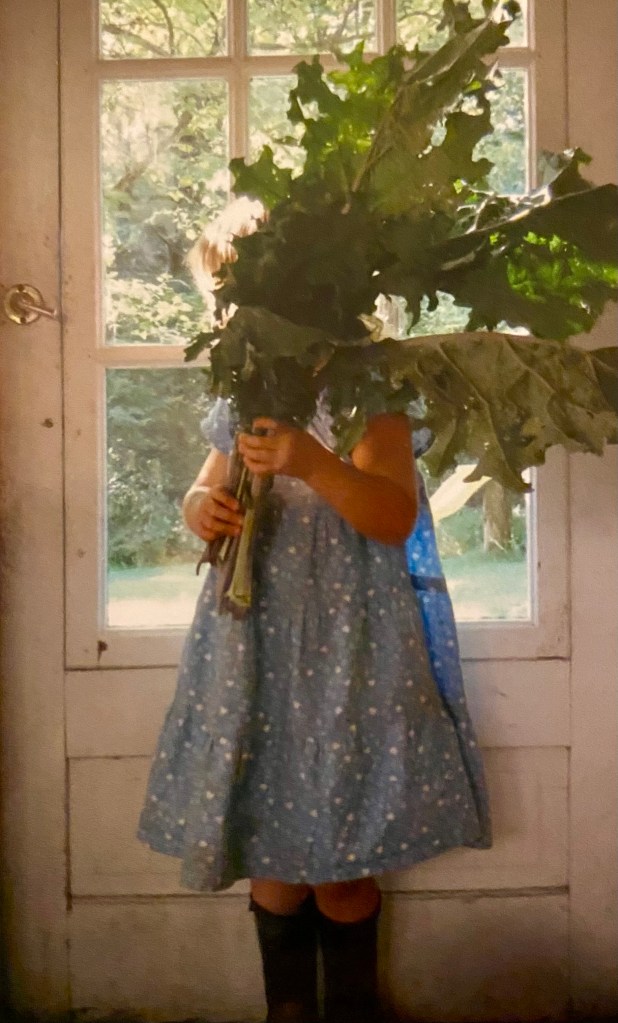
The world far beyond my small family’s sorrows teeters towards deceit and collapse. There’s no inoculation against any spiritual ailment, really. Measles, sure, but never the terrifying largeness of grief or rage, or losing safety or love. Which leads me back to the photo above, my little daughter as she was at our kitchen door, in her hand-me-down mud boots and a handmade cotton dress, carrying stalks of garden-cut kale. A reminder never to sentimentalize or diminish the rugged and real lives we live.

A Pretty Song

From the complications of loving you
I think there is no end or return.
No answer, no coming out of it.

Which is the only way to love, isn’t it?
This isn’t a playground, this is
earth, our heaven, for a while.

Therefore I have given precedence
to all my sudden, sullen, dark moods
that hold you in the center of my world.

And I say to my body: grow thinner still.
And I say to my fingers, type me a pretty song.
And I say to my heart: rave on.

— Mary Oliver