Good and Hard Place

Balmy days move into our wedge of Vermont. The leaves are turning colors in scattered spots — some gold, a glimmer of red — but nothing threatening, nothing ominous yet.

Live in Vermont as long as I have (a few eons, perhaps, it feels like some days), and you know winter isn’t far in the offing. But for now, the days and nights when we sleep with the windows open, the air is redolent with sweetness.

If there’s one thing we’ve collectively learned from the pandemic, I suppose it would be that the Here and Now matters immensely. We soak up sweetness, knowing tomorrow may bring an unknown kind of hardness.

Thank you to all who came out last night, in-person, to the Hardwick Town House. The Town House has had so much history, and last night’s audience of listeners in masks — well, that’s the history we’re participating in these days.

I’m now on a mostly virtual book tour. If you can stop in at all, please do.

Finally — I mentioned last night that the original working title for Unstitched was A Good and Hard Place. There’s plenty of hard things in my book, but it’s full of the goodness of life, too. Here’s hoping you have a taste of goodness today, too.

And, a thank you to Literary North for running a short original piece.

Taking Stock.

The little apple tree that someone planted at our house before I bought it boasts fist-sized apples this year, surprising me. The previous year, the tree produced just a handful of apples. The first year we lived here bore only a single fruit. But this year, one branch bends so low beneath the weight it threatens to break.

On an evening walk, I pick a single apple, its skin tart, the flesh mealy. Enough good for pie. That’s fine news for the day.

*

I’m honored to participate as an author in CLiF’s Book Club for Grown-Ups. The Children’s Literacy Foundation is an inspiring, give-books-to-kids organization. If you’re interested, you can participate, too. Link included for a free sign-up.

Last, a little Richard Brautigan from Tokyo-Montana Express on this autumn morning:

“There are not too many fables about man’s misuse of sunflower seeds.” 

Fat Beauties.

Our cucumbers withered and died this year, producing little. For years, I’ve built my little mounds and buried seeds or planted my seedlings. This year, the extreme heat, the fluctuations of cold and rain, and sultry heat again, made the vines lie down and quit.

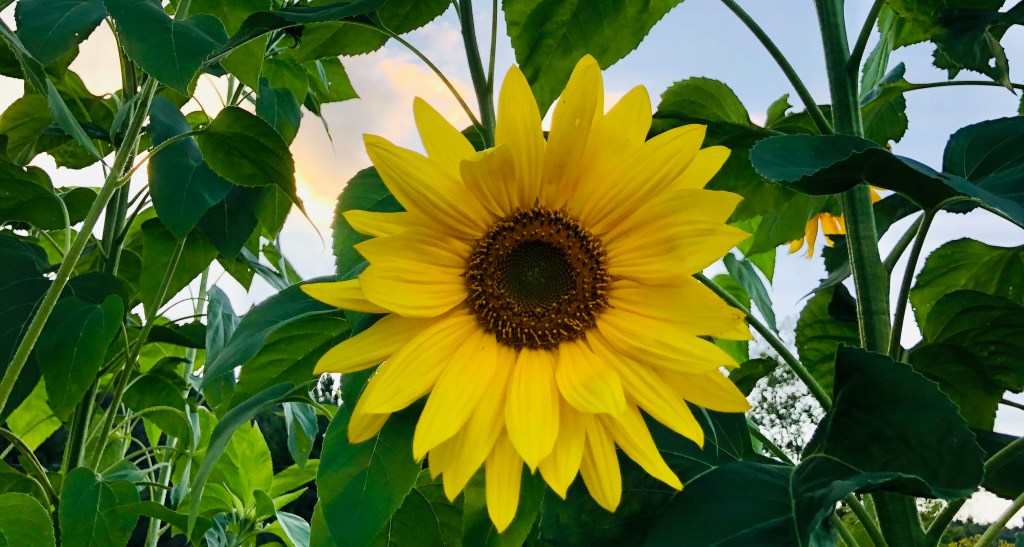
The queen of my garden is the sunflower, their golden faces open high above my head, friend to the sparrows and finches who dart through their stalks.

In the face of grim news, I offer this as a tiny sliver: the sunflowers are growing mightily. Bees are fattening.

Poetry, For Now.

Talking with friends by the side of a road, I notice a flock of Canada geese in the field across the road.

My friends tell me hunting season is just a few days away. The geese should move along.

My friends leave, too, one by one, and I linger with one woman, talking about farming in Vermont, an acquaintance we believe may have gone down the rat hole of QAnon, our elderly parents who live thousands of miles away. We branch into motherhood and gardening.

At the end of August, my youngest starts 11th grade today. The cats and I are up long before dawn this morning, the days dwindling at each end rapidly now. Next spring, with its promises of coltsfoot and trilliums seems forever away. I stand at our kitchen counter, drinking coffee, reading the New York Times.

Here’s a poem, not offered as an antidote to so many families, all over the globe, just solidarity.

Hope has holes

in its pockets. 

It leaves little

crumb trails

so that we, 

when anxious,

can follow it.

Hope’s secret: 

it doesn’t know

the destination–

it knows only

that all roads

begin with one 

foot in front

of the other.”

–Rosemerry Wahtola Trommer
Hardwick, Vermont

Petal. Stone. Blood.

Just before school starts this year, we spend a Sunday driving to the other side of Vermont, down along Lake Champlain, and crossing at the Crown Point bridge. There’s little traffic anywhere. We stop in Bristol for coffee, and then I keep driving, my friend and I in the front, our three daughters with their long legs sprawled in the back.

We’re headed to Fort Ticonderoga. Our daughters are taking an intensive history course this year, and I’m thinking the girls view the trip at first as a combination of the dusty past and an Instagram opportunity. Very quickly, we realize this is a site of stone, metal weapons, rammed earth, strategy, and bloodshed.

In the day’s sultriness, we wander behind the fort and discover the Fort’s immense gardens, now given over almost entirely to flowers. There’s few visitors and apparently no staff.

Below us, the lake lies still as a photograph, blue surrounded by the green hills. The crickets unfurl their slow late summer song. We’re in absolutely no rush at all, lingering among these flowers petals while, up on the hillside, someone bangs a constant dirge on a drum.

This ruined temple

should have its sad tale told only

by a clam digger.”

— Basho
Mount Defiance, New York

Sunday Morning Reading.

On my drive a few weeks ago to New Hampshire, I listened to Donald Antrim’s essay in The New Yorker about his hospitalization shortly before he published a memoir about his mother’s death. He was eventually treated with electroconvulsive therapy, partly at the urging of David Foster Wallace.

In this sticky August weekend, I’m reading that memoir, The Afterlife.

Here’s a line from this fiercely written book:

People are fond of saying that the truth will make you free. But what happens when the truth is not one simple, brutal thing?”

— Donald Antrim
Greensboro, Vermont