Inner Lives

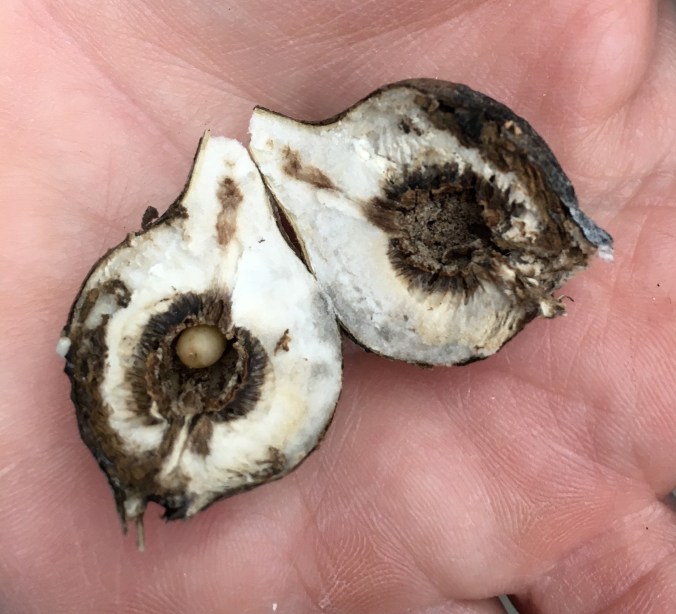
With the kids at school this afternoon, we gathered goldenrod galls. On an old board, I cut the galls open with a knife somewhat too dull for the work. Inside, we discovered the hidden world of the larvae, curled up in its spongy nest. All winter, these miniature creatures have lived in their solitary round homes, steadily growing, with a single shaft of light illuminating their passing days.

50 weeks – 50 weeks! – are needed to create this fly: roughly 350 days. Then, those that survive the winter, those that are lucky enough to be passed over by chickadees or curious children, live for two weeks: perhaps 14 days.

Our children, intently curious, good-humored in a light mist, have a life cycle fortunately (generally) so much different. How many long days and night have gone into my mothering? I wouldn’t begin to count. It’s not a mathematical equation.

Nor was it really mathematics we explored today beneath that rough covering. It was life.

BLUEBIRD

there’s a bluebird in my heart that
wants to get out
but I’m too tough for him,
I say, stay in there, I’m not going
to let anybody see
you.
there’s a bluebird in my heart that
wants to get out
but I pour whiskey on him and inhale
cigarette smoke
and the whores and the bartenders
and the grocery clerks
never know that
he’s
in there…..

– Charles Bukowski
FullSizeRender

Photo by Molly S.

Travels Around the Globe & Through the Centuries

Late into last night and early this morning – two periods of darkness – I read Caroline Alexander’s The Bounty, the travels of Captain William Bligh and his misfortunes. She writes of the exquisite natural beauty of Tahiti, and about the chaos of Western men sailing on their rampage for vengeance, men sailing the seven seas, the seven deadly sins rioting through this story.

This evening, walking with my daughter in the early spring evening, the robins singing, I imagined how divine that virgin land must have been, with its contrasts of color and elevation, its welcoming inhabitants, the plethora of food. As a writer, I can’t help but admire the endless metaphorical possibilities….

Reading about the great strife and literal journeys of others deepens the geography of my own domestic Vermont life, reflecting my black sandy beaches. Greater misery of others doesn’t diminish the suffering of those in my world, but widens the landscape, per se, of what it means to be human.

… under cloudless skies and mild breezes…. the lush, dramatic peaks of Tahiti. Closer in, and the mountain cascades, the graceful palms, and the sparkling volcanic black beaches could be seen beyond thundering breakers and surf. The few ships that had anchored here had all attempted to describe the vision like beauty of the first sight of this island rising into view from the blue Pacific. Bligh had called Tahiti “the Paradise of the World.”

– Caroline Alexander, The Bounty: the True Story of the Mutiny on the Bounty

FullSizeRender.jpg

Woodbury, Vermont


The Civility of Vermont


Like anywhere else, Vermont has its share of injustices, but also a steady practicality. People generally lend a hand in need, to friend or stranger.

This afternoon, the girls and I took a teenage friend on a steep walk. Why? she inquired.

Because it’s fun, I answered.

On a day like today, full of sunlight, the grass beginning to green even in March, with no bugs and no ice, what a joy to be human, and not a machine.

We are born with some things in our veins…

Virginia Reeves, Work Like Any Other

IMG_0473

Montpelier, Vermont/Photo by Molly S.


Maize v. Corn

When I was ten, my family and I camped one summer all the way from New Hampshire to Wyoming to Mexico. One of the places we visited was Mesa Verde, in Colorado. In the visitors’ center, we saw an ancient urn found in a cave (as I remember), filled with corn seed. The archeologists planted some of the precious seed; the kernels germinated. The seedlings grew and thrived.

A few summers ago, I returned to Mesa Verde as a grown woman with my family, and that urn was still there, in that same visitors’ center. For a few days, we stayed with friends, who took us to one of the many once-upon-a-time villages, which had been excavated and filled back in, and now seemed traversed mainly by wildlife. We walked among the remains of walls and abode houses, theorizing where these families might have planted crops, how they harbored water, what kind of lives they might have lived.

Water and maize: clearly the narrative of life for these people: material and undoubtedly spiritual, too. As I begin planting seeds again this season, I can’t help but think of that ancient clay vessel, so reverently crafted and painted, its dear contents preserved. And, 21st woman that I am, I can’t help but remark what a far distance those precious seeds have travelled to the industrial giant of King Corn.

This is the yin and yang of the earth, an energetic feedback. What happens below relates directly to what is happening on the surface and in the atmosphere and vice versa. Tectonics does not end at the ground beneath your feet. It is a dynamic system from the earth’s interior all the way into the sky and back.

–– Craig Childs

FullSizeRender

Koyaanisqatsi: Unbalanced Life

Not long ago, one of my daughter’s friends remarked that everyone desires the warm feeling of home. And yet, why is it so darned hard to keep the home in balance? The stuff of literature is family, never wholly at ease, always shifting and turning, brimming with hunger and unmet desire…. the stuff of life: this material I write about; this very matter I live.

This winter, even a mouse came to die beneath my wood stove, spreading out its little furry body, relinquishing fear of us in its desire to expire on the hearth. The snow is all gone but the hard ugly leavings of dirtied lumps. Vermont in March should be heavy winter, sun bright over fresh snow, and we should be skiing in t-shirts, sunburning. The wind has been blowing every night, bringing neither spring nor storm. It’s off, all of it, this winter that never was.

Long after dinner tonight, the girls and I sat at the table, talking, myself knitting, pulling together through language. They tell me, this happened today, and we did that, while I’m thinking of those sunny faces of coltsfoot, the deep yellow blossoms that push up through the rockiest and poorest of soils. When will they return? I rely on language and story, yes, to bind us together, and my other old stand-by – resilience – thinking…

Surely some revelation is at hand…

– Yeats

FullSizeRender.jpg

March, Vermont

How To Write a Story….

Any writer knows a story can be told a myriad of ways. Today, visiting a school that once hovered near the brink of disintegration, I realized that school’s story could once have been told in numbers that reflected too much poverty, too little resources and not enough skills: too little – and too little again, and again, and maddeningly again – all the way around.

Instead, this is now a story of growing gardens and colorful classes – and thriving children. Who decides when a story needs to be rewritten? For a school? Or for yourself?

I remember Mary Oliver’s line posing the question about what to do with your one wild and precious life. Create at least one or two fine things, I thought. Leave one or two marks for better, and not for worse.

Sometimes I go about pitying myself, and all the while I am being carried across the sky by beautiful clouds.

– Ojibway proverb

FullSizeRender.jpg

Hardwick, Vermont