Old Receipts & Agriculture

Unraveling a long trail of receipts today, I realized how poorly that paper trail tells our story. How can an equipment receipt for nine thousand dollars illustrate what those nine thousand dollars really cost our family? How many gallons of syrup I poured, steaming, from a three-gallon stainless steel pail into a giant barrel? With a baby on my back, I was always steeled to keep those tiny fingers from the golden flow of scalding maple syrup. How many of my fellow female sugarmakers, sweaty and beleaguered, have labored in sugarhouses, filled with curling smoke and steam, little ones on their backs?

How can any living, creative endeavor at all be measured in those figures?

Thisthisthat?

Certainly, our children cannot. A puzzle piece, neither more, nor less.

For where your treasure is, there your heart will be also.

– Matthew 6:21

FullSizeRender

Photo by Gabriela

Stormy Spring Fever

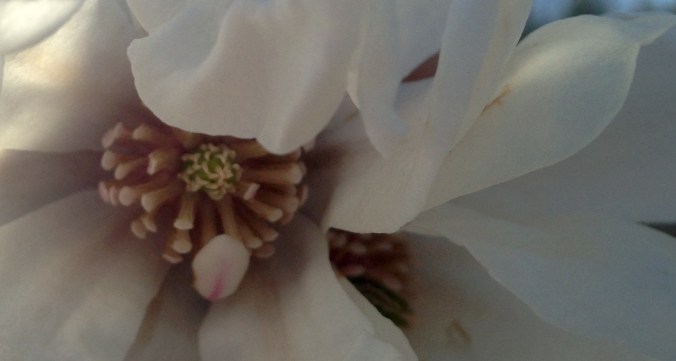
Not only the children have spring fever; I’m afflicted, too. In this rainy afternoon, the children are outside, equipped with boots and splashed bright cheeks.

In the woods, the rain lessens. Green trout lily leaves sprinkle the forest floor profusely now, although the coltsfoots’ golden blossoms are folded up, napping away the deluge. In the cold, damp earth, my freezing fingers tugged free a few of my garlic sprouts, their pale white roots clinging deeply in the soil, winding around rouge pebbles. I chopped their savory greens and tender shoots for a salad, a taste of liquid chlorophyll, I imagine.

This is the season of secrets unearthing – last fall’s decaying fungus belly-white, frog eggs fattening near the pond’s stippled surface, the children too big for last year’s summer clothes.

We need the tonic of wildness…. At the same time that we are earnest to explore and learn all things, we require that all things be mysterious and unexplorable, that land and sea be indefinitely wild, unsurveyed and unfathomed by us because unfathomable. We can never have enough of nature.

– Henry David Thoreau, Walden

FullSizeRender.jpg

Woodbury, Vermont

Hope Springs

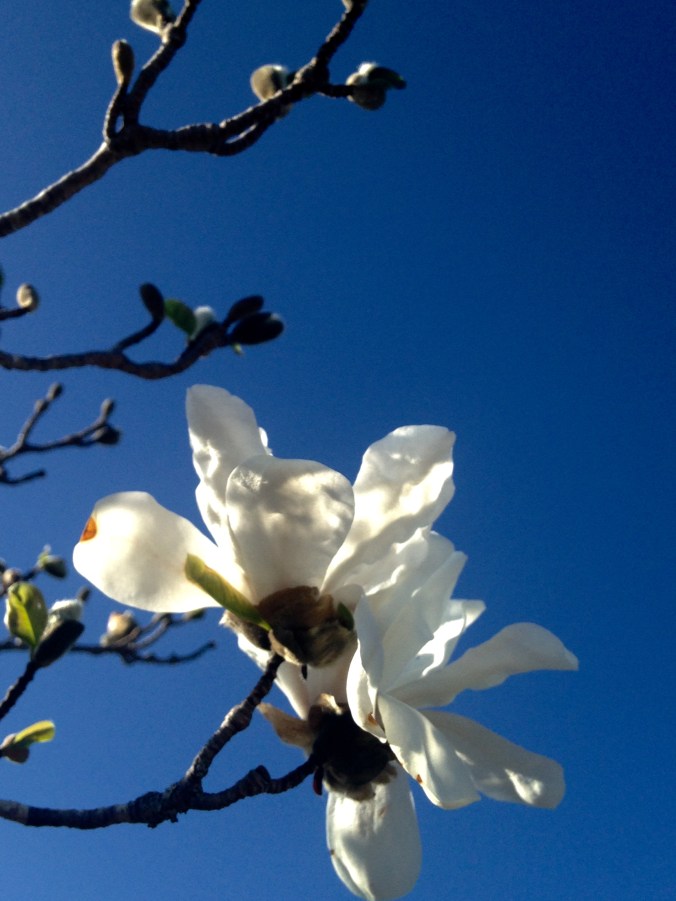
Some unexpected events in our thawing patch of Vermont:

  • dinner guests of chatting children eating grilled eggplant and chicken wings, with gusto
  • exquisitely beautiful poems read at the Galaxy Bookshop last night – and adult companionship, too
  • clouds of frog eggs, knots of trillium blossoms, profuse sunshine and clothes drying on the line
  • a rotten tooth mended

But hope is not about what we expect. It is an embrace of the essential unknowability of the world, of the breaks with the present, the surprises. Or perhaps studying the record more carefully leads us to expect miracles – not when and where we expect them, but to expect to be astonished, to expect that we don’t know.

Rebecca Solnit, Hope in the Dark

FullSizeRender.jpg

Brattleboro, Vermont/Photo by Molly S.

Slow Learner

At breakfast at the hotel, my ten-year-old is mesmerized by fruit loops. I’ve never tried those, she says, looking at the rainbow bits yearningly.

Go for it, I tell her.

Nearing the end of the milky bowl, she lays down her spoon and comments that Cheerios are better. Those colored rings have failed to hold up to their promised joy. It’s a loss she takes easily, mere observation. When her older sister was that age, I would have leapt forward to fill that moment: disappointed with a cereal? Try this. Or this. This time around, I let it lie. It’s the slightest sadness, and I just let it be. Second time around, I let her keep that sadness for herself.

That evening, she floats on her back in the hotel’s pool, then raises her dripping face and smiles radiantly, sparkling clean, thoroughly happy with buoyancy. I can’t help but stretch for her chlorine-scented hand, and then we flip over and float again, together.

Bring on winter, bring on

disease, & rot & fracture,
because the more broken

we become, the more music
we can spin out of our bones.

– Stephen Cramer, Bone Music

FullSizeRender.jpg

Woodbury, Vermont/April/Photo by Molly S.

Roadside Schooling

The kids and I stood at an exit off I-91 today looking for an old maple tree. The tree wasn’t hard to find, right near a park-and-ride, the fieldstone remains of a former barn or house nearby. My younger daughter noted the upper, dying branches of the tree had been wired together, and remarked that, rather than taking a chainsaw to the trunk, someone had taken the time to care for this tree. This ancient beauty may yet linger for years.

The evening before, we had listened to a poet read about this former Vermont farm, in his collection Vermont Exit Ramps II. At the terribly sad ending of this story about Romaine Tenney, I watched in the dim theatre as my older daughter’s mouth visibly opened in shock.

On our drive home, I realized how carefully she had listened to the poem, as she gave me solid directions. While the midmorning commuter traffic rolled in and out of the lot, we studied the mountains and the bend of the land, living in the facets of the past’s stone and trees traces, the sunny and breezy present, and the poem, binding the two.

Hello black fly. Thanks for the welcome.
Now I know what Romaine Tenney cursed
and loved here on Tenney Hill Road: the sting
inside blossoming, the black bother
at the center of the eye bent on spring beauty….

– Neil Shepard, “Romaine Tenney”

IMG_2245.JPG

Brattleboro, Vermont/Photo by Molly S.

Ah, Monet

When my older sister was a student at Williams College, I often rode the Greyhound and visited her. While she was in German or physics class, I walked to the Clark Art Museum. Entrance was free for students, so I could visit over and over. As I read a lot, too, I learned about Monet and his garden, and Renoir and his women.

Although I didn’t realize it at the time, I was learning art is a physical craft. None of the guards cared if I leaned into the paintings and admired brush strokes, bending in to see the raised curved of paint Sisley’s brush had left. I studied how a particular shade of yellow lent a certain light. I became a writer and not a painter, but those hours in the Clark were invaluable to me. I learned to step into light, to realize darkness as moving force, and to see what is there, rather than what I expected to be there.

Yesterday, I visited with my daughters. In a room suffused with natural light, filled with Impressionist beauties, my younger daughter walked to my most beloved painting in the whole museum – Monet’s ‘Geese in the Brook’ – a golden, sunlit beauty. This child, who had been more interested in the possibility of ice cream rather than Pissarros, said that was her favorite.

When I asked her why, she said, Because it’s beautiful. Look at it, mom.

Bingo, I thought to myself. That was worth the trip alone.

I was learning something from the painting of Cézanne that made writing simple true sentences far from enough to make the stories have the dimensions that I was trying to put in them. I was learning very much from him but I was not articulate enough to explain it to anyone. Besides it was a secret.

Ernest Hemingway, A Moveable Feast

FullSizeRender

Williamstown, MA