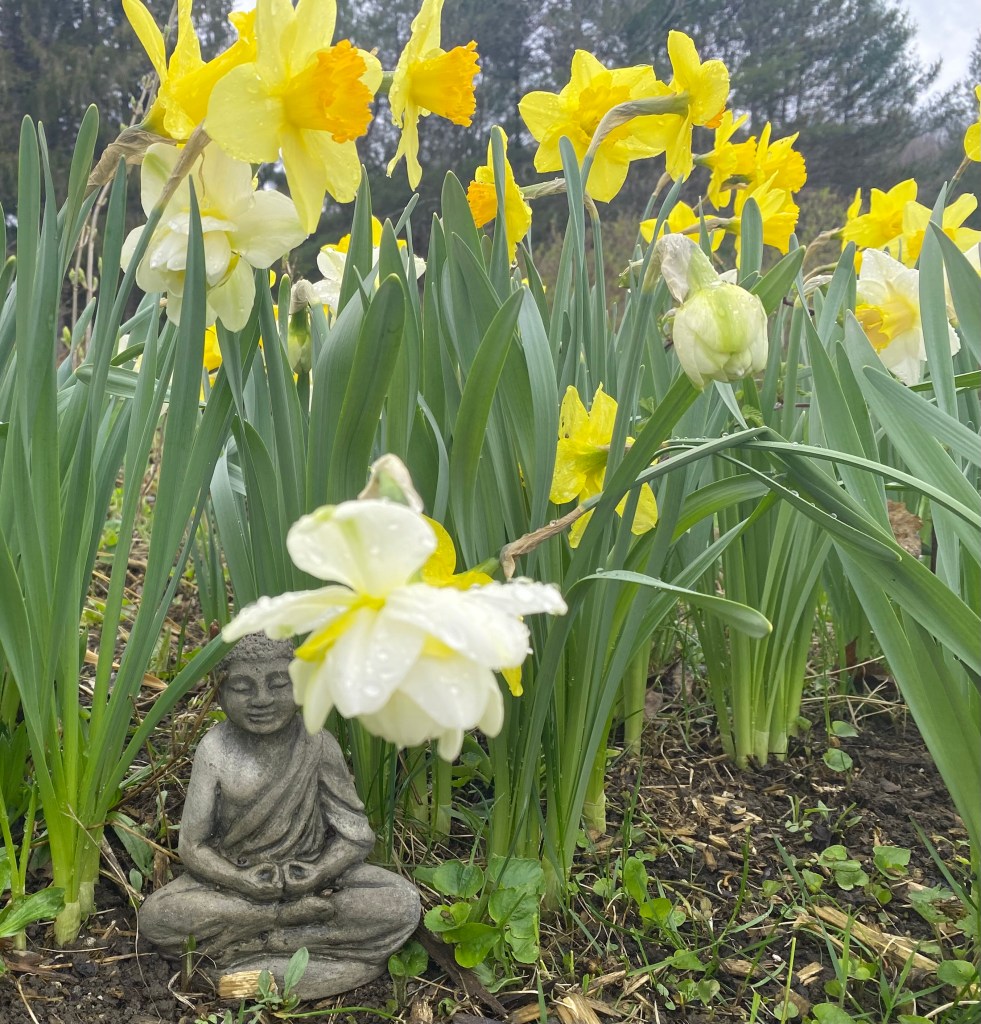
Spring, in all her variations.

In the dark, the robins chirp, their language weaving night to dawn to daylight. Imagine, a whole season of birdsongs ahead. Or, I remind myself, quit stretching into the future. Simply listen.

Word around northern Vermont is that the spring is stuck. Days with thin ribbons of chilly sunlight. Drizzle and damp. In my wool hat and sweater, leather boots, I pull out the broken branches beneath the mock orange. Last winter’s heavy snow slid from the roof and snapped the brittle branches that should have been trimmed, anyway, last year. Against the house’s southern foundation, a cluster of white violets blooms. Every morning, the green pushes forth. The Japanese lilac I planted last April brushes out. Red stalks of peonies emerge. The tulips hold their plump buds closed, teasing, tomorrow, tomorrow.

But in the realm of today, today, each day I feel the chemo less in my body. Yesterday afternoon, in my fifteen-minute house tidying, I suddenly realized that my body has been cycling through chemo for six months. Before that, I’d been (ignorantly) filled with rapidly growing cancer. Now, walking barefoot around the house, the cats lazily watching me from their perches on couch backs, I realized what was different was that my body felt like mine again, me, the way I’d forgotten as familiar.

In alignment with that strand of my good news (apparently in opposition to what’s happening with arts funding on the national level), here’s a line from Dostoyevsky’s Prince Myshkin I read this morning: “Do you know I don’t know how one can walk by a tree and not be happy at the sight of it?”
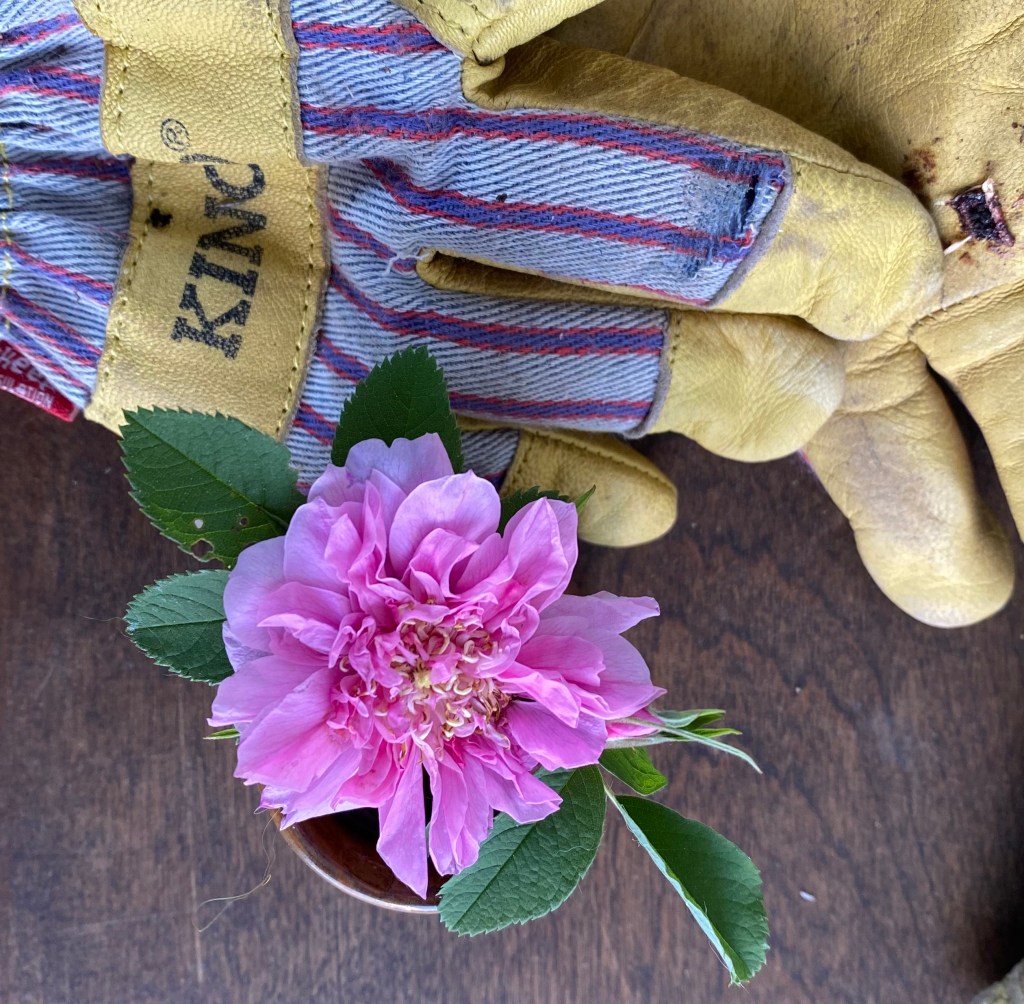
Pay it forward: a debt.

In the local coffeeshop, a stranger kicks up a conversation, and we bat around our mutual appreciation for this early summer – the blossoms profuse. He buys his order and adds my coffee, too. Pay it forward, he says, and vanishes into the morning.

I take my coffee to the courtyard down the street, empty at this time of day. Ahead of me, after this bench work stint, the day sprawls. I move from eddy to eddy.

In the late morning, a friend I haven’t seen in a few years calls. I’m now in a dim basement room. As we talk, our conversation dips into the past. I feel as if I’m lifting silty strands of stories, stringing them through my hands, searching for clues to tie pieces together.

All day long, I ponder our conversation, how the actions of one person ripple through friends and acquaintances, shift through strangers’ lives, how I’ve always been interested in this since I was a teenager, holed up in my parents’ hammock, reading John Steinbeck’s East of Eden. Later in the day, still stuck on this, I stack firewood, listening to news about the Trump trial. In the hot June sunlight, the freshly cut wood is redolent with sap. An earthworm wriggles. The neighbor boys bike into my driveway, circle around through the grass, ever curious about whatever mundane thing I’m doing. Overhead, those turkey vultures circle their late afternoon sweep, ever hungry. Little snapshot of my terrain.

I believe that there is one story in the world, and only one. . . . Humans are caught—in their lives, in their thoughts, in their hungers and ambitions, in their avarice and cruelty, and in their kindness and generosity too—in a net of good and evil. . . . There is no other story.

— John Steinbeck

“Writing is about breaking down…”

A book of Knausgaard’s essays makes its way into my house. On a snowy day, the cats and I finish putting together my taxes, then read. The snow piles and drifts. The next day, the snow melts and melts, running in sun-sparkling rivulets. Readers either love Knausgaard or despise him, like readers understand Halldór Laxness, or don’t, much in the same way that I have never understood Jane Austen. When I began reading Knausgaard’s Struggle books, a neighbor read at my breakneck pace, loving his words. She and I have long since traveled our own different lives. But reading these essays reminds me of her, how profoundly she believed in beauty as a force. Whichever way she’s traveled, I wonder how that’s worked out for her.

Writing is about breaking down what you can do and what you’ve learned, something that would be inconceivable to a craftsman, a cabinetmaker, for instance, who can’t possibly start from scratch every time.

— Karl Ove Knausgaard

The Long Night Moon.

In the year’s tail-end days, the neighbors’ children sled down their short hill, hats off, snowsuits unzipped in the warm afternoon. I wander over with a tin of sweets and chat for a bit about sledding conditions, getting the low-down on the mixture of slush and ice. The full moon rises silently, December’s Long Night Moon. Various blues layer the sky, the hues that remind me of the sea in my land-locked geography.

During the in-between pieces of holiday and work, I’m slowly savoring The Eight Mountains by Paolo Cognetti, an Italian novel about deep friendship and love of great mountains. A main character, Bruno, speaks about rebuilding a tumbled-in Alpine house: “Look, it doesn’t matter how long it takes. If you try to think too far ahead with this kind of work, it’ll drive you nuts.” Likewise: writing a book, parenting, living a life.

The neighbors’ children offer me a handful of wet snow, chock-full with dirt and last year’s sunflower seed hulls.

A Little Less Domesticity

I was reading last night when my daughter opened my door and asked what’s happening. Through the opened windows, a fox was screaming — a chilling sound — as if a child was in distress. The fox wandered in the woods and ravine behind our house, coming and going, calling.

Eventually, I turned off my light and lay in the darkness. Our cat sat on the windowsill, pressed up against the screen, listening to the wild world. What a relief — simply the natural world, hungering.

The power of dissent is a rich part of who we are.

— Sameer Pandya, Members Only

IMG_8056.jpg


Creative Mountains

Driving to Stowe this morning, my ten-year-old daughter pointed at Mt. Mansfield and said with utter joy, I’m going up in those mountains today.

She did. With her companion and the child’s mother, they skied higher than she ever had, returning at the day’s end with cheeks sweaty red, her braids tumbled. On the way home, as she told me about her day, I realized she had made a mental map of her journey, laying winter skiing over her summer hiking.

While she skied, I sat in a sun-filled room with strangers and climbed my own mystical creative mountain, traversing the terrain of novel writing through rock and streams, dusty back roads and the variated sky bent over a village. My villagers (like the people I know) sleep and dream, wake and eat, their hearts filled with desire and lust, with unhappiness and the unrequited past, with daily pleasures, like eating salad and enchiladas with a child and listening to her story.

How I admire this child and her fearless joy, her unalloyed pleasure in sun and snow, in steep mountains, and the wind over her face. As creative adults, shouldn’t we aim for that confidence in hard places, that dusting away of doubt that so frequently plagues us?

More to the heart, perhaps, like a child, we should savor unfettered happiness in our hours.

And then, of course, the novel-writing itself affects the novelist, because novel-writing is a transformative act.

Jane Smiley, 13 Ways of Looking at the Novel

IMG_4372

Photo by Molly S./Woodbury, Vermont