“When the electricity shuts off, you boil water, you crack ice.”

In addition to showing up at Dartmouth-Hitchcock for chemo and consults to save my life, which thankfully appears to be going nicely, I also joined a writing group the hospital offers. Because writing saves lives, too.

Here’s a poem I read in this class, too good not to pass along.

“Chickens” by Kate Gale

I come from hay and barns, raising  
chickens. In spring, lambs come.  

You got to get up, fly early, do the orphan run  
sleep till dawn, start the feeding.  

When the electricity shuts off, you boil water, you crack ice.  
You keep the animals watered.  

You walk through the barn, through the hay smell, 
your hair brittle where you chopped it with scissors  

same ones you use for everything. Your sweater has holes.  
When you feed the ram lambs, you say goodbye.  

Summer, choke cherries; your mouth’s dry. Apples, cider.  
Corn picking. Canning for weeks that feel like years.  

Chopping heads off quail, rabbits, chickens.  
You can pluck a chicken, gut it fast.  

You find unformed eggs, unformed chicks.  
They start chirping day nineteen.  

You make biscuits and gravy for hundred kids  
serve them up good. You’re the chick  

who never got past day nineteen, never found your chick voice.  
You make iced tea. They say, you’re a soldier in the king’s army.  

At night, you say to yourself, Kathy, someday.  
We go walking. We go talking. We find a big story.  

A cracking egg story. A walking girl story.  
A walking out of the woods story. A not slapped silly story.  

A not Jesus story. Hush, Kathy you say, we get out of here.  
We find out where chicks go when they learn to fly.

Calendar (and actual) spring…

In my rinse-and-repeat pattern of this long winter, driving back from Dartmouth in the late morning, sunlight sprawling over the brown fields, the tree limbers along the interstate beginning the season’s cutting, I notice the Connecticut River has thawed. Unmutable sign the back of this mighty winter has cracked.

Home, my yard half-buried yet in twig-strewn snow, the ash buckets mark their winter resting place, a chaos of cinders that touch the edge of the quartz-pebbled rose garden my youngest and I made, years ago.

Later, a friend stops by with good cheer and belated and welcome Christmas presents. The sun is yet bright. We walk, slowly, slowly, on the short stretch of dead-end road before my house. I point to a robin perched in a pin cherry. She spies last summer’s hornet nest spun into the lilacs, a nest on the neighbor’s windowsill.

We were once neighbors ourselves. In mud season, we walked with our little kids up and down our back road, taking our time as the kids searched for frog eggs in the roadside ditches and tender green folds pushing up through matted brown leaves in the forest: the first spring beauties and trout lilies, bloodroot. Now, during my last hospitalization, her son repaired my daughter’s car, stayed for dinner and conversation.

Too snowy and wet to sit down, I lean against my car’s bumper. A robin chirps in the neighbors’ sugar maple, an expanse of curved trunk and branch and twig. Such a meager peep peep this rust-bellied hand-sized creature makes, prying winter away, thrusting our world towards nest building, egg laying, song.

“Against Panic” by Molly Fisk

You recall those times, I know you do, when the sun  

lifted its weight over a small rise to warm your face,   

when a parched day finally broke open, real rain   

sluicing down the sidewalk, rattling city maples   

and you so sure the end was here, life a house of cards   

tipped over, falling, hope’s last breath extinguished   

in a bitter wind. Oh, friend, search your memory again —   

beauty and relief are still there, only sleeping. 

Sips of May.

As the spring dusk settles down, I’m wandering around the edges of my garden. The lilacs have just begun opening, a tiny four-petaled blossom here, another there, the remainder of that lavender flower still knotted, not yet relaxed into the wide open spring season.

I’m in my ragged jeans, dirt under my nails, when my neighbor pulls into her driveway and gets out of her Prius. She’s wearing what she calls her rag-bag dress, and the two of us make a kind of pair. I’ve known her since our oldest kids were babes in arms, not yet eating smashed carrots.

It’s been a year for each of us — and I mean that: a year. We both have college-aged kids in and out of our houses. Under the fragrance of pear blossoms, we immediately head into that long-running conversation we have about her work and my work, about writing and art, about aging parents. The half moon rises over my apple tree.

May, in all her radiant beauty. Here I am, with a hundred chores in one day — a hot water heater repair, more writing, plant arugula and Brussel sprouts, my constant fiddling with the wood pile, the daughter chat. How this Vermont world loves to green. Yes, and again, more, yes, yes.

Where I Am.

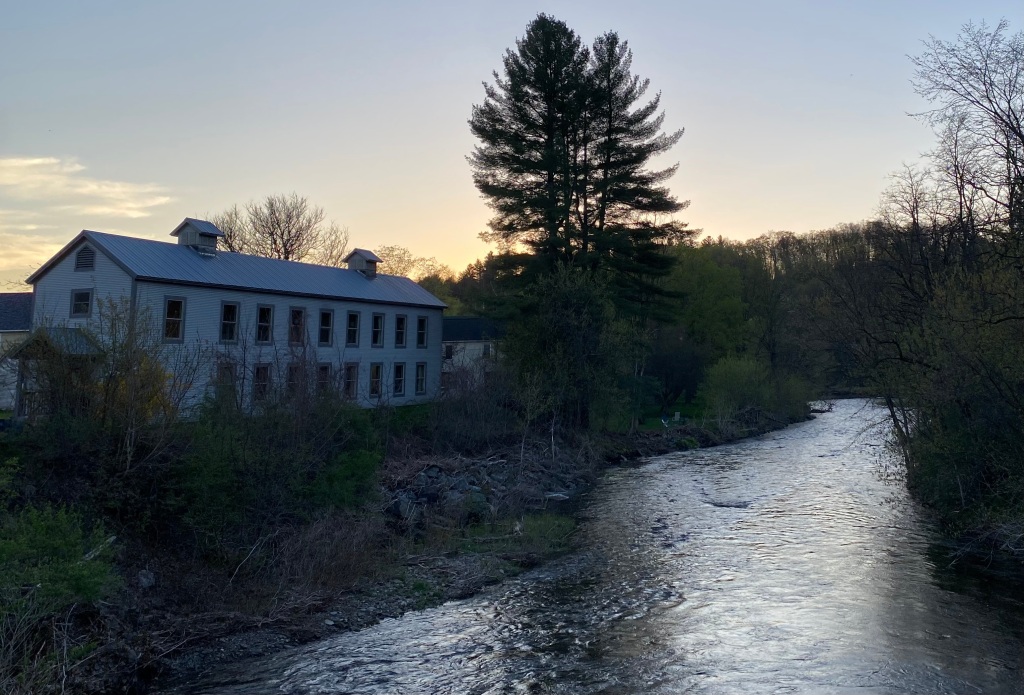
For a week, I’m lucky to be staying at the Vermont Studio Center for the Arts, tucked in Johnson, Vermont, with writers and visual artists. A word, first: like anyone in this culture driven to create art, I’ve been swimming upstream (clumsily) for what seems like most of my life. But this magical place offers notsomuch an antidote but an alternative possibility.

In one way, I feel like I’m a college student at tiny rural Marlboro College again, eating communal meals with the same cohort, attending presentations, talking and so much talking. How’s your book going? What are you doing with copper? So many interesting people writing and sculpting and painting. But, like everyone else here, I’m far beyond college age, using my studio hours fiercely.

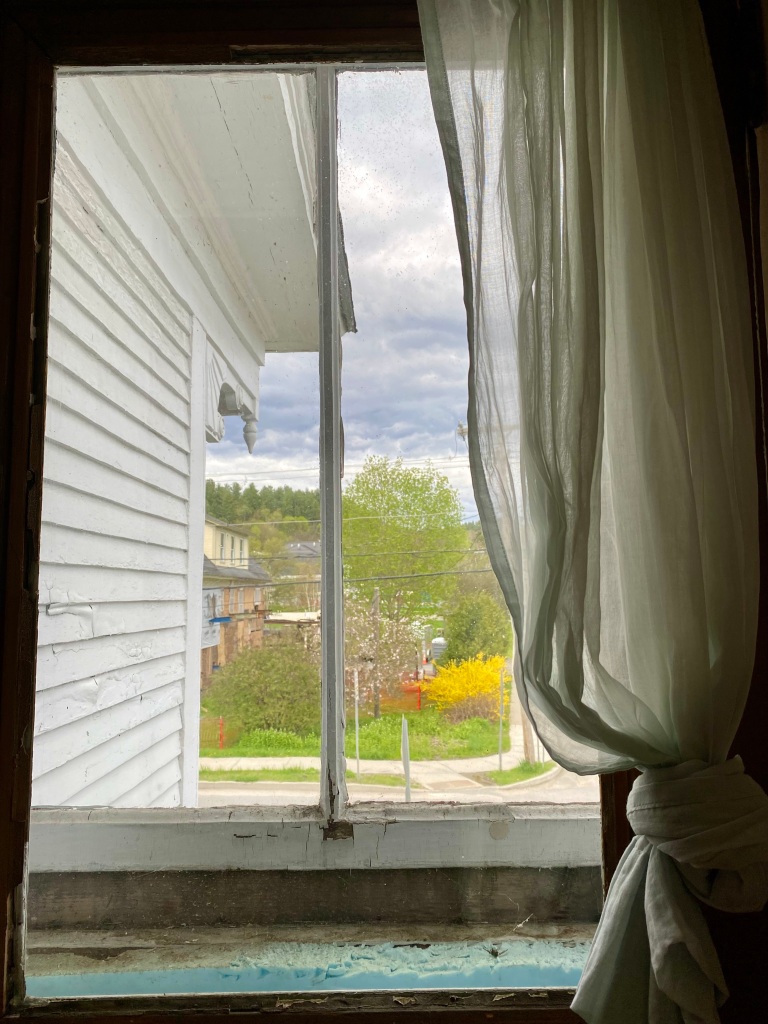
In my studio building, a former resident wrote in a communal notebook about arriving worn down from the grind of capitalism, and how rejuvenated she left after her stay here. I’ve long realized that our capitalist model often draws out the mean and petty strands of us, like a competitive gardening streak that weirdly surfaced in a long-ago baby group I attended. Which serves, of course, exactly no one at all. For this bit of time and space, I’m savoring this dear space, where my back is watched, and I can do my work.

… Last, thank you all for your notes and emails since my mother’s death. My father recently uploaded his memoir, 87 years of his indisputably distinct life.